U.S. crypto trading platform Coinbase delivered an earnings report that's easy to misinterpret. In the second quarter, total revenue fell to $1.22 billion, with a GAAP net loss of $359 million. According to the earnings report supplement Coinbase filed with the U.S. Securities and Exchange Commission on July 30th, this marks the company's second consecutive quarter of net losses.
Looking solely at the income statement, the story seems familiar—the crypto cycle. Weak coin prices, declining volatility, reduced user trading, and consequently shrinking exchange revenue. But there's another narrative in this report. According to Coinbase's disclosure, its share of the crypto trading volume market rose to 10.3%, setting a new company-record high. In a receding quarter, it captured more traffic.
Coinbase's cyclicality hasn't disappeared; it's just that it no longer completely mirrors the cyclicality of spot trading. Market share, stablecoins, and derivatives are now splitting the company's revenue and liquidity sources into several distinct streams.
Why Does the Platform Grow Stronger as the Market Cools Down?
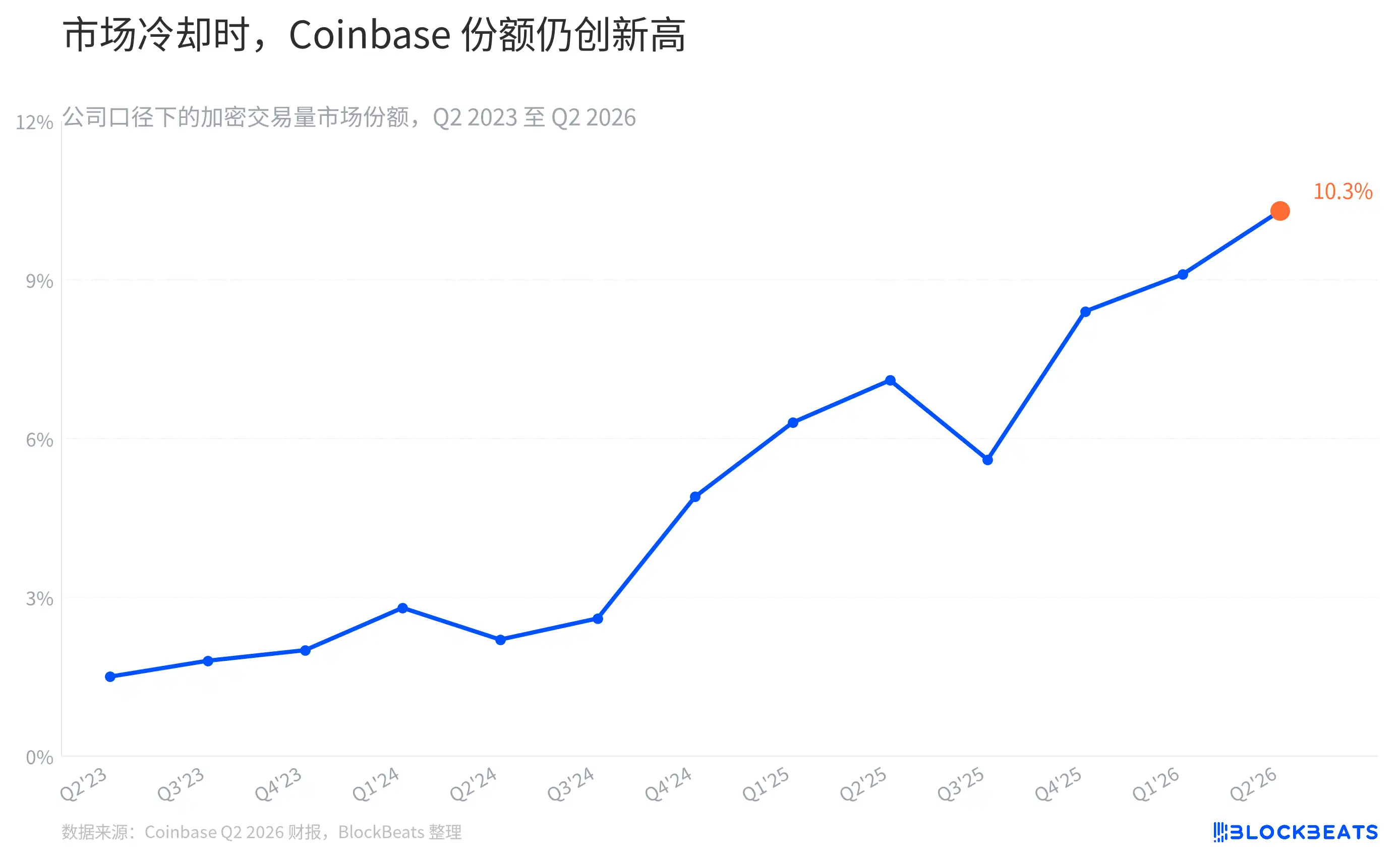
In the second quarter, the global crypto spot trading volume metric used by Coinbase fell 25% quarter-over-quarter. Yet, according to the company's earnings report, Coinbase's market share during the same period climbed from 9.1% in Q1 to 10.3%. Less revenue doesn't mean the platform's relative position has worsened.
Exchanges aren't fighting over a static pie. When the market is hot, retail investors flood in, and liquidity naturally thickens. When the market is dull, the users who remain test the platform's depth, product offerings, and compliant access channels. Coinbase's strongest tag has been its status as the compliant U.S. on-ramp. The current market share curve indicates this on-ramp is attracting a larger portion of trading activity.
However, this curve has its limits. Market share is Coinbase's internal calculation based on data from sources like CoinDesk Data, CoinMetrics, Dune, and Tardis, and includes stablecoin conversion activities. It's suitable for observing changes in its own competitiveness but should not be taken as the sole industry-wide market share standard.
What's Supporting Trading Revenue?
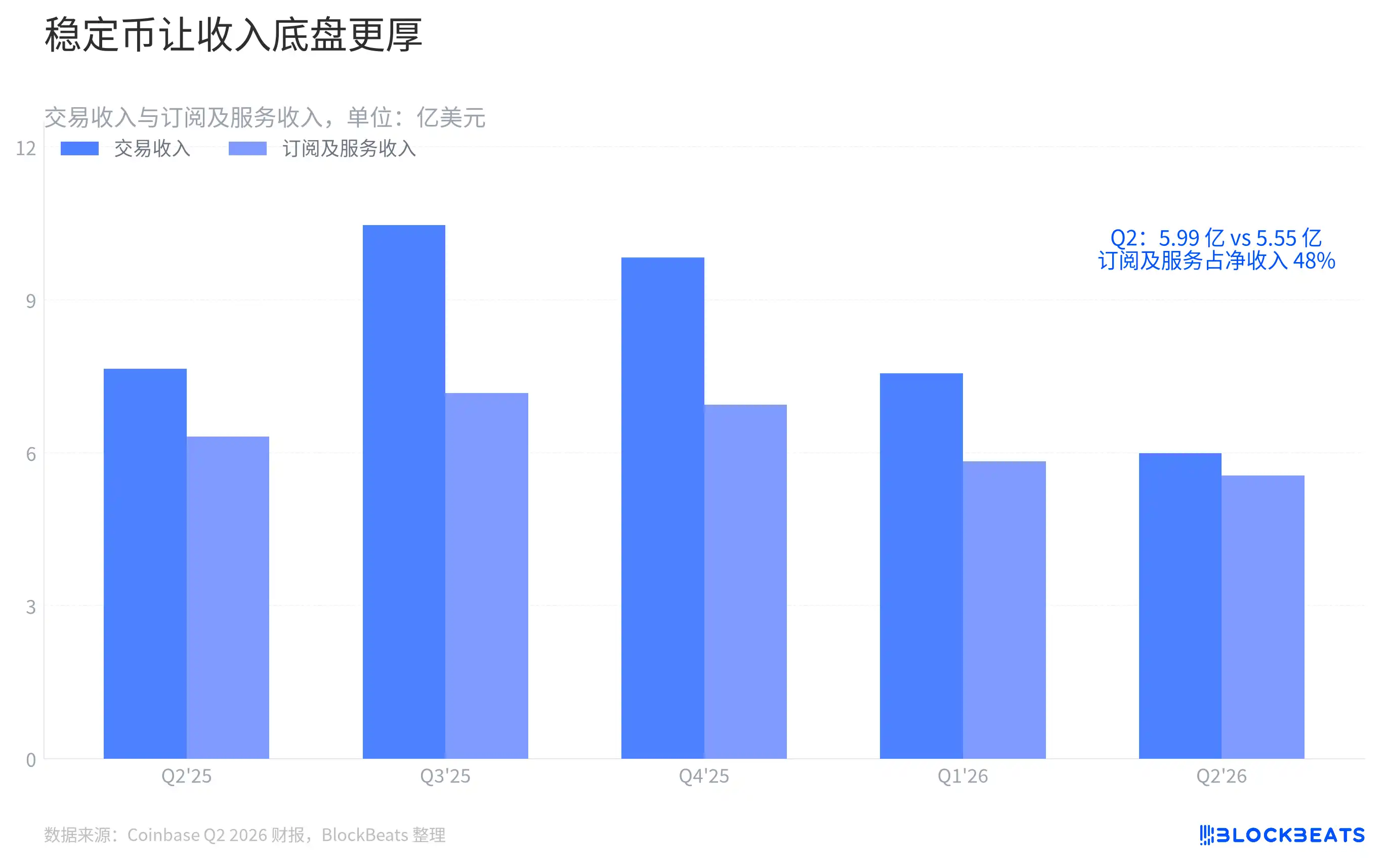
According to Coinbase's earnings report, second-quarter transaction revenue was $599 million, while subscription and services revenue was $555 million. The gap between them is now just a narrow sliver. In the past, transaction revenue was the primary beam that rose swiftly during bull markets. Now, subscription, custody, staking, interest, and stablecoin businesses are forming another layer of foundational income.
The largest portion comes from stablecoins. The company disclosed that stablecoin revenue this quarter was $292 million. Its logic differs from spot commission fees. When users hold USDC within Coinbase's products, the platform can share in the interest from reserve assets and partnership proceeds. A transaction commission is one-time. Stablecoin balances remain, generating returns on a daily basis.
This change is not abstract. The average USDC balance within Coinbase's products has risen to $20 billion. According to the company, over 30% of USDC's circulating supply was within its products at quarter-end. For the exchange, this is akin to turning wallets that were only opened during market rallies into accounts where funds can be parked.
This also explains why subscription and services revenue accounted for 48% of net revenue this quarter. This isn't to say Coinbase has become immune to coin price influences. Interest rate changes, fluctuations in USDC market cap, and user willingness to hold stablecoins will still impact this revenue line. However, its rhythm no longer needs to sync perfectly with spot trading volume.
After Spot Volume Shrinks, Where Does Liquidity Go?
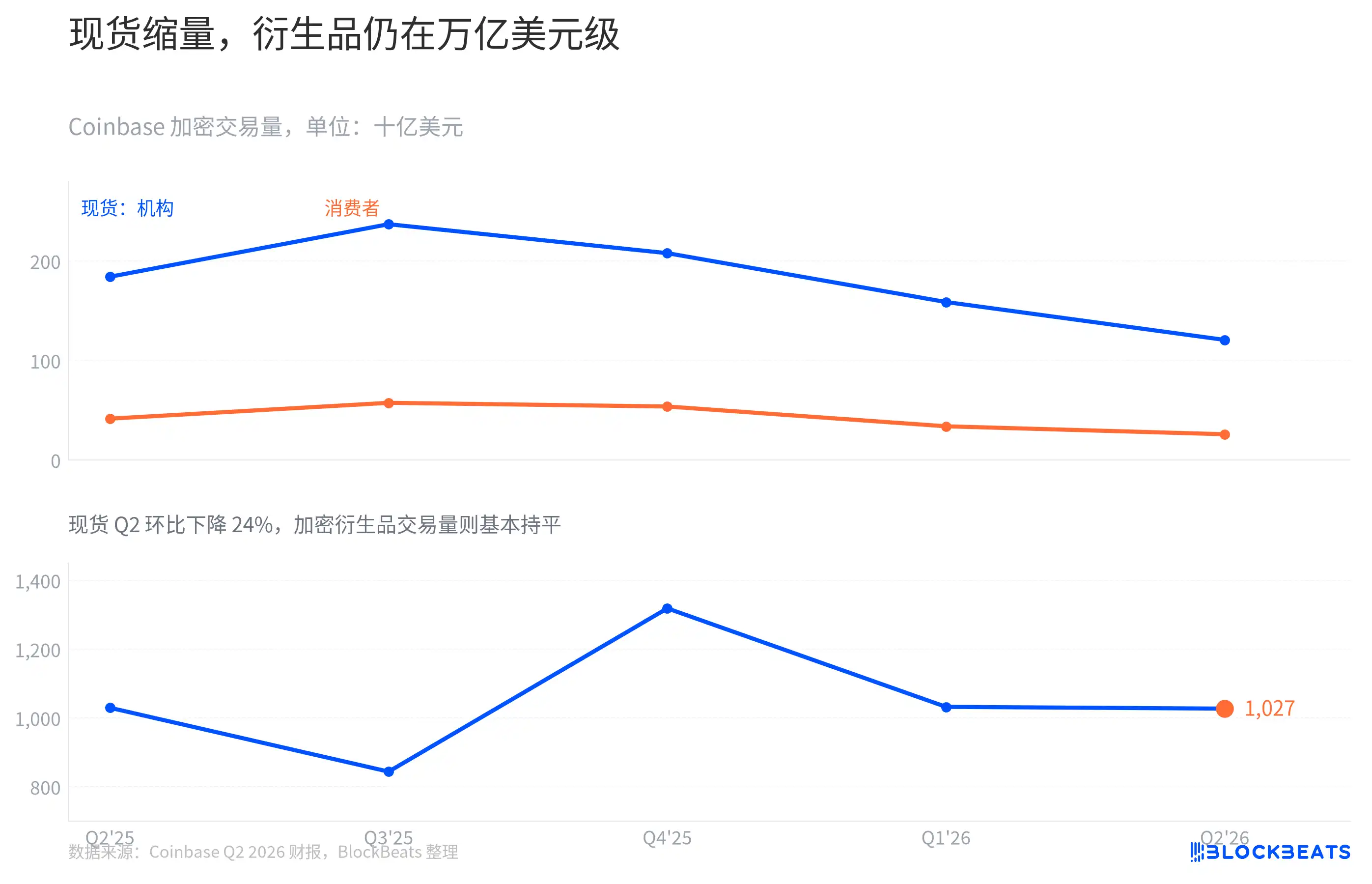
In the second quarter, Coinbase's crypto spot trading volume fell to $146.4 billion. Crypto derivatives trading volume remained at $1.03 trillion. According to the company's report, spot volume declined 24% quarter-over-quarter, while derivatives volume was largely flat.
This isn't a simple case of product substitution. Spot buying and selling are more akin to taking a directional bet on price, most likely to be postponed during low volatility. Derivatives serve purposes like leverage, hedging, and cross-market position adjustments; professional traders don't exit completely just because the market is quiet. Their trading volumes also can't be used directly to extrapolate revenue; derivatives are reported as notional amounts, and their fee structures and revenue recognition logic differ from spot.
Coinbase repeatedly emphasized global perpetual contracts, U.S. compliant access, and Deribit integration in its report. Its goal isn't just to add a derivatives tab next to the spot page; it's to enable one piece of collateral to support more trading needs. Once a platform can connect spot, stablecoins, and derivatives to the same pool of liquidity, the cost for users to leave is no longer just downloading another app.
Net Loss—Where Exactly Is the Loss?
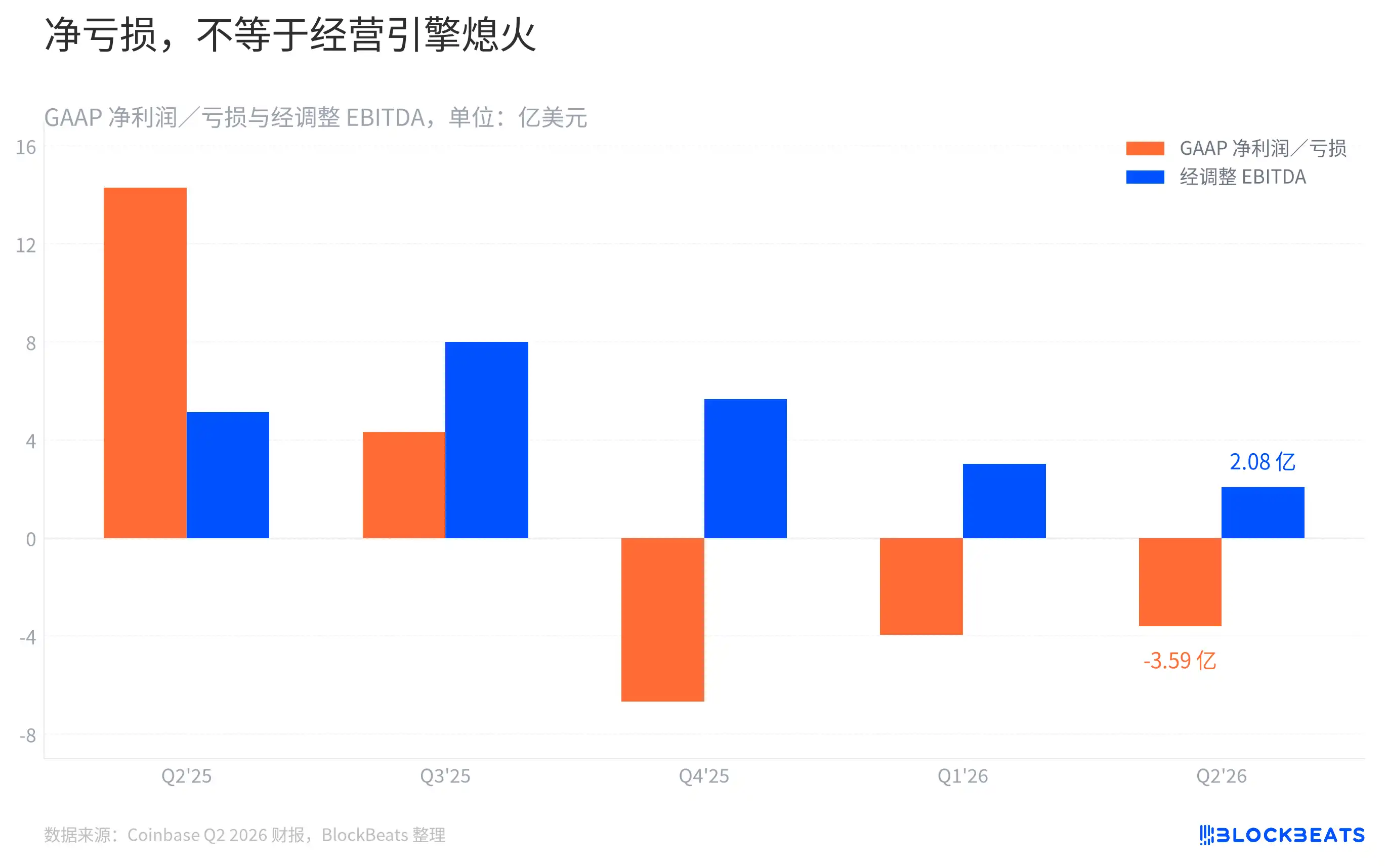
The GAAP net loss of $359 million this quarter is of course a real result. However, according to Coinbase's report, adjusted EBITDA for the same period remained positive at $208 million and has been positive for 14 consecutive quarters. The gap between these two bars is precisely what's most easily overlooked when reading the earnings report.
The GAAP income statement includes fair value changes of crypto asset investments, investment gains/losses, restructuring charges, and stock-based compensation in the current period's results. Adjusted EBITDA removes several of these items. It's a more direct gauge of whether operational activities can cover day-to-day costs in the period, but it's not an alternative scorecard to replace net profit.
According to the company's disclosure, the operating loss this quarter was $113 million, indicating that the decline in transaction revenue is still weighing on the profit side. Adjusted expenses decreased 9% quarter-over-quarter, and the full-year guidance for adjusted expenses was narrowed to $4.20 billion - $4.45 billion. Controlling expenses can reduce bleeding during low-volatility periods, but it cannot replace the validation of new revenue streams.
This is the real question left by Coinbase's earnings report. It has already proven it can gain market share even as the market cools and has stablecoins and derivatives keeping the platform afloat. The next time market trading volume declines, readers should watch not just how much revenue falls, but whether these new streams can continue channeling water into the same account.