Author: Nancy, PANews
Recently, the crypto market has been shrouded in a chill once again, with Bitcoin once falling below the $60,000 mark, and mainstream crypto assets generally weakening.
In contrast, Solana has shown a relatively independent trend, rising about 14.9% in the past week. Behind the price increase lies the driving force of local ecosystem recovery and on-chain governance upgrades.
Ecosystem Shows Recovery Signals, RWA and Meme Coins Both Heating Up
Recently, the Solana ecosystem has released signals of recovery, especially in the two major sectors of tokenized stocks and meme coins.
In the RWA field, RWA.xyz data shows that as of July 3, based on the number of holding wallets, the number of RWA holding wallets on the Solana chain has exceeded 293,000, accounting for about 31.1% of the entire network, ranking first among all public chains. The second and third places, Plume and Ethereum, have approximately 248,000 and 205,000 respectively. Meanwhile, the number of RWA assets on the Solana chain has reached 2,119, also ranking first, surpassing mainstream public chains such as Arbitrum, Ethereum, and BNB Chain.
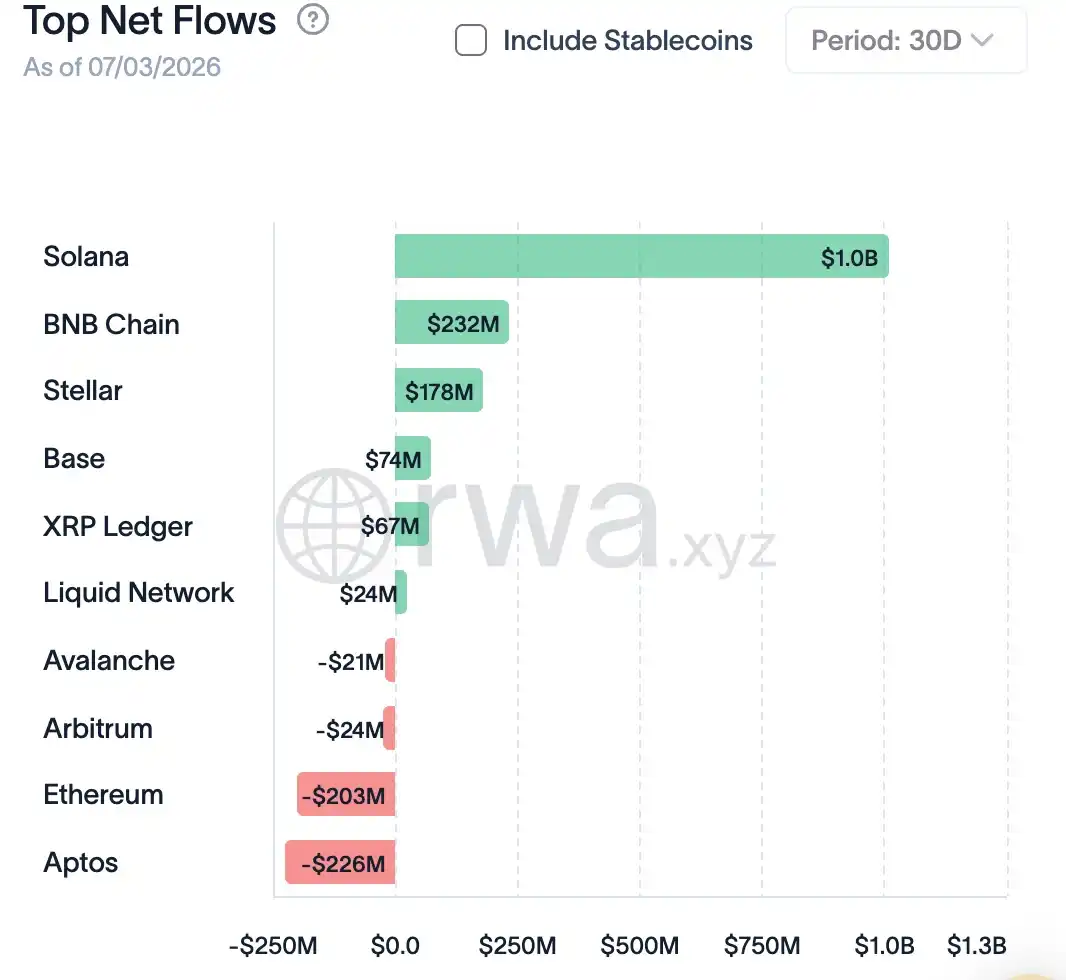
However, from the perspective of asset scale, Solana still has significant room for catch-up. Currently, the total value of RWAs on its chain is about $3.55 billion, still showing a considerable gap compared to Ethereum. But observing from capital flow, the net inflow of RWAs on the Solana chain over the past 30 days has exceeded $1 billion, significantly leading public chains such as Ethereum, BNB Chain, Arbitrum, Base, XRP Ledger, and Aptos, which confirms that funds have recently been flowing into the Solana ecosystem.
Behind this round of growth in the RWA market on Solana is the rapid expansion of the tokenized stock market.
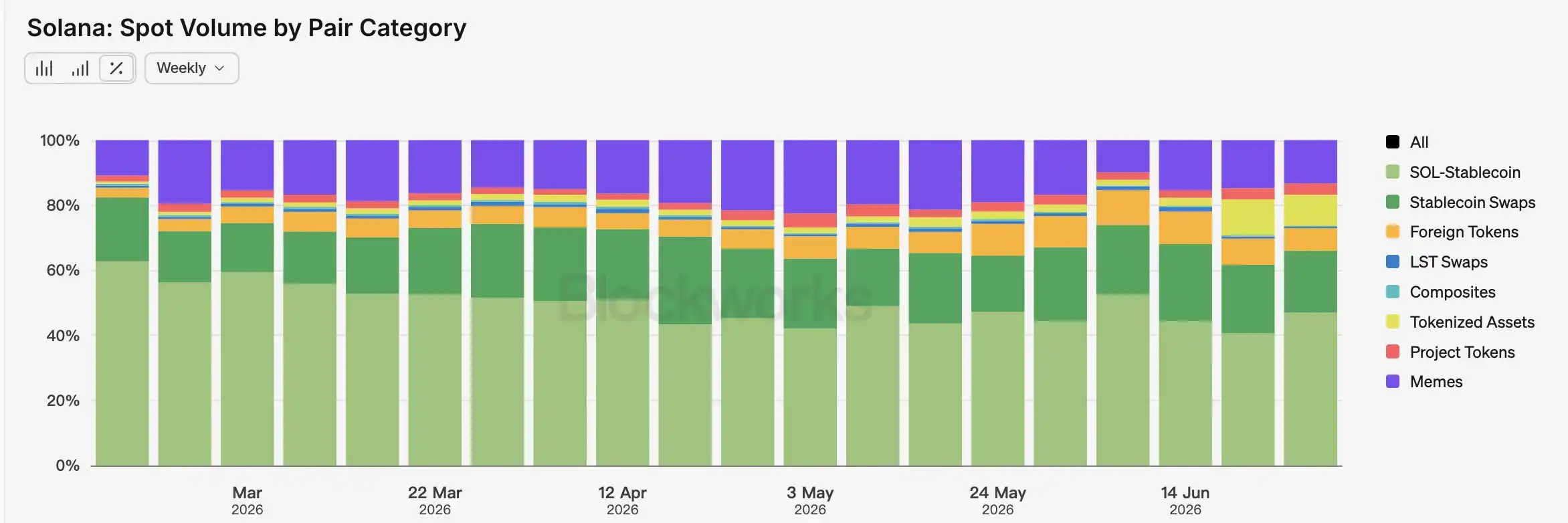
According to the latest data from Blockworks, tokenized assets now account for about 10% of Solana's weekly spot trading volume, a significant increase from just 1% at the beginning of the year. They have now become the second-largest trading category after meme coins.
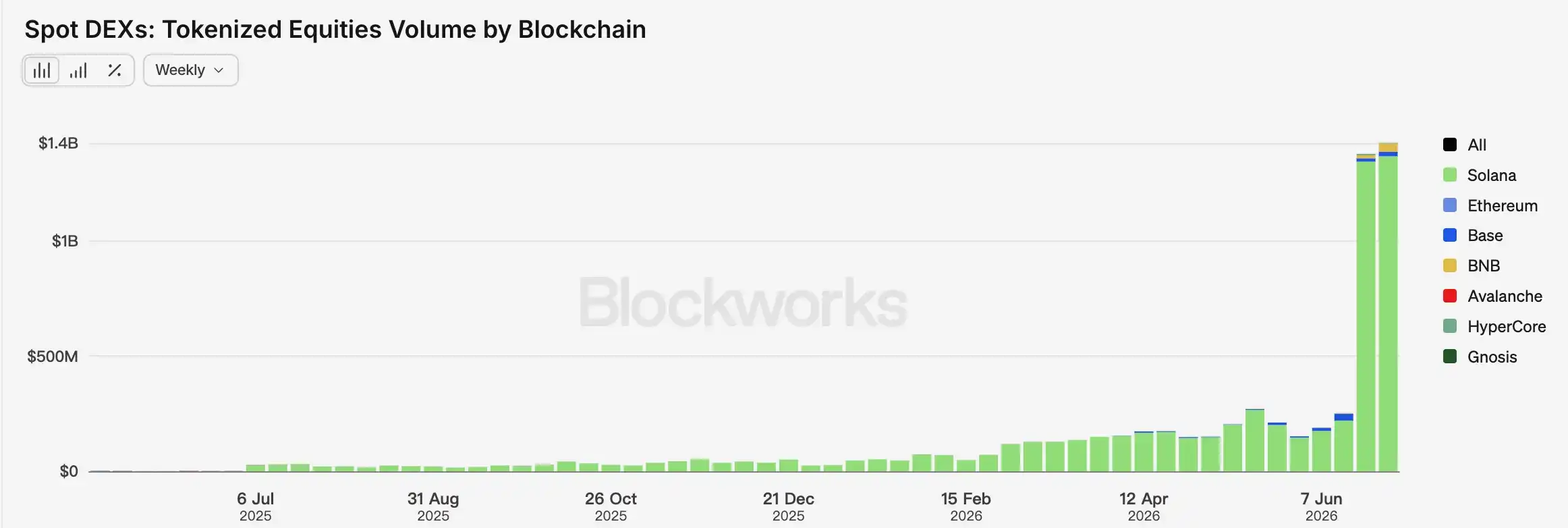
At the same time, the weekly trading volume of tokenized stocks on Solana has also reached a historical high, breaking $1.42 billion, a 30.9-fold increase compared to the beginning of the year, accounting for about 96% of the entire tokenized stock market's trading share. This growth mainly benefits from the tokenized stock business launched by Backpack last month. Currently, Backpack has become Solana's largest tokenized stock issuance platform. The tokenized stocks SPCX and MU it launched contribute about 95% and 99% of Solana's chain trading volume, respectively.
On the other hand, the meme coin market, which had been quiet for a long time, has also started to warm up.
Recently, crypto KOL Ansem publicly supported the eponymous meme coin ANSEM, quickly igniting "trench" trading enthusiasm on the Solana chain. Driven by factors such as celebrity endorsement, high concentration (Ansem holds 65% of the total token supply), and airdrop expectations, the market cap of ANSEM once surged to over $180 million within just a few days.
Dune data shows that as of July 3, Ansem has airdropped ANSEM tokens worth over $12.57 million to 979 addresses. Meanwhile, currently about 94.75% of ANSEM traders are in profit, further stimulating market sentiment.
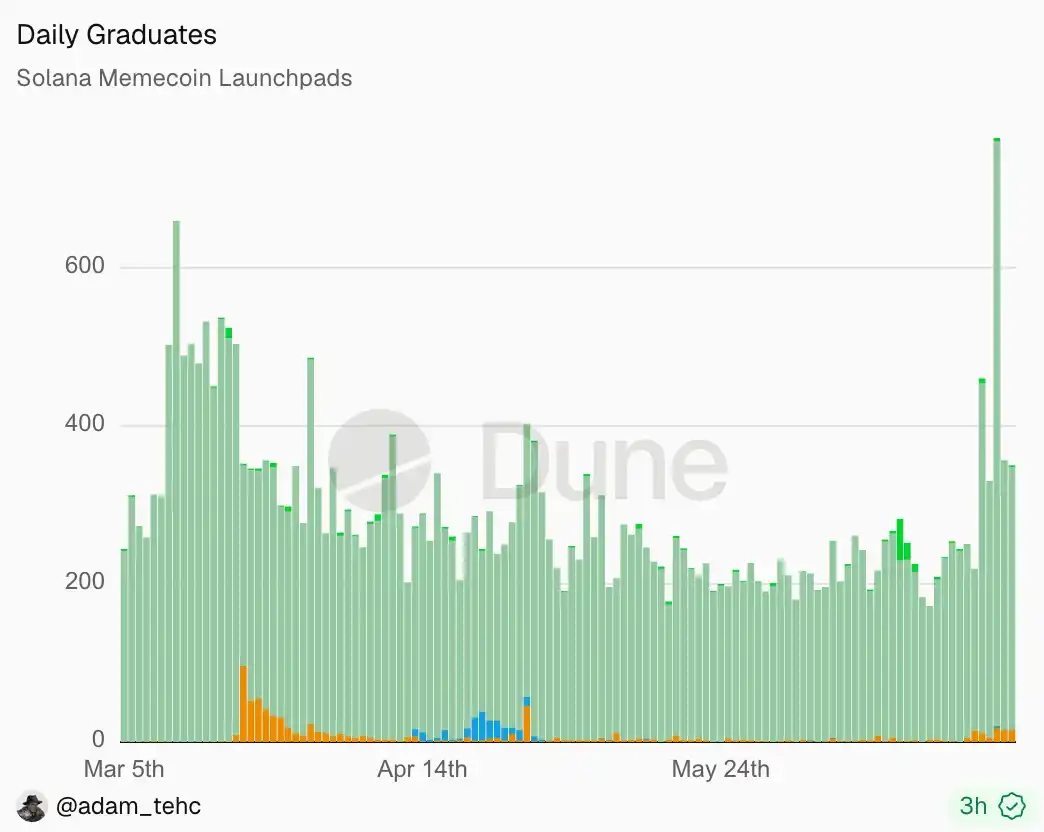
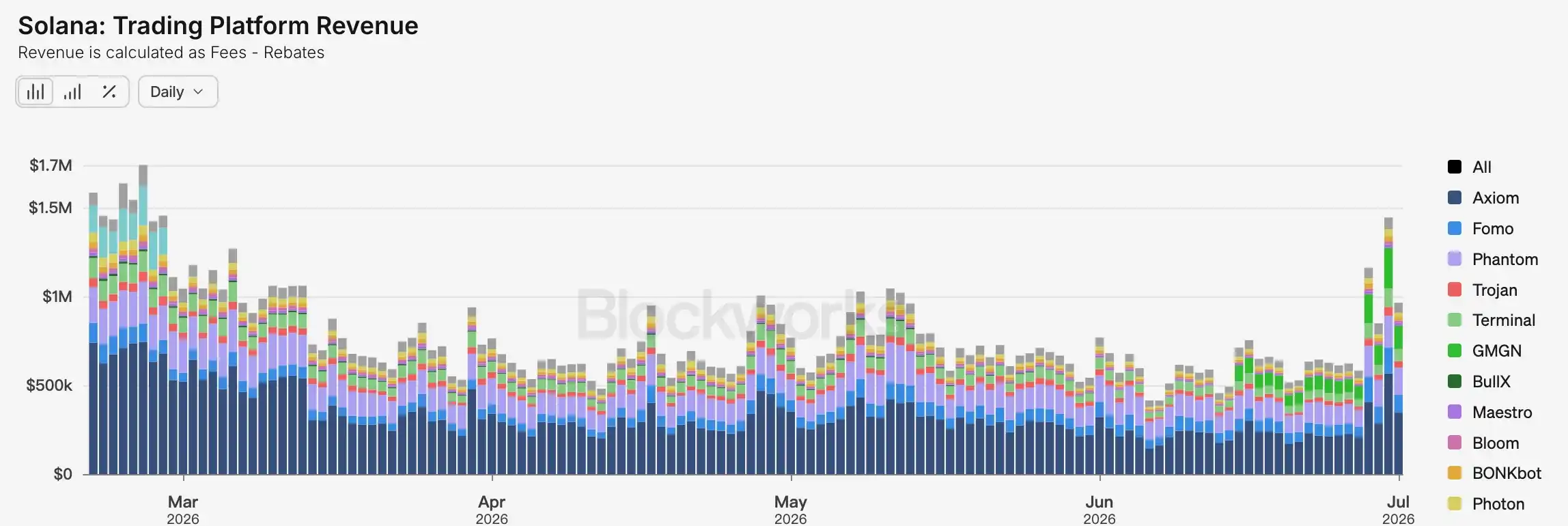
Driven by the ANSEM trend, the activity of the Solana meme ecosystem has also rebounded. Taking Pump.fun as an example, Dune data shows that the number of tokens successfully graduating from the platform daily has reached a new high since April, with daily trading volume more than doubling compared to a month ago. At the same time, Blockworks data shows that the daily revenue of Solana ecosystem trading platforms such as Axiom, Phantom, GMGN, and Fomo recently once again hit new highs since February of this year.
Solana On-Chain Governance Welcomes Key Upgrade: 100,000 SOL Required to Propose
Recently, Solana's on-chain governance mechanism has undergone an upgrade, further enhancing the decentralization of protocol decision-making, which is expected to promote the further healthy development of the ecosystem.
On July 2, the Solana Foundation announced the official launch of the on-chain governance mechanism Solana Governance Proposals (SGP). Validators can submit, support, and vote on core protocol decisions through SGP. The entire governance process is completed on-chain, employing a stake-weighted voting mechanism and verified through Merkle proofs.
According to the rules, any validator who has received at least 100,000 SOL delegated (approximately $8 million at the current price) can initiate a governance proposal. Previously, stakers mainly participated indirectly by delegating to validators. Voting weight will be calculated based on the amount staked. Additionally, delegates can override the voting choices of the validators they delegate to, which to some extent enhances community participation and further lowers the governance threshold.
Before the launch of SGP, Solana's protocol governance primarily relied on the SIMD (Solana Improvement Documents) process.
Developers typically submit technical proposals on GitHub. After open community discussion and review by core developers, the core team is responsible for completing the development and releasing a new client version. Subsequently, validators independently decide whether to upgrade their node software. When the active stake proportion running the new version reaches a sufficient threshold and the network is stable, the corresponding features are officially activated at a designated Slot or Epoch through Feature Gates.
This governance model is essentially off-chain consensus combined with practical client adoption, effectively avoiding network splits caused by hard forks while maintaining high iteration efficiency. However, direct community participation in major governance matters was relatively limited.
It is worth noting that SGP will not replace SIMD; the two will coexist in a division of labor. SIMD will continue to focus on protocol upgrades and technical improvements, while SGP will focus on important ecological governance issues, providing a unified, transparent, on-chain decision-making channel for the community and validators, also further lowering the governance threshold. This clear division of governance responsibilities both increases community engagement and helps maintain the independence and efficiency of core protocol development.
To prevent governance resources from being consumed by low-quality proposals, Solana has also set thresholds. Governance proposals must first be initiated through the SGP process and receive support from no less than 15% of the active stake before they can formally enter the on-chain voting stage. This ensures that proposals entering the voting stage have a certain foundation of community consensus. Currently, Solana's total staked amount is approximately 42.8 million SOL (about 68% of the total supply), meaning a proposal needs support from about 6.42 million SOL staked to enter the voting stage.

In addition to the governance mechanism upgrade, Solana is simultaneously advancing tokenomics optimization, with proposals SIMD-550 and SIMD-553 expected to be implemented in 2026. These two proposals aim to increase SOL's annual inflation reduction rate from 15% to 30% and are estimated to reduce the issuance of approximately 18.9 million new SOL over the next 6 years.
Looking at the entire ecosystem, the current recovery is still mainly concentrated in hot sectors. Whether it's the number of active on-chain addresses or the overall transaction scale, there is still a significant gap compared to the peak of the last bull market. This indicates that the Solana ecosystem is still in a stage of local recovery, with some distance to go before a full-scale recovery.