The Market Trades on Expectations, But You're Waiting for Answers

marsbit发布于2026-07-03更新于2026-07-03

文章摘要

The market trades on expectations, not on waiting for answers. A common misconception is that prices react after data is released. In reality, sensitive capital moves based on anticipated changes in policy, capital flows, and sentiment. Once an expectation forms, prices adjust in advance. For example, if the market expects the Federal Reserve to cut interest rates, assets like gold, growth stocks, or BTC may rise ahead of the actual announcement. When the cut finally happens, the market might show little movement or even pull back—not because the news isn't significant, but because it was already priced in. The same applies to reports like non-farm payrolls. If weak employment data is anticipated, gold and bonds may rally beforehand. When the data confirms the weakness, prices may not rise further, as it merely validates existing expectations. This explains why markets sometimes appear irrational: good news doesn't always lift prices, and bad news doesn't always cause declines. The key is to assess whether an event was already anticipated and whether capital has begun to price it in or is now taking profits. The market is always trading the future, not the present. Price movements reflect bets on what comes next. Therefore, focusing solely on headlines can lead to losses. Instead, investors should ask: Was this news already expected? Is the market still pricing it in, or is it time to cash out? In short, the market doesn't wait for answers—it acts on the future it...

Author: SOL I Don't Understand

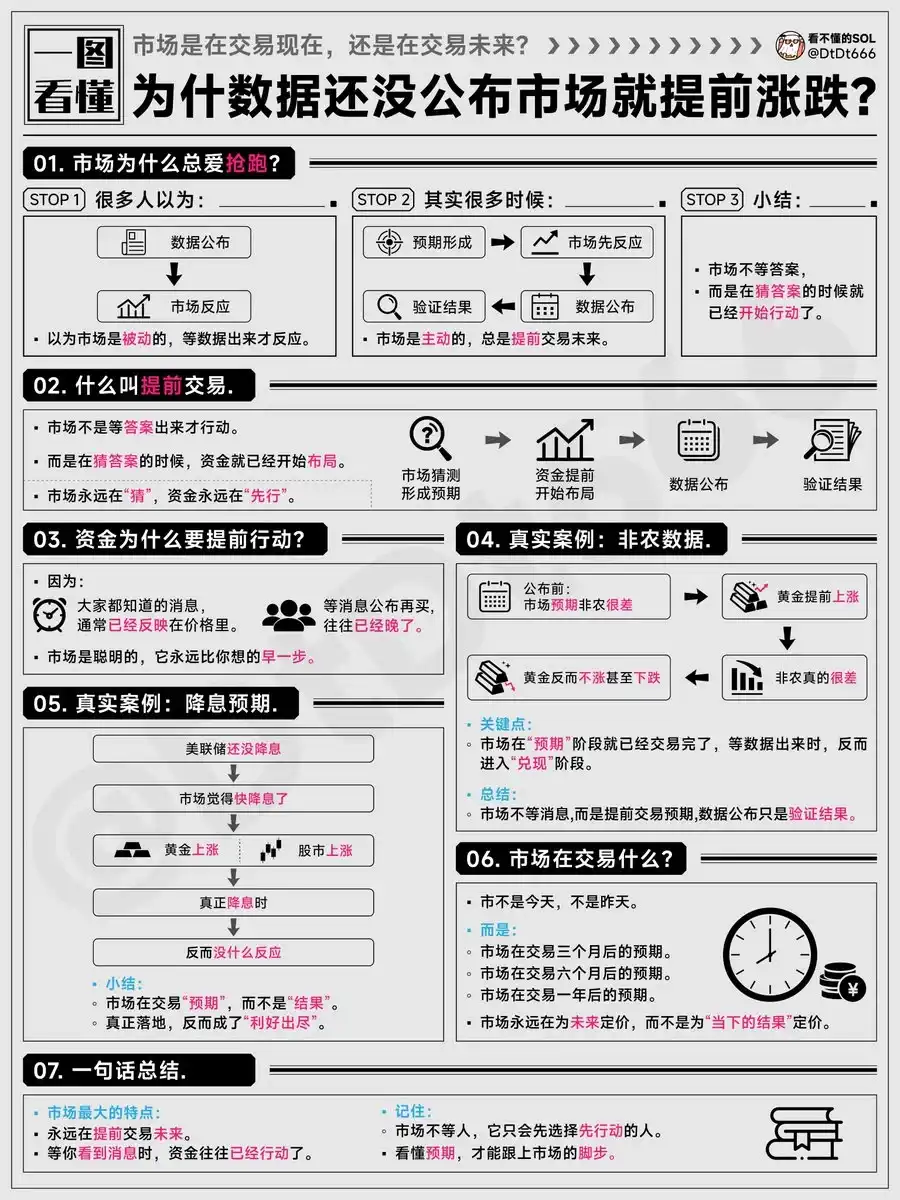
Why does the market often rise or fall before data is even released?

Because the market never trades solely on the "outcome"; more often, it trades on "expectations."

Many people understand the market like this:

Data is released, the market sees it, and then starts reacting.

But the real market often isn't like that.

Truly sensitive capital rarely waits for the answer to come out before acting. It first assesses: How might policy change next, where will capital flow, and how will sentiment shift.

Once expectations form, prices move first.

For example, if the market thinks the Fed is about to cut rates, gold, growth stocks, and BTC might react in advance. But by the time the actual rate cut happens, the market may show little movement, or even pull back.

It's not that the positive news is useless.

It's because that positive news was already traded during the preceding rally.

The same goes for Non-Farm Payroll data.

If before the release, the market already expects employment to weaken, gold and bonds might rise in advance. When the NFP data truly comes out weak, gold might not necessarily continue rising.

Because for the market, this isn't "new information," it's merely "confirmation."

So you often see:

Positive news comes out, but no rise.

Negative news comes out, but no fall.

Many people think the market makes no sense.

Actually, it's not that the market is crazy; it's that the market has already moved ahead of the news.

Where ordinary investors lose money most easily is by only reading news headlines.

Seeing good news, they chase; seeing bad news, they flee.

But the real question should be:

Did the market anticipate this news beforehand?

Has capital already priced it in?

Is this the beginning of pricing it in, or is it the stage of realization?

The market isn't trading today; it is constantly trading the future.

Behind price movements is capital continuously betting on what will happen next.

So when looking at the market, don't just focus on "what happened."

Look more at:

What did people previously think would happen.

Does the current result exceed expectations.

Is capital continuing to price it in, or starting to cash out.

Many market moves seem illogical because you're looking at the result, while the market trades on the deviation from expectations.

To summarize in one sentence:

The market doesn't wait for answers.

The market only chooses, in advance, the future it believes in.

By the time you see the news, capital has often been moving for a long time.
热门币种推荐

相关问答

QWhat is the core idea of the article regarding how financial markets work?

AThe article's core idea is that markets trade on expectations of future events, not just on the official results or news when they are announced.

QAccording to the author, why might an asset fail to rise after positive news (e.g., a Fed rate cut) is officially announced?

ABecause the positive expectation was likely already priced into the market beforehand. Traders anticipated the event and acted on it, so the official announcement is just a confirmation, not new information that triggers a new reaction.

QWhat does the term 'expectation gap' or 'expectation differential' refer to in the context of the article?

AIt refers to the difference between what the market was expecting to happen and what actually happens. The market's price movement often reflects this gap, not the raw news itself.

QWhat is a key mistake the article says ordinary investors often make?

AA key mistake is reacting directly to news headlines (buying on good news, selling on bad news) without considering whether that news was already anticipated and 'priced in' by the market.

QWhat should an investor analyze instead of just the news itself, according to the article's conclusion?

AAn investor should analyze the market's prior expectations, whether the actual result exceeded or fell short of those expectations, and whether capital is still pricing in the future event or has begun to take profits ('sell the news').

你可能也喜欢

十年变迁:加密初创的消亡之路

**摘要:** 文章回顾了加密行业过去十年从自由初创到高度合规化的根本性转变。 **昔日(2017年前后):** 行业准入门槛极低,匿名开发者仅凭白皮书和代码即可通过ICO快速融资并启动项目。监管缺失,资金和合规成本近乎为零,催生了大量创新实验,但也伴随着欺诈和投资者损失,为后续严格监管埋下伏笔。 **当下(2026年):** 行业面貌已彻底改变。在欧美亚等主要市场合规运营,企业必须像传统金融机构一样,配备完整的法务、合规团队,建立反洗钱体系,并满足高昂的牌照与资本金要求(例如,在美国全面运营的前三年合规成本可达75-120万美元)。 与此同时,风险投资逻辑巨变。资金高度集中于后期成熟企业(如2026年Q1,C轮后融资占风投资金28.4%),而早期初创融资严重萎缩(种子轮仅占5.2%)。风投更偏好交易平台、借贷等基础设施,对前沿探索性项目的支持减少。 **关键壁垒与行业格局:** 技术创新的重要性下降,**合规牌照、银行合作渠道、机构客户资源和品牌信任**成为核心护城河。这导致并购成为巨头快速获取这些稀缺资源的主要方式(如Coinbase收购Deribit)。行业话语权向少数资源雄厚的老牌企业集中,新入局者面临巨大障碍。 **结论与反思:** 行业成熟化带来了机构信任和投资者保护等好处,但也显著提高了创业门槛,压缩了无资源创业者的创新空间。加密行业正复刻传统金融的整合轨迹,其最初“去中心化”和“打破垄断”的理想,正面临被高合规成本和资本壁垒所侵蚀的挑战。

Foresight News21分钟前

十年变迁:加密初创的消亡之路

Foresight News21分钟前

机器人看视频学操作,伯克利首次打通互联网视频到灵巧手真机部署链路

加州大学伯克利分校的研究团队提出了一种名为“Do as I Do”的端到端流程,首次成功实现了从互联网单目RGB视频到灵巧手真机部署的完整链路。该方法旨在解决机器人“看”视频却“不会做”的核心难题,即如何将带有噪声的日常人类操作视频,转化为多指灵巧手能够执行的动作轨迹。 系统流程分为两个阶段。第一阶段,通过引导式扩散模型,稳定地从视频中重建出4D手-物交互过程,解决了传统方法在运动模糊、遮挡下跟踪不稳定的问题。第二阶段,针对重建出的带噪声参考轨迹,改进了原有的动作重定向优化框架,通过多项设计显著提升了成功率,从25%提升至71%。 研究团队利用该方法,从网络视频中生成了涵盖放置、书写、搅拌、锤击等20类复杂日常操作的500条已验证轨迹,并选取其中10项成功部署到双UR3e机械臂与双Sharpa Wave灵巧手平台上进行50Hz的真实执行。Sharpa Wave灵巧手因其接近人手的尺度和自由度,更适合此类迁移。 研究同时指出,直接从网络海量视频中筛选可用数据至关重要,未经处理的视频中仅有约5%的片段适合用于机器人学习,并总结了一套关键的数据筛选要点。这项工作标志着将人类视频大规模转化为机器人可执行数据的关键一步,为机器人学习开辟了新的数据来源。

marsbit1小时前

机器人看视频学操作,伯克利首次打通互联网视频到灵巧手真机部署链路

marsbit1小时前

交易

现货

热门文章

相关讨论

欢迎来到HTX社区。在这里,您可以了解最新的平台发展动态并获得专业的市场意见。以下是用户对SOL(SOL)币价的意见。

活动图片