Solana whales bet $15mln against SOL – Bears can drive it down to $40 IF…

ambcrypto发布于2026-06-28更新于2026-06-28

文章摘要

Despite Solana demonstrating strong on-chain growth and diversification, with Q2 trading volume surging over 3,200% to $67 billion, its price action remains weak. A $15 million short position has been placed against SOL, suggesting some traders are betting on a bearish move. The rationale hinges on crowded leveraged long positions that could trigger forced selling if market momentum weakens, especially if Bitcoin faces pressure. This could drive SOL to retest the $40 level. The article frames Solana's current consolidation near $70 as a potential bull trap, noting early ETF outflow weakness in June 2026 as a counterpoint to the network's robust underlying activity.

Diversification is one of the key goals Layer 1 networks are trying to achieve.

Nothing shows this better than Solana.

According to Token Terminal, Solana’s trading volume has jumped to over $67 billion in Q2, up from just over $2 billion in Q1. To put this into perspective, that’s roughly a 3,200% QoQ increase, showing a sharp surge in on-chain activity this quarter.

Backing this narrative, Ansem has also pointed out Solana’s growing diversification, with activity spread across memecoins, perpetual trading, tokenized assets, staking protocols, and more. This mix of use cases is what’s helping Solana stand out among L1s right now.


Source: X

To put it into context, another prominent analyst noted Solana’s expanding use cases across different sectors, further reinforcing the idea that demand isn’t purely speculative.

Instead, it’s driven by users who want to trade familiar assets on faster, more efficient rails.

Against this setup, Solana’s technical weakness starts to look more like a textbook undervaluation case. Price action has been lagging behind what’s actually happening on-chain, where activity continues to expand. In other words, the network is still seeing real usage growth even while the chart looks softer.

Historically, this kind of divergence is usually what traders start watching closely. And yet, Solana’s ETF flows suggest otherwise. Does this make the recent $15 million short on Solana [SOL] a more strategic setup, hinting at a potential bull trap forming underneath SOL’s current chop?

Is Solana setting up for a squeeze or a breakout?

Any large position around an asset needs strong factors supporting the bet.

From an on-chain perspective, a $15 million short on Solana looks like a bold call given how strong activity has been. Volume continues to push to new highs as Solana expands and diversifies into a more efficient L1, strengthening its position as a key player in the Web3 transition.

But that doesn’t necessarily mean the trader is relying on that narrative.

The counter-argument is positioning.

If there are heavily leveraged longs stacked below, a drop in momentum could trigger forced selling rather than voluntary exits. That kind of setup can accelerate downside moves, especially around key liquidity zones like $66.
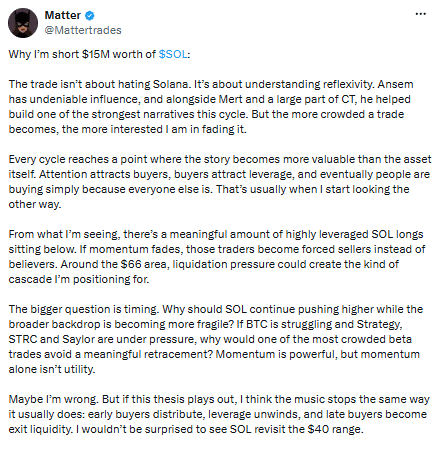
Source: X

The key question is timing.

If broader market conditions are weakening and Bitcoin [BTC] is under pressure, it raises the risk that crowded beta trades like SOL face a deeper pullback. If that unwind plays out, traders flush leverage, late longs become exit liquidity, and price breaks through support quickly. In that case, SOL can retest $40.

In this context, the trader’s $15 million short is being positioned as a liquidity-driven, risk-off trade rather than a purely fundamental call.

On ETFs, Solana spot products have seen steady inflows since launching, but June 2026 is showing early weakness. Flows are currently around -$5.8 million in outflows for the month.

Keeping all this in mind, Solana’s consolidation around $70, therefore, starts to look like a textbook bull trap.


Final Summary

  • Solana shows strong on-chain activity, but price and ETF flows are starting to weaken.
  • If leverage is crowded, the $15 million short may be betting on a liquidity flush and a possible bull trap in Solana [SOL].


热门币种推荐

相关问答

QAccording to the article, what is the key reason behind the divergence between Solana's on-chain activity and its price performance?

AThe article suggests that Solana's technical weakness (lagging price) looks like a textbook undervaluation case, where real on-chain usage is growing but the price chart appears softer. It hints this could be a strategic setup for a potential bull trap.

QWhat specific condition must be met for SOL's price to potentially retest $40, as mentioned in the analysis?

AFor SOL to potentially retest $40, broader market conditions would need to weaken with Bitcoin under pressure. This could trigger an unwind where leveraged longs are flushed, turning late longs into exit liquidity and causing a rapid break through support levels.

QHow does the article characterize the purpose of the $15 million short position on SOL by whales?

AThe article characterizes the $15 million short as a liquidity-driven, risk-off trade. It is positioned as a bet on a potential liquidity flush from crowded leveraged long positions, rather than being a purely fundamental call against Solana's strong on-chain activity.

QWhat evidence does the article provide for Solana's growing diversification and on-chain strength?

AThe article cites that Solana's trading volume jumped to over $67 billion in Q2 from just over $2 billion in Q1 (a ~3,200% QoQ increase). It also mentions activity is spread across memecoins, perpetual trading, tokenized assets, and staking protocols, showing demand beyond pure speculation.

QWhat does the data show about Solana spot ETF flows as of June 2026, and how does this relate to the overall narrative?

AAs of June 2026, Solana spot ETF flows are showing early weakness, with approximately $5.8 million in outflows for the month. This contributes to the bearish argument that, despite strong on-chain activity, price and investment flows are weakening, supporting the idea of a potential bull trap.

你可能也喜欢

为了买在研减肥药,一群美国人学用比特币支付

彭博社报道,美国一群从未接触过加密货币的普通消费者,为购买在研减肥药而首次学习使用比特币支付。一位49岁的美国市场总监Zach,通过中国卖家以240美元购得一年剂量的在研减肥药瑞他鲁肽,而美国市场同类产品年花费高达3600美元,巨大的价差促使他克服对比特币的偏见完成交易。 这类交易催生了一个以加密货币支付的灰色肽类药物市场。肽类是当前热门减肥药(如司美格鲁肽)的有效成分,大量未经美国食品药品监督管理局(FDA)批准的同类产品以“研究用化学品”名义在网上销售。由于法律风险,传统支付渠道常将其拒之门外,比特币等加密货币因此成为重要支付手段。数据显示,该市场加密货币支付规模快速增长,2026年一季度达3200万美元,年化规模或超1亿美元,但相对于整个肽类黑市(估计10-30亿美元)仍很小。 加密支付与这一市场的联系不仅在于交易。在纽约等地的线下聚会中,加密社群、生物黑客、长寿爱好者等群体高度重叠,共同关注并推动相关话题。 目前,美国监管机构正考虑将部分热门肽类药物合法化,以规范市场、保障安全。若传统支付渠道随之开放,加密货币在这一特定领域的支付用例可能面临收缩。报道中的买家Zach则表示,因其减肥目标已达到,将退出此类交易。

marsbit22分钟前

为了买在研减肥药,一群美国人学用比特币支付

marsbit22分钟前

交易

现货

热门文章

相关讨论

欢迎来到HTX社区。在这里,您可以了解最新的平台发展动态并获得专业的市场意见。以下是用户对SOL(SOL)币价的意见。

活动图片