Author: Joseph Chalom, Sharplink CEO
Compiled by: Saoirse, Foresight News
I just concluded my Asia tour, during which I engaged in in-depth discussions with Ethereum developers and ecosystem leaders. Special thanks to the teams at Nonce Classic, Four Pillars, and DSRV in Seoul, as well as our partners at SNZ, and the newly established Hong Kong Ethereum Community Hub. Supported by the Ethereum Foundation, this hub is Asia's first permanent, physical offline Ethereum community.
What struck me most during this trip was not only the vibrant atmosphere of the industry but also the meticulous, pragmatic attitude and ambitious vision of the local builders. The global Ethereum ecosystem is teeming with high-quality projects, innovative experiments, and long-term strategic thinking, which moved and inspired me deeply.
A set of data also came alive through these offline interactions: According to data provided by Electric Capital, the total number of cumulative contributors to Ethereum has exceeded one million, specifically 1,012,824 individuals; no other ecosystem in the crypto industry comes close.
A Milestone Worth Noting
Although a million is a round number, and many such figures can be hollow, this statistic is profoundly significant. Behind the number lies the world's largest and continuously expanding pool of technical talent, gathered by a global, open, permissionless blockchain network. More crucially, the scale and professional depth of this talent pool are still growing.
Of these one million developers, approximately 232,000 remained active in development over the past 12 months.
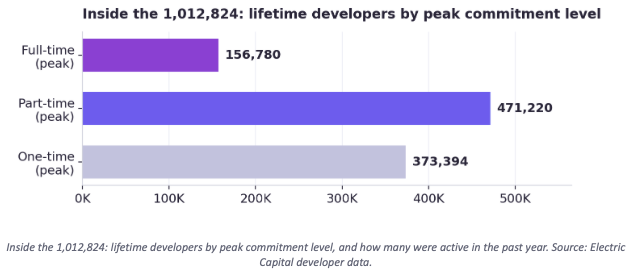
Ethereum's cumulative 1,012,824 developers: Full-time peak 156,780, Part-time peak 471,220, One-time participant peak 373,394. Part-time developers constitute the largest proportion of the total group. Source: Electric Capital
Why Ethereum? This is the Truly Critical Question
For a long time, discussions within the crypto industry have revolved around transaction speed, fees, and throughput. Every emerging public chain claims to be "faster than Ethereum." However, the most critical question in the crypto space has never been which chain has the best performance, but another core inquiry:
On which chain will top-tier developers choose to build and innovate for the long term?
On this point, Ethereum stands alone, irreplaceable. Its advantages extend beyond the technical layer, encompassing institutional, cultural, economic, and composability dimensions. This is the result of a decade-long accumulation of developers, infrastructure, industry standards, development tools, liquidity, academic research, various applications, and collaborative efforts within the industry—a complex ecosystem that others cannot replicate.
Ethereum has already become the underlying universal operating system for programmable finance and the issuance of native on-chain assets.
What Are the Million Developers Building Now? And How Are They Continuously Fortifying the Industry's Moat
The value of the million-developer community is primarily reflected in the industry's most challenging and far-reaching problems they are tackling today: underlying protocol scaling, privacy technology, post-quantum security, and the future intelligent autonomous systems that will run on-chain.
The Glamsterdam Upgrade: Innovating While Upholding Core Foundations
The Glamsterdam upgrade, planned for 2026, perfectly illustrates how Ethereum innovates while adhering to its core values. The core changes in this upgrade include the standardization of the proposer-builder separation mechanism (ePBS) and block-level access lists (BALs). These will enable parallel execution, significantly increasing network throughput. Additionally, there are plans to raise the gas limit, substantially enhancing the capacity of the Layer 1 mainnet.
While meeting future market scaling demands, it ensures network credibly neutrality, security, stability, and fair MEV distribution—this is a clear manifestation of Ethereum's continuously strengthening moat.
Synchronous Composability: Making Dozens of Rollups Feel Like a Single, Complete Public Chain
Composability has always been Ethereum's trump card, and the next breakthrough is extending this capability to all Layer 2 networks. Native, foundational Rollups combined with synchronous composability can solve the problem of ecosystem fragmentation: within a single atomic transaction, a smart contract on one Rollup can directly call a contract on the mainnet or another Layer 2 network, without cross-chain bridges or waiting periods.
Teams like Linea, the Ethereum Economic Zone, Gnosis, and Zisk, in collaboration with the Ethereum Foundation, are advancing related research and development, integrating this architecture with real-time proof technology. The final result will be: dozens of Rollups are no longer isolated networks but merge into one, directly addressing external skepticism about Ethereum's ecosystem fragmentation.
Post-Quantum Security: Ethereum's Most Prominent Leading Track
No other major public chain ecosystem has prepared for the post-quantum era's security framework as proactively as Ethereum. Relying on the "Purge Ethereum" development roadmap, the dedicated Post-Quantum Security Working Group established by the Ethereum Foundation in early 2026, the official website pq.ethereum.org, and over a dozen client teams running weekly post-quantum interoperability devnets, an open-source collaborative migration plan has taken shape, aiming for completion around 2029.
Once quantum computing poses security risks, institutions managing trillions of dollars in custodial assets will focus on one thing: which public chain was the earliest and most comprehensive in its protective preparations.
Moat Beyond Developers: Composability, Unified Standards, and Industry Trust
Ethereum's developer talent advantage will continue to compound, rooted in its underlying architectural design. Its most critical network effect is not liquidity, but extreme composability: applications like lending, stablecoins, exchanges, wallets, tokenized assets, oracles, and Layer 2 Rollups function like freely combinable financial building blocks, interoperable through unified industry standards, allowing developers to avoid building entire systems from scratch.
The EVM is the crypto industry's universal application layer, and the Solidity programming language is applicable across hundreds of networks like Base, Arbitrum, Optimism, Polygon, ZKsync, Scroll, and Linea.
Mastering Ethereum development maximizes development options, creating a virtuous cycle: more developers enter → supporting tools continuously improve → market liquidity increases → institutions continue to enter → attracting more developers to build interoperable protocols and assets. Liquidity begets more liquidity, and composability amplifies the advantages of composability.
Ethereum firmly occupies the core position for value accumulation, not just short-term on-chain activity.
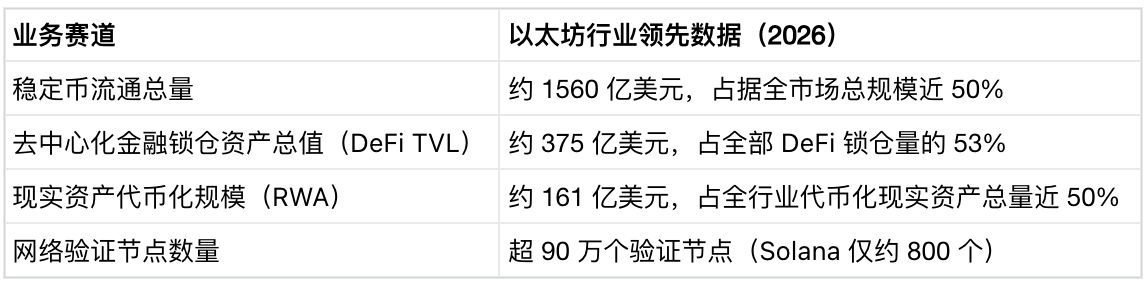
Three core advantages continue to widen the lead:
- Credible Neutrality: Ethereum has over 900,000 validator nodes, while Solana has only about 800. This highly decentralized, neutral, and unbiased platform attribute is a core trait highly valued by large financial institutions;
- Modular Architecture: Rollups like Base, Arbitrum, and Optimism do not fragment the Ethereum ecosystem; instead, they expand it into an interconnected, modular on-chain economy where all Layer 2 networks can inherit the mainnet's security guarantees;
- Industry Ecosystem Culture: Ethereum gathers the industry's top researchers, cryptographers, and EIP standard-setters. This group defines the direction of the entire crypto industry. This cultural barrier, formed through the accumulation of talent, is difficult for any forked project to replicate.
The Uniqueness of Ethereum
There's a world of difference between merely generating short-term on-chain activity and becoming the long-term coordination layer for global native finance, earning the trust of leading financial institutions. In the minds of the largest asset-holding institutions, Ethereum holds an absolute mainstream position. These institutions prioritize security, trust, and liquidity most highly. I witnessed this industry trend firsthand during my previous tenure at BlackRock.
The law of technology industry development is: In the long run, ecosystem resources converge towards unified standards, sufficient liquidity, and developer consensus. This is precisely Ethereum's impregnable moat.
After meeting with local developers, builders, and ecosystem leaders in Seoul and Hong Kong, I am more convinced than ever of Ethereum's competitive advantages. I met the top talent building the next generation of financial infrastructure—the future entrepreneurs of the industry, the designers of intelligent autonomous financial systems. It is precisely these teams and practitioners who will reshape the entire world.
Ethereum's future is happening right now.