Who Will Take Over After SpaceX's IPO?

marsbit发布于2026-06-12更新于2026-06-12

文章摘要

SpaceX is set to go public on June 12 with a $1.8 trillion valuation, but only about 5.56 billion shares (4.2% of the total) will be initially available for trading. Buy-side pressure is expected in three distinct waves. First, the IPO subscription at a fixed $135 per share, which is oversubscribed by nearly 4 times. Second, immediate secondary market trading post-listing. Third, and most significant, the forced buying by passive index funds. The Nasdaq 100 index has modified its rules to include SpaceX just 15 trading days after its IPO, despite its small float, which will compel hundreds of tracking funds to buy large quantities of stock. However, this initial supply shortage will not last. A staged lock-up release is designed for the approximately 54% of shares held by VCs, early employees, and other insiders (excluding Elon Musk's 42%, which is locked for 366 days). Releases begin after the Q2 earnings report, with subsequent unlocks at multiple intervals up to 180 days post-IPO. This means selling pressure from insiders will gradually increase throughout the latter half of the year. A key counterbalance is scheduled for mid-December during the Nasdaq 100's annual rebalancing. By then, the public float will have expanded significantly, forcing index funds to buy more shares, potentially providing institutional support after months of insider selling.

Author: BitalkNews

On June 12, SpaceX will go public with a valuation of $1.8 trillion, but only about 556 million shares will actually enter circulation, corresponding to a float market cap of approximately $75 billion, which is about 4.2% of the total valuation.

In the initial phase of listing, the free float will be extremely small, but buying demand will arrive in three consecutive waves.

The first wave is the IPO subscription on June 12. Institutions and retail investors will buy the newly issued 556 million shares at a fixed price of $135. About 70% will be allocated to institutional investors, and 30% will be reserved for retail investors—a retail allocation three times higher than in a typical large IPO. Ordinary investors can subscribe through platforms like Robinhood and Fidelity. Current subscription demand has already exceeded $250 billion, nearly 4 times oversubscribed.

The second wave is trading in the secondary market after the opening. After the IPO subscription is completed, the stock will start trading on NASDAQ. The opening price is highly likely to be above $135. Prices during this phase will be determined by market supply and demand.

The third wave is the forced buying by passive funds, which is the most noteworthy aspect. The Nasdaq 100 is one of the most important stock indices in the U.S., containing the 100 largest non-financial stocks, including Apple, Nvidia, and Microsoft. Globally, over $600 billion in funds track this index, and they are required to hold each stock according to its weight in the index.

Normally, a newly listed company must wait several months to qualify for inclusion, but NASDAQ has specifically modified its rules for SpaceX, allowing fast-track inclusion just 15 trading days after listing. It has also removed the original 10% minimum free-float requirement and introduced a new weighting rule: even though SpaceX's actual free float is only 5%, the index will calculate its weight as up to 3 times that, or 15%. Once the inclusion takes effect, hundreds of funds tracking the index will need to buy SpaceX shares within a few days. With a float of only $75 billion, the concentrated influx of buying demand in a short period can easily drive up the price. These funds do not consider valuation or make judgments; they buy when the rules dictate.

These three waves of buying demand will occur almost seamlessly within the first month after listing.

However, this supply-demand imbalance will not last forever.

SpaceX has not adopted the traditional 180-day lock-up period common in IPOs. Instead, it has designed a phased release mechanism.

To understand this mechanism, we first need to grasp the post-IPO shareholding structure: The newly issued IPO shares account for about 4.2% of the total shares. Elon Musk personally holds about 42%, while the remaining approximately 54% is held by VCs, early employees, and other internal shareholders. The newly issued portion becomes tradable upon listing. Musk's shares are fully locked for 366 days and will not move. The phased unlocking applies only to the middle 54%.

Specific timeline:

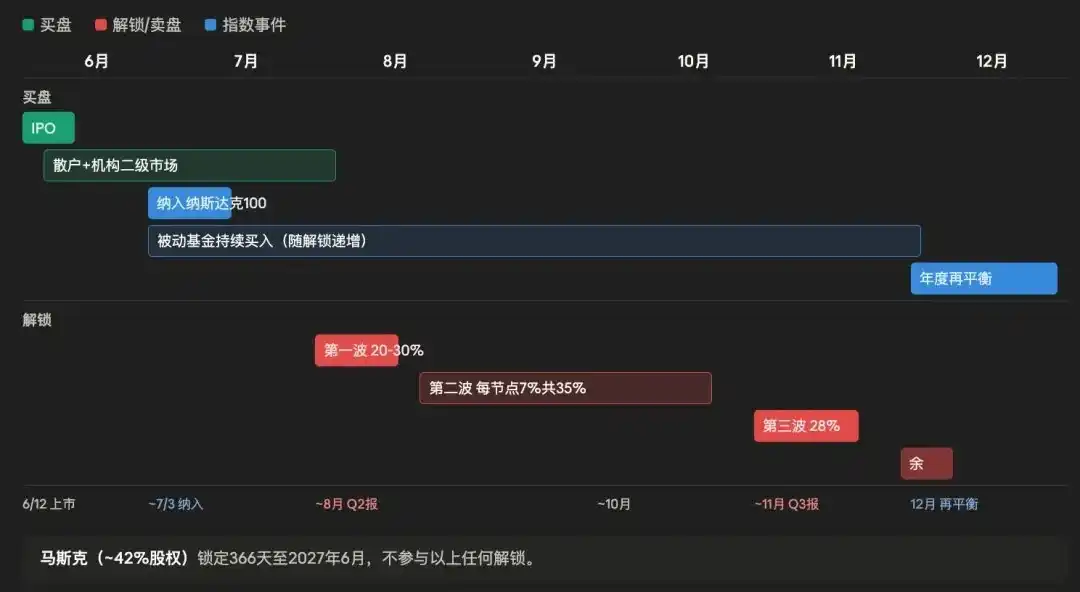
  • First wave, two days after the Q2 earnings release: Locked-up shareholders can sell up to 20% of their locked shares. If the stock price stays 30% above the IPO price and meets the threshold for 5 out of 10 trading days at this point, an additional 10% will be unlocked. This means the earliest group of insiders may start selling as soon as early August.
  • Second wave, on days 70, 90, 105, 120, and 135 after the IPO: 7% will be unlocked at each milestone, totaling 35% across the five milestones.
  • Third wave, after the Q3 earnings release, another 28% is unlocked, with the remainder released upon the expiration of the 180-day lock-up.

Elon Musk's shares are locked for 366 days, and he does not participate in any early releases. He controls over 85% of the voting rights, and this commitment is a crucial pillar of short-term market confidence in SpaceX.

From listing until the end of the year, the market will experience a six-month transformation in supply and demand dynamics. In the first half, the free float is locked up, and buying demand is highly predictable. In the second half, shares are gradually released, and each earnings milestone becomes a test of selling pressure.

The timing design is particularly noteworthy: By the time of the Nasdaq 100 annual rebalancing in mid-December, most insider shares will have been unlocked through the earlier phases. With the free float significantly increased, NASDAQ will correspondingly raise SpaceX's index weight, prompting passive funds to purchase additional shares again. This essentially provides institutional, mandatory buying support to cushion the market several months after insiders have sold substantial amounts.
热门币种推荐

相关问答

QAccording to the article, what is the special arrangement made by NASDAQ to include SpaceX in the NASDAQ-100 index, and what is its potential impact?

ANASDAQ specially modified its rules for SpaceX, allowing it to be eligible for inclusion in the NASDAQ-100 just 15 trading days after its IPO. This move removed the previous 10% minimum free float requirement and introduced a new weighting rule: even though SpaceX's actual free float is only about 5%, the index will calculate its weight based on a cap of up to three times that, or 15%. This means that upon inclusion, passive funds tracking the index will be forced to buy a significant amount of SpaceX stock relative to its small float, potentially pushing up the price sharply in a short period.

QDescribe the three waves of buying pressure for SpaceX stock mentioned in the article and the sequence in which they occur.

AThe three waves of buying pressure are: 1) The IPO subscription on June 12th, where institutions and retail investors purchase the newly issued shares at a fixed price of $135. 2) Secondary market trading after the stock begins trading on NASDAQ, where the price is set by market supply and demand. 3) The mandatory buying by passive index funds after SpaceX is included in the NASDAQ-100 index. These three waves of buying pressure are described as occurring almost seamlessly within the first month after the listing.

QHow does SpaceX's lock-up release mechanism for insiders differ from a traditional 180-day lock-up, and what is its schedule?

ASpaceX does not use a traditional 180-day uniform lock-up expiration. Instead, it has a staged release mechanism for the approximately 54% of shares held by VCs, early employees, and other insiders. The schedule is: The first wave allows locked-up shareholders to sell up to 20% of their holdings two days after the Q2 earnings report, with an extra 10% unlocked if the stock price meets certain conditions. The second wave involves unlocks of 7% each on days 70, 90, 105, 120, and 135 post-IPO, totaling 35%. The third wave unlocks 28% after the Q3 earnings report, with the remainder released at the 180-day mark. Elon Musk's 42% stake is locked for 366 days and is not part of this staged release.

QWhat role does the NASDAQ-100 annual rebalancing in mid-December play according to the article's analysis of the supply and demand dynamics for SpaceX stock?

AThe article suggests that by the time of the NASDAQ-100's annual rebalancing in mid-December, most of the insider shares will have been unlocked through the earlier staged releases. With the free float significantly increased by then, NASDAQ will correspondingly raise SpaceX's weighting in the index. This forces the passive funds tracking the index to buy additional shares again. This institutional, forced buying is seen as providing a market floor several months after the period of heavy potential selling by insiders.

QWhat is the estimated total valuation of SpaceX at its IPO, and what is the size and percentage of the initial free float being offered?

ASpaceX is going public with an estimated total valuation of $1.8 trillion. The actual number of shares entering circulation at the IPO is about 556 million, corresponding to a free-float market capitalization of approximately $75 billion, which represents about 4.2% of the total valuation.

你可能也喜欢

产品发布:市场指南针

Glassnode推出全新工具“市场指南针”,旨在解决用户面对海量数据时难以抉择的问题。该工具通过七个维度综合分析市场:其中四个前瞻性维度(宏观环境、资金流动、投资者行为、链上基本面)汇合成一个从“风险规避”到“风险偏好”的主综合评分;另外三个独立维度(周期位置、衍生品、跨资产轮动)则描述当前市场状态。 目前主评分为14(满分100),处于“风险规避”区间,显示市场仍处熊市阶段。比特币价格约64,400美元,月内下跌16%。具体来看: * **宏观**:评分23,主要受美元走强拖累。 * **资金流动**:评分31,稳定币供应增长转负,市场“弹药”略有减少。 * **投资者行为**:评分35,长期持有者占比创新高,显示筹码正流向坚定持有者。 * **链上基本面**:评分38,网络活动有初步回暖迹象,但尚未全面复苏。 * **周期位置**:评分18,处于“投降”阶段,但现价仍高于平均成本。 * **衍生品**:评分43,杠杆率较低,市场仓位谨慎且对冲充分。 * **跨资产轮动**:评分70,显示资金相对青睐山寨币,但各板块普跌,实为“跌得少”的相对优势。 总体而言,市场处于低位盘整阶段,内部结构正在修复,但由美元主导的宏观约束尚未解除,明确的趋势反转仍需等待美元指数回落至其200日均线以下。该工具每日更新数据,每周提供分析摘要。

insights.glassnode5小时前

产品发布:市场指南针

insights.glassnode5小时前

英伟达CPU压境,中国RISC-V迎战:半导体深观察之四

英伟达即将向中国客户提供其首款专为AI设计的独立CPU Vera,基于Arm架构,单颗售价超2万美元。这凸显了中国在AI算力需求激增下,对CPU架构自主可控的迫切性。文章指出,除了x86和Arm,RISC-V正成为中国突破“不可能三角”(繁荣、可控、自主)的关键赛道。 RISC-V因其开源、模块化特性,被视为实现自主可控且有机会繁荣的路径。当前,中国已成为全球RISC-V发展的热点,受AI算力需求、出口管制压力、开源降本以及政策支持等多重因素推动。国内多家厂商的高性能RISC-V核心在SPEC定点跑分上已触及或超过15分的行业门槛,并实现了3GHz以上的主频,拿到了进入高性能计算俱乐部的“入场券”。 产业焦点已从单核性能转向完整的“计算子系统”,包括自研一致性片上网络(NoC)和满足数据中心要求的全栈RAS能力。已有厂商交付了40核、严格兼容RVA23国际标准的服务器处理器,体现了对生态统一性的重视。在视频编解码、加解密等特定负载上,部分国产RISC-V处理器已接近甚至超越x86/Arm同代产品。 挑战同样严峻。生态碎片化、EDA工具链不完善、验证复杂度高、单核能效追趕、以及先进工艺制约等都是必须啃下的“硬骨头”。业界清醒认识到,在数据中心领域超越成熟架构的周期将比预期更长。 结论是,面对英伟达Vera的敲门,中国自研CPU并非只有跟随Arm一条路。RISC-V赛道已在中国推开大门,并在高性能计算领域取得了实质性进展。虽然前路漫长,充满工程挑战,但它为中国提供了在下一轮算力革命中掌握主动权的可能性。

marsbit6小时前

英伟达CPU压境,中国RISC-V迎战:半导体深观察之四

marsbit6小时前

Stratosphere、Pudgy Penguins与Streamex于2026年ETHConf及纽约科技周期间举办创始人圆桌VIP晚宴

2026年6月9日,在ETHConf 2026和纽约科技周期间,Stratosphere、Pudgy Penguins和Streamex在纽约市联合举办了一场私密的“创始人桌”VIP晚宴,汇聚了数字资产、科技、人工智能、传统金融和机构资本领域的众多领导者。 此次仅限受邀者参加的晚宴,旨在将精选的创始人、运营商、基金、高管及机构领袖聚集一堂,在私密环境中促进自然交流。出席嘉宾包括来自花旗、BitMine、BitGo、未来资产证券(美国)、Experian、Pyth Network、Space and Time、MegaETH、B3、Stable、Antler、Delphi Digital、Fun、Linera、Vanta Trading、Streamex、PolyData、Horizen Labs、World Foundation、Zipcode、OpenLedger、Onyx、Definitive、Notalone Ventures等机构的代表。 晚宴由Stratosphere主办,Pudgy Penguins和Streamex联合举办。Stratosphere贡献了其广泛的创始人、运营商、投资者和机构网络;Pudgy Penguins带来了数字资产领域强大的消费品牌和社区;Streamex则聚焦于代币化黄金和大宗商品市场,引入了机构及现实世界资产的视角。 Stratosphere首席执行官哈桑·谢赫表示:“我对数字资产的下一阶段,尤其是商品代币化感到乐观。这类晚宴让我们能将基金、机构和创始人聚集在同一房间,探讨市场走向。”该“创始人桌”系列活动计划在全年主要全球会议期间持续举办,致力于在私密、以关系驱动的场合中连接创始人、资本、机构和领先品牌。 Stratosphere是一家服务于科技和金融行业领导者的生态合作伙伴与增长咨询公司。

TheNewsCrypto8小时前

Stratosphere、Pudgy Penguins与Streamex于2026年ETHConf及纽约科技周期间举办创始人圆桌VIP晚宴

TheNewsCrypto8小时前

交易

现货
合约

热门文章

如何购买S

欢迎来到HTX.com!我们已经让购买Sonic(S)变得简单而便捷。跟随我们的逐步指南,放心开始您的加密货币之旅。第一步:创建您的HTX账户使用您的电子邮件、手机号码注册一个免费账户在HTX上。体验无忧的注册过程并解锁所有平台功能。立即注册第二步:前往买币页面,选择您的支付方式信用卡/借记卡购买:使用您的Visa或Mastercard即时购买Sonic(S)。余额购买:使用您HTX账户余额中的资金进行无缝交易。第三方购买:探索诸如Google Pay或Apple Pay等流行支付方法以增加便利性。C2C购买:在HTX平台上直接与其他用户交易。HTX场外交易台(OTC)购买:为大量交易者提供个性化服务和竞争性汇率。第三步:存储您的Sonic(S)购买完您的Sonic(S)后,将其存储在您的HTX账户钱包中。您也可以通过区块链转账将其发送到其他地方或者用于交易其他加密货币。第四步:交易Sonic(S)在HTX的现货市场轻松交易Sonic(S)。访问您的账户,选择您的交易对,执行您的交易,并实时监控。HTX为初学者和经验丰富的交易者提供了友好的用户体验。

2.6k人学过发布于 2025.01.15更新于 2026.06.02

如何购买S

相关讨论

欢迎来到HTX社区。在这里,您可以了解最新的平台发展动态并获得专业的市场意见。以下是用户对S(S)币价的意见。

活动图片