Editor's Note: This article revolves around the airstrike carried out by U.S. forces against targets near the Strait of Hormuz in Iran in the early morning of June 10, Beijing time. Dean Blundell, in a tone of strong irony, criticizes the Trump administration's policy reversals on Iran: A U.S. Army AH-64 Apache helicopter crashed near the Strait of Hormuz, with two pilots rescued; the cause of the incident remains disputed. Trump initially called it "no big deal," but later on Truth Social characterized it as Iran "shooting down" a U.S. helicopter, using this as a justification to launch strikes against Iran's coastal air defense, radar, and ground control facilities.
The article's true critique is not merely this military response, but rather the Trump administration's repeated creation of the public opinion smoke screen that a "deal is about to be reached." While claiming negotiations are in the "final stages" and an agreement could be signed "in two or three days," it escalates military actions and publicly humiliates Iran. The so-called diplomatic negotiations resemble a political performance serving the news cycle. Meanwhile, the U.S. military's so-called "proportional response" further provokes retaliatory strikes by Iran against American regional bases. The Strait of Hormuz still fails to return to normal, with oil prices and market pressure persisting. The author reminds readers that when "very close" repeatedly replaces real progress, perhaps the most rational response is not to believe, but to record it, and assume reality is likely the exact opposite.
The original text follows:
Let's start with the timeline, because this timeline itself is the core of the entire deception.
Monday night, a U.S. Army AH-64 Apache attack helicopter crashed in the Strait of Hormuz off the coast of Oman. Both pilots survived and were unharmed—they were rescued by an unmanned vessel within two hours. It must be admitted, that was a pretty cool piece of military hardware, the only part of the whole story that actually worked properly.
But there's a detail Trump won't write into those all-caps social media posts: A U.S. official told The Associated Press that the Apache crashed after colliding with an Iranian drone, and it's currently unclear if the collision was intentional. Trump himself also told The Wall Street Journal that the whole thing was "no big deal," and that "the pilots are fine."
So, please remember this first: no big deal. The pilots are fine. The cause is still under investigation. Maybe it was just an accident.
Tuesday morning, the same person, a different mood. He went on Truth Social again and wrote: "I have just been informed by our great military that last night, Iranians shot down one of our highly advanced Apache helicopters while patrolling the skies over the Strait of Hormuz...... America must respond to this attack. Thank you all for your attention on this matter!"
From "no big deal" to "must respond" in less than one news cycle. This person reversed his own statement in under 24 hours, and we are somehow still expected to nod along as if facing some art of statecraft.
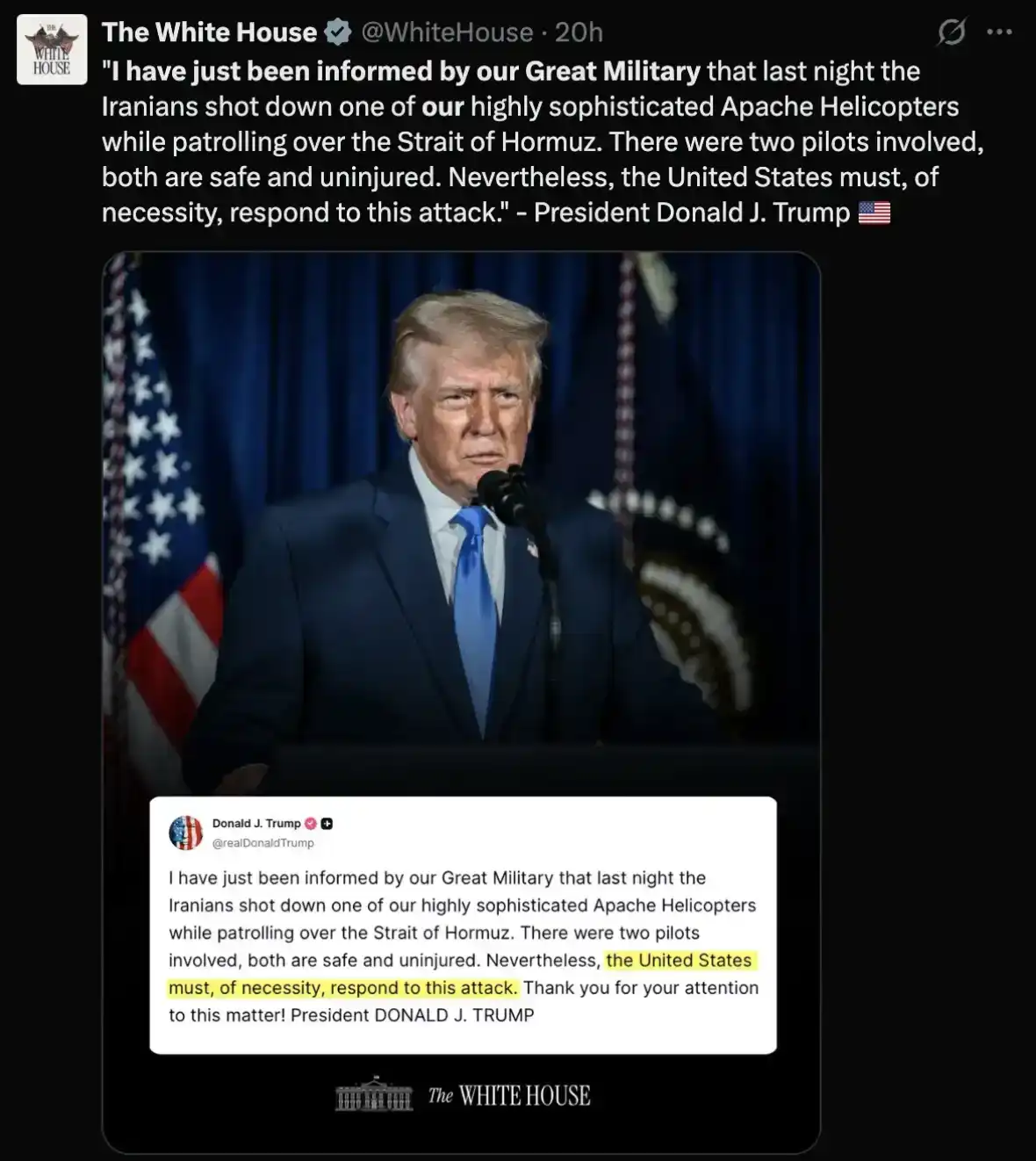
Late Tuesday night into early Wednesday morning, U.S. Central Command began launching strikes against coastal areas in Iran. The operation lasted from Tuesday 22:00 GMT to nearly 01:00 Wednesday, targeting about 20 sites including air defense systems, ground control stations, and surveillance radar stations. Locations spanned Qeshm Island, Goruk, Bandar Abbas, Jask, Sirik, and Minab, stretching along the Strait of Hormuz and deep into the strait. The Pentagon's justification: "Self-defense strikes," a "proportionate response" to "Iran's unprovoked aggression."
According to Iranian state television, the result of this so-called "proportionate response" on the ground was: Two water reservoirs near Sirik were struck, disrupting the drinking water supply for about 20,000 people in the Bamani area. Next time you hear the term "surgical strike," remember this scene.
The same night, Iran retaliated. Iran's Revolutionary Guard Corps claimed they launched 21 strikes against American targets in the region—drone attacks hit the U.S. Fifth Fleet in Bahrain and the Ali Al Salem base in Kuwait, while long-range missiles targeted the Azraq airbase in Jordan; they claimed to have destroyed an F-35 hangar there. Jordan stated it had shot down five missiles. Iranian Foreign Minister Araghchi, using a deterrent tone Trump likely wishes he had, said: "If you want security, leave our region." Iranian Parliament Speaker Ghalibaf said: "We prefer to use the language of diplomacy, but other languages, we speak more fluently."
Wednesday morning. And then—right here—the real key moment appeared. Trump was back on Truth Social, the "chief dealmaker" taking off the mask completely:
"The Iranian military is in complete disarray. Most of their forces, like their navy and air force, don't even exist anymore—they have been completely defeated. Iran talks, but doesn't act. The Middle East bully is dead!!! They took too long to negotiate a deal that was incredibly good for them, and now they have to pay the price!!!"
"They took too long to negotiate."

Too long. The same person who, just the morning before, claimed the deal was in the "final stages" and could be signed in "two or three days." The same person who, after leaving the NBA Finals on Monday night, said both sides were in the final stages of a "very, very good deal" that would "immediately" reopen the Strait of Hormuz once signed.
The "Two or Three Days" Industrial Complex
I want you to really think about something. Throughout this war, Trump has been telling us: The deal is coming. By Sunday, this war had lasted over 100 days. By my count—yes, I've recorded each one, because someone has to do it—since this conflict erupted in late February, Trump has promised an imminent, shiny, just-around-the-corner deal over thirty times.
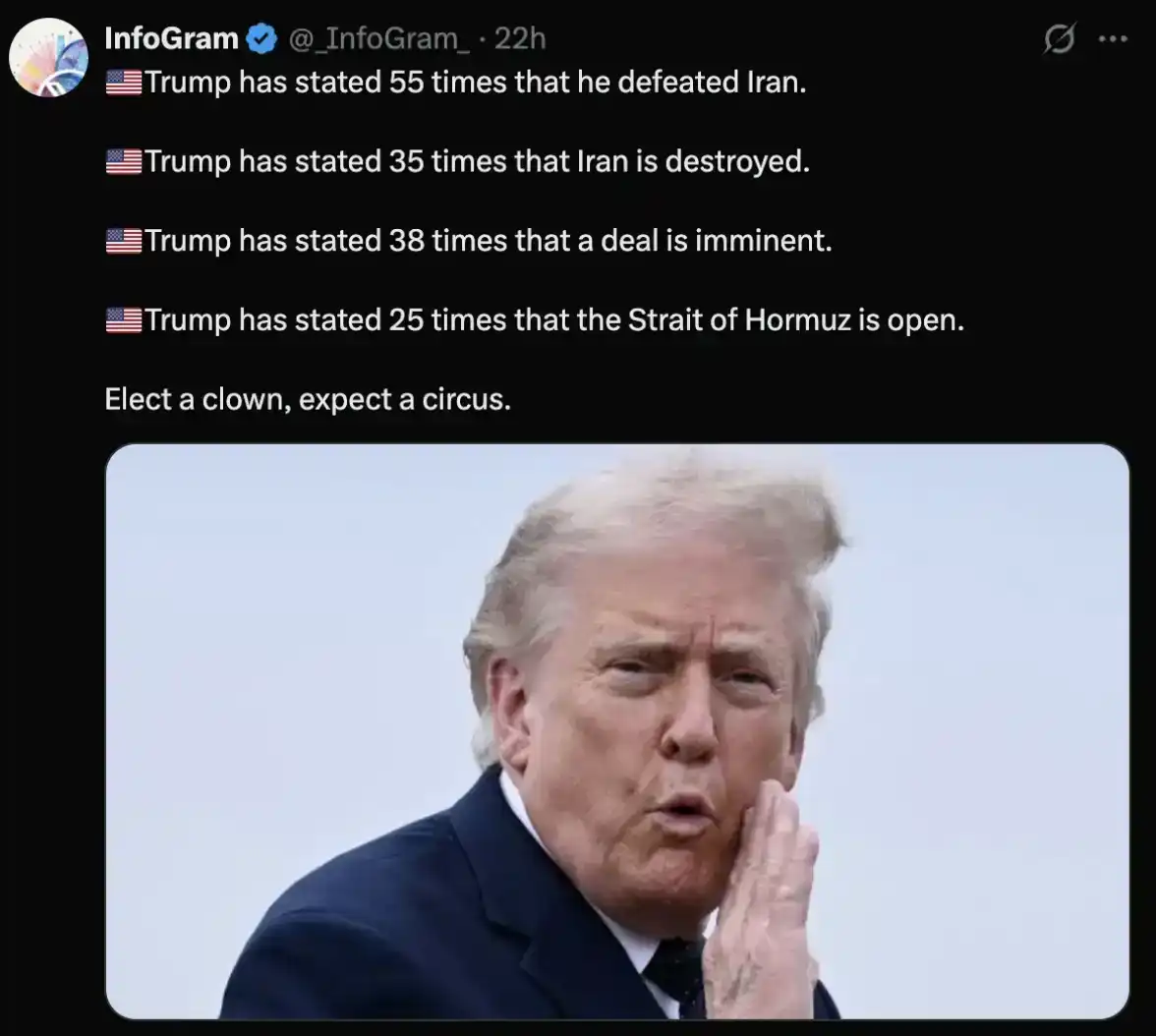
A few receipts pulled from the "receipt drawer":
March 23: Announced "very good and productive conversations" and postponed the threatened power plant strikes by five days. Iran's response? They flatly denied any talks happened. Oil prices fell initially, then bounced back after Tehran debunked his claim.
Late March: Threatened to "destroy" Iran's power plants within 48 hours if they didn't open the strait. They didn't open. He didn't act.
April: Announced a "10-day pause on energy facility destruction period." A ceasefire was declared. Negotiations followed in Pakistan, mainly brokered by Islamabad, ending in failure.
This week: "Final stages." "Two or three days." "Open immediately upon signing."
Wednesday: "They took too long. Must pay the price."
This isn't negotiation. This is a slot machine that only spits out media exposure. Every pull of the lever, the same three cherries pop up on the screen: deal is almost done, the other side is weak, trust me.
And each time, JD Vance stands beside him to back him up—on Sunday, he told CBS the administration was "very close" to a deal. Very close. Probably the two most abused words in this administration, barely beaten out by "perfect call."
Let's Take the Mask Off
Behind the so-called "trust me, bro" lie these things.
If you're truly in control of negotiations, you don't need to blow up water reservoirs to prove you're winning. If you're truly in control of negotiations, the other side won't fire 21 missiles at three of your bases the same night. If you're truly in control of negotiations, your diplomatic posture doesn't shift like a mood ring from "very, very good deal" to "the Middle East bully is dead" in 18 hours—a shift whose only discernible external trigger seems to be his mood about the cable news coverage.
The blockade he keeps bragging about—in his own words, "the most successful blockade in naval history"—hasn't stopped Iran from launching attacks across the region, hasn't reopened the Strait of Hormuz, and hasn't produced any deal. A shopkeeper in Tehran even told CBS this week his store shelves remain full. But sure, it can still be "the most successful ever." He actually wrote "praise Allah"—I have many questions about that, but that's for another article.
The real tell is here: The Strait remains closed. The war's only stated concrete objective—reopening the passage for a fifth of the world's oil supply—remains unmet after 100+ days. Dozens of "imminent" deals, a naval blockade, and now a new round of strikes later. Oil is up nearly 2%. Markets are down. And the man at the center of it all is still posting in all caps declaring a "bully" dead.
This isn't leverage. This is a guy who lost control of the car sometime around March and has spent three months insisting he always meant to drift it into the guardrail.
The Bottom Line
It's a good thing, of course, that the two pilots are safe and sound; that's the only clean outcome in this whole affair. But tonight, 20,000 people in southern Iran have no drinking water, three U.S. allies have been hit by missiles, a Jordanian F-35 hangar might be a smoldering ruin, and the man responsible has handled the whole thing like a pro-wrestling promo.
Every "two or three days" is either a lie or a delusion. And by now, the difference between the two doesn't matter. You can't say Tuesday the deal is in the "final stages," Wednesday say "they took too long," and then expect anyone with functioning memory to keep trusting your read on Thursday's situation.
So, next time you hear "we're very close," whether it's Trump saying it, Vance saying it, or any of them, please do the only semi-sane thing left.
Count it. Record it. Then assume the exact opposite is true.
Because "trust me, bro" stopped being foreign policy somewhere around the twelfth promise of a deal. We're well past thirty now.
That, it seems, is worth remembering.