Author: Ada, Deep Tide TechFlow
The "New Stock God" Serenity, popular on X, recently shared his systematic views on Taiwan's AI industry chain. He named 9 Taiwanese stocks covering three main themes: CPO (Co-Packaged Optics), ASIC (Application-Specific Integrated Circuit), and compound semiconductors. He identified CPO as "the biggest industrial theme for the next phase." Goldman Sachs predicts the global Optical TAM will explode from $15 billion in 2026 to $154 billion in 2028, with CPO's share growing from $164 million to $91 billion. He also explicitly stated: Taiwan's AI industry chain does not have a bubble; the real risk is not cross-strait relations, but the capital expenditures of hyperscale cloud service providers.
TSMC COUPE Countdown to 2026 Mass Production, 5 Taiwanese Stocks Cover Each Segment
The hard timeline anchoring Serenity's CPO thesis is TSMC's COUPE (Compact Universal Photonic Engine) platform entering mass production in 2026.
According to TrendForce's April 1st report citing TSMC's Advanced Packaging Integration Director Hou Shangyu at SEMICON Taiwan, COUPE, based on SoIC technology for heterogeneous integration of electronic and photonic integrated circuits, is on schedule for mass production in 2026. Hou also identified three bottlenecks for CPO scaling: wafer-level testing, Fiber Array Unit (FAU) integration, and high-speed optical packaging assembly. The 5 CPO Taiwanese stocks named by Serenity correspond precisely to these three bottleneck segments and their surrounding support infrastructure.
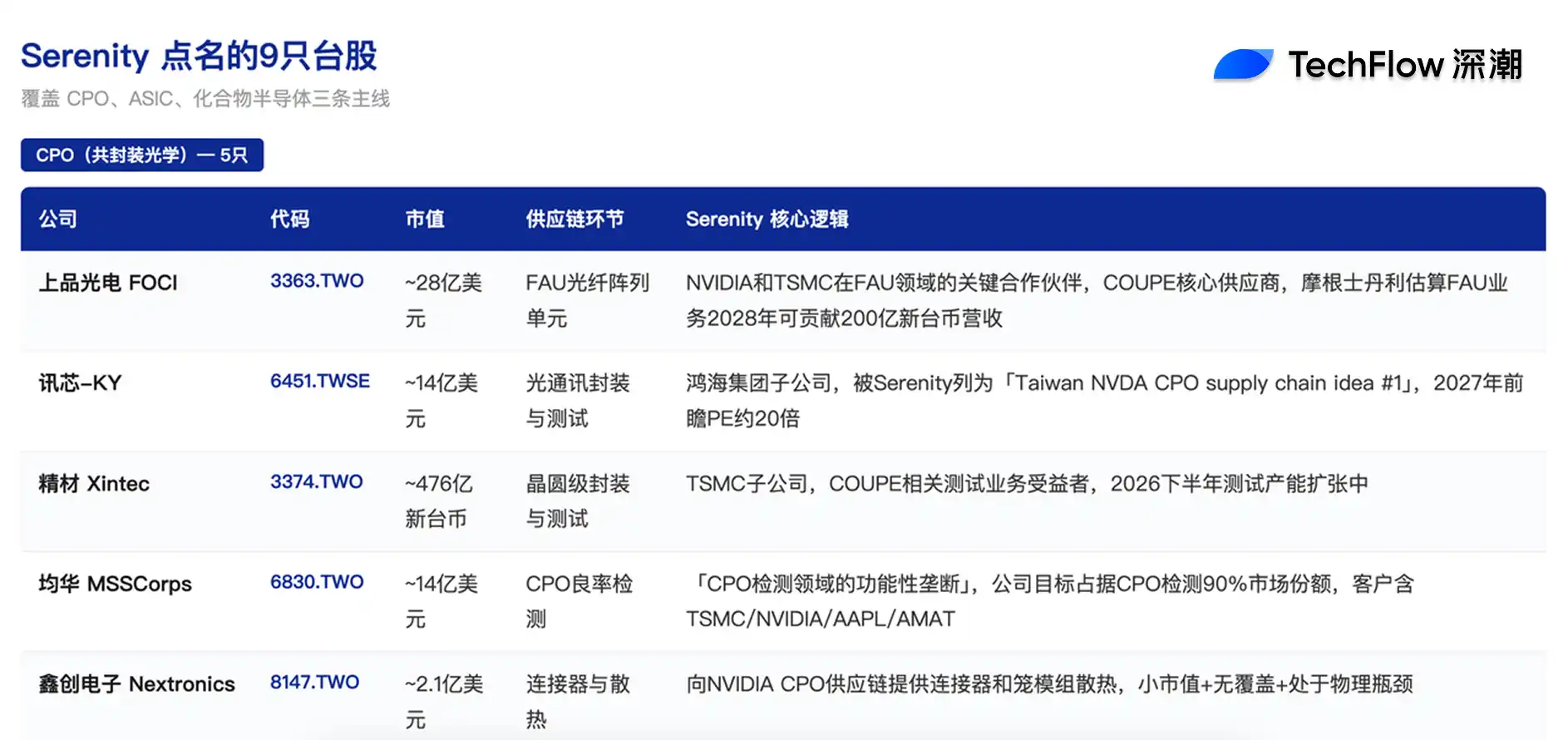
The first is FOCI (First-O-Link Optronics, 3363.TWO), with a market cap of approximately $2.8 billion. FOCI is a key partner for NVIDIA and TSMC in the FAU field and a core supplier within the COUPE architecture. Serenity stated on X that FOCI's current market cap of around $2.8 billion "has not fully reflected its strategic position in the industry chain." Morgan Stanley estimates FOCI's FAU business could contribute approximately NT$20 billion in revenue from a single product line by 2028, whereas it is currently nearly zero. As early as March, Hunterbrook Media and Citrini Research, through cross-referencing four patents from FOCI, Himax, and TSMC, confirmed a "fingerprint-level" correspondence between the three companies on 22-channel FAUs, providing the strongest external evidence of FOCI's entry into COUPE's core supply chain.
The second is Shunsin Technology (6451.TWSE), with a market cap of approximately $1.4 billion. Shunsin is the optical communication packaging and testing subsidiary of Foxconn Group. Serenity once listed Shunsin as "Taiwan NVDA CPO supply chain idea #1" on X, reasoning that "Foxconn is NVIDIA's ODM, akin to Celestial getting a free ride with MRVL's listing." He provided a personal estimate that Shunsin's forward P/E for 2027 is around 20x.
The third is Xintec (3374.TWO), with a market cap of approximately NT$47.6 billion. Xintec is TSMC's wafer-level packaging and testing subsidiary, with Chairman CH Chen. Its main businesses are wafer-level chip-scale packaging and wafer testing. According to a DIGITIMES report on May 29, 2026, Xintec is preparing capacity for testing business expansion in the second half of 2026. In a recent interview, Serenity categorized Xintec as a "beneficiary of COUPE-related testing business."
The fourth is MSSCorps (6830.TWO), with a market cap of approximately $1.4 billion. Serenity explicitly stated on X that he had established a position in MSSCorps, offering a strong judgment: "This looks like a functional monopoly in CPO inspection. The market might confuse it with material/failure analysis oligopolies like MA-tek and iST." He then cited MSSCorps' own statement, "The company aims to capture 90% of the CPO inspection market share," to support this. MSSCorps' customer mapping includes TSMC, NVIDIA, AAPL, AMAT, etc. Among the three CPO bottlenecks pointed out by TSMC, "wafer-level testing" is the segment where MSSCorps directly holds a key position.
The fifth is Nextronics (8147.TWO), with a market cap of approximately $210 million. Serenity's reason for establishing a position in Nextronics is its supply of "CPO connectors and Cage Thermal Modules" to NVIDIA's CPO supply chain. Nextronics has the smallest market cap among the 5 CPO Taiwanese stocks, fitting Serenity's typical stock selection profile of "small market cap + no coverage + positioned at a physical bottleneck."
Roughly sorted by supply chain segment, the 5 stocks are: FAU access (FOCI), optical communication packaging & testing (Shunsin Technology, Xintec), yield inspection (MSSCorps), connectors & thermal management (Nextronics). The downstream customers for this entire chain are highly concentrated in NVIDIA and TSMC.
Three Taiwanese ASIC Companies Bind to Three Hyperscalers' Custom Chip Development
Beyond NVIDIA GPUs, the continued volume ramp of hyperscale cloud service providers' self-developed ASICs, such as AWS Trainium, Google TPU, and Microsoft Maia, constitutes the second main theme in Serenity's Taiwanese stock list.
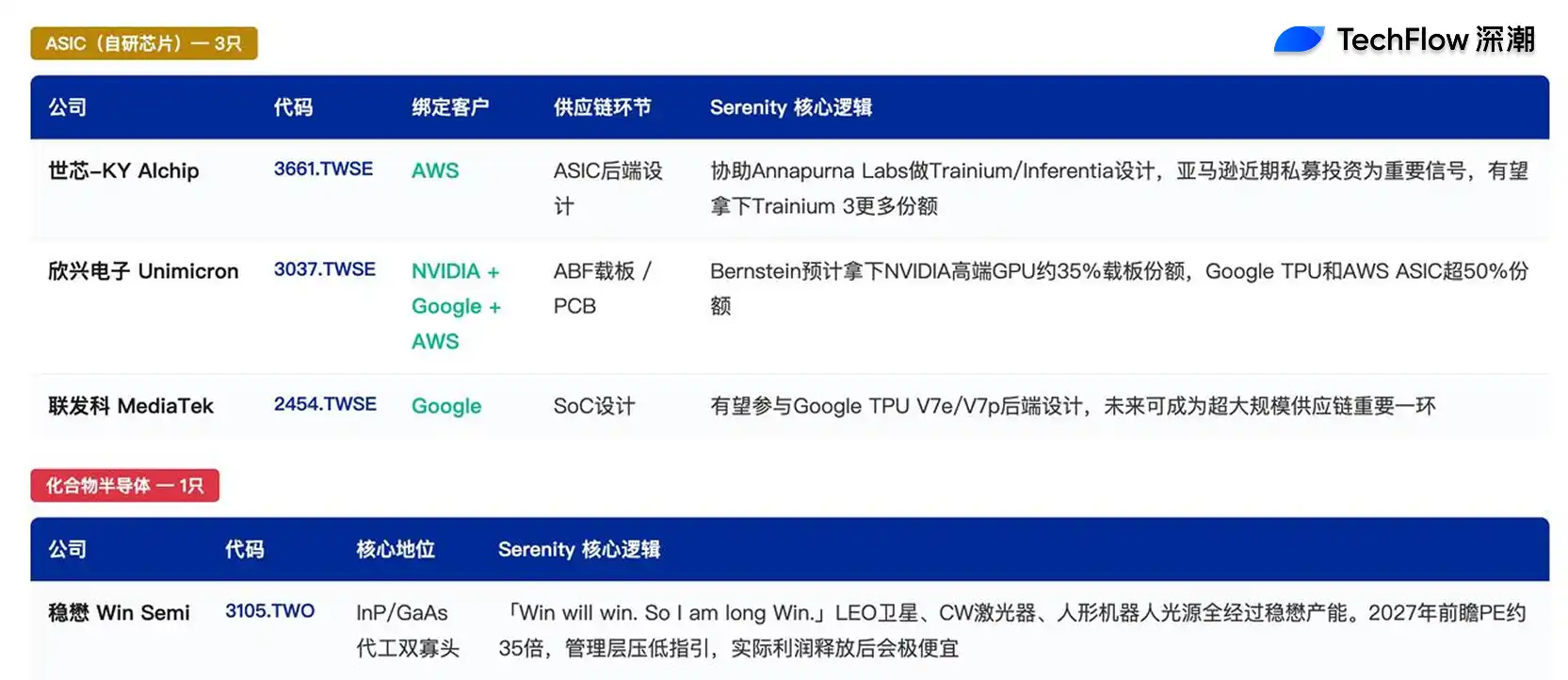
Alchip (3661.TWSE) is the most representative stock on this line. Founded in 2003 and headquartered in Taipei, Alchip specializes in advanced CMOS ASIC design and manufacturing. According to industry chain data compiled by Global Tech Research, Alchip primarily assists Amazon's Annapurna Labs with backend design for the AWS Trainium and Inferentia chip series. Current projects include Trainium 1 and Inferentia 2. Serenity recently stated that Alchip is expected to gain more market share in the design of AWS Trainium 3, especially as Amazon's recent private investment in Alchip is interpreted by the market as a significant signal. Alchip's collaboration with Ayar Labs in the CPO field also represents further expansion of its potential market.
Unimicron (3037.TWSE) is an ASIC beneficiary from the perspective of ABF substrates and PCBs. According to Gotrade News citing Bernstein's May 4th research report, Unimicron is expected to secure about 35% of the ABF substrate share for NVIDIA's high-end GPUs and over 50% share for ASIC chips like Google TPU and AWS Trainium. Bernstein listed TSMC and Unimicron as "the two most representative Taiwanese stocks in the Asian market's AI Capex cycle." Unimicron's Q1 2026 revenue grew 8% quarter-over-quarter, with a gross margin of 18%.
News of MediaTek's (2454.TWSE) collaboration with Google on TPUs is already widely circulated in the market. According to Global Tech Research analysis, MediaTek may participate in providing backend design support for future Google TPU V7e/V7p. Serenity recently noted that while some of this positive news is already partially reflected in the stock price, he believes MediaTek's future ASIC business growth is still worth continuous attention. In the coming years, MediaTek has the opportunity to become an extremely important part of the hyperscale supply chain for major US cloud providers.
These three Taiwanese companies bind to the core segments of hyperscalers' self-developed chips from three different dimensions: design services, substrate packaging, and SoC design.
Win: The Undervalued InP/GaAs Duopoly
Serenity's most resolute and explicitly stated holding among Taiwanese stocks is Win Semiconductor (3105.TWO).
Win is one of the world's leading compound semiconductor foundries, forming a duopoly with GlobalFoundries in InP (Indium Phosphide) and GaAs (Gallium Arsenide) foundry services. The market's traditional impression of Win comes from its relationship with the SpaceX Starlink and Broadcom (AVGO) supply chains.
Serenity's recent statement on X was: "Win will win. So I am long Win." Serenity's core judgment is that Win is one half of the InP and GaAs foundry duopoly. Future products for LEO (Low Earth Orbit) satellites like SpaceX Starlink, Continuous Wave (CW) lasers, and vision/radar light sources for humanoid robots will all utilize Win's foundry capacity.
He provided a valuation estimate: Win's forward P/E for 2027 is around 35x. While this may not seem cheap, he believes "management is intentionally guiding earnings low; the P/E will appear extremely cheap after actual profit realization." Win's business of assisting silicon photonics companies in expanding laser mass production capabilities is the future core growth engine in Serenity's view, and this part is not yet fully priced in by the market.
InP is the segment where Serenity first established a position in a US stock, AXTI, which he termed a "Hormuz Strait" type of investment. He compares InP substrates to "the oil of the future AI optical communication era." Win's position in Taiwanese stocks is the downstream foundry node of this industry chain.
Segments Serenity Did Not Mention But Essential for the Full Picture: Upstream Materials, Energy, Liquid Cooling
Serenity's 9 named Taiwanese stocks are concentrated in the midstream segments of CPO and ASIC. For a complete view of Taiwan's AI industry chain, upstream materials and downstream energy/liquid cooling sectors are equally indispensable. Serenity did not directly cover this part in his public remarks, but it cannot be omitted for a full understanding.
On the upstream materials side, TSMC itself (TSMC, 2330.TWSE) is the central node of the entire picture. According to Bernstein forecasts, TSMC's earnings will grow about 40% in 2026, with a compound annual growth rate of about 20% for 2027-2028; the company has set its 2026 capital expenditure guidance at the high end of the $52-56 billion range. In the upstream transmission chain of AI Capex, TSMC is both an amplifier and a throttle. Its capital expenditure direction directly determines the order rhythm for all downstream Taiwanese stocks in packaging & testing, substrates, inspection, connectors, etc.
On the energy and liquid cooling side, Taiwanese AI data centers are facing tangible power supply pressure. According to Reccessary's December 2025 report citing Taipower System Planning Director Yi Xuquan, global key grid equipment like transformers and gas turbines are in short supply. Gas turbine delivery lead times have extended from 2-3 years to 7-8 years, with prices doubling, and "grid construction speed simply cannot keep up." This supply-side bottleneck has created structural opportunities for three key Taiwanese stocks.
First, Delta Electronics (2308.TWSE), as the power management and integrated liquid cooling solution leader, has penetrated both the white space (IT computing) and grey space (power & cooling) scenarios of AI data centers. Second, AVC (3017.TWSE) is a global leader in thermal solutions, covering a full stack of technologies from cold plate liquid cooling to immersion cooling. Lastly, Auras Technology (3324.TWSE) focuses on liquid cooling module manufacturing and is a tier-1 supplier to NVIDIA. According to Goldman Sachs predictions, the global server cooling total addressable market will grow 111%, 77%, and 26% in 2025-2027, respectively, reaching $17.6 billion in 2027. This growth curve is synchronized with the CPO growth curve within the AI capital expenditure cycle.
The Real Risk is Not Cross-Strait Relations, But Hyperscale Cloud Service Providers' Capital Expenditures
Serenity's judgment on the overall risk of Taiwan's AI industry chain differs from the mainstream market narrative.
He recently stated that Taiwan's AI supply chain currently does not have a bubble, and the valuations of many Taiwanese companies are still relatively low compared to their US Nasdaq counterparts; geopolitical risks are overly amplified by the market because Taiwan is already an indispensable part of the global technology supply chain, and "no country would choose a zero-sum, large-scale supply chain disruption." Looking 7-10 years ahead, the US is building a domestic supply chain through companies like Intel, but there is no particularly significant systemic risk in the next 2-3 years.
He pointed out that the real risk worth tracking is the capital expenditures of hyperscale cloud service providers. The continuous expansion of investments by large cloud providers like Microsoft, Amazon, Google, Meta, and Oracle is the core driver of the current AI industry boom. "As long as these companies continue to increase AI infrastructure construction, Taiwan's supply chain will continue to benefit; but if hyperscale cloud service providers start cutting capital expenditures, Taiwan's AI supply chain may experience a relatively significant valuation adjustment."
Initial signs of a "stress test" for this judgment are beginning to appear.
Recent marginal changes in the market are worth noting as tracking clues. On June 3rd, Broadcom announced its Q2 FY2026 results. The Q3 FY2026 guidance for AI chip revenue was $16 billion, approximately $1.2 billion below the LSEG-compiled sell-side consensus estimate of $17.2 billion. Broadcom CEO Hock Tan also maintained the full-year AI semiconductor revenue guidance of $56 billion without raising it. The market interpreted the "lack of an upward revision" negatively. On June 5th, the Philadelphia Semiconductor Index (SOX) plunged 10.26%, its largest single-day drop since March 2020. On the same day, South Korea's KOSPI fell 5.54%, and on June 8th, KOSPI opened down 8.37%, triggering a trading halt.
However, the key reference point to watch currently is TSMC's 2026 capital expenditure, locked at the high end of the $52-56 billion range, showing no substantial reduction yet. The capital expenditure guidance from hyperscale cloud service providers themselves also remains on an upward revision track. Whether Serenity's predicted "real risk" is triggered depends on the capital expenditure guidance from Microsoft, Amazon, Google, Meta, and Oracle in their Q2 and Q3 2026 earnings reports. This is the core premise for the validity of Serenity's Taiwanese stock list and the most important marginal variable to track in the next quarter.