OpenSea Launches ERC-8257: A Tool Store for AI Agents, Unlock APIs by Buying an NFT

marsbit发布于2026-05-27更新于2026-05-27

文章摘要

OpenSea has merged the ERC-8257 standard, an on-chain "Agent Tool Registry" that enables AI Agents to autonomously discover, pay for, and access tools. This standard allows developers to publish tools with programmable access rules (e.g., NFT ownership, subscriptions) and pricing directly on-chain. For example, an AI Agent needing a premium API can buy the required NFT itself and gain access without human intervention, turning NFTs into keys for the agent economy. The system works with complementary standards like ERC-8004 for agent identity and x402 for payments. A live demo shows an NFT appraisal tool offering discounted rates to holders of a specific NFT collection. ERC-8257 aims to decentralize tool distribution and access control, allowing any on-chain asset to grant utility to AI agents. The SDK is available for building on Ethereum and Base.

Author: OpenSea

Compiled by: TechFlow

TechFlow Introduction: When an AI Agent is denied by an API due to insufficient permissions, it goes and buys an NFT on-chain, then retries and succeeds — this is not science fiction; OpenSea's newly merged ERC-8257 standard makes this a reality. For NFT holders, the JPGs you own might suddenly become keys to the Agent economy. For developers, tool publishing, pricing, and access control are all placed on-chain, no longer requiring endorsement from centralized platforms.

App Store provides developers with a place to publish tools, users with a place to browse, and built-in access control and payment. The AI Agent tool ecosystem requires similar infrastructure.

But today, Agent tools are scattered across documentation, GitHub repositories, and centralized directories. There is no open tool registry, no standardized access control, and Agents cannot browse available tools and acquire them as needed.

Watching a software pay another software autonomously for access, with no human intervention — it feels a bit strange indeed. But that's precisely the point.

ERC-8257: Agent Tool Registry is the foundational layer that makes all this work. This is the newly merged open Ethereum standard: an on-chain registry where anyone can publish tools, declare access rules and pricing, allowing Agents to autonomously meet these requirements.

For Tool Developers: Publish once, set access thresholds for your NFT holders, offer subscription packages, limit seat counts, let them trade in open markets. Your rules, executed on-chain.

For Agents: Browse the registry, see what's required, then handle it. Purchase an NFT, mint a subscription, sign a payment. No human intervention needed.

Imagine This Scenario

An AI Agent is helping you evaluate NFT prices. It tries to call a professional pricing tool. The tool responds: Access denied, you need to hold a specific NFT for a discounted price. The Agent immediately buys one on-chain, retries, and gets the answer.

Seconds, not days. No human involvement throughout.

This is the world ERC-8257 makes possible. Not five years from now. Today.

Why On-Chain?

Crypto is the only infrastructure that allows access rules to be both rich and self-service. x402 proved it: pay-per-call, immediate access. But pay-per-call is just one form of access. Trading signals might need limited seats. Partner APIs might be open only to holders. Research subscriptions might require tiered pricing. ERC-8257 handles it all.

How It Works

You register a tool with a manifest (tool functions, invocation methods, fees) and an "access predicate." The access predicate is a smart contract that answers one question: Does this address have access?

A predicate can check any condition: NFT ownership, active subscription (ERC-5643), whitelist, ZK proof, DAO vote, staking amount. Predicates are pluggable, following the same pattern as Seaport zones and Uniswap v4 hooks: an extension point, an open design space.

ERC-8257 handles discovery and access control. Payment is handled by the most suitable protocol: x402 for micropayments, MPP for metered billing, others join as needed. These layers are composable.

What This Means for NFTs

Every NFT collection just gained new potential utility.

Hold the right token, and your Agent gets cheaper API packages. Mint a limited seat, and your Agent gains access that others can't buy at any price. PFP collections, membership passes, CC0 artwork — any on-chain asset can become a key to tools your Agent needs to do its job.

Projects built around community identity now have a way to extend membership into the Agent economy.

Its Place in the Tech Stack
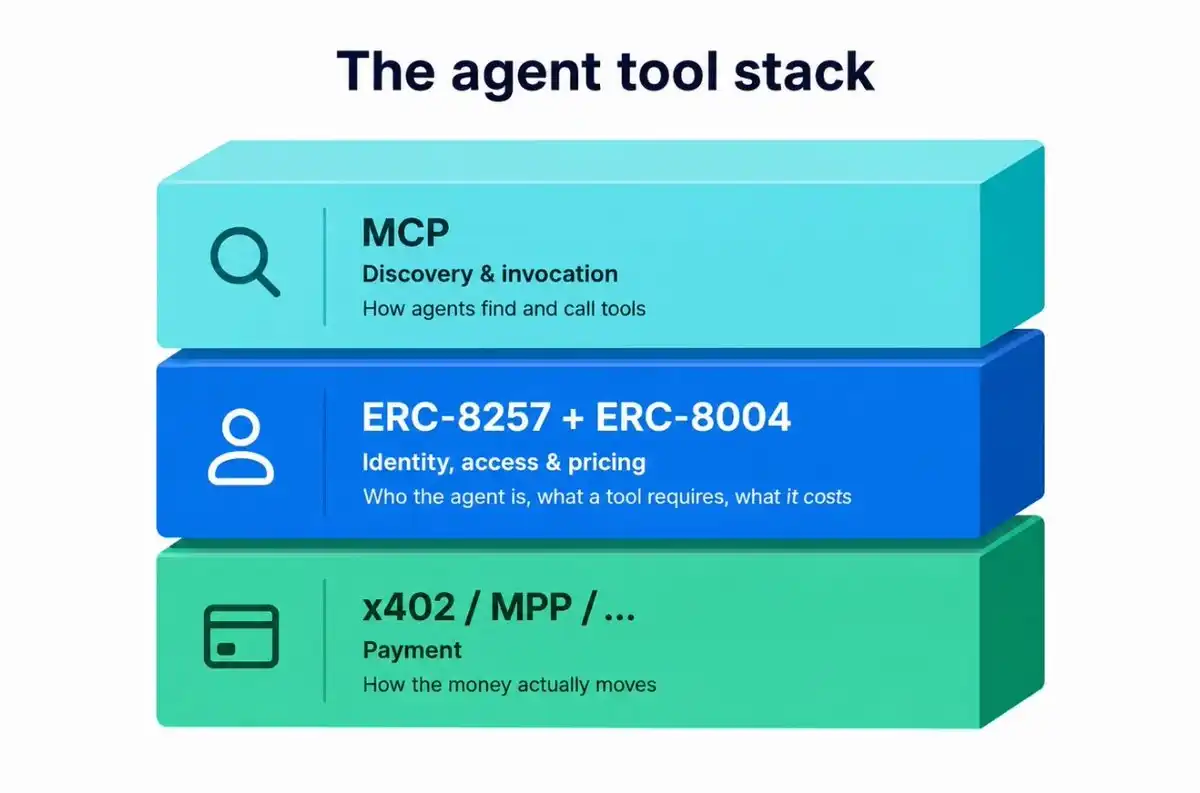
MCP tells your Agent what tools exist. ERC-8004 defines your Agent's identity. ERC-8257 explains how to actually use a tool. x402 handles payment. Each layer is composable.

An Agent registered via ERC-8004 can link to restricted tools from the ERC-8257 registry in its services array. You don't need to choose between them. They are different layers of the same tech stack.

See It in Action

nft-appraisal-tool: Point it to any NFT, it returns a price appraisal including low/mid/high ranges, confidence, recent trades, and comparable cases. Two tiers: 0.05 USD/call for anyone, 0.01 USD/call for CHONK holders on Base.

An Agent without CHONK calls the holder endpoint. Response: 403 — predicate gate denied. You need CHONK on Base.

The Agent buys one, retries, and the same call returns success.

$ npx @opensea/tool-sdk pay https://nft-appraisal-tool.vercel.app/api/holder --auth siwe \

--body '{"chain":"ethereum","contractAddress":"0x79fcdef22feed20eddacbb2587640e45491b757f","tokenId":"4707"}'

Wallet: 0x3184...0465

Response (403):

{"error":"Predicate gate: access predicate denied","toolId":"2","predicate":"0xc872..."}

The predicate explicitly tells it what's needed: CHONK on Base. The Agent buys one on OpenSea and retries, the call goes through.

$ npx @opensea/tool-sdk pay https://nft-appraisal-tool.vercel.app/api/holder --auth siwe \
--body '{"chain":"ethereum","contractAddress":"0x79fcdef22feed20eddacbb2587640e45491b757f","tokenId":"4707"}'
Wallet: 0x5eca...e2a8

Response (200):
{
"low": {"amount": "1.8", "currency": "ETH", "usd": 5460},
"mid": {"amount": "2.3", "currency": "ETH", "usd": 6970},
"high": {"amount": "3.1", "currency": "ETH", "usd": 9400},
"confidence": "medium",
"reasoning": "Comparable Squiggles in this color band sold between 1.9 and 2.6 ETH...",
...
}

No human between the 403 and the 200. Whoever holds the access NFT has the access.

What Can Be Built Next?

Professional pricing oracles. On-chain analytics subscriptions. Research subscriptions. Partner whitelist APIs. Limited-seat tools traded in open markets like any other asset.

None of these needed to exist a year ago. The moment the registry goes live, they all become possible.

Start Building

Live on Ethereum and Base.

@opensea/tool-sdk handles the low-level details, providing scaffolding, gating, registration, deployment to Vercel, Cloudflare, or Express. Includes usable examples.

npx @opensea/tool-sdk init my-tool

Full specification at 8257.ai.

Get Involved

ERC-8257 is still in draft. Help us improve the spec before we launch Registry 1.0. Publish a tool, even a small one. We'll promote interesting projects.

Join the Telegram group t.me/ERC8257 to discuss ERC, tool SDK, and more with the authors @CodinCowboy and @ralxz.

Disclaimer: This content is for informational purposes only and does not constitute financial or trading advice. Mention of specific projects, products, services, or tokens does not constitute endorsement, sponsorship, or recommendation by OpenSea. OpenSea does not guarantee the accuracy or completeness of the information presented, and readers should independently verify any statements before taking action. Readers should conduct their own due diligence and assume full responsibility for any decisions made.


相关问答

QWhat is the main purpose of ERC-8257 introduced by OpenSea?

AThe main purpose of ERC-8257 is to serve as an on-chain registry for AI agent tools. It allows developers to publish tools, set access rules (like requiring a specific NFT for access), define pricing, and manage subscriptions. This enables AI agents to autonomously discover, pay for, and use these tools without human intervention.

QHow does an AI agent gain access to a restricted tool according to the article's example?

AIn the article's example, an AI agent is initially denied access (403 error) to an NFT appraisal tool because it lacks the required CHONK NFT on Base. The agent autonomously purchases the necessary NFT on-chain and retries the request. With the NFT now in its possession, the access predicate grants permission, and the tool call succeeds (200 response), providing the price assessment.

QWhat is an 'access predicate' in the context of ERC-8257?

AAn 'access predicate' in ERC-8257 is a smart contract that defines the conditions for accessing a tool. Its sole function is to answer the question: 'Does this address have access?' It can check for various conditions such as NFT ownership, active subscriptions (e.g., ERC-5643), inclusion in a whitelist, ZK proofs, DAO votes, or staking amounts, making the access control system flexible and pluggable.

QHow does ERC-8257 potentially change the utility of existing NFTs?

AERC-8257 gives existing NFT collections new potential utility by allowing them to act as keys or passes for AI agent tool access. Holding a specific NFT could grant an agent discounted API rates, exclusive tool access, or membership privileges. This extends the value of PFP collections, membership passes, and other on-chain assets into the emerging agent economy.

QWhat role does the x402 protocol play in the ERC-8257 ecosystem?

AThe x402 protocol handles the payment layer within the ERC-8257 ecosystem. It is designed for micro-payments, enabling per-use, immediate payment for tool access. While ERC-8257 manages tool discovery and access control, x402 (alongside other protocols like MPP for metered billing) provides the financial infrastructure for agents to autonomously pay for the services they consume.

你可能也喜欢

Sharplink CEO:百万以太坊开发者,谁与争锋?

以太坊生态系统迎来重要里程碑:终身开发者数量突破100万,达到1,012,824位,其中过去一年活跃者约23.2万。这一庞大且持续增长的技术人才库,构成了以太坊最核心的竞争优势。 文章指出,加密领域的核心问题并非链上速度,而是“最优秀的建设者选择在哪里长期构建”。以太坊凭借十年来积累的开发者生态、基础设施、标准、工具及流动性,已成为可编程金融和互联网原生资本形成的默认操作系统。其优势体现在制度、文化、经济与可组合性等多个层面。 当前,开发者们正专注于构建行业最前沿且高难度的基础设施,包括:提升核心协议可扩展性的Glamsterdam升级、实现Rollup间高效协同的“同步可组合性”,以及为应对未来威胁而领先布局的“抗量子计算”能力。 此外,以太坊的护城河还在于其深度的可组合性(应用像乐高积木一样互操作)、被广泛采纳的EVM标准与Solidity技能,以及由超过90万验证者保障的“可信中立性”。这些因素共同吸引了最顶尖的研究人员与大型金融机构,并推动了一个自我强化的飞轮:更多开发者带来更多工具与流动性,进而吸引更多建设者。 作者通过与亚洲以太坊社区的交流,深切感受到当地建设者的严谨与雄心,并确信以太坊作为全球金融互联网底层操作系统的领先地位正因其庞大的开发者生态而持续巩固。

Odaily星球日报26分钟前

Sharplink CEO:百万以太坊开发者,谁与争锋?

Odaily星球日报26分钟前

以太坊达成百万开发者里程碑,Sharplink CEO 深挖以太坊未来可能性

以太坊累计开发者总数已突破101万,其中约23.2万人在过去一年保持活跃,这使其拥有加密领域最大且持续增长的技术人才库。Sharplink CEO Joseph Chalom强调,以太坊的核心优势并非单纯的交易性能,而在于它汇聚了顶尖开发者并构建了深厚的护城河。 当前,开发者正致力于推进底层协议扩容、隐私技术、抗量子安全以及智能自主系统等关键领域。例如,计划于2026年进行的Glamsterdam升级将通过ePBS和BALs等机制提升网络吞吐量与安全性。同时,同步可组合性技术旨在让数十条Rollup像单一公链一样无缝协作,解决生态割裂问题。在抗量子安全方面,以太坊已成立了专项小组并运行测试网,目标是于2029年完成迁移,这使其在面向未来的安全准备上领先于其他公链。 以太坊的护城河还体现在其极致的可组合性、统一的行业标准(如EVM和Solidity)以及由此形成的强大网络效应。此外,其可信中立性(拥有超90万验证节点)、模块化架构以及由顶尖人才定义的行业生态文化,共同构成了难以复制的竞争优势。 Chalom总结道,以太坊正从创造短期链上活跃度,转向成为全球原生金融的协调底层,并获得了寻求安全、信任与流动性的主流金融机构的认可。其资源向统一标准、充足流动性和开发者共识集中的趋势,正使其护城河不断加固。

Foresight News38分钟前

以太坊达成百万开发者里程碑,Sharplink CEO 深挖以太坊未来可能性

Foresight News38分钟前

交易

现货
合约

热门文章

什么是Altura NFT ?

成长学院:学习“Altura NFT“ ,瓜分5000 USDT代币奖励

5.9k人学过发布于 2024.06.11更新于 2024.06.12

什么是Altura NFT ?

GoMining: NFT让比特挖矿变得更简单

GoMining NFT(也称为数字矿机或NFT矿机)提供了一种由特定数量算力(以TH为单位)支持的智能且可扩展的解决方案。

6.1k人学过发布于 2024.07.15更新于 2024.07.15

GoMining: NFT让比特挖矿变得更简单

什么是 AINFT

EternaFi 代理与 $AINFT:Web3 生态系统中 AI 驱动的 NFT 基础设施的全面分析 人工智能(AI)与区块链技术的交汇点正在迅速发展,建立创新平台,重新定义所有权模型和经济参与。EternaFi 代理及其原生代币 $AINFT 体现了通过非同质化代币(NFT)对 AI 基础设施进行代币化的突破性方法。该项目由 Nova Club 的开发团队于 2025 年 7 月推出,EternaFi 将 AI 的进步与区块链的去中心化金融机制相结合,为 Web3 生态系统内的参与者提供了独特的投资机会。本文旨在对 EternaFi 代理进行深入评估,涵盖其核心组成部分、功能及其在加密领域的重要性。 介绍与项目概述 EternaFi 代理是区块链技术如何民主化访问先进 AI 能力的显著例子。该项目旨在通过多样化经济参与,重塑 AI 所有权的范式,使复杂的 AI 系统能够被更大范围的利益相关者所接触。项目的核心是对 Nova Club 开发的专有大型语言模型(LLM)进行代币化,使 NFT 持有者能够获得该模型经济表现的部分收益。 通过利用代表 LLM 权益的 NFT,EternaFi 代理促进了一种模式,使利益相关者不仅参与 AI 服务的消费,还能分享平台所产生的经济回报。这种变革性的方法使 AI 服务的发展能够建立可持续的收入模型,同时促进广泛的社区参与并促进透明的治理。 什么是 EternaFi 代理? EternaFi 代理代表了一个 AI-NFT 基础设施项目,旨在将 AI 的能力与区块链技术融合在一个连贯的生态系统中。该项目的基本特征是创建作为金融工具的 NFT,代表 Nova Club 专有 AI 基础设施的所有权份额。每个 NFT 象征着对基础 AI 系统经济表现的直接接触,为投资者提供了丰厚的机会。 该项目运行在 Base 区块链 上,以其可扩展性和高效性而闻名,从而确保可管理的交易成本,同时促进无缝的操作体验。一个显著的特点是收入分享机制,NFT 持有者可以获得由平台提供的 AI 服务所产生的部分订阅收入。这种创新的方法在 AI 服务的成功与分配给持有者的经济红利之间建立了联系,从而确保社区内利益的一致性。 EternaFi 代理的创造者是谁? EternaFi 代理的创作力量是 Nova Club,一个位于新加坡的开发团队,擅长将 AI 和区块链技术结合在一起。他们在 AI 开发和加密货币分析方面的先前经验为该项目增添了可信度,为 EternaFi 代理的创建贡献了广泛的专业知识。Nova Club 的使命是民主化对尖端 AI 技术的访问,同时建立可持续的经济模型,使用户和开发者都能受益。 他们对透明度、社区治理和创新的承诺体现在 EternaFi 平台的设计和实施中,旨在建立一个独特的生态系统,促进积极的参与和长期价值创造。 EternaFi 代理的投资者是谁? 关于支持 EternaFi 代理的投资者或投资组织的具体细节并未公开。然而,EternaFi 通过向公众出售 NFT 采取了包容性的方法来资助其开发,允许各种参与者投资于该生态系统。该项目的架构确保核心基础设施得到负责任的资金支持,同时允许社区成员参与 AI 服务所产生的所有权和经济回报。 这种模式通过使投资者和项目开发者的利益一致,强调了社区参与,创造了一个鼓励长期参与的合作环境。 EternaFi 代理是如何运作的? EternaFi 代理通过一个多层次的生态系统运作,其中 NFT 作为项目内所有权表示的主要手段。每个 NFT 持有者有权分享由基础 AI 驱动的平台产生的每月订阅收入,从而将 NFT 所有权定位为一种丰厚的投资工具。 收入生成机制 EternaFi 平台的主要收入来源于与提供的 AI 服务相关的订阅费用。用户可以访问各种分级服务,从基本市场分析工具到全面的 AI 辅助交易解决方案。这些服务被货币化,并形成收入分享框架的基础,通过自动化智能合约将利润分配给 NFT 持有者。 EternaFi 生态系统的一个创新特点是透明的收入分享机制,确保奖励根据 AI 平台运营的可验证指标进行分配。这在 AI 服务的表现与社区投资者可获得的回报之间建立了直接联系,从而建立了可持续的经济模型。 质押和归属机制 EternaFi 的参与者可以通过质押他们的 NFT 来解锁额外的经济利益。归属计划旨在促进参与者的长期承诺,奖励那些持续支持项目的人。这确保了利益的一致性,并培养了实现项目长期目标所必需的社区参与感。 透明治理 EternaFi 代理拥抱去中心化治理,允许 NFT 持有者在平台的发展和未来方向的决策中发挥积极作用。治理结构包括社区投票机制,为 NFT 持有者提供了影响重大决策的机会,促进了项目增长的合作方式。 EternaFi 代理的时间线 EternaFi 代理的发展轨迹展示了在满足社区参与者需求的同时,建立可持续 AI 基础设施的系统化方法。以下是该项目历史上重要里程碑的时间线: 2025 年 7 月: EternaFi 代理的推出,包括 NFT 的公开销售和 $AINFT 代币在 Base 区块链上的部署。 2025 年第四季度: 建立市场基础设施,包括流动性池和为 NFT 持有者推出质押仪表板。 2026 年: 启动社区参与计划,扩展 AI 能力,并与跨链技术集成。 2026 年第四季度: 实施红利分配系统,使 NFT 持有者能够从其投资中获得经济利益。 这些里程碑标志着专注于建立一个功能性和参与性生态系统,同时确保持续演变以满足市场需求。 技术基础设施与区块链集成 EternaFi 代理基于一个先进的技术框架,将 AI 系统与区块链能力相结合。该项目运行在 Base 区块链上,利用可扩展性和低交易成本的优势。基础智能合约架构管理 NFT 所有权、收入分享和社区管理功能,确保效率和透明度。 AI 系统开发 支撑 EternaFi 代理的专有大型语言模型是独立开发的,旨在满足无需依赖外部专有框架的收入生成应用。这一努力反映了创建一个多功能和适应性强的 AI 基础设施的承诺,能够为用户提供有意义的服务,从而为投资者创造经济价值。 安全措施 EternaFi 安全基础设施的稳健性至关重要。定期审计和严格的安全措施确保 AI 系统和区块链机制的完整性,保护免受潜在漏洞的影响,同时增强参与者的信心。 结论 EternaFi 代理在人工智能和区块链技术领域标志着一项创新,开启了社区所有权和经济参与先进 AI 能力的途径。该项目通过 NFT 对 AI 基础设施进行代币化的全面策略为未来的去中心化生态系统树立了先例。 通过将技术复杂性与以用户为中心的经济模型相结合,EternaFi 不仅促进了参与,还为社区参与者生成了可持续的收入分享框架。EternaFi 的重要性远不止于其运营成功,它还展示了区块链如何民主化尖端 AI 技术,为未来在这一交叉领域的冒险铺平道路。 EternaFi 代理的演变可能预示着一个新的 AI 发展时代的到来,特征是参与者驱动的治理、可持续的经济模型和透明的验证,最终有助于更广泛地民主化 AI 和技术在各行业的可及性。

1.8k人学过发布于 2025.08.14更新于 2025.08.14

什么是 AINFT

相关讨论

欢迎来到HTX社区。在这里,您可以了解最新的平台发展动态并获得专业的市场意见。以下是用户对NFT(NFT)币价的意见。

活动图片