Qubic Starts Dogecoin Mining Phase 2, Shifting Rewards Away From XMR

bitcoinist发布于2026-04-16更新于2026-04-16

文章摘要

Qubic has entered phase 2 of its Dogecoin mining rollout, shifting miner rewards from Monero (XMR) to DOGE-based incentives. Starting with epoch 209, computors can operate in either XMR or DOGE mode, with only the higher-yielding contribution counted per index—effectively phasing out XMR if DOGE is more profitable. All block rewards are used for QUBIC buybacks, which are then distributed proportionally based on Dogecoin shares submitted. This transition, part of a three-phase plan announced in March, aims to fully migrate from XMR to DOGE, allowing parallel operation of DOGE mining (via Scrypt ASICs) and AI training (on CPUs/GPUs). Phase 2 introduces weekly reward windows, aligning with Qubic’s goal of scaling toward full-capacity dual-workstream operations.

Qubic has moved its Dogecoin mining rollout into phase 2, a step that begins redirecting miner economics away from Monero and toward DOGE-linked rewards. For Qubic, the change matters because phase 2 is where the migration stops being a live test and starts becoming a real incentive shift.

In an April 15 Discord update shared on X by community member Rayyan, Qubic tech lead Joetom said phase 2 began with epoch 209 and that, from this point, “each computor can operate in either legacy XMR mode or Doge mode.” He added: “For every computor index, only one contribution is counted: max(XMR, DOGE). This effectively replaces XMR participation if Doge yields a higher contribution. No dual counting.”

Qubic Activates Dogecoin Phase 2

The move lines up with the transition plan Qubic published ahead of launch. In its March 27 rollout note, the team described a three-phase migration from XMR to DOGE. Phase 1 was a testing period in which XMR revenue remained intact while Dogecoin mining ran on mainnet in a non-rewarded validation mode.

Phase 2 was framed as the decision point, where computors could opt into DOGE rewards while XMR began phasing out. Phase 3 is the end state: XMR removed, DOGE running at full production, and Qubic’s CPU and GPU resources returned to full-time AI training.

That broader architecture is central to Qubic’s pitch. Under the old model, the network alternated between Monero hashing and AI-related work. With Dogecoin, Qubic says the jobs can run in parallel because DOGE mining relies on Scrypt ASICs, while the network’s AI training stack runs on CPUs and GPUs. The result, in Qubic’s telling, is a cleaner division of labor and a path toward running both workstreams at full capacity rather than splitting general-purpose compute between them.

Joetom’s April 15 message also clarified how rewards are now being routed. “All block rewards are used for Qubic buybacks,” he wrote. “The acquired Qubic is distributed proportionally based on delivered Doge shares.”

He then outlined how accounting will evolve as the system scales: “Target state is a daily reward window from 12:00 to 12:00 UTC. All blocks mined within a window are allocated to shares submitted within the same window. Phase 2 starts with a weekly window aligned to epochs.”

That mechanism fits the buyback structure Qubic had already outlined publicly. The network has said DOGE mined through its system is sold, the proceeds are used to buy back QUBIC, and those tokens are then distributed to participants based on contribution.

The timing also tracks the roadmap. Qubic launched Dogecoin mining on April 1 and said the full migration from Monero would likely play out across roughly four weeks, with phase lengths flexible depending on stability and network conditions. Phase 2 arriving in mid-April suggests that schedule is broadly holding, even if reward windows and other parameters remain adjustable.

At press time, DOGE traded at $0.09618.
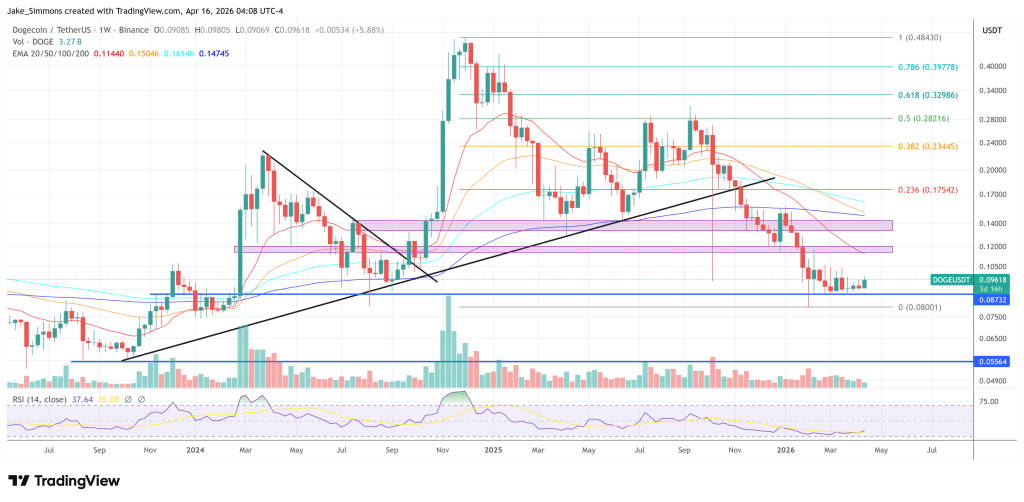
DOGE holds above key support, 1-month chart | Source: DOGEUSDT on TradingView.com

热门币种推荐

相关问答

QWhat is the main change introduced in Qubic's Dogecoin mining phase 2?

APhase 2 begins redirecting miner economics away from Monero (XMR) and toward DOGE-linked rewards, allowing computors to operate in either legacy XMR mode or Doge mode, with only the higher-yielding contribution being counted.

QHow does Qubic's reward distribution mechanism work in the new Dogecoin mining system?

AAll Dogecoin block rewards are used for Qubic buybacks. The acquired QUBIC tokens are then distributed proportionally to participants based on the Doge shares they delivered.

QWhat is the stated benefit of switching from Monero to Dogecoin mining for the Qubic network?

AThe switch allows Dogecoin mining (which relies on Scrypt ASICs) and AI training (which runs on CPUs and GPUs) to operate in parallel, creating a cleaner division of labor and enabling both workstreams to run at full capacity instead of splitting general-purpose compute between them.

QWhat are the three phases of Qubic's migration from XMR to DOGE mining?

APhase 1 was a testing period with XMR revenue intact. Phase 2 is the decision point where computors can opt into DOGE rewards while XMR phases out. Phase 3 is the end state with XMR completely removed and DOGE running at full production.

QHow does the reward window system work in the target state of phase 2?

AThe target state is a daily reward window from 12:00 to 12:00 UTC. All blocks mined within a window are allocated to shares submitted within that same window, though phase 2 starts with a weekly window aligned to epochs.

你可能也喜欢

比特币八月行情:专家预计将测试价格区间,而非快速反转

比特币在八月可能继续承压,分析师预计市场将测试关键区间而非快速反转。七月比特币从多年低点反弹,但专家认为持续上涨条件尚不成熟,价格仍有跌至6万美元以下的风险。截至七月底,比特币交易于约6.35万美元,较2025年10月的历史高点下跌约50%。市场目前处于6万至6.5万美元的窄幅区间内。 分析师指出,高利率、持续通胀、强势美元以及石油价格等因素共同构成不利的宏观经济背景,压制了比特币价格。此外,美国国债等传统资产的高收益率吸引了部分资金,而加密货币ETF资金持续流出(上半年净流出54亿美元),显示机构需求疲软。 从历史数据看,八月通常是加密货币的弱势月份。专家认为市场可能正处于新周期开始前的最后阶段,建议投资者可考虑逐步积累仓位,但需警惕短期波动。 主要预测场景如下: - 基本情况(50%概率):在5.8万至6.8万美元区间震荡。 - 负面场景(30%概率):跌破5.8万美元,下探5万至5.5万美元。 - 正面场景(20%概率):突破6.7万美元,目标看向7.1万至7.5万美元。 关键支撑位在6万至6.1万美元附近,而稳定在6.7万美元上方可能打破下跌趋势。部分分析师认为,即便反弹至7万美元,也可能出现新一轮下跌,长期目标位指向约5.3万美元区域。多数观点认为,更显著的趋势性行情可能需等到今年第四季度。 投资者在八月需密切关注利率、通胀数据、ETF资金流、市场风险偏好以及主要参与者的动向,这个月可能更多是对耐心的考验,而非实现重大突破的时机。

cryptonews.ru3小时前

比特币八月行情:专家预计将测试价格区间,而非快速反转

cryptonews.ru3小时前

Coldcard硬件钱包被黑:黑客在25分钟内转走594枚比特币

硬件钱包Coldcard遭黑客攻击:25分钟内损失594枚比特币 硬件钱包长期以来被认为是存储数字货币最安全的方式,但Coinkite公司设备近期发生的事件迫使许多人重新审视这一观点。2026年7月30日,攻击者在短短25分钟内从500个地址转走了594.5枚比特币(约合4000万美元)。 问题的根源在于一个潜伏了五年的软件代码错误。Coldcard本应通过安全芯片生成真随机数来创建种子短语,但由于一个宏定义中的笔误,Coinkite的开发者早在2021年3月就意外禁用了此功能。这导致设备转而基于可预测的数据(如处理器序列号和内部系统时钟)生成密钥,使得生成的种子短语看似安全,实则因生成过程可预测而极易被破解。对于Mk2和Mk3型号,密钥搜索空间骤降至约40位,而更新的Mk4、Mk5和Q型号的最终熵值也仅为约72位,远低于所需的128位。 攻击者无需物理接触设备或进行网络钓鱼。他们仅利用了有缺陷的生成器参数,在离线状态下进行大规模枚举,生成了数百万可能的种子短语,并通过公开账本找到有余额的地址,自行签署了转账交易。 Coinkite最初声称新版本设备不受影响,但后续分析迫使公司承认所有运行受影响固件的设备均存在风险。公司负责人Rodolphe Novak已公开道歉,但排除了对受损用户进行经济补偿的可能性。 对于已创建种子短语的用户,仅更新固件无法消除风险。必须将设备更新至安全版本固件,在更新后的设备上生成全新的种子短语,并将所有资金完全转移到由此新种子短语生成的新地址。使用BIP-39标准的密码短语可降低风险,但不能替代密钥迁移。公司的其他产品如TAPSIGNER等未受此次事件影响。 此事件表明,即使是专用硬件也需要对代码进行持续独立的审计,尤其是在加密功能方面。从机器分析角度看,这与过去OpenSSL等随机数生成器缺陷长期未被发现的情况类似。开源代码理论上可通过独立审计和自动化工具加速发现此类错误,但此次漏洞潜伏五年表明理论与实践仍有差距。

cryptonews.ru3小时前

Coldcard硬件钱包被黑:黑客在25分钟内转走594枚比特币

cryptonews.ru3小时前

交易

现货

热门文章

如何购买XMR

欢迎来到HTX.com!我们已经让购买Monero(XMR)变得简单而便捷。跟随我们的逐步指南,放心开始您的加密货币之旅。第一步:创建您的HTX账户使用您的电子邮件、手机号码注册一个免费账户在HTX上。体验无忧的注册过程并解锁所有平台功能。立即注册第二步:前往买币页面,选择您的支付方式信用卡/借记卡购买:使用您的Visa或Mastercard即时购买Monero(XMR)。余额购买:使用您HTX账户余额中的资金进行无缝交易。第三方购买:探索诸如Google Pay或Apple Pay等流行支付方法以增加便利性。C2C购买:在HTX平台上直接与其他用户交易。HTX场外交易台(OTC)购买:为大量交易者提供个性化服务和竞争性汇率。第三步:存储您的Monero(XMR)购买完您的Monero(XMR)后,将其存储在您的HTX账户钱包中。您也可以通过区块链转账将其发送到其他地方或者用于交易其他加密货币。第四步:交易Monero(XMR)在HTX的现货市场轻松交易Monero(XMR)。访问您的账户,选择您的交易对,执行您的交易,并实时监控。HTX为初学者和经验丰富的交易者提供了友好的用户体验。

1.4k人学过发布于 2024.03.29更新于 2026.06.02

如何购买XMR

相关讨论

欢迎来到HTX社区。在这里,您可以了解最新的平台发展动态并获得专业的市场意见。以下是用户对XMR(XMR)币价的意见。

活动图片