Michael Saylor’s reputation for buying Bitcoin near local highs is less a timing flaw than a function of how the treasury model works, according to Metaplanet Director of Bitcoin Strategy Dylan LeClair. In an interview, LeClair argued that the apparent pattern reflects when capital markets are most open, not a deliberate effort to chase peaks.
Why Saylor Keeps Buying The Bitcoin Top
LeClair said the criticism misunderstands the mechanics behind Strategy’s buying. “The Bitcoin treasury model is very pro-cyclical,” he said. “So when times are good, generally over a four-year market or minute to minute, it’s easiest to raise capital. And so the capital markets are wide open when Bitcoin’s strong for common equity. But when it’s weak, they’re not.”
That dynamic, he said, helps explain why Strategy’s purchases often arrive when Bitcoin is already trading strongly. If the company’s stock is performing well and its enterprise value is rich relative to its Bitcoin holdings, it becomes easier and more attractive to issue equity and convert that capital into more BTC. “When we sell stock, we buy literally minute to minute,” LeClair said, referring to Saylor’s own description of the process. “So when a weekly purchase comes out, people are like, well, Strategy bought the range high again. Well, it’s like, no, the causality is reversed.”
In LeClair’s telling, Strategy is not buying strength because it wants to pay up. It is buying when its financing window is strongest. That distinction matters, especially for listed Bitcoin treasury companies whose capital-raising ability is tightly linked to sentiment, equity multiples, and market liquidity.
He said that model is now evolving. Where Strategy once relied primarily on common stock issuance and, at times, convertible bonds, LeClair pointed to the growing importance of preferred equity offerings, especially STRC, as a potential shift in how Bitcoin-linked firms fund purchases across different market regimes. The attraction is that preferreds may allow companies to keep raising capital even when Bitcoin is weak and common equity is less appealing to issue.
“The thing with STRC that’s really, really interesting is that they now have a mechanism to basically raise regardless of the market conditions,” he said. “So Bitcoin can be strong, Bitcoin can be weak. If STRC is at 100, they can raise a lot, a lot of money.” He added that Strategy had already used that structure aggressively, saying Saylor raised $1.2 billion in a week without selling MSTR.
LeClair framed that as more than a financing tweak. He described it as a new bridge between BTC exposure and pools of capital that cannot buy spot BTC or even ETFs directly. “There’s trillions of dollars of fixed income in the world that want low volatility, high yield,” he said. “And so Saylor says, okay, well, I’ll design, I’ll engineer security for you.”
That broader capital-markets angle ran through much of LeClair’s interview. While he said Metaplanet’s core BTC thesis has not changed despite the market drawdown, he acknowledged that execution has. In strong markets, treasury firms can lean on common equity fundraising. In weaker conditions, other instruments may matter more. “The ways that we navigate the capital markets have been tweaked a bit,” he said.
LeClair also suggested Strategy is becoming the marginal buyer of Bitcoin, arguing that Saylor is now purchasing more than the ETFs combined. At the same time, he said the company is improving its capital structure by issuing new securities while making its existing convertible debt less significant relative to the rest of the balance sheet. In his view, that combination is creating an increasingly powerful acquisition engine for BTC.
At press time, BTC traded at $67,639.
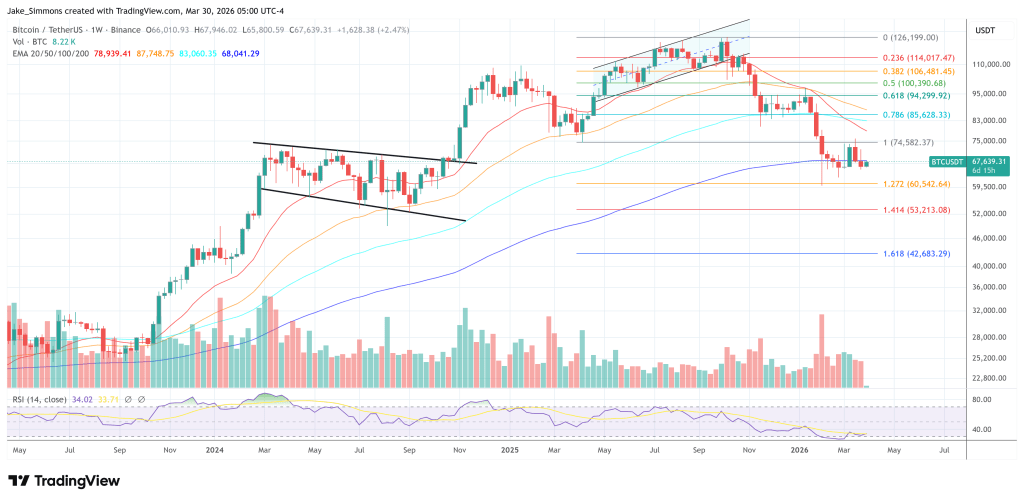
Featured image from YouTube, chart from TradingView.com