In a wide-ranging conversation with Paul Barron, Canary Capital CEO Steven McClurg laid out a blunt, three-pronged case for why spot XRP ETFs could debut with stronger demand than their Ethereum counterparts—and keep it. His core argument rests on the absence of staking yield cannibalizing ETF demand, XRP’s category leadership in traditional financial rails, and what he describes as unusually deep community and institutional interest ready to convert into flows the moment approvals land.
Why XRP Could Beat ETH From The Start
McClurg’s first point is mechanical and immediate: Ethereum’s native yield is a headwind for its ETFs; XRP has no such drag. “If you’re actually a bit more cryptonative, you’re not going to buy an ETH ETF because you can … get a 2 to 3% yield,” he said, noting that investors comfortable with self-custody or on-chain tools can harvest staking rewards that a plain beta ETF does not deliver [thus far].
By contrast, “since XRP doesn’t offer that … you’re not losing out on anything,” which, in his view, removes a key reason for yield-sensitive buyers to bypass the fund wrapper. The way he frames it, Ethereum’s best feature for on-chain holders is precisely what limits the appeal of an off-chain ETF, at least until regulators permit staking within the funds—a change he says issuers are actively discussing: “We are all talking to the SEC and then trying to get staking allowed in the ETFs.”
From there, he shifts to positioning. McClurg casts XRP as the clear leader in a different category than Ethereum, and one he believes aligns more directly with how incumbent finance actually moves money. “I really see XRP as the leader in more traditional financial services rails,” he said, describing cross-border payments, remittances and institutional settlement as the network’s center of gravity.
He contrasts that with Ethereum, which he places in a broader, more competitive bucket of “open-source protocols,” arguing that its relative advantage has narrowed: “Ethereum did a lot … but Ethereum is now old technology … older, slower, less secure, more expensive to run. And there’s a lot better opportunities out there in my opinion,” he added, reaching for a consumer-tech analogy—“this is basically the Palm Pilot and we already have the iPhone.”
Whether readers agree with the jab or not, the logic of his ETF call is straightforward: category leaders with crisp narratives tend to attract adviser due-diligence and model-portfolio allocations more quickly than platforms facing an expanding set of like-for-like competitors.
The third leg of his thesis is demand-side. McClurg argues the bid for XRP exposure has been building for years and is ready to express through regulated wrappers as soon as they are available. He puts a number on it that will raise eyebrows: “I think XRP is $5 billion the first month … across the board,” he said, before making the explicit comparison—“out of the gate it’s definitely going to outperform what ETH did out of the gate.”
Part of that confidence comes from what he sees as a different investor base composition. In his telling, financial advisers who now routinely pair a “big and safe” issuer with a crypto-native specialist will be comfortable adding XRP once the pathway is clear, and the online community already tracking the asset will finally have a mainstream channel that fits retirement accounts and institutional mandates.
Why A XRP ETF May Be Imminent
All of this presupposes one thing: that an XRP ETF can get to market in short order. On that timing, McClurg is unambiguous. Reacting to the end of Ripple’s litigation with the SEC, he said, “I absolutely believe that there’ll be an XRP ETF this year … it really is just a matter of time.”
He then pointed to an underappreciated structural tailwind: the exchanges’ proposed “generic listing standards” for single-asset crypto ETFs. “There is a generic listing standard that was published in the last week by NASDAQ, New York Stock Exchange and Cboe … under the new generic listing standard … any token that has a futures market in the US on a CFTC-regulated exchange for more than 6 months does qualify,” he explained, while emphasizing the rule still sits in a public-comment phase.
On that criterion, he added, “XRP has had a six-month futures market here in the next couple of months.” The implication is clear: once the standard is approved, multiple assets—including XRP—could move through the process in a batch, avoiding the bespoke rulemaking that slowed non-Bitcoin ETFs for years.
McClurg also argues that XRP’s architecture—often criticized by crypto purists—is a feature, not a bug, for the buyers who matter most to ETF uptake. “I think that centralization actually works for certain industries,” he said, citing password resets, compliance stops and jurisdictional controls that banks and broker-dealers require in payments and tokenized securities workflows.
“A more centralized framework for a blockchain actually makes a lot of sense,” he said, especially in countries with stringent financial-crime rules. That framing serves a practical ETF point: if the institutions who allocate through ETFs prefer systems that mirror existing controls, XRP’s DNA could ease adoption on trading desks and in risk committees where the first question is not throughput but operational and regulatory fit.
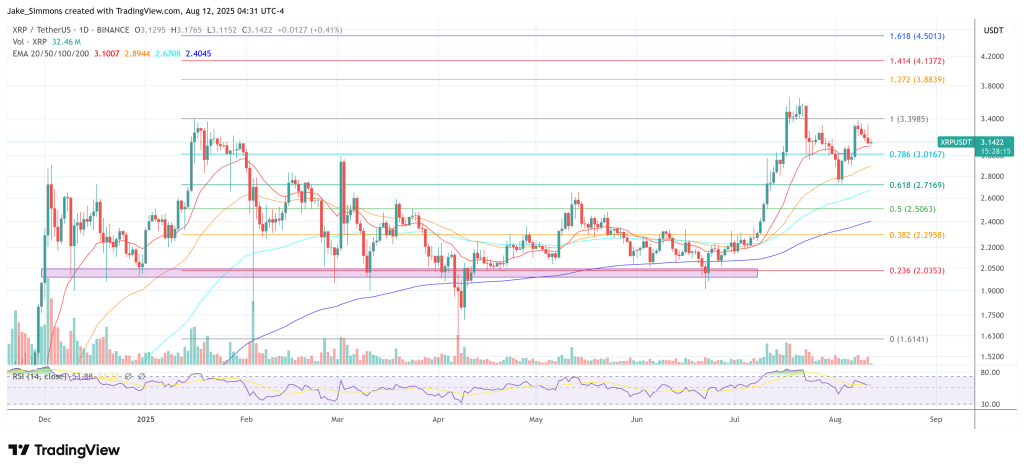
At press time, XRP traded at $3.14.

Related Posts