A weekend post on X from the official Solana account ignited a fresh round of cross-chain sniping after it juxtaposed the Ethereum network’s transaction speed with Nasdaq’s trade throughput. “When they say the future of markets runs at 22 TPS but NASDAQ handles 2k trades per second,” Solana wrote on August 9, implicitly positioning the layer-1 as better aligned with modern market plumbing.
Ethereum users bristled, arguing the comparison was a category error between an open, permissionless blockchain and a closed, centralized exchange network. The sharpest rebuttal came from the pseudonymous researcher polynya (@apolynya), who has 94,000 followers on X.
When they say the future of markets runs at 22 TPS but NASDAQ handles 2k trades per second pic.twitter.com/TAsGAcFc7k
— Solana (@solana) August 9, 2025
Solana Vs. Ethereum
In a detailed post, polynya argued that the technical baselines underlying US equities infrastructure dwarf anything a minimally decentralized layer-1 can achieve under global consensus. “Nasdaq’s SIP is designed to handle 10 million operations per second, with a latency of 0.02 milliseconds (though realistically, constrained by speed of light, it still gets to 0.2 ms between NYSE or Cboe and Nasdaq), and is readily parallelisable for infinite throughput. (There are three SIPs operating currently.),” polynya wrote.
From that premise, the conclusion was blunt: “Given the crippling limitation of achieving strict global consensus, Nasdaq will forever be thousands of times faster and cheaper than any minimally decentralised L1 blockchain, short of exotic new physics that does not yet exist.”
Polynya added that if blockchains want to approach real-time markets, they must lean on succinct cryptography rather than raw TPS. “The only known method to get anywhere close is by using ZK proofs instead for real-time execution and deferring & speeding up strict global consensus by orders of magnitude (as you only need to achieve consensus on a succinct proof instead of millions of transactions), and even then, it’ll cost orders of magnitude more, will take years to mature, and it’s not an appropriate use of this tech as Nasdaq does not require strict global consensus anyway.”
The post ended with an indictment of the metric itself: “Totally wild that cryptobros are still coping about ‘TPS’ like it’s 2017 instead of building applications that make people’s lives better. (Degenerate gambling does not.)”
Solana Labs founder Anatoly Yakovenko (@aeyakovenko) pushed back on both the framing and the cryptographic remedy. He first contended that “Zk proofs are always slower than classical execution.” Expanding on that, Yakovenko argued the equities-style comparison—if one is to be made—should be about intake guarantees and scheduling rather than block TPS or consensus latency.
“Nasdaq requires that every message is included, and that all messages are treated the same,” he wrote, before pointing to how priority fees alter inclusion on blockchains: “The way that priority fees work is that any txs with a priority fee lower than the floor inclusion price in the block doesn’t get included. So the comparison to Nasdaq that matters is scheduler throughput and latency, not block tps or consensus latency. You can have 10 second blocks with 1000 tps, and a scheduler on the block producer that can reliably tell the trader that their tx is included in microseconds.”
From an economic perspective, Yakovenko suggested Solana’s design already drives the cost of marginal drops toward irrelevance. “If the floor priority fee is < spread / K for a pretty small K, then including additional messages is not going to improve spreads. Solana already achieved this. The floor inclusion price is a fraction of a basis point, which means that additional dropped messages have an economic value of less than a basis point. Dropping them vs including them has nearly zero marginal difference.”
The Misconception About ZK Proofs
He later returned to the ZK debate to stress where proofs do and do not help. “I don’t understand where people get this misconception that ZK proofs are faster or can somehow make a system faster. It’s completely wrong. They can lower some of the costs for replication, but they can’t improve performance if replication cost isn’t a blocker.”
Yakovenko illustrated the point with a bandwidth-versus-execution thought experiment: “Let’s assume that zk proofs are completely free and instant. If sizeof(tx) < sizeof(state change) then it’s nearly always faster to download the tx and execute it locally because local memory bandwidth and latency is better than network bandwidth and latency. It would take more time to download the state result from the transaction than downloading the transaction itself and using local copy of the state to execute it and produce the result.”
His bottom line targeted Ethereum’s cost model: “So the only place where zk proofs actually help is if replication is expensive. Where is replication insanely expensive? On ethereum L1. It’s cheaper to post a state root and a zk proof so the L1 can skip executing all the state.”
Solana community developer João Mendonça (@joaomendoncaaaa) argued that Solana’s ambition is not to equal Nasdaq’s raw speed. “the point of solana as a replacement for nasdaq is not to be as fast as nasdaq itself,” he wrote, but to offer similar execution prices “with 1000x the accessibility, worldwide, [without] asking for permission, 24/7, with uncensorable asset ownership and portability throughout all of defi.”
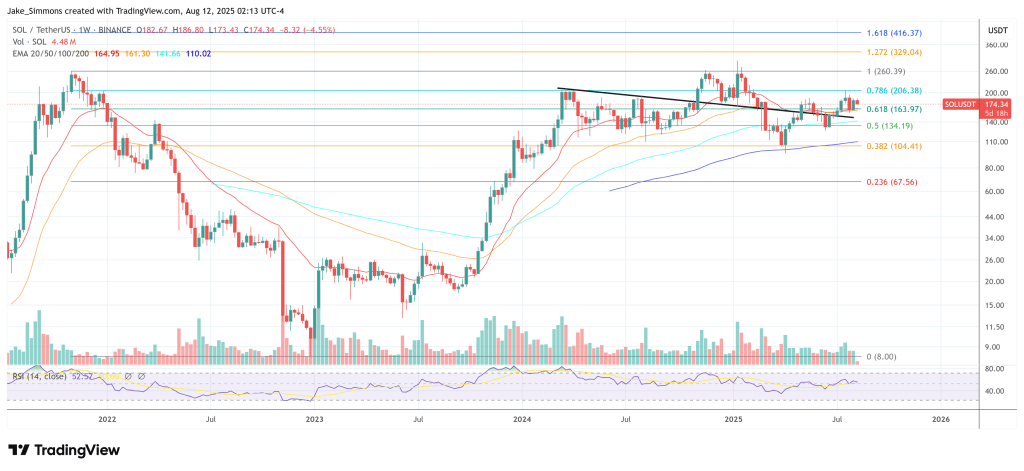
At press time, SOL traded at $174.34.

Related Posts