Bo Hines’ abrupt exit over the weekend left a vacuum at the top of the White House’s crypto apparatus. But the Trump administration moved quickly. Patrick Witt is stepping in to run point on crypto policy from the West Wing as Executive Director of the President’s Council of Advisors for Digital Assets, while continuing to serve as Acting Director of the Pentagon’s Office of Strategic Capital (OSC).
Witt is not a Twitter-native crypto influencer; he’s a policy hand with one foot in national security and the other in crypto strategy. The Defense Department lists him as Acting Director of OSC, the investment office stood up to channel credit into critical technologies.
Who Is Crypto’s New Leader In The White House?
If you want to know how Patrick Witt thinks about Bitcoin, there’s only one place to look: his on-stage interview at the Bitcoin Policy Summit in late June—his sole public appearance to date in which he directly discussed Bitcoin and crypto. In that conversation, Witt moved the Strategic Bitcoin Reserve (SBR) from slogan to mechanics. “We’ve already taken some steps with the SBR,” he said. “How do we follow that up with the accumulation plan?”
Witt’s rationale for an SBR was framed as statecraft, not speculation. “Bitcoin and the digital assets ecosystem is an engine for economic growth,” he argued, adding that the administration “want[s] to be the crypto capital of the world.” He called digital assets “a tool of modern statecraft,” warning that if the United States doesn’t “actively [shape] and influence what that new construct looks like” for the next-generation financial system, it risks ceding advantage.
Crucially, Witt tied the reserve to an organized policy pipeline rather than a one-off announcement. Alongside the GENIUS Act and CLARITY, he referenced “the [now released] report on the interagency activities,” then returned to the SBR’s operational next step—“the accumulation plan.”
Why is Witt the person saying this? Because his second hat is executional. As Acting Director of the Pentagon’s Office of Strategic Capital (OSC), he described a federally backed credit window designed to rebuild industrial capacity and compete in strategic technologies. When he joined, OSC “had $984 million of capital to lend,” later expanding to “$5 billion where we currently sit,” with potential—pending legislation—to “grow to $200 billion.”
Demand already ran hot: the first notice of funding drew “$9 billion worth of requests,” eight to nine times the initial pool. Asked what might intersect with Bitcoin, Witt was careful but plain: OSC would target “enabling infrastructure… potentially more on the energy side, compute power. We want compute and energy to be domestic, secure and abundant.” Pair that with an SBR accumulation plan and a clear picture emerges: sovereign balance-sheet exposure to Bitcoin alongside public credit that lowers the cost of the physical inputs miners and broader crypto infrastructure consume.
Witt also made the hierarchy explicit. “We recognize the difference in the space… Bitcoin definitely has primacy for us,” he said, even as the White House pushes broader digital-asset policy. The request to industry was equally direct: be “a trusted partner and an objective resource,” bring research and credible projects, and accept that real legislation demands “horse trading and compromise.” That’s the practical context for any SBR rollout: the West Wing will need private-sector expertise to harden custody, automate execution, and publish transparent reporting that markets can trust.
Bitcoin Softwar Thesis Playing Out?
This interview also lands squarely in a national-security conversation many in Bitcoin already know: Major Jason Lowery’s “Softwar” thesis. Lowery argues that proof-of-work is a non-kinetic form of power projection that secures property in cyberspace—an energy-grounded deterrence mechanism. Witt never cites Lowery, but his vocabulary rhymes with it: Bitcoin as “statecraft,” domestic “mining” as priority, capital markets as a national-security asset, and public credit aimed at energy and compute.
It’s why some community reaction highlighted his dual roles—White House crypto lead and OSC chief—and urged, “If you haven’t read ‘Software’ [sic] by Major Jason Lowery, you might want to give it a go.” Whether or not the administration embraces Softwar’s strongest claims, Witt’s only public remarks suggest the reserve is being treated as strategic infrastructure, not a talking point.
Strip it down, and the signal is clean. The White House seems to have made a strategic pivot: it’s a strategic pivot. Trump’s Bitcoin and crypto plans are steered by someone who views it not as an asset class but as critical infrastructure to be controlled. Bo Hines got replaced by a Pentagon-linked strategist.
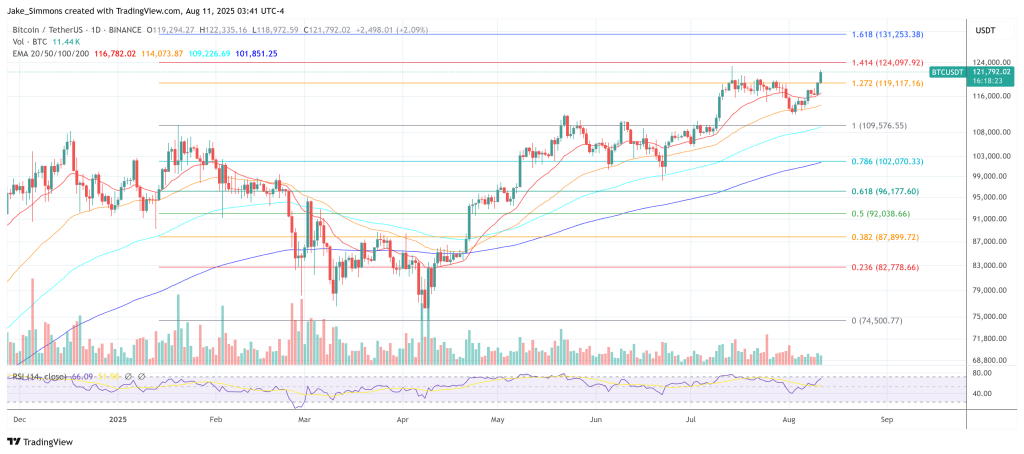
At press time, BTC traded at $121,792.

Related Posts