Bitcoin Whales Haven’t Made Their Exit Yet – Is The Bull Cycle Still Intact?

bitcoinist发布于2025-04-13更新于2025-04-13

文章摘要

After suffering a steep 30% correction that took prices below $75,000, Bitcoin is showing signs of strength once again. The...

Trusted Editorial content, reviewed by leading industry experts and seasoned editors. Ad Disclosure

After suffering a steep 30% correction that took prices below $75,000, Bitcoin is showing signs of strength once again. The broader crypto market joined BTC in a sharp rebound following a key macro development: US President Donald Trump’s announcement of a 90-day pause on reciprocal tariffs for all countries except China, which now faces a 145% tariff. This easing of trade war fears brought some much-needed relief across risk assets.

Despite the volatility, Bitcoin’s resilience is gaining attention. According to insights from CryptoQuant, whales—large holders excluding entities like exchanges and mining pools—have not exited their positions. In fact, current on-chain data shows accumulation activity similar to what was observed during the August–September 2023 sideways market phase. This pattern historically reflects long-term conviction and has often preceded major rallies.

While short-term uncertainty remains, the continued presence of whale accumulation supports the idea that this correction is part of a broader bullish cycle rather than a structural breakdown. With prices stabilizing and sentiment slowly improving, Bitcoin now faces a critical test to reclaim higher levels and potentially resume its upward trajectory.

Bitcoin Resilient As Key Accumulation Suggests Bull Cycle Intact

Bitcoin remains strong after reclaiming the $80,000 level, and many analysts believe the worst part of the correction is over. However, global tensions—especially those tied to escalating U.S. tariffs—continue to pressure financial markets, with fears of a looming global recession growing. Despite this backdrop, Bitcoin has shown resilience and is now approaching a critical daily resistance near $88,700.

The recent 90-day pause on reciprocal tariffs for all nations except China, which still faces a 145% tariff, has provided some short-term relief. But lasting recovery depends on whether the US and China can reach a broader agreement.

Meanwhile, on-chain data from CryptoQuant reveals a compelling trend: Bitcoin whales haven’t made their exit. These whales, excluding exchanges and mining pools, offer a clearer view of real trading behavior and accumulation patterns. Historically, their movements have closely mirrored price action.

Bitcoin 1-year Change in Whale Holdings | Source: CryptoQuant

At the cycle peak last year, whale exits were marked by consistent profit-taking. This time, however, they are accumulating again, echoing patterns seen in the August–September 2023 sideways market. Unlike the 2020 COVID crash, which whales anticipated with early exits, they are holding firm during this correction.

This suggests the current downturn is not a structural crisis but a sharp pullback in a broader bull cycle. If this manufactured crisis resolves, a new wave of liquidity—possibly driven by QE from both the Fed and China—could favor assets like gold and Bitcoin. For now, whale conviction remains a bullish signal.

BTC Price Near Key Moving Averages

Bitcoin is trading at $83,600, now just 5% away from the 200-day moving average (MA) around $87,100. This technical level is a crucial milestone for bulls aiming to confirm a reversal and reestablish a long-term uptrend. To build a solid bullish case, BTC must not only hold above the $81,000 support zone but also reclaim the $85,000 level, which aligns closely with the 200-day exponential moving average (EMA).
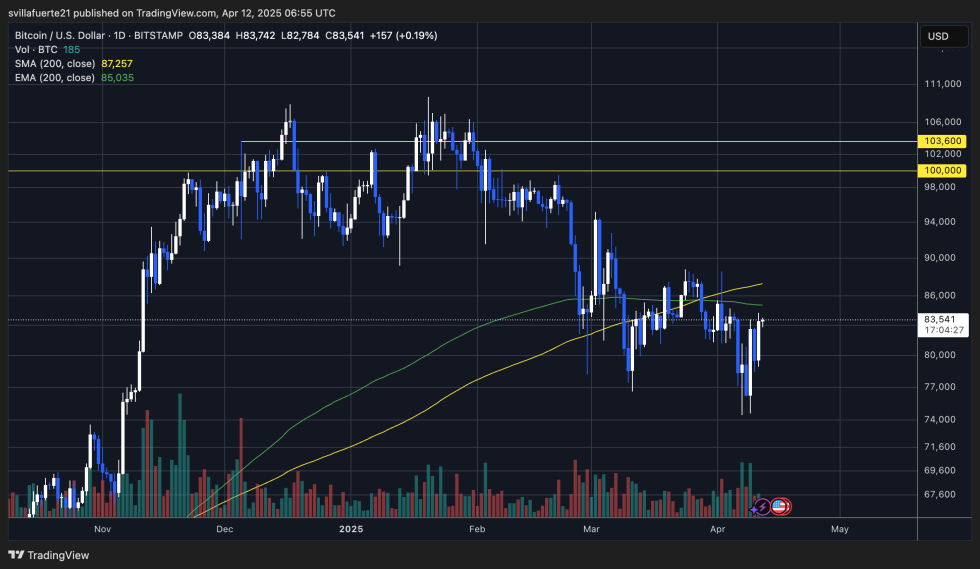
BTC testing crucial liquidity | Source: BTCUSDT chart on TradingView

Reclaiming these moving averages would signal a potential shift in trend, helping reinforce short-term momentum and restoring confidence across the market. The price action over the past week has shown signs of strength, but technical validation through these averages is essential before a true breakout can unfold.

However, downside risks remain. If Bitcoin fails to hold the $81,000–$80,000 range, selling pressure could escalate quickly. A breakdown below this region would likely open the door to a retest of the $75,000 level, where demand could be tested again.

With macroeconomic tensions still weighing on investor sentiment, BTC is at a critical inflection point. The coming days will determine whether bulls can solidify control—or if another correction leg is on the horizon.

Featured image from Dall-E, chart from TradingView 

Editorial Process for bitcoinist is centered on delivering thoroughly researched, accurate, and unbiased content. We uphold strict sourcing standards, and each page undergoes diligent review by our team of top technology experts and seasoned editors. This process ensures the integrity, relevance, and value of our content for our readers.

Sebastian's journey into the world of crypto began four years ago, driven by a fascination with the potential of blockchain technology to revolutionize financial systems. His initial exploration focused on understanding the intricacies of various crypto projects, particularly those focused on building innovative financial solutions. Through countless hours of research and learning, Sebastian developed a deep understanding of the underlying technologies, market dynamics, and potential applications of cryptocurrencies. As his knowledge grew, Sebastian felt compelled to share his insights with others. He began actively contributing to online discussions on platforms like X and LinkedIn, focusing on fintech and crypto-related content. His goal was to expose valuable trends and insights to a wider audience, fostering a deeper understanding of the rapidly evolving crypto landscape. Sebastian's contributions quickly gained recognition, and he became a trusted voice in the online crypto community. To further enhance his expertise, Sebastian pursued a UC Berkeley Fintech: Frameworks, Applications, and Strategies certification. This rigorous program equipped him with valuable skills and knowledge regarding Financial Technology, bridging the gap between traditional finance (TradFi) and decentralized finance (DeFi). The certification deepened his understanding of the broader financial landscape and its intersection with blockchain technology. Sebastian's passion for finance and writing is evident in his work. He enjoys delving into financial research, analyzing market trends, and exploring the latest developments in the crypto space. In his spare time, Sebastian can often be found immersed in charts, studying 10-K forms, or engaging in thought-provoking discussions about the future of finance. Sebastian's journey as a crypto analyst and investor has been marked by a relentless pursuit of knowledge and a dedication to sharing his insights. His ability to navigate the complex world of crypto, combined with his passion for financial research and communication, makes him a valuable asset to the industry. As the crypto landscape continues to evolve, Sebastian remains at the forefront, providing valuable insights and contributing to the growth of this revolutionary technology.

热门币种推荐

你可能也喜欢

2026年或将如何重新定义以太坊、Solana、Base和Avalanche

2026年,区块链基础设施正经历重大转型,重点从散户采用转向满足日益增长的机构需求。目前,公有链上承载着超过300亿美元的代币化现实世界资产(RWA),暴露出现有网络在处理能力、结算速度、合规性和可靠性方面的不足。因此,以太坊、Solana、Base和Avalanche等主要区块链正在从协议层面进行根本性重构,旨在为机构级金融活动提供支持。 以太坊通过“Glamsterdam”升级,将大幅提高Gas限制并引入新的核心功能,为并行执行做准备。Solana的“Alpenglow”升级则着重重构共识机制,将最终确认时间从12.8秒大幅缩短至约100-150毫秒,并减少网络资源消耗。Base正在开发“Beryl”,旨在通过B20代币标准提供更好的合规资产发行框架。Avalanche的“Octane”升级则在提升交易处理速度的同时,降低企业应用部署成本。 这些升级显示,竞争焦点正从单纯追求速度,转向基础设施的长期可靠性、监管合规性和机构适用性。随着升级在2026至2027年陆续部署并投入生产,能够持续提供稳定结算、合规兼容且抗压能力强的网络,将最有可能吸引未来的大规模代币化资本。技术升级本身不会决定最终赢家,已被验证的实际执行能力和现有生态系统优势(如以太坊在合规标准和流动性上的领先地位)将是关键。

ambcrypto16分钟前

2026年或将如何重新定义以太坊、Solana、Base和Avalanche

ambcrypto16分钟前

Tiger Research:先把 RWA 代币化搬到海外去

文章探讨了在监管尚不完善的地区,金融机构如何通过海外扩张推进实物资产(RWA)代币化。当前RWA市场增长迅速,但监管滞后阻碍了发展。金融机构面临等待立法、使用监管沙盒或进入海外市场的战略选择。文章建议,鉴于RWA的全球性,优先考虑在监管成熟的海外市场积累经验是抢占先机的关键。 跨境RWA业务要求精细规划,涉及六个核心准备领域:选择海外基地与路径(如香港、新加坡、美国)、获取必要牌照、定义代币化资产类型、明确目标投资者范围、设计结算币种与支付流程,以及安排好托管、区块链选择等运营细节。 具体进入路径主要有两种: 1. **直接进入成熟司法管辖区**:例如香港、新加坡或美国。这些地区监管框架相对清晰,并存在可加速落地的成熟平台(如香港的HSBC Orion、美国的Securitize)。机构可利用现有海外实体或与本地平台合作,以降低入场门槛和缩短时间。 2. **采用链上原生路径**:通过与Ondo Global、Plume Nest等具备内建合规能力的链上平台合作,直接设计链上发行与流通结构。这种方式可以绕过在特定地区建立实体存在的复杂程序,实现更快的市场进入和更广泛的流动性对接,但结构设计复杂且监管指引较少。 文章最后通过一个假设案例,说明一家中型券商如何分步骤(评估现有基地与牌照、选择平台、合规与产品设计、搭建托管与运营结构、最终发行验证)在香港完成一次债券代币化发行的完整流程。 核心结论是:在监管空窗期,等待并非最佳策略。金融机构应主动评估并选择适合自身的海外或链上路径,尽快通过实际运营积累经验,因为市场的竞争不会等待监管完全就绪。实现成功销售,完成从结构设计到投资者到位的全流程,才是代币化业务落地的实质。

marsbit27分钟前

Tiger Research:先把 RWA 代币化搬到海外去

marsbit27分钟前

交易

现货

热门文章

加密市场宏观研报:《GENIUS Act》法案取得重大进展,BTC突破历史新高,后市全新展望

2025年5月22日,比特币价格正式突破11万美元大关,创下历史新高。在政策面、宏观经济、资金面与投资者结构共同作用下,一场结构性牛市浪潮正在展开。而此轮上涨背后的核心驱动,是美国《GENIUS稳定币法案》的实质性进展以及多项利好的叠加。本文将从政策端突破、宏观环境转向、链上与ETF资金结构、交易行为演化,以及重点受益赛道五大维度,全面解析此轮BTC再创新高的深层逻辑,并前瞻下半年市场的潜在趋势。

1.7k人学过发布于 2025.05.22更新于 2025.05.22

加密市场宏观研报:《GENIUS Act》法案取得重大进展,BTC突破历史新高,后市全新展望

相关讨论

欢迎来到HTX社区。在这里,您可以了解最新的平台发展动态并获得专业的市场意见。以下是用户对BTC(BTC)币价的意见。

活动图片