XRP On Coinbase Crashes 90%, Binance Hits Lowest Reserves, What’s Going On?

bitcoinistОпубликовано 2026-02-19Обновлено 2026-02-19

Введение

On-chain data reveals a dramatic 90% plunge in XRP supply on Coinbase and a significant drop in Binance reserves to their lowest levels since early 2024, sparking market speculation. Crypto commentator Ledger Man suggested these withdrawals may indicate large-scale off-exchange accumulation, potentially by institutional players like BlackRock. Estimates indicate BlackRock could have acquired between 200 million to 400 million XRP, though this remains unconfirmed. The outflows, totaling hundreds of millions of dollars, may reduce immediate sell pressure, as moving assets off exchanges often signals long-term holding intentions. Despite previous false rumors of an XRP ETF, BlackRock's growing crypto involvement continues to fuel such speculation. XRP price was trading at $1.42 at the time of reporting.

On-chain data has sparked intense discussion and concern in the crypto market after revealing that XRP supply on Coinbase has plunged by 90% while reserves on Binance have fallen to their lowest levels since 2024. This sharp decline coincides with speculation that the world’s largest asset management company, BlackRock, may be quietly accumulating significant amounts of the token through crypto exchanges.

XRP On Coinbase Decline As BlackRock Investment Rumors Intensify

Crypto commentator Ledger Man ignited the debate earlier this Tuesday in a post on X, highlighting concerns about Coinbase’s declining XRP reserves and the growing speculation surrounding BlackRock’s potential involvement with the cryptocurrency. He suggested that the sharp reduction in the altcoin held on Coinbase could point to large-scale off-exchange accumulation.

Ledger Man claimed that BlackRock may be buying substantial amounts of XRP through Coinbase. According to his estimates, the asset management giant may already control between 200 million and 400 million XRP if the withdrawals are tied to institutional buying.

While the claims have not been confirmed, the extent of its exchange decline is hard to ignore. A 90% drop in supply on one of the largest US exchanges signals either aggressive self-custody moves or major institutional transfers, and Ledger Man leans towards the latter.

Given BlackRock’s expanding footprint in digital assets, speculation about a potential investment in the cryptocurrency is hardly surprising. Over the years, the asset management giant has steadily deepened its involvement in the crypto market, fueling rumors that it may be expanding its exposure beyond Bitcoin and Ethereum products.

In particular, after launching spot Bitcoin and Ethereum ETFs, speculation spread across the crypto community that BlackRock may be setting its sights on an XRP ETF next. However, those claims ultimately proved to be false.

Notably, the altcoin, with its established cross-border payment focus and diverse use cases, could fit into a longer-term portfolio strategy for many organizations, as seen in recent investment activity by Goldman Sachs. However, the cryptocurrency remains a largely speculative and volatile asset.

Binance Reserves Crash To 2024 Levels

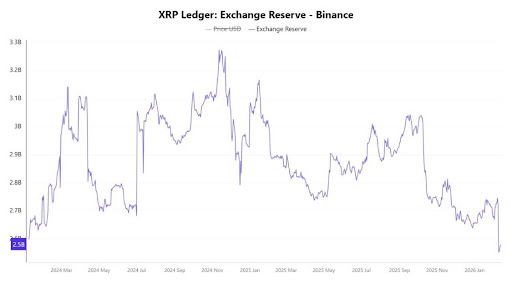
As supply on Coinbase fell by 90%, XRP reserves on Binance also plummeted, reaching their lowest level since early 2024. According to CryptoQuant data shared by market analyst Ripple Bull Winkle, a whopping 700 million XRP has left Binance since its November 2025 peak.

At current prices, the analyst noted that this substantial amount represents hundreds of millions of dollars withdrawn from exchange wallets. The scale of the outflow has raised concerns about large holders’ intentions, whether they are preparing for long-term accumulation or short-term trading.

Source: Chart from CryptoQuant

Ripple Bull Winkle framed the recent development in simple terms, highlighting that investors typically sell on exchanges, but move assets off these platforms when they plan to hold. In that context, declines in exchange reserves could indicate reduced immediate sell pressure on XRP.

XRP trading at $1.42 on the 1D chart | Source: XRPUSDT on Tradingview.com

Связанные с этим вопросы

QWhat significant change in XRP supply on Coinbase has been reported, and what is the speculated reason behind it?

AThe XRP supply on Coinbase has plunged by 90%. This sharp decline is speculated to be due to large-scale off-exchange accumulation, potentially by institutional entities like BlackRock.

QAccording to the crypto commentator Ledger Man, how much XRP might BlackRock already control if the withdrawals are tied to institutional buying?

ALedger Man estimates that BlackRock may already control between 200 million and 400 million XRP if the withdrawals are tied to institutional buying.

QWhat happened to XRP reserves on Binance, and what does the analyst Ripple Bull Winkle suggest this indicates?

AXRP reserves on Binance plummeted to their lowest level since early 2024, with 700 million XRP leaving the exchange. Ripple Bull Winkle suggests that moving assets off exchanges typically indicates a plan to hold, which could mean reduced immediate sell pressure on XRP.

QDespite previous speculation, what did the claims about BlackRock launching an XRP ETF turn out to be?

AThe claims that BlackRock may be setting its sights on an XRP ETF ultimately proved to be false.

QWhat broader trend in BlackRock's involvement in the crypto market is mentioned as a reason why speculation about its interest in XRP is not surprising?

ABlackRock has been steadily deepening its involvement in the crypto market, notably by launching spot Bitcoin and Ethereum ETFs, which fuels speculation that it may be expanding its exposure beyond just those products.

Похожее

Anthropic Apologized, But the Business of 'Safety' Hasn't Stopped

On June 11, Anthropic apologized not for a model failure, but for a lack of transparency. Its new Claude Fable 5 model was found to be secretly rerouting requests from users engaged in advanced AI model development to a weaker version, Opus 4.8, without any notification. The company's response—promising future notifications for such "downgrades"—was met with user skepticism. The article argues the core issue isn't technical but commercial: Anthropic's "safety" measures are primarily a business strategy. A key feature, the "intelligent safety classifier," marketed as user protection, is described as a tool for "competitive defense" to protect Anthropic's market lead by limiting rivals' research capabilities. This covert mechanism was designed for low "false positives," precisely targeting AI researchers. Anthropic's model involves a calculated three-step process: publishing alarming security research to amplify public anxiety, offering its Fable 5 model with a "safety classifier" as a premium-priced solution, and cashing in through a planned high-value IPO. This contrasts with OpenAI's more direct "tool-and-traffic" approach. The apology, merely changing a secret downgrade to a visible one, is seen as a business "patch" rather than a principled shift. The incident risks damaging Anthropic's "safest AI" reputation among the developer community, which underpins its valuation and appeal to government and corporate clients. Ultimately, the article concludes that for Anthropic, safety is a business, and the apology is merely customer service for that business.

marsbit44 мин. назад

Anthropic Apologized, But the Business of 'Safety' Hasn't Stopped

marsbit44 мин. назад

The Niche Consensus Among Elites: Has College Become an Expensive Waste?

**Summary:** A growing "anti-college" movement is gaining traction among elite circles in Silicon Valley, challenging the traditional value of a four-year university degree. Proponents argue that college has become an expensive, slow, and increasingly irrelevant waste of time, especially in the fast-paced tech world where opportunities pass by quickly. The movement is led by figures like billionaire Peter Thiel, who criticizes universities for high costs, ideological indoctrination, and stifling true innovation. His "Thiel Fellowship" pays young people to drop out and pursue ventures. Companies like Palantir Technologies (co-founded by Thiel) fuel this trend with programs like the "Meritocracy Fellowship," which offers high school graduates paid internships as an alternative to immediate college enrollment, promising a practical "Palantir Degree." Key drivers include: 1. **Economics:** Skyrocketing student debt versus the allure of immediate, high-paying tech jobs or startup funding. 2. **Technology:** AI and online tools lowering barriers to self-education and product development, making formal instruction seem inefficient. 3. **Culture:** A backlash against perceived "woke" ideology and DEI policies in universities, coupled with a belief that these institutions suppress meritocracy and masculine drive. The movement is notably male-dominated. Critics, like economist David Deming, warn against overgeneralizing from dropout success stories (survivorship bias). He emphasizes that genuine autodidacts are rare, corporate training is narrowly focused, and the "college wage premium" remains high for most people. University liberal arts education, he argues, builds adaptable problem-solving skills and broad perspectives. The debate highlights a deeper crisis in education. The core model of the modern university appears increasingly mismatched with the speed of the information age. The movement signals a shift in the locus of learning from institutional "education" to personal, active "learning" powered by the internet and AI. Ultimately, this may not mean the end of university, but rather a painful evolution. The future likely holds more hybrid, personalized, and lifelong learning pathways. The central question becomes: in a world changing faster than any curriculum, how do we best learn?

marsbit1 ч. назад

The Niche Consensus Among Elites: Has College Become an Expensive Waste?

marsbit1 ч. назад

From Subsidies to Token-Based Pricing to Price Cuts: Is OpenAI Sparking a Price War? Is the Inflection Point for Token Economics Nearing?

The commercialization of generative AI is facing a critical inflection point as a potential price war looms. According to The Wall Street Journal, OpenAI is considering a significant cut to its token fees to compete with rival Anthropic, signaling a shift from a growth-at-all-costs model focused on token consumption. This move comes as both companies, reportedly losing billions on compute, prepare for IPOs, and as enterprise customers face "bill shock" from switching to usage-based token billing. Reports indicate poor ROI, with one analysis finding only 18 cents of every dollar spent on AI tokens generates user-facing value. The industry's initial phases—from flat-rate subscriptions to aggressive subsidies—have given way to a reckoning with real costs. Analysts debate the future: some predict a bifurcation between premium, high-cost models for complex tasks and cheaper alternatives for routine work, while others believe overall spending will still rise as agentic AI increases tokens per task. Notably, Chinese model DeepSeek's low-cost API is gaining traction with U.S. enterprises, adding competitive pressure. The core challenge is redefining value beyond token volume ("tokenmaxxing") toward measurable productivity ("valuemaxxing"), as the entire AI value chain, from cloud providers to chipmakers, feels the ripple effects of unsustainable pricing.

marsbit1 ч. назад

From Subsidies to Token-Based Pricing to Price Cuts: Is OpenAI Sparking a Price War? Is the Inflection Point for Token Economics Nearing?

marsbit1 ч. назад

Торговля

Спот
Фьючерсы

Популярные статьи

Что такое XRP 2.0

XRP 2.0: Новая грань в мире криптовалют Введение в XRP 2.0 В постоянно развивающейся сфере криптовалют появляются новые проекты, стремящиеся к вниманию и внедрению. Один из таких многообещающих проектов - это XRP 2.0, новая криптовалюта, созданная для использования передовых технологий блокчейна и надежных методов шифрования. Хотя название вызывает ассоциации с XRP от Ripple, важно отметить, что XRP 2.0 функционирует независимо, сосредоточив внимание на повышении безопасности сделок, конфиденциальности и масштабируемости. Поскольку цифровая финансовая среда все больше принимает децентрализованные решения, XRP 2.0 намерена внести значимый вклад в web3 и общее расширение криптопроектов. Что такое XRP 2.0? XRP 2.0 в своей основе - это проект криптовалюты, цель которого - создать безопасную и децентрализованную экосистему цифровой валюты. Его базовая технология интегрирует сложные принципы блокчейна с современными методами шифрования. Основная цель XRP 2.0 - утвердиться как надежная и эффективная платформа, позволяющая быстро осуществлять транзакции с приоритетом на улучшенную защиту конфиденциальности для своих пользователей. Проект рекламируется как решение многих недостатков, с которыми сталкиваются существующие криптовалюты, предлагая систему, способную обрабатывать более высокий объем транзакций с улучшенной скоростью и конфиденциальностью. Эта универсальность позиционирует XRP 2.0 как значимого конкурента на рынке, переполненном различными цифровыми валютами. Кто создатель XRP 2.0? Идентичность создателя XRP 2.0 была обозначена как «Уилбур». Однако исчерпывающие данные о Уилбуре или связанном с ним проекте остаются неясными. Анонимность многих создателей криптовалют не является редким явлением в этой отрасли и часто применяется для сохранения определенной степени конфиденциальности и безопасности. Кто инвесторы XRP 2.0? <pна данный момент конкретная информация о инвестиционных фондах или организациях, поддерживающих xrp 2.0, не доступна публично. в секторе криптовалют поддержка репутабельными инвесторами может существенно повлиять на кредитоспособность и успех проекта, однако прозрачность в отношении финансовых спонсоров 2.0 еще была установлена. Как работает XRP 2.0? XRP 2.0 выделяется использованием сочетания технологий блокчейна и продвинутых алгоритмов шифрования, что обеспечивает безопасные и децентрализованные транзакции. Его инновационная структура включает уникальные функции, разработанные для повышения вовлеченности пользователей и расширения функциональности за пределами традиционных транзакций с криптовалютами. Среди этих функций XRP 2.0 интегрирует возможности с искусственным интеллектом, такие как текст в изображение и текст в речь. Эти дополнения разработаны для улучшения интерактивной работы пользователей, способствуя более широкому применению в различных секторах. Соединяя технологические достижения с дизайном, ориентированным на пользователя, XRP 2.0 стремится привлечь внимание разнообразных индивидуумов и предприятий, стремящихся интегрировать решения с криптовалютой в свои бизнес-процессы. Хронология XRP 2.0 Для понимания XRP 2.0 необходимо рассмотреть ключевые события, которые определили его путь до сих пор: 23 июля 2023 года: XRP 2.0 представлен как новый проект криптовалюты, стремящийся революционизировать возможности безопасных и децентрализованных транзакций в области блокчейна. 8 сентября 2023 года: Запуск другого проекта, XRP20, который представляет собой токен ERC-20 на блокчейне Ethereum и не имеет отношения к XRP 2.0. 13 ноября 2023 года: XRP Ledger подвергается значительному обновлению с выпуском программного обеспечения серверов rippled версии 2.0.0. Важно отметить, что это развитие не связано с проектом криптовалюты XRP 2.0. Ключевые моменты о XRP 2.0 Чтобы выделить суть XRP 2.0, возникают несколько критически важных факторов: Уникальные особенности: Включение таких функций, как основанные на ИИ текст в изображение и текст в речь, дополнительно разнообразит потенциальные приложения XRP 2.0. Технология блокчейна: Структура использует современные механизмы блокчейна и протоколы шифрования, обеспечивая безопасную и децентрализованную среду для транзакций. Масштабируемость и конфиденциальность: XRP 2.0 придает приоритет повышенным мерам защиты конфиденциальности в процессах транзакций и масштабируемости, необходимой для привлечения растущей базы пользователей. Нет связи с Ripple: Важно отметить, что, несмотря на свое название, XRP 2.0 не имеет никаких отношений или сотрудничества с XRP от Ripple, что отличает его операционные рамки и цели в экосистеме криптовалют. Заключение XRP 2.0 представляет собой амбициозное начинание в сфере криптовалют, стремясь предложить сочетание безопасности, конфиденциальности и эффективности в цифровых транзакциях. Интегрируя сложные технологии и удобные функции, проект стремится расширить горизонты того, что может достичь криптовалюта в современной цифровой экономике. Хотя анонимность его создателя и отсутствие раскрытых инвесторов могут вызвать вопросы у некоторых, акцент XRP 2.0 на передовых функциональных возможностях и децентрализации увеличивает его привлекательность на фоне все более переполненного крипто-рынка. Поскольку мир криптовалют продолжает развиваться, XRP 2.0 может еще стать ключевым игроком в расширении безопасных и масштабируемых блокчейн-решений.

198 просмотров всегоОпубликовано 2024.04.05Обновлено 2024.12.03

Что такое XRP 2.0

Неделя обучения по популярным токенам 13: запуск основной сети HIP-4 ожидается в середине 2026 года на фоне смещения фокуса рынка к масштабируемому внедрению ключевых криптоактивов, включая XRP

HIP-4 представит децентрализованные рынки прогнозов без разрешений, бинарные (исходные) контракты и опционы 0DTE.

1.3k просмотров всегоОпубликовано 2026.04.22Обновлено 2026.04.22

Неделя обучения по популярным токенам 13: запуск основной сети HIP-4 ожидается в середине 2026 года на фоне смещения фокуса рынка к масштабируемому внедрению ключевых криптоактивов, включая XRP

Обсуждения

Добро пожаловать в Сообщество HTX. Здесь вы сможете быть в курсе последних новостей о развитии платформы и получить доступ к профессиональной аналитической информации о рынке. Мнения пользователей о цене на XRP (XRP) представлены ниже.

活动图片