Will Bitcoin’s falling network activity hamper Saylor’s 100th BTC purchase?

ambcryptoОпубликовано 2026-02-24Обновлено 2026-02-24

Введение

Michael Saylor continues to acquire Bitcoin for MicroStrategy despite BTC's price dropping below $65,000. The company is set to announce its 100th BTC purchase, having accumulated 717,131 BTC worth approximately $48.7 billion. However, with an average purchase price of $76,027 per Bitcoin, the firm currently faces an unrealized loss of around $5.8 billion. While Bitcoin ETFs recently saw $88.1 million in inflows, indicating institutional interest, Bitcoin network activity has declined since August 2025, raising concerns about reduced retail participation. The success of Saylor’s strategy hinges on Bitcoin’s future price direction.

While there is a lot of air around Bitcoin [BTC] falling below $65,000, Michael Saylor is still focused on buying more.

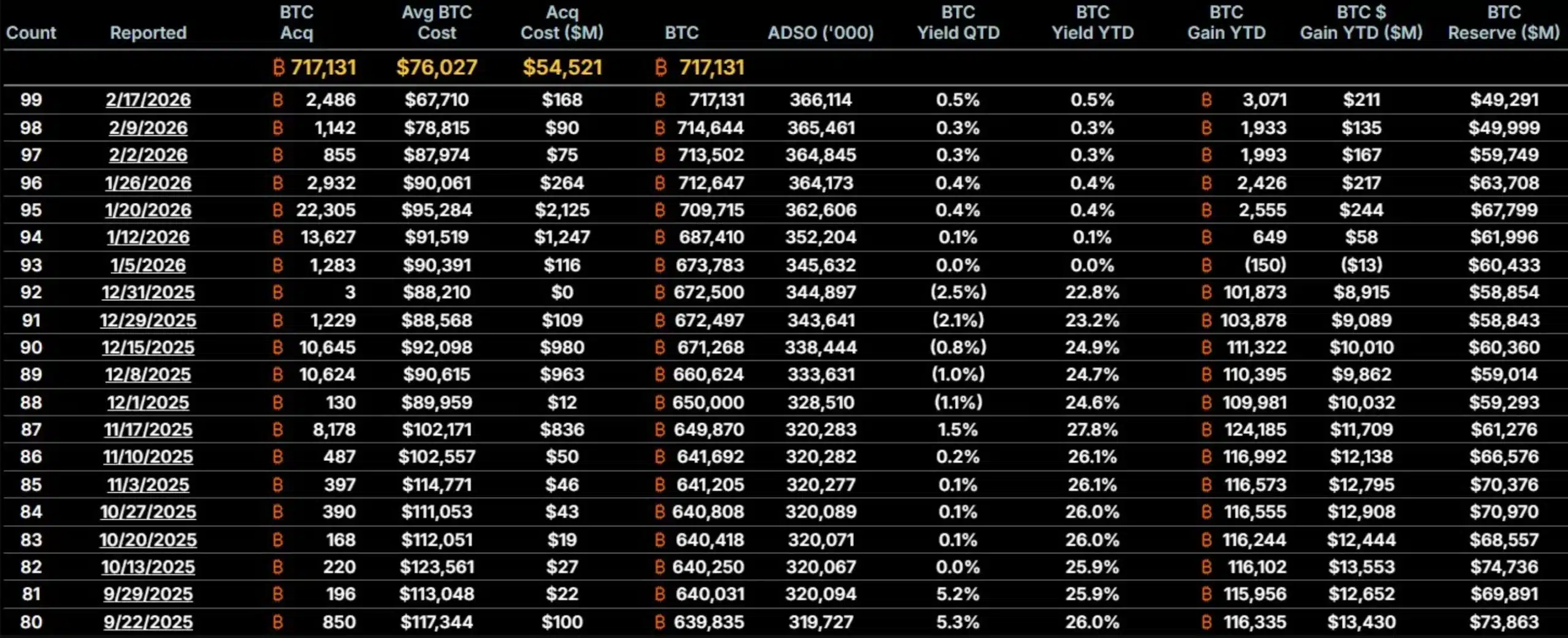
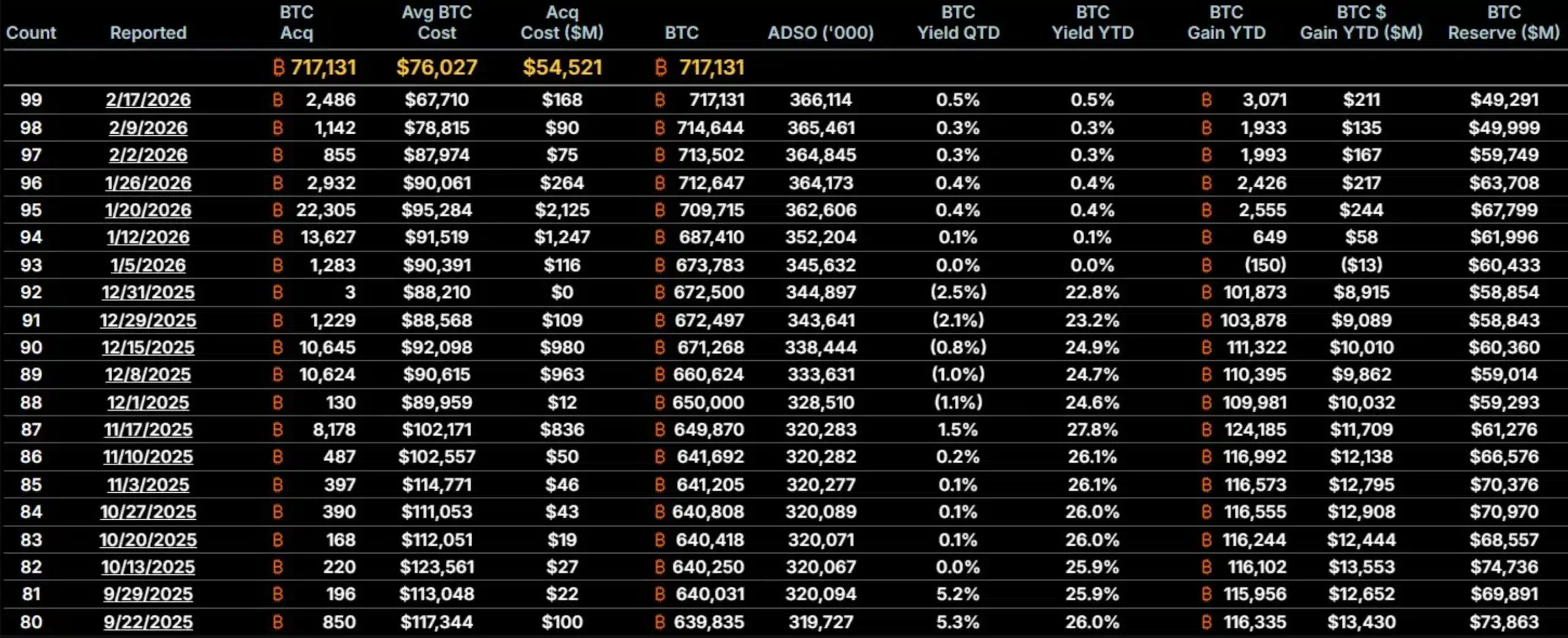
On the 22nd of February, he shared his latest “Orange Century” chart on X, showing how his company keeps adding Bitcoin to its holdings.

The chart, instead of just showing off, tells the story of how, since 2020, Strategy has rebuilt its entire business around Bitcoin.

But the latest numbers show a risky situation. Strategy now holds about 717,131 BTC, which is nearly two-thirds of all Bitcoin owned by companies.

The community responds to Saylor’s post

Responding to this news, an X account named Satoshi Stacker noted,

“Tomorrow, Strategy will announce their 100th $BTC purchase since they established their bitcoin treasury strategy.”

Source: Satoshi Stacker/X

This followed Strategy’s recent addition of 1,142 BTC for more than $90 million.

Over time, these repeated buys, totaling 99 purchases, have helped the company build a massive reserve of 717,131 BTC, now worth about $48.7 billion.

But the problem is the price.

Strategy’s average buying price is $76,027 per Bitcoin. Since the current market price is lower, the company is sitting on a paper loss of around 10.7%, approximately $5.8 billion.

Current market dynamics

This coincided with Strategy’s stock MSTR rising about 1.24% to $131.05 at press time and Bitcoin falling by 2.36% to around $66,451 in the past 24 hours.

Additionally, on the 20th of February, Bitcoin ETFs saw $88.1 million in inflows, ending three days of losses. This shows that big institutions are still interested.

But there is also bad news.

Since August 2025, the number of active users on the Bitcoin network has been slowly falling. It has not returned to the 800,000–900,000 daily user levels seen in past bull markets.

In simple terms, fewer people are using Bitcoin regularly.

This is worrying because past bull runs were driven by strong retail participation, everyday users buying, trading, and using Bitcoin. Presently, that engine seems weak.

Now, whether Saylor’s strategy proves successful or dangerously risky depends largely on Bitcoin’s future price direction.


Final Summary

  • Michael Saylor remains committed to buying Bitcoin, even as prices fall and losses grow.
  • With an average buying price above current market levels, the company is sitting on billions in unrealized losses.

Связанные с этим вопросы

QWhat is Michael Saylor's current strategy regarding Bitcoin purchases despite the price drop?

AMichael Saylor remains committed to buying more Bitcoin, with his company MicroStrategy consistently adding to its holdings, as evidenced by its upcoming 100th BTC purchase.

QHow many Bitcoins does MicroStrategy currently hold, and what is its significance in the corporate Bitcoin landscape?

AMicroStrategy now holds about 717,131 BTC, which constitutes nearly two-thirds of all Bitcoin owned by companies.

QWhat is MicroStrategy's average buying price for Bitcoin, and how does it compare to the current market price?

AMicroStrategy's average buying price is $76,027 per Bitcoin, which is above the current market price, resulting in an unrealized loss of approximately 10.7% or $5.8 billion.

QWhat recent trend in Bitcoin network activity is causing concern, and why is it significant?

ASince August 2025, the number of active users on the Bitcoin network has been declining and has not returned to the 800,000–900,000 daily user levels seen in past bull markets, indicating weaker retail participation.

QHow did Bitcoin ETFs perform recently, and what does it indicate about institutional interest?

AOn February 20th, Bitcoin ETFs saw $88.1 million in inflows, ending three days of losses, which shows that big institutions are still interested in Bitcoin.

Похожее

The Merger of Codex and ChatGPT Marks the Beginning of a Major Reshuffle in Programming Tools

OpenAI is shifting its strategic focus from ChatGPT to Codex, merging them along with the browser tool Atlas into a unified desktop super-app. This move signals an internal belief that Codex, originally a programming tool, represents the next evolution of AI more than conversational models like ChatGPT. Over the past year, Codex's weekly active users have surged past 5 million. The key distinction is that while ChatGPT answers questions, Codex executes tasks. Enterprises increasingly value this ability to get work done over simply receiving advice. Consequently, Codex is attracting professionals beyond developers, including analysts, bankers, marketers, and product managers. OpenAI's reorganization and increased investment in Codex stem from recognizing that the future of AI competition lies in execution capabilities, not just conversation. The company is launching role-specific plugins (e.g., for data analysis, sales, design) to transform Codex into a broad knowledge work platform that automates and redefines white-collar workflows. Beyond being a tool, Codex reflects OpenAI's ambition to redefine software. New features like "Sites"—which generates interactive websites from documents—and collaborative "Annotations" aim to create a paradigm where the AI understands the goal and handles the tools and steps, functioning more like a digital colleague than traditional software. The ultimate goal is a unified experience where the user cares only about the completed task.

marsbit7 мин. назад

The Merger of Codex and ChatGPT Marks the Beginning of a Major Reshuffle in Programming Tools

marsbit7 мин. назад

Interpreting Investment Opportunities in the Age of Great Navigation, Invesco Great Wall Fund Releases '2026 Report on Chinese Enterprises Going Global'

Invesco Great Wall Fund has released its "2026 China Corporate Globalization Report," titled "The 'Great Navigation Era' of Chinese Enterprises." The report analyzes the new trends and investment opportunities as Chinese companies expand globally, moving from simple product exports to comprehensive overseas operations involving services, branding, and local production. Driven by factors like trade friction, the pursuit of higher profit margins abroad, and policy support, globalization is becoming essential for Chinese companies. The report outlines an evolution: from early product export ("Globalization 1.0") to the current "Globalization 2.0," characterized by overseas capacity, capital goods investment, consumer brand expansion, and service exports. Chinese firms' competitive advantages are highlighted, including a vast engineer talent pool, low-cost and robust infrastructure, and complete industrial clusters. Specific sectors with significant出海 potential are identified: * **Capital Goods** (e.g., engineering machinery, power equipment): Benefiting from global demand, especially in Belt & Road markets and the AI-driven power grid upgrade cycle. * **Consumer Brands**: Transitioning from cost to brand advantage, leveraging供应链 efficiency. * **Technology & Innovation**: Including AI applications, optical modules within global tech supply chains, and new energy vehicles focusing on local production. * **Pharmaceuticals**: Chinese biotech firms are becoming preferred partners for global pharma, with potential for breakthrough drugs in areas like oncology and weight loss. The report concludes that corporate globalization represents a sustained, core theme for China's capital markets, though companies must navigate challenges like geopolitics and localization.

marsbit20 мин. назад

Interpreting Investment Opportunities in the Age of Great Navigation, Invesco Great Wall Fund Releases '2026 Report on Chinese Enterprises Going Global'

marsbit20 мин. назад

GitHub, Transfixed by AI

On the night of February 9th, GitHub suffered a major outage caused by a simple configuration change—reducing a cache refresh interval from 12 to 2 hours—that triggered a cascade of failures. This was not an isolated event, but part of a broader pattern. In early 2026, GitHub experienced at least 8 major incidents, failing to meet its promised 99.9% availability. These outages stemmed from structural issues: explosive growth in load, tight service coupling, and insufficient protection against abnormal traffic. This unprecedented load is driven by AI Agents. In 2025, GitHub handled ~1 billion commits. By 2026, weekly commits reached 275 million, projecting to ~14 billion for the year—a 14x increase. AI tools like Claude Code now contribute 4.5% of all public repository commits, with weekly submissions surging 25x in just three months. AI-generated pull requests jumped from 4 million to 17 million per month in half a year. Unlike human developers, AI Agents work continuously, generating commits at a scale that overwhelms infrastructure designed for human rhythms. The surge also shattered GitHub's business model. Copilot's flat-rate pricing, based on assisting human developers, became unsustainable as Agentic AI sessions consumed resources worth hundreds of dollars for a few dollars in fees. In response, GitHub imposed usage limits and, by June 1st, shifted to a pay-per-use "AI Credits" system. Facing this new reality, GitHub realized a 10x scaling plan was insufficient. It announced a need to *redesign* its architecture for 30x current scale—decoupling services, adding fault isolation, and improving change management to prevent cascading failures. Other platforms like Stripe and AWS are facing similar challenges with AI Agents. Fundamentally, GitHub is transitioning from a human collaboration platform to an "exhaust pipe" for automated AI workflows. Its detailed post-mortem reports aim to maintain trust during this turbulent rebuild. The February outage was not just a technical glitch, but a signal of the software industry's entry into a new, AI-driven era.

marsbit59 мин. назад

GitHub, Transfixed by AI

marsbit59 мин. назад

Торговля

Спот
Фьючерсы

Популярные статьи

Как купить S

Добро пожаловать на HTX.com! Мы сделали приобретение Sonic (S) простым и удобным. Следуйте нашему пошаговому руководству и отправляйтесь в свое крипто-путешествие.Шаг 1: Создайте аккаунт на HTXИспользуйте свой адрес электронной почты или номер телефона, чтобы зарегистрироваться и бесплатно создать аккаунт на HTX. Пройдите удобную регистрацию и откройте для себя весь функционал.Создать аккаунтШаг 2: Перейдите в Купить криптовалюту и выберите свой способ оплатыКредитная/Дебетовая Карта: Используйте свою карту Visa или Mastercard для мгновенной покупки Sonic (S).Баланс: Используйте средства с баланса вашего аккаунта HTX для простой торговли.Третьи Лица: Мы добавили популярные способы оплаты, такие как Google Pay и Apple Pay, для повышения удобства.P2P: Торгуйте напрямую с другими пользователями на HTX.Внебиржевая Торговля (OTC): Мы предлагаем индивидуальные услуги и конкурентоспособные обменные курсы для трейдеров.Шаг 3: Хранение Sonic (S)После приобретения вами Sonic (S) храните их в своем аккаунте на HTX. В качестве альтернативы вы можете отправить их куда-либо с помощью перевода в блокчейне или использовать для торговли с другими криптовалютами.Шаг 4: Торговля Sonic (S)С легкостью торгуйте Sonic (S) на спотовом рынке HTX. Просто зайдите в свой аккаунт, выберите торговую пару, совершайте сделки и следите за ними в режиме реального времени. Мы предлагаем удобный интерфейс как для начинающих, так и для опытных трейдеров.

1.4k просмотров всегоОпубликовано 2025.01.15Обновлено 2026.06.02

Как купить S

Sonic: Обновления под руководством Андре Кронье – новая звезда Layer-1 на фоне спада рынка

Он решает проблемы масштабируемости, совместимости между блокчейнами и стимулов для разработчиков с помощью технологических инноваций.

2.3k просмотров всегоОпубликовано 2025.04.09Обновлено 2025.04.09

Sonic: Обновления под руководством Андре Кронье – новая звезда Layer-1 на фоне спада рынка

HTX Learn: Пройдите обучение по "Sonic" и разделите 1000 USDT

HTX Learn — ваш проводник в мир перспективных проектов, и мы запускаем специальное мероприятие "Учитесь и Зарабатывайте", посвящённое этим проектам. Наше новое направление .

1.8k просмотров всегоОпубликовано 2025.04.10Обновлено 2025.04.10

HTX Learn: Пройдите обучение по "Sonic" и разделите 1000 USDT

Обсуждения

Добро пожаловать в Сообщество HTX. Здесь вы сможете быть в курсе последних новостей о развитии платформы и получить доступ к профессиональной аналитической информации о рынке. Мнения пользователей о цене на S (S) представлены ниже.

活动图片