Why Bitcoin Seasonality Failed: Inside BTC’s Structural Breakdown In February 2026

bitcoinistОпубликовано 2026-03-03Обновлено 2026-03-03

Введение

Bitcoin is consolidating between $62,000 and $69,000 amid geopolitical uncertainty, showing hesitant price action. February 2026 broke historical seasonality with a 14.94% decline, driven by structural weaknesses rather than a single event. Key factors included thin liquidity, leverage imbalances in derivatives, and weak spot demand. On-chain metrics like SOPR below 1 and flattened Realized Cap indicated underlying stress. A mid-month leverage cascade triggered liquidations, accelerating the drop in a low-liquidity environment. Despite extreme fear in sentiment, the absence of sustained spot demand and stablecoin growth limited rebounds to short-covering rallies. Macro conditions treated Bitcoin as a risk asset, reinforcing fragility. A recovery requires consistent spot inflows and disciplined rebuilding of open interest.

Bitcoin is currently consolidating between $62,000 and $69,000, compressing within a narrowing range as geopolitical tensions in the Middle East inject fresh uncertainty into global risk markets. Rather than trending decisively, price action reflects hesitation. Buyers have defended the lower bound near $62K, yet repeated failures below $69K indicate that upside conviction remains limited in the current environment.

According to XWIN Research Japan, February 2026 marked a notable break in historical seasonality. Bitcoin closed the month down 14.94%, despite February traditionally ranking among its stronger periods, often delivering double-digit average gains. This year, the pattern failed. The decline was not driven by a single headline event but by structural fragilities: thin liquidity conditions, leverage imbalances across derivatives markets, and persistently weak spot demand.

At the beginning of February, Bitcoin was trading near $84,000. However, on-chain indicators already signaled underlying stress. SOPR remained below 1, confirming that coins were being spent at a loss. Realized Cap flattened, pointing to a slowdown in fresh capital entering the network. Meanwhile, the Coinbase Premium lacked consistent strength, suggesting that US spot demand had not materially returned.

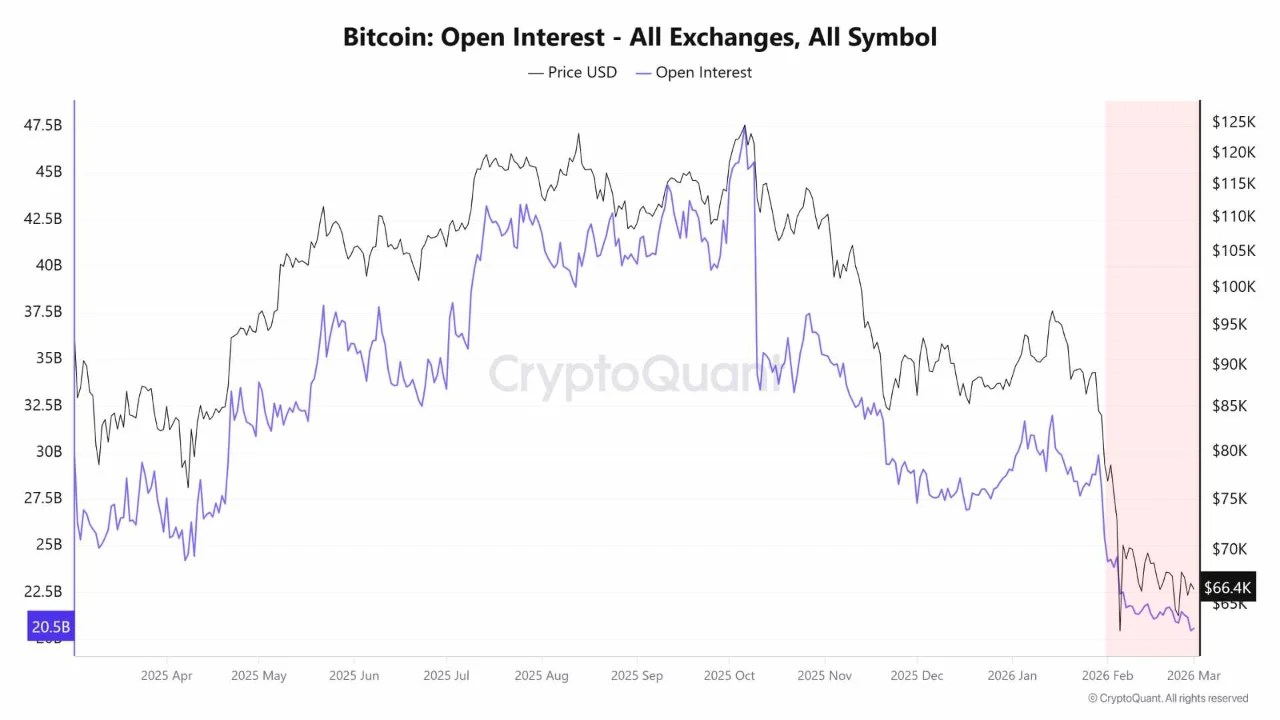
The mid-February drawdown was not simply a directional selloff; it was a leverage event. As the price weakened, liquidation cascades accelerated the decline, forcing long positions out of the market. Open Interest contracted sharply, confirming that the move was driven by derivatives unwinds rather than steady spot distribution. In a thin liquidity regime, these leverage resets tend to exaggerate volatility. When order books are shallow, relatively modest flows can push prices disproportionately, amplifying downside extensions.

Bitcoin Open Interest All Exchanges | Source: CryptoQuant

Although Fear & Greed dropped into Extreme Fear, sentiment exhaustion alone proved insufficient to engineer a durable reversal. Capitulation without follow-through demand often produces reflex bounces, not structural bottoms.

The more structural constraint was the absence of consistent spot participation. ETF flows recorded intermittent daily inflows, but they lacked sustained weekly momentum. At the same time, stablecoin supply growth remained muted, indicating limited sidelined capital ready to deploy. Consequently, rebounds were largely short-covering rallies, driven by position unwinds rather than fresh accumulation.

Macro context reinforced this fragility. Equity weakness and dollar strength framed Bitcoin as a high-beta liquidity proxy, not a defensive asset. In February, structural supply-demand imbalances overpowered historical seasonality. A durable shift now depends on persistent spot inflows and disciplined Open Interest rebuilding.

Связанные с этим вопросы

QWhat was the primary reason for Bitcoin's breakdown of historical seasonality in February 2026 according to the article?

AThe breakdown was driven by structural fragilities, including thin liquidity conditions, leverage imbalances across derivatives markets, and persistently weak spot demand, rather than a single headline event.

QWhat on-chain indicators signaled underlying stress in the Bitcoin market at the beginning of February 2026?

ASOPR remained below 1, indicating coins were being spent at a loss; Realized Cap flattened, showing a slowdown in fresh capital; and the Coinbase Premium lacked consistent strength, suggesting weak US spot demand.

QHow did leverage contribute to the mid-February price drawdown in Bitcoin?

AThe drawdown was a leverage event where weakening price triggered liquidation cascades, forcing long positions out of the market. This derivatives unwind, in thin liquidity conditions, exaggerated volatility and accelerated the decline.

QWhy were the rebounds in Bitcoin's price not considered structural bottoms?

AThe rebounds were largely short-covering rallies driven by position unwinds rather than fresh accumulation, due to the absence of consistent spot participation and sustained demand from ETFs or stablecoin inflows.

QHow did the macro context in February 2026 affect Bitcoin's performance?

AEquity weakness and dollar strength framed Bitcoin as a high-beta liquidity proxy rather than a defensive asset, reinforcing its fragility and making it susceptible to broader market conditions.

Похожее

First Batch of Keynote Speakers and Partners Announced! Web2+3 Summit: Defining the Next Generation of Digital Economy

Web2+3 Summit: Defining the Next Generation of Digital Economy The 6th BEYOND International Technology Innovation Expo (BEYOND Expo 2026), Asia's largest tech and ecosystem exhibition, is launching a dedicated Web2+3 stage for the first time. Co-hosted by BEYOND Expo and ChainNeXT Group, the Web3 Summit will take place from May 28–30, 2026. Against the backdrop of accelerating global tech integration, the boundaries between Web2 and Web3 are rapidly blurring. With clearer global regulations for blockchain-driven internet (Web3) and the special issuance of a Hong Kong dollar stable币 license by the Hong Kong SAR government on April 10, 2026, Web3's decentralized principles are quickly merging with traditional industries (Web2) such as e-commerce, finance, and artificial intelligence. Focused on blockchain-driven digital economy elements, the summit will center on three core principles—implementability, commercial viability, and compliance. It will bring together top Web3 experts to discuss key integration areas like stablecoin payment finance (PayFi), real-world asset tokenization (RWA), and decentralized AI (DeAI), unveiling new opportunities for industrial innovation. The first wave of confirmed speakers includes Jack Kong (Director of Hong Kong Cyberport, Chairman of Nano Labs), Yat Siu (Chairman of Animoca Brands), Michael Wu (Co-founder & CEO of Amber Group), Michael Heinrich (Co-founder & CEO of 0G), and Art Abal (Co-founder of Vana). More Web3 ecosystem pioneers, AI, and fintech experts will be announced soon. Core forum topics include: - Web2+DeAI: New AI Paradigms Driven by Decentralized Infrastructure - Web2+RWA: Real-World Asset Tokenization and Global Liquidity - Web2+PayFi: Cross-Border Payments and Financial Innovation Powered by Crypto Infrastructure - Web2+3 AI: Autonomous Agents and the Crypto Economy - Web2+3 Wealth: On-Chain and Off-Chain Integrated Investment Ecosystems - Web2+3 Commerce: A New Landscape for Global Trade Driven by Stablecoins Additional agenda details will be released in the near future.

marsbit4 ч. назад

First Batch of Keynote Speakers and Partners Announced! Web2+3 Summit: Defining the Next Generation of Digital Economy

marsbit4 ч. назад

Торговля

Спот
Фьючерсы

Популярные статьи

Тест по Bitcoin Биткоина

HTX Learn: Изучите Bitcoin halving и Заработаете Токены USDT

3.0k просмотров всегоОпубликовано 2024.04.16Обновлено 2024.04.16

Тест по Bitcoin  Биткоина

Что такое $BITCOIN

ЦИФРОВОЕ ЗОЛОТО ($BITCOIN): Комплексный анализ Введение в ЦИФРОВОЕ ЗОЛОТО ($BITCOIN) ЦИФРОВОЕ ЗОЛОТО ($BITCOIN) — это проект на основе блокчейна, работающий в сети Solana, который стремится объединить характеристики традиционных драгоценных металлов с инновациями децентрализованных технологий. Хотя он носит имя Биткойн, часто называемого “цифровым золотом” из-за его восприятия как средства хранения ценности, ЦИФРОВОЕ ЗОЛОТО является отдельным токеном, предназначенным для создания уникальной экосистемы в ландшафте Web3. Его цель — позиционировать себя как жизнеспособный альтернативный цифровой актив, хотя детали его применения и функциональности все еще развиваются. Что такое ЦИФРОВОЕ ЗОЛОТО ($BITCOIN)? ЦИФРОВОЕ ЗОЛОТО ($BITCOIN) — это токен криптовалюты, специально разработанный для использования в блокчейне Solana. В отличие от Биткойна, который выполняет широко признанную роль хранения ценности, этот токен, похоже, сосредоточен на более широких приложениях и характеристиках. Примечательные аспекты включают: Инфраструктура блокчейна: Токен построен на блокчейне Solana, известном своей способностью обрабатывать высокоскоростные и недорогие транзакции. Динамика предложения: ЦИФРОВОЕ ЗОЛОТО имеет максимальное предложение, ограниченное 100 квадриллионами токенов (100P $BITCOIN), хотя детали о его обращающемся предложении в настоящее время не раскрыты. Утилита: Хотя точные функциональные возможности не описаны, есть указания на то, что токен может быть использован для различных приложений, потенциально связанных с децентрализованными приложениями (dApps) или стратегиями токенизации активов. Кто создатель ЦИФРОВОГО ЗОЛОТА ($BITCOIN)? На данный момент личность создателей и команды разработчиков, стоящих за ЦИФРОВЫМ ЗОЛОТОМ ($BITCOIN), остается неизвестной. Эта ситуация типична для многих инновационных проектов в области блокчейна, особенно тех, которые связаны с децентрализованными финансами и феноменом мем-криптовалют. Хотя такая анонимность может способствовать культуре, ориентированной на сообщество, она усиливает опасения по поводу управления и ответственности. Кто инвесторы ЦИФРОВОГО ЗОЛОТА ($BITCOIN)? Доступная информация указывает на то, что у ЦИФРОВОГО ЗОЛОТА ($BITCOIN) нет известных институциональных спонсоров или значительных венчурных капиталовложений. Проект, похоже, функционирует по модели пирингового взаимодействия, сосредоточенной на поддержке и принятии сообществом, а не на традиционных путях финансирования. Его активность и ликвидность в основном сосредоточены на децентрализованных биржах (DEX), таких как PumpSwap, а не на устоявшихся централизованных торговых платформах, что еще больше подчеркивает его подход, ориентированный на grassroots. Как работает ЦИФРОВОЕ ЗОЛОТО ($BITCOIN) Операционные механизмы ЦИФРОВОГО ЗОЛОТА ($BITCOIN) можно подробно описать на основе его дизайна блокчейна и характеристик сети: Механизм консенсуса: Используя уникальный механизм доказательства истории (PoH) Solana в сочетании с моделью доказательства доли (PoS), проект обеспечивает эффективную валидацию транзакций, что способствует высокой производительности сети. Токеномика: Хотя конкретные дефляционные механизмы не были подробно описаны, большое максимальное предложение токенов подразумевает, что оно может быть предназначено для микротранзакций или нишевых случаев использования, которые еще предстоит определить. Интероперабельность: Существует потенциал для интеграции с более широкой экосистемой Solana, включая различные платформы децентрализованных финансов (DeFi). Однако детали относительно конкретных интеграций остаются неуточненными. Хронология ключевых событий Вот хронология, которая подчеркивает значимые вехи, касающиеся ЦИФРОВОГО ЗОЛОТА ($BITCOIN): 2023: Первоначальное развертывание токена происходит в блокчейне Solana, отмеченное его адресом контракта. 2024: ЦИФРОВОЕ ЗОЛОТО приобретает видимость, когда оно становится доступным для торговли на децентрализованных биржах, таких как PumpSwap, позволяя пользователям обменивать его на SOL. 2025: Проект наблюдает спорадическую торговую активность и потенциальный интерес к инициативам, возглавляемым сообществом, хотя на данный момент не зафиксировано никаких значительных партнерств или технических достижений. Критический анализ Сильные стороны Масштабируемость: Основная инфраструктура Solana поддерживает высокие объемы транзакций, что может повысить полезность $BITCOIN в различных сценариях транзакций. Доступность: Потенциально низкая цена торговли за токен может привлечь розничных инвесторов, способствуя более широкому участию благодаря возможностям дробного владения. Риски Отсутствие прозрачности: Отсутствие публично известных спонсоров, разработчиков или процесса аудита может вызвать скептицизм относительно устойчивости и надежности проекта. Волатильность рынка: Торговая активность сильно зависит от спекулятивного поведения, что может привести к значительной волатильности цен и неопределенности для инвесторов. Заключение ЦИФРОВОЕ ЗОЛОТО ($BITCOIN) является интригующим, но неоднозначным проектом в быстро развивающейся экосистеме Solana. Хотя он пытается использовать нарратив “цифрового золота”, его отход от установленной роли Биткойна как средства хранения ценности подчеркивает необходимость более четкого различения его предполагаемой утилиты и структуры управления. Будущее принятие и усвоение, вероятно, будут зависеть от решения текущей непрозрачности и более четкого определения его операционных и экономических стратегий. Примечание: Этот отчет охватывает синтезированную информацию, доступную на октябрь 2023 года, и с тех пор могут произойти события.

99 просмотров всегоОпубликовано 2025.05.13Обновлено 2025.05.13

Что такое $BITCOIN

Fractal Bitcoin: масштабирование Биткоина с помощью рекурсивной системы

Fractal Bitcoin — масштабное Layer-1-решнение, созданное на базе кода Биткоина, позволяющего достигать бесконечного масштабирования с помощью рекурсивного подхода.

2.2k просмотров всегоОпубликовано 2025.06.30Обновлено 2025.06.30

Fractal Bitcoin: масштабирование Биткоина с помощью рекурсивной системы

Обсуждения

Добро пожаловать в Сообщество HTX. Здесь вы сможете быть в курсе последних новостей о развитии платформы и получить доступ к профессиональной аналитической информации о рынке. Мнения пользователей о цене на BTC (BTC) представлены ниже.

活动图片