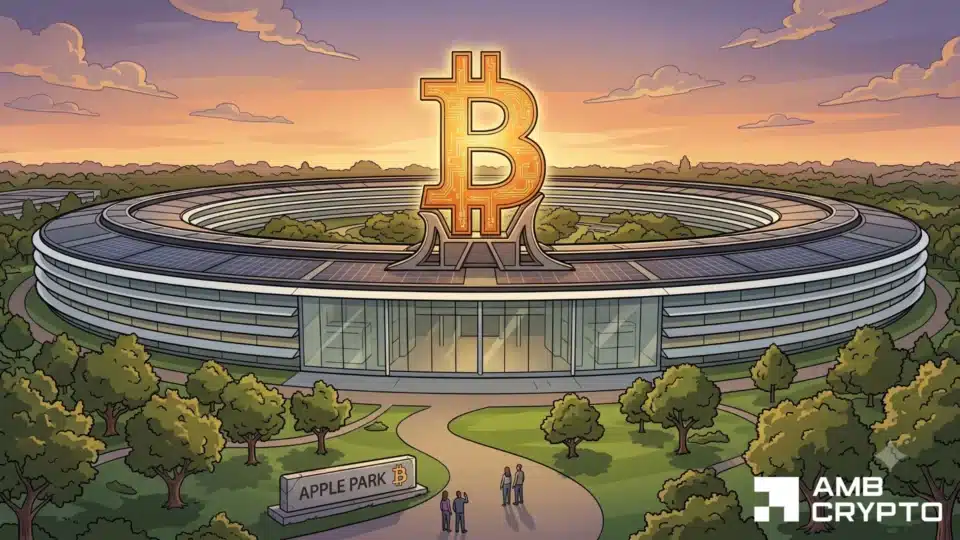
When the 'Bitcoin Bible' Prophecy Meets Soaring Silver: Is the Old Theory Still Valid?

比推Опубликовано 2026-01-28Обновлено 2026-01-28

Введение

A book published in 2018, "The Bitcoin Standard," argued that Bitcoin is a harder form of money than gold and that silver cannot serve as a reliable store of value due to its high supply elasticity—meaning production can quickly ramp up when prices rise, causing bubbles to burst, as seen in the Hunt brothers' case in the 1980s. However, eight years later, silver has surged to a record $117 per ounce, driven by structural shifts. Unlike past speculative bubbles, today’s rally is fueled by industrial demand: over 60% of silver use now comes from sectors like solar panels, electric vehicles, and AI hardware. Supply has not kept pace; mining output has declined since 2016, and inventories are shrinking. New factors, such as China’s export restrictions on refined silver, have further tightened markets. Bitcoin maximalists cite the book to defend their stance, arguing silver’s rise is temporary and that Bitcoin’s fixed supply makes it superior long-term. But current silver dynamics challenge earlier assumptions, highlighting a clash between old theories and new realities. As silver continues its rally, Bitcoin proponents await a narrative reversal.

Author: David, Shenchao TechFlow

Original Title: An 8-Year-Old Book About Bitcoin Is 'Predicting' a Silver Crash?


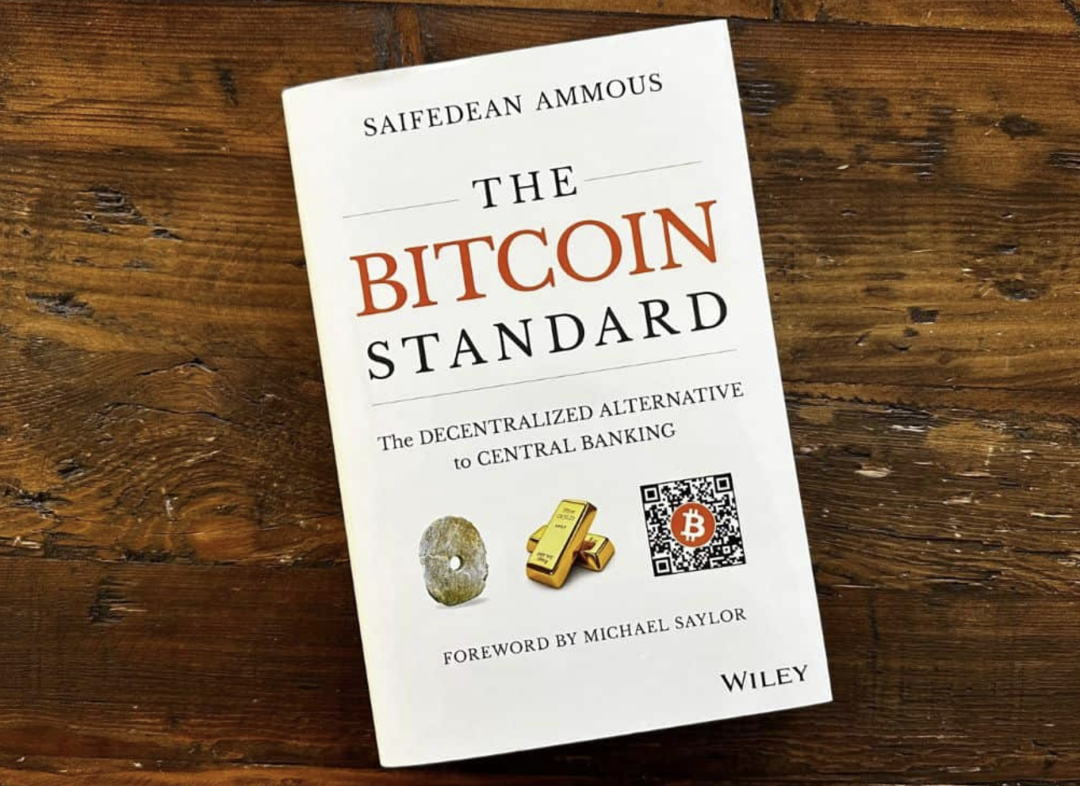
In 2020, MicroStrategy founder Michael Saylor read a book and decided to buy $425 million worth of Bitcoin.

This book is called "The Bitcoin Standard," published in 2018, translated into 39 languages, sold over a million copies, and is revered by Bitcoin enthusiasts as the "Bible."

Author Saifedean Ammous, a Columbia University economics PhD, has one core argument:

Bitcoin is a "harder" form of hard currency than gold.

Meanwhile, on the book's promotional page, Michael Saylor's endorsement reads:

"This book is a work of genius. After reading it, I decided to buy $425 million worth of Bitcoin. It has had the greatest impact on MicroStrategy's way of thinking, leading us to shift our balance sheet to a Bitcoin standard."

But there is one chapter in this book that isn't about Bitcoin. It's about why silver cannot become a hard currency.

Eight years later, silver has just surged to a historic high of $117 per ounce, the investment frenzy in precious metals continues, and even Hyperliquid and a number of CEXs have begun listing precious metal contracts in various forms.

Often at times like these, there are always those who act as whistleblowers or defectors to warn of risks, especially in an environment where everything is rising except Bitcoin.

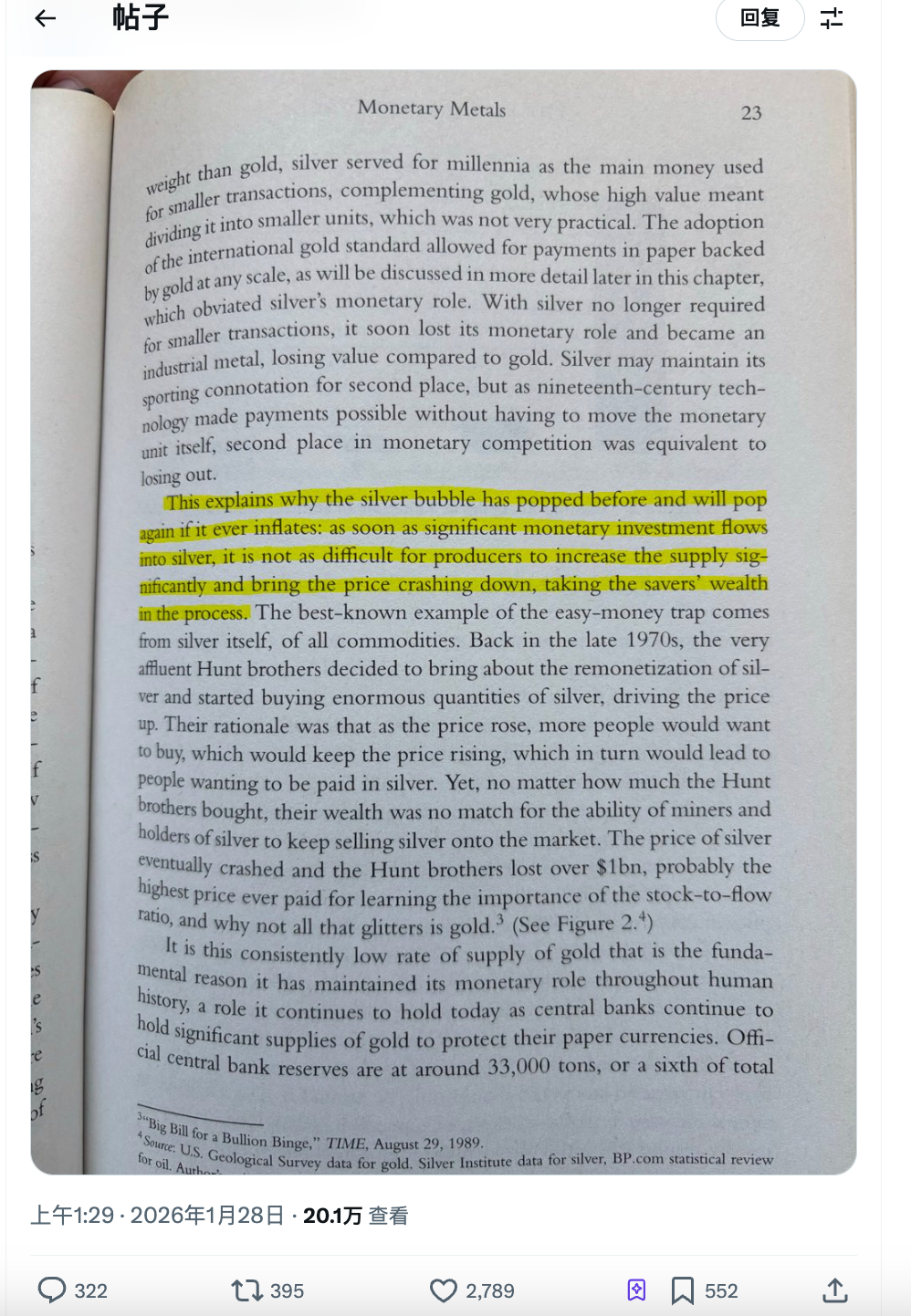
For example, a widely circulated post on Crypto Twitter today is someone quoting from this book, sharing a screenshot of page 23 with a highlighted paragraph that reads:

Every silver bubble has burst, and the next one will be no exception.

The History of Silver Speculation

Before you rush to criticize, let's look at what this core argument actually is.

The core argument in this book is called stock-to-flow. OG BTC enthusiasts have probably heard of this theory.

Translated into plain language: For something to become a "hard currency," the key is how difficult it is to increase its production.

Gold is hard to mine. Global above-ground gold stocks are about 200,000 tons, with annual new production of less than 3,500 tons. Even if the gold price doubles, miners can't suddenly dig out twice as much gold. This is called "supply rigidity."

Bitcoin is even more extreme. The total supply is capped at 21 million coins, halving every four years, and no one can change the code. This is scarcity created by algorithm.

What about silver?

The gist of that highlighted passage is: Silver bubbles have burst before and will burst again. Because once large amounts of money flow into silver, miners can easily increase supply, driving the price down, and evaporating the wealth of savers.

The author also gives an example: the Hunt brothers.

In the late 1970s, Texas oil tycoons the Hunt brothers decided to hoard silver, attempting to corner the market. They bought billions of dollars worth of silver and futures contracts, driving the price from $6 to $50, setting a then-historic high for silver.

And then? Miners疯狂出货白银 (frantically sold silver), exchanges raised margin requirements, and the silver price crashed. The Hunt brothers lost over $1 billion and eventually went bankrupt.

Therefore, the author's conclusion is:

Silver's supply elasticity is too high,注定不可能成为价值储存工具 (doomed to be unable to become a store of value). Every time someone tries to hoard it as "hard currency," the market will teach them a lesson with increased production.

When this logic was written in 2018, silver was $15 an ounce. Nobody cared.

Is This Silver Rally Different?

For the above logic about silver to hold true, there is a premise: if the silver price rises, supply can keep up.

However, data from the last 25 years tells a different story.

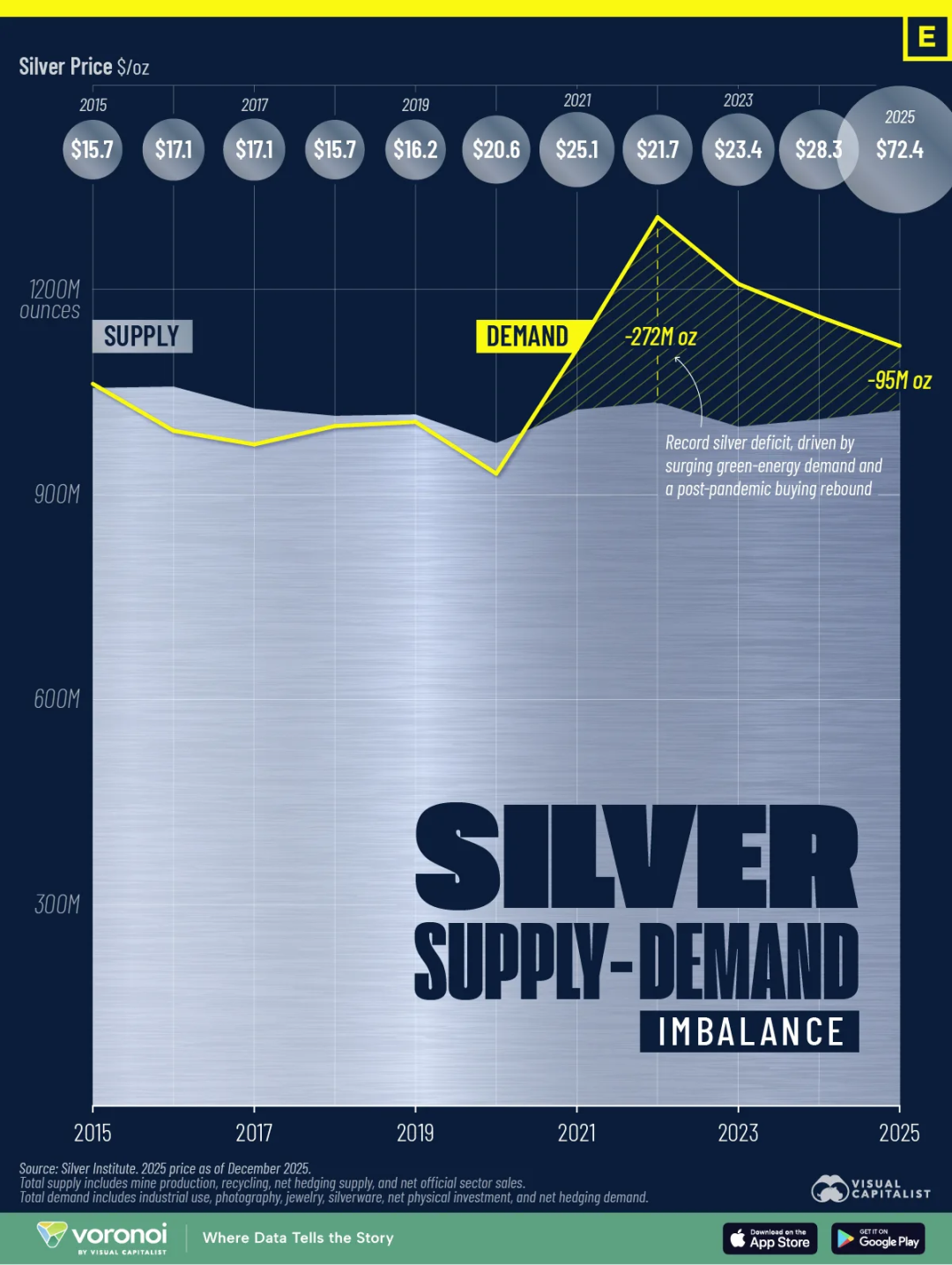
Global silver mine production peaked in 2016 at approximately 900 million ounces. By 2025, this number had dropped to 835 million ounces. The price increased 7-fold, but production反而缩了 7% (instead shrank by 7%).

Why doesn't the "price rise leads to production increase" logic work?

One structural reason is that about 75% of silver is produced as a by-product of copper, zinc, and lead mining. Miners' production decisions depend on the prices of these base metals, not on silver. Even if the silver price doubles, if the copper price doesn't rise, mines won't open more.

Another reason might be time. The cycle from exploration to production for a new mine project is 8 to 12 years. Even if work starts immediately, no new supply will be seen before 2030.

The result is five consecutive years of supply deficit. According to Silver Institute data, from 2021 to 2025, the global cumulative silver deficit is close to 820 million ounces, almost equivalent to a full year's global mine production.

Meanwhile, silver inventories are also bottoming out. The London Bullion Market Association's deliverable silver inventory has dropped to only 155 million ounces. The silver lease rate has surged from the normal 0.3%-0.5% to 8%, meaning someone is willing to pay an 8% annualized cost just to secure physical silver.

There's also a new variable. Starting January 1, 2026, China implemented export restrictions on refined silver, with only state-owned large factories with an annual production capacity of over 80 tons able to obtain export licenses. Small and medium-sized exporters are directly shut out.

In the era of the Hunt brothers, miners and holders could use increased production and selling to smash the price.

This time, the supply side might be running out of bullets.

Speculation, but also Rigid Demand

When the Hunt brothers hoarded silver, silver was a monetary speculation. Buyers thought: the price will rise, hoard it and wait to sell.

The driving force behind the 2025 silver rally is completely different.

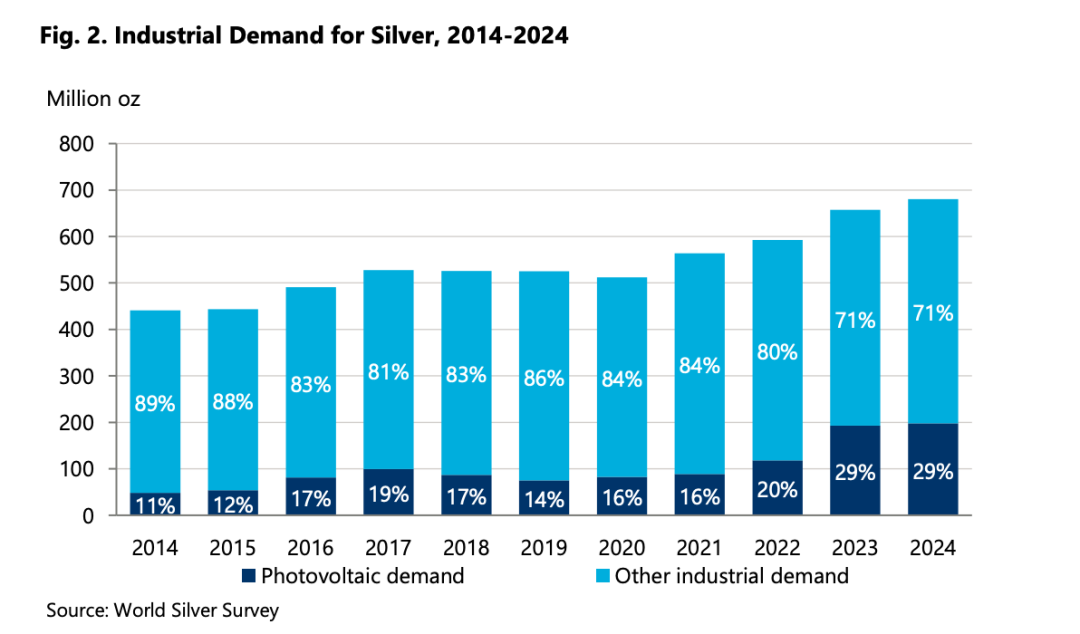
First, look at some data. According to the World Silver Survey 2025 report, industrial demand for silver reached 680.5 million ounces in 2024, a historical high. This number accounts for over 60% of total global demand.

What is industrial demand buying?

Photovoltaics (PV). Every solar panel requires silver paste for its conductive layer. The International Energy Agency predicts global PV installed capacity will quadruple by 2030. The PV industry is already the single largest industrial buyer of silver.

Electric Vehicles (EVs). A traditional internal combustion engine vehicle uses about 15-28 grams of silver. An electric vehicle uses 25-50 grams, with high-end models using even more. Battery management systems, motor controllers, charging interfaces—silver is needed everywhere.

AI and Data Centers. Servers, chip packaging, high-frequency connectors—silver's conductivity and thermal conductivity are irreplaceable. This demand began accelerating in 2024, and the Silver Institute specifically listed "AI-related applications" in its report.

In 2025, the U.S. Department of the Interior listed silver on its "Critical Minerals" list. The last time this list was updated, lithium and rare earths were added.

Of course, sustained high silver prices will bring about a "silver thrifting" effect, such as some PV manufacturers already reducing the amount of silver paste per panel. But the Silver Institute's prediction is that even considering thrifting, industrial demand will remain near record levels for the next 1-2 years.

This is essentially rigid demand, a variable that Saifedean might not have foreseen when writing "The Bitcoin Standard."

A Book Can Also Provide Psychological Comfort

Bitcoin's "digital gold" narrative has recently been muted in the face of actual gold and silver.

The market has dubbed this year the "Debasement Trade": a weakening dollar, rising inflation expectations, geopolitical tensions, funds flowing into hard assets for safety. But this wave of safe-haven money chose gold and silver, not Bitcoin.

For Bitcoin maximalists, this requires an explanation.

Hence, the aforementioned book becomes a kind of classical reference for an answer and a defense of their position: silver is rising now because it's a bubble, wait for it to crash, then you'll know who was right.

This is more like a narrative self-rescue.

When the asset you hold underperforms the market for a whole year, you need a framework to explain "why I'm still right."

Short-term price doesn't matter, long-term logic does. Silver's logic is wrong, Bitcoin's logic is right, so Bitcoin must outperform, it's just a matter of time.

Is this logic consistent? Yes. Can it be falsified? Difficult.

Because you can always say "not enough time has passed."

The problem is, the real world doesn't wait. Brothers holding Bitcoin and altcoins, still坚守加密圈 (holding fast to the crypto circle), are really anxious.

A Bitcoin theory written 8 years ago cannot automatically cover the reality of not rising 8 years later.

Silver is still soaring, and we sincerely wish Bitcoin good luck.


Twitter:https://twitter.com/BitpushNewsCN

Bitpush TG Discussion Group:https://t.me/BitPushCommunity

Bitpush TG Subscription: https://t.me/bitpush

Original link:https://www.bitpush.news/articles/7606661

Связанные с этим вопросы

QWhat is the core argument of 'The Bitcoin Standard' regarding Bitcoin and gold?

AThe core argument of 'The Bitcoin Standard' is that Bitcoin is a harder form of 'hard currency' than gold, based on its superior stock-to-flow ratio and algorithmic scarcity.

QAccording to the book, why is silver not considered a reliable store of value?

AThe book argues that silver is not a reliable store of value because its supply is highly elastic; when prices rise, miners can easily increase production, leading to price crashes and loss of wealth for savers.

QWhat historical example does the author use to illustrate the risk of silver speculation?

AThe author uses the example of the Hunt brothers in the late 1970s, who attempted to corner the silver market but ultimately went bankrupt after miners increased supply and exchanges raised margin requirements, causing prices to collapse.

QHow has the supply dynamics of silver changed since the book was written, challenging its original thesis?

ASince the book was written, silver production has declined despite rising prices, due to structural factors like silver being a byproduct of other metals and long lead times for new mines, resulting in a sustained supply deficit.

QWhat new industrial demands are driving silver's current price surge, according to the article?

ACurrent industrial demands driving silver's price surge include its use in photovoltaic solar panels, electric vehicles, and AI/data center applications, which account for over 60% of global demand and create rigid, non-speculative needs.

Похожее

Торговля

Спот
Фьючерсы

Популярные статьи

Тест по Bitcoin Биткоина

HTX Learn: Изучите Bitcoin halving и Заработаете Токены USDT

3.0k просмотров всегоОпубликовано 2024.04.16Обновлено 2024.04.16

Тест по Bitcoin  Биткоина

Что такое $BITCOIN

ЦИФРОВОЕ ЗОЛОТО ($BITCOIN): Комплексный анализ Введение в ЦИФРОВОЕ ЗОЛОТО ($BITCOIN) ЦИФРОВОЕ ЗОЛОТО ($BITCOIN) — это проект на основе блокчейна, работающий в сети Solana, который стремится объединить характеристики традиционных драгоценных металлов с инновациями децентрализованных технологий. Хотя он носит имя Биткойн, часто называемого “цифровым золотом” из-за его восприятия как средства хранения ценности, ЦИФРОВОЕ ЗОЛОТО является отдельным токеном, предназначенным для создания уникальной экосистемы в ландшафте Web3. Его цель — позиционировать себя как жизнеспособный альтернативный цифровой актив, хотя детали его применения и функциональности все еще развиваются. Что такое ЦИФРОВОЕ ЗОЛОТО ($BITCOIN)? ЦИФРОВОЕ ЗОЛОТО ($BITCOIN) — это токен криптовалюты, специально разработанный для использования в блокчейне Solana. В отличие от Биткойна, который выполняет широко признанную роль хранения ценности, этот токен, похоже, сосредоточен на более широких приложениях и характеристиках. Примечательные аспекты включают: Инфраструктура блокчейна: Токен построен на блокчейне Solana, известном своей способностью обрабатывать высокоскоростные и недорогие транзакции. Динамика предложения: ЦИФРОВОЕ ЗОЛОТО имеет максимальное предложение, ограниченное 100 квадриллионами токенов (100P $BITCOIN), хотя детали о его обращающемся предложении в настоящее время не раскрыты. Утилита: Хотя точные функциональные возможности не описаны, есть указания на то, что токен может быть использован для различных приложений, потенциально связанных с децентрализованными приложениями (dApps) или стратегиями токенизации активов. Кто создатель ЦИФРОВОГО ЗОЛОТА ($BITCOIN)? На данный момент личность создателей и команды разработчиков, стоящих за ЦИФРОВЫМ ЗОЛОТОМ ($BITCOIN), остается неизвестной. Эта ситуация типична для многих инновационных проектов в области блокчейна, особенно тех, которые связаны с децентрализованными финансами и феноменом мем-криптовалют. Хотя такая анонимность может способствовать культуре, ориентированной на сообщество, она усиливает опасения по поводу управления и ответственности. Кто инвесторы ЦИФРОВОГО ЗОЛОТА ($BITCOIN)? Доступная информация указывает на то, что у ЦИФРОВОГО ЗОЛОТА ($BITCOIN) нет известных институциональных спонсоров или значительных венчурных капиталовложений. Проект, похоже, функционирует по модели пирингового взаимодействия, сосредоточенной на поддержке и принятии сообществом, а не на традиционных путях финансирования. Его активность и ликвидность в основном сосредоточены на децентрализованных биржах (DEX), таких как PumpSwap, а не на устоявшихся централизованных торговых платформах, что еще больше подчеркивает его подход, ориентированный на grassroots. Как работает ЦИФРОВОЕ ЗОЛОТО ($BITCOIN) Операционные механизмы ЦИФРОВОГО ЗОЛОТА ($BITCOIN) можно подробно описать на основе его дизайна блокчейна и характеристик сети: Механизм консенсуса: Используя уникальный механизм доказательства истории (PoH) Solana в сочетании с моделью доказательства доли (PoS), проект обеспечивает эффективную валидацию транзакций, что способствует высокой производительности сети. Токеномика: Хотя конкретные дефляционные механизмы не были подробно описаны, большое максимальное предложение токенов подразумевает, что оно может быть предназначено для микротранзакций или нишевых случаев использования, которые еще предстоит определить. Интероперабельность: Существует потенциал для интеграции с более широкой экосистемой Solana, включая различные платформы децентрализованных финансов (DeFi). Однако детали относительно конкретных интеграций остаются неуточненными. Хронология ключевых событий Вот хронология, которая подчеркивает значимые вехи, касающиеся ЦИФРОВОГО ЗОЛОТА ($BITCOIN): 2023: Первоначальное развертывание токена происходит в блокчейне Solana, отмеченное его адресом контракта. 2024: ЦИФРОВОЕ ЗОЛОТО приобретает видимость, когда оно становится доступным для торговли на децентрализованных биржах, таких как PumpSwap, позволяя пользователям обменивать его на SOL. 2025: Проект наблюдает спорадическую торговую активность и потенциальный интерес к инициативам, возглавляемым сообществом, хотя на данный момент не зафиксировано никаких значительных партнерств или технических достижений. Критический анализ Сильные стороны Масштабируемость: Основная инфраструктура Solana поддерживает высокие объемы транзакций, что может повысить полезность $BITCOIN в различных сценариях транзакций. Доступность: Потенциально низкая цена торговли за токен может привлечь розничных инвесторов, способствуя более широкому участию благодаря возможностям дробного владения. Риски Отсутствие прозрачности: Отсутствие публично известных спонсоров, разработчиков или процесса аудита может вызвать скептицизм относительно устойчивости и надежности проекта. Волатильность рынка: Торговая активность сильно зависит от спекулятивного поведения, что может привести к значительной волатильности цен и неопределенности для инвесторов. Заключение ЦИФРОВОЕ ЗОЛОТО ($BITCOIN) является интригующим, но неоднозначным проектом в быстро развивающейся экосистеме Solana. Хотя он пытается использовать нарратив “цифрового золота”, его отход от установленной роли Биткойна как средства хранения ценности подчеркивает необходимость более четкого различения его предполагаемой утилиты и структуры управления. Будущее принятие и усвоение, вероятно, будут зависеть от решения текущей непрозрачности и более четкого определения его операционных и экономических стратегий. Примечание: Этот отчет охватывает синтезированную информацию, доступную на октябрь 2023 года, и с тех пор могут произойти события.

99 просмотров всегоОпубликовано 2025.05.13Обновлено 2025.05.13

Что такое $BITCOIN

Fractal Bitcoin: масштабирование Биткоина с помощью рекурсивной системы

Fractal Bitcoin — масштабное Layer-1-решнение, созданное на базе кода Биткоина, позволяющего достигать бесконечного масштабирования с помощью рекурсивного подхода.

2.2k просмотров всегоОпубликовано 2025.06.30Обновлено 2025.06.30

Fractal Bitcoin: масштабирование Биткоина с помощью рекурсивной системы

Обсуждения

Добро пожаловать в Сообщество HTX. Здесь вы сможете быть в курсе последних новостей о развитии платформы и получить доступ к профессиональной аналитической информации о рынке. Мнения пользователей о цене на BTC (BTC) представлены ниже.

活动图片