Twenty One Plunges Nearly 20% on Debut: The Valuation Mystery of the Third-Largest Bitcoin DAT

Odaily星球日报Опубликовано 2025-12-10Обновлено 2025-12-10

Введение

Twenty One Capital (NYSE: XXI), a Bitcoin-focused asset reserve company backed by Tether and SoftBank, debuted on the New York Stock Exchange on December 9. Despite its strong backing and large Bitcoin holdings, its stock plunged nearly 20% on the first trading day. The company holds 43,514 BTC, making it the third-largest corporate Bitcoin holder globally, yet its market valuation sits at just $186 million—a mere 4.6% of its Bitcoin's market value. This extreme discount stems from its reliance on "shareholder injections" rather than open-market purchases. Most of its Bitcoin came directly from Tether, raising transparency and sustainability concerns. The broader Digital Asset Treasury (DAT) model is under pressure, with most major Bitcoin-holding companies trading below their net asset value. While proponents like Michael Saylor argue Bitcoin will become a foundational asset in the digital economy, the market remains skeptical in the short term, demanding more proof of the model’s resilience.

Original | Odaily Planet Daily (@OdailyChina)

Author | Ding Dang (@XiaMiPP)

Twenty One Capital (NYSE: XXI), a "Bitcoin asset reserve company" backed by stablecoin giant Tether and Japanese conglomerate SoftBank Group, officially listed on the New York Stock Exchange on December 9. However, in stark contrast to its resource advantages of "heavy assets" and "strong backing," the stock price plummeted immediately after the first day's opening, with a intraday drop of nearly 20%. The capital market's initial report card was not friendly.

Twenty One was founded in early 2025 and is led by Strike founder and CEO Jack Mallers. It is positioned as a company with Bitcoin as its core asset allocation. It has strong backing from stablecoin issuer Tether, Japan's SoftBank Group, and Wall Street investment bank Cantor Fitzgerald.

It is important to note that Twenty One did not undergo a traditional IPO but instead completed a backdoor listing by merging with Cantor Equity Partners (a SPAC), officially listing on the NYSE on December 9. Cantor Equity Partners is a key platform under Cantor Fitzgerald. The company is headed by Brandon Lutnick, son of the U.S. Secretary of Commerce, who personally led this merger. He emphasized in the announcement that Cantor's partnership was key to engaging innovative participants like Tether and SoftBank. This relationship adds a "dimension of institutional prestige" to Twenty One Capital, especially in the context of the Trump administration's promised crypto-friendly policies.

But market sentiment is clearly more complex. The company initially under the ticker CEP saw its stock price surge from $10.2 to a high of $59.6 after the announcement, a gain of nearly 6 times. The initial enthusiasm for the "Bitcoin reserve company" narrative was almost written on the K-line chart. However, as speculative sentiment faded, the price quickly fell back and is currently hovering around $11.4, erasing almost all of the premium.

This forms an extremely strong contrast with its massive Bitcoin holdings. As of the listing, Twenty One held 43,514 BTC, with a market value of approximately $4.03 billion, ranking third in the global corporate Bitcoin holdings list, behind only Strategy and MARA Holdings.

Valuation Puzzle: Causes Behind the Extreme Discount

What truly puzzles the market is its valuation structure. At the current stock price level, Twenty One's overall market capitalization is only about $186 million, with a market multiple (mNAV) as low as 0.046. This means the capital market is only willing to price its Bitcoin assets at about 4.6% of their book value. Why such an extreme discount?

A deep dive into its asset acquisition method reveals that Twenty One's Bitcoin reserves were not primarily formed through long-term purchases on the open market but highly relied on a "shareholder infusion" model: its initial reserve of approximately 42,000 BTC came from a direct capital injection by Tether. Subsequently, on May 14, 2025, the company added 4,812 BTC through Tether, costing about $458.7 million at the time, corresponding to a cost of about $95,300 per coin; and before the listing, it completed an additional plan to acquire about 5,800 BTC through PIPE financing and convertible bond mechanisms.

The advantage of this model is its high efficiency, avoiding the lengthy process of building positions in the secondary market and allowing for scaled-up reserves in a short time; but the cost is equally obvious: assets are highly concentrated from a few related parties, making it difficult for investors to fully penetrate its internal transaction structure, custody form, and potential agreement constraints. Transparency and sustainability naturally become important discount factors in market pricing.

Collective Dilemma of the "Digital Asset Reserve Company" Model

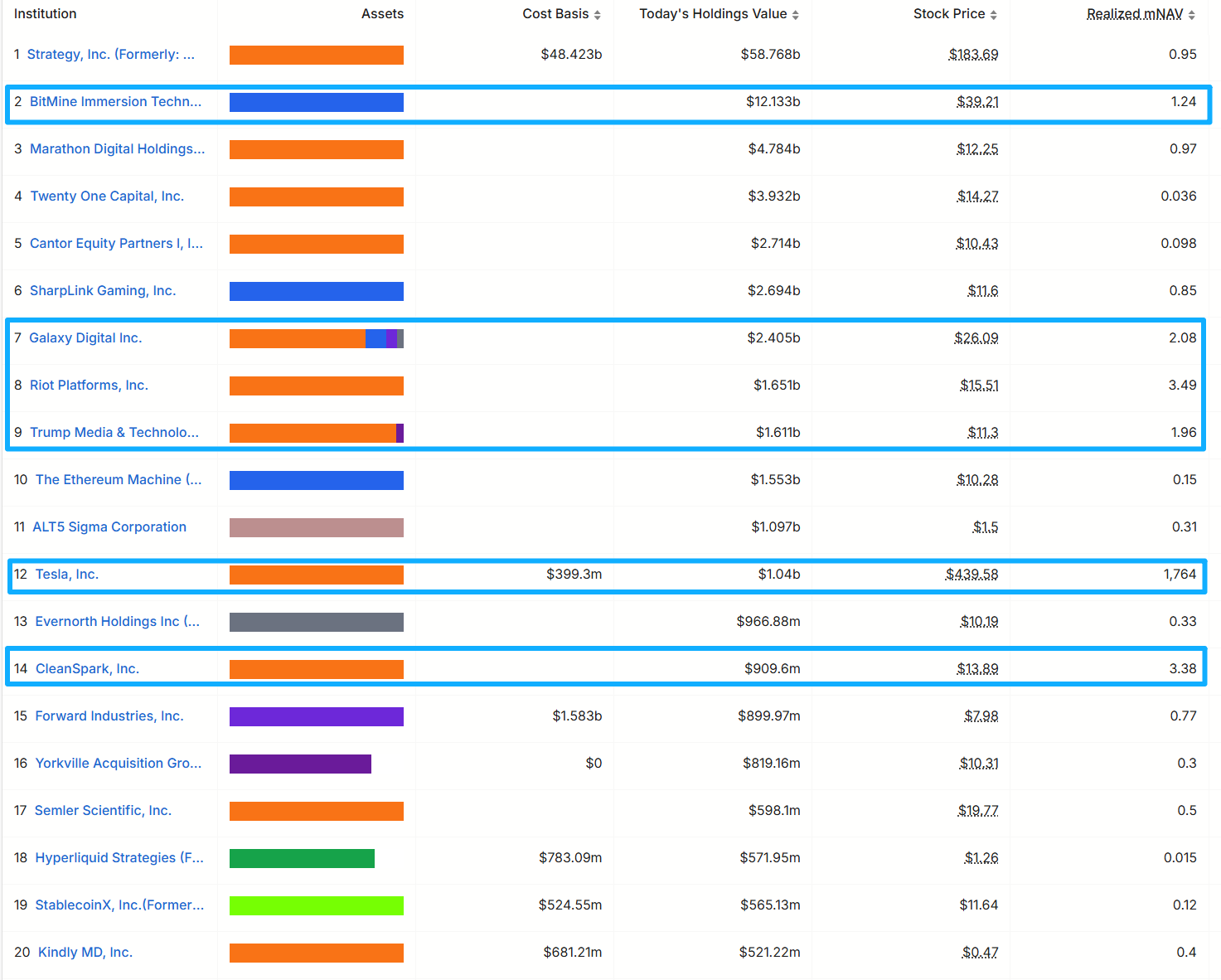
From an industry perspective, Twenty One's problem is no longer an isolated case. According to defillama.com data, there are currently over 70 "crypto-stock companies" (i.e., listed companies holding crypto assets) globally. Among the top 20 holders, the mNAV of most companies has fallen below 1, including Strategy, which pioneered this model.

As the overall crypto market retreats, these "crypto-stock companies" have gradually retreated from being the core of the narrative to marginal assets in risk models. The current valuation of these crypto asset reserve companies has generally turned cautious.

However, there is an order of magnitude difference between Strategy and Twenty One. Strategy currently holds about 660,600 Bitcoin, accounting for about 3% of the total Bitcoin supply, a scale more than 15 times that of Twenty One. This size not only gives it stronger market influence but also a certain symbolic meaning of "systemic anchoring." When Strategy's mNAV falls below 1, the market naturally raises deeper questions: Will it be forced to sell coins? Could its debt structure trigger a stampede? Has the DAT model lost its logical foundation in the face of the macro cycle?

In fact, with the significant retreat of the crypto market in 2025, the DAT model faces severe tests. The core of this model is to accumulate Bitcoin through debt and equity financing, treating it as the "ultimate asset" to hedge against inflation and currency devaluation. But when Bitcoin's price volatility significantly amplifies, the stability of this model begins to waver. Some companies, despite holding large amounts of BTC, face valuation pressure due to operational costs and market sentiment. Twenty One's extreme discount, while related to its asset acquisition method, is also a concentrated reflection of the market's risk pricing for the entire DAT model.

Conclusion: The Narrative Remains, But the Market Needs Time

At the Binance Blockchain Week on December 4, Michael Saylor provided a broader perspective. In his speech titled "Why Bitcoin Remains the Ultimate Asset: The Next Chapter of Bitcoin," he reiterated his core judgment about Bitcoin's next decade: Bitcoin is transitioning from an investment product to the "basic capital" of the global digital economy, and the rise of the digital credit system will reshape the traditional $300 trillion credit market. From policy shifts and changes in bank attitudes, to the institutional absorption of ETFs, and the explosive growth of digital credit tools, Saylor描绘s a new financial order accelerating into being: digital capital provides energy, digital credit provides structure, and Bitcoin will become the underlying asset supporting it all.

From this perspective, companies like Twenty One do possess a potential for being "correct in the long term"—if Bitcoin ultimately completes its migration from a high-risk asset to "digital gold," then these companies may become core carriers in this migration process.

But the problem is, "correct in the long term" does not automatically equate to "reasonably priced in the present." The market still needs time to verify Bitcoin's true role in the macro system, and it also needs time to reassess the resilience of the DAT model under different cycle conditions.

Related reading: "Full Text of Saylor's Dubai Speech: Why Bitcoin Will Become the Underlying Asset of Global Digital Capital"

Связанные с этим вопросы

QWhat was the stock performance of Twenty One Capital (NYSE: XXI) on its first day of trading?

AThe stock of Twenty One Capital experienced a significant decline on its first day, with the price falling nearly 20%.

QWho are the major backers of Twenty One Capital?

ATwenty One Capital is backed by stablecoin issuer Tether, the Japanese conglomerate SoftBank Group, and the Wall Street investment bank Cantor Fitzgerald.

QHow did Twenty One Capital acquire the majority of its Bitcoin reserves?

AThe majority of its Bitcoin reserves were acquired through 'shareholder infusions,' primarily a direct capital injection of approximately 42,000 BTC from Tether, rather than through gradual purchases on the open market.

QWhat is the market's valuation (mNAV) of Twenty One Capital's Bitcoin holdings, and what does this indicate?

AThe market is valuing Twenty One Capital's Bitcoin holdings at a significant discount, with a market multiple (mNAV) of just 0.046, meaning the market is pricing its Bitcoin assets at only about 4.6% of their book value. This indicates deep market skepticism and a discount due to concerns over transparency and the sustainability of its asset acquisition model.

QAccording to the article, what is the broader challenge facing the Digital Asset Treasury (DAT) company model?

AThe broader challenge for the DAT model is that as the crypto market has experienced a major pullback, the core premise of using debt and equity to accumulate Bitcoin as a hedge is being tested. Market volatility has shaken the model's stability, leading to widespread discounted valuations (mNAV below 1) for many companies in this sector, reflecting a market-wide repricing of risk for the entire DAT model.

Похожее

The Era Has Arrived Where Human Writers Must Prove They Are Not Machines

The article describes an era where AI-generated content is flooding the market, forcing human authors to prove they are not machines. It begins with the example of dozens of AI-written, error-ridden biographies of Henry Kissinger appearing on Amazon within hours of his death, a pattern repeated for other deceased celebrities and even living experts who find fraudulent books under their names. This spam content has exploded, with monthly new book releases on platforms like Amazon reaching 300,000 by late 2025. The issue spans genres, from suspiciously high proportions of AI-written teen romance and self-help books to dangerous, AI-generated foraging guides containing lethal advice. The platforms' automated review systems, designed to catch plagiarism and banned words, are ill-equipped to detect AI-generated text that avoids these pitfalls while being nonsensical or fraudulent. The problem has infiltrated traditional publishing. A major publisher, Hachette, had to recall a bestselling horror novel after AI detection tools suggested 78% of its content was machine-generated. An acclaimed European philosophy book was later revealed to be entirely written by AI under a fake author persona. In response, authors are fighting back. At the 2026 London Book Fair, 10,000 writers published a blank book titled "Don't Steal This Book" containing only their signatures—using emptiness as a protest weapon in an age of AI overproduction. Initiatives like the "Human Author Certification" program have emerged, ironically placing the burden on humans to prove their work is not machine-made. The article warns of a vicious cycle: AI-generated low-quality books pollute the data used to train future AI models, leading to "model collapse" and an ever-worsening flood of digital waste, eroding trust in publishing and devaluing human creativity.

marsbit8 мин. назад

The Era Has Arrived Where Human Writers Must Prove They Are Not Machines

marsbit8 мин. назад

The King of Blind Date Attire in Korea: How SK Hynix Made a Comeback Against Samsung?

In South Korea's dating scene, SK Hynix employees are now highly sought after, a status shift fueled by the company's astronomical profits and employee bonuses, projected to reach up to 6.1 million RMB per person by 2027. This marks a dramatic reversal for the long-time second-place player in memory semiconductors, which has now surpassed its rival Samsung in annual operating profit. The turnaround story began in 2008 when a struggling Hynix, emerging from bankruptcy restructuring, took a risky bet by agreeing to develop High Bandwidth Memory (HBM) with AMD. At the time, HBM had no clear market beyond high-end graphics cards and was a costly, complex technology. Major players like Samsung, pursuing its own HMC technology, declined. For Hynix, with only memory as its core business, it was a gamble born of necessity. The pivotal moment came in 2012 when SK Group Chairman Chey Tae-won acquired Hynix. Defying industry downturns, he invested heavily in R&D and fabrication, sustaining the HBM project through over a decade of commercial uncertainty and internal challenges. A key break occurred around 2016-2017 when Samsung faced production issues supplying HBM2 for Google's TPU, allowing SK Hynix to gain a crucial foothold in the data center market. The AI explosion post-ChatGPT in 2022 was the catalyst, turning HBM into a critical bottleneck for AI accelerators like NVIDIA's GPUs. By 2025, SK Hynix captured 62% of the global HBM market, leaving Samsung at 17%. For the first time, its annual operating profit exceeded Samsung's. Analysts point to the "innovator's dilemma" to explain Samsung's miss: its vast, successful business portfolio made it risk-averse, preventing an all-in bet on the initially niche HBM technology. In contrast, SK Hynix, as a challenger with its back against the wall, had no choice but to commit fully. The story highlights how Korea's chaebol system allows for ultra-long-term bets beyond quarterly pressures. However, SK Hynix's lead isn't guaranteed. Samsung is aggressively catching up on HBM4, and challenges like customer concentration (heavy reliance on NVIDIA) and technical hurdles in advanced packaging remain. The narrative underscores a market truth: the greatest alpha often comes from betting on uncertain, long-term directions others dismiss, much like HBM in 2008.

marsbit48 мин. назад

The King of Blind Date Attire in Korea: How SK Hynix Made a Comeback Against Samsung?

marsbit48 мин. назад

Торговля

Спот
Фьючерсы

Популярные статьи

Тест по Bitcoin Биткоина

HTX Learn: Изучите Bitcoin halving и Заработаете Токены USDT

3.0k просмотров всегоОпубликовано 2024.04.16Обновлено 2024.04.16

Тест по Bitcoin  Биткоина

Что такое $BITCOIN

ЦИФРОВОЕ ЗОЛОТО ($BITCOIN): Комплексный анализ Введение в ЦИФРОВОЕ ЗОЛОТО ($BITCOIN) ЦИФРОВОЕ ЗОЛОТО ($BITCOIN) — это проект на основе блокчейна, работающий в сети Solana, который стремится объединить характеристики традиционных драгоценных металлов с инновациями децентрализованных технологий. Хотя он носит имя Биткойн, часто называемого “цифровым золотом” из-за его восприятия как средства хранения ценности, ЦИФРОВОЕ ЗОЛОТО является отдельным токеном, предназначенным для создания уникальной экосистемы в ландшафте Web3. Его цель — позиционировать себя как жизнеспособный альтернативный цифровой актив, хотя детали его применения и функциональности все еще развиваются. Что такое ЦИФРОВОЕ ЗОЛОТО ($BITCOIN)? ЦИФРОВОЕ ЗОЛОТО ($BITCOIN) — это токен криптовалюты, специально разработанный для использования в блокчейне Solana. В отличие от Биткойна, который выполняет широко признанную роль хранения ценности, этот токен, похоже, сосредоточен на более широких приложениях и характеристиках. Примечательные аспекты включают: Инфраструктура блокчейна: Токен построен на блокчейне Solana, известном своей способностью обрабатывать высокоскоростные и недорогие транзакции. Динамика предложения: ЦИФРОВОЕ ЗОЛОТО имеет максимальное предложение, ограниченное 100 квадриллионами токенов (100P $BITCOIN), хотя детали о его обращающемся предложении в настоящее время не раскрыты. Утилита: Хотя точные функциональные возможности не описаны, есть указания на то, что токен может быть использован для различных приложений, потенциально связанных с децентрализованными приложениями (dApps) или стратегиями токенизации активов. Кто создатель ЦИФРОВОГО ЗОЛОТА ($BITCOIN)? На данный момент личность создателей и команды разработчиков, стоящих за ЦИФРОВЫМ ЗОЛОТОМ ($BITCOIN), остается неизвестной. Эта ситуация типична для многих инновационных проектов в области блокчейна, особенно тех, которые связаны с децентрализованными финансами и феноменом мем-криптовалют. Хотя такая анонимность может способствовать культуре, ориентированной на сообщество, она усиливает опасения по поводу управления и ответственности. Кто инвесторы ЦИФРОВОГО ЗОЛОТА ($BITCOIN)? Доступная информация указывает на то, что у ЦИФРОВОГО ЗОЛОТА ($BITCOIN) нет известных институциональных спонсоров или значительных венчурных капиталовложений. Проект, похоже, функционирует по модели пирингового взаимодействия, сосредоточенной на поддержке и принятии сообществом, а не на традиционных путях финансирования. Его активность и ликвидность в основном сосредоточены на децентрализованных биржах (DEX), таких как PumpSwap, а не на устоявшихся централизованных торговых платформах, что еще больше подчеркивает его подход, ориентированный на grassroots. Как работает ЦИФРОВОЕ ЗОЛОТО ($BITCOIN) Операционные механизмы ЦИФРОВОГО ЗОЛОТА ($BITCOIN) можно подробно описать на основе его дизайна блокчейна и характеристик сети: Механизм консенсуса: Используя уникальный механизм доказательства истории (PoH) Solana в сочетании с моделью доказательства доли (PoS), проект обеспечивает эффективную валидацию транзакций, что способствует высокой производительности сети. Токеномика: Хотя конкретные дефляционные механизмы не были подробно описаны, большое максимальное предложение токенов подразумевает, что оно может быть предназначено для микротранзакций или нишевых случаев использования, которые еще предстоит определить. Интероперабельность: Существует потенциал для интеграции с более широкой экосистемой Solana, включая различные платформы децентрализованных финансов (DeFi). Однако детали относительно конкретных интеграций остаются неуточненными. Хронология ключевых событий Вот хронология, которая подчеркивает значимые вехи, касающиеся ЦИФРОВОГО ЗОЛОТА ($BITCOIN): 2023: Первоначальное развертывание токена происходит в блокчейне Solana, отмеченное его адресом контракта. 2024: ЦИФРОВОЕ ЗОЛОТО приобретает видимость, когда оно становится доступным для торговли на децентрализованных биржах, таких как PumpSwap, позволяя пользователям обменивать его на SOL. 2025: Проект наблюдает спорадическую торговую активность и потенциальный интерес к инициативам, возглавляемым сообществом, хотя на данный момент не зафиксировано никаких значительных партнерств или технических достижений. Критический анализ Сильные стороны Масштабируемость: Основная инфраструктура Solana поддерживает высокие объемы транзакций, что может повысить полезность $BITCOIN в различных сценариях транзакций. Доступность: Потенциально низкая цена торговли за токен может привлечь розничных инвесторов, способствуя более широкому участию благодаря возможностям дробного владения. Риски Отсутствие прозрачности: Отсутствие публично известных спонсоров, разработчиков или процесса аудита может вызвать скептицизм относительно устойчивости и надежности проекта. Волатильность рынка: Торговая активность сильно зависит от спекулятивного поведения, что может привести к значительной волатильности цен и неопределенности для инвесторов. Заключение ЦИФРОВОЕ ЗОЛОТО ($BITCOIN) является интригующим, но неоднозначным проектом в быстро развивающейся экосистеме Solana. Хотя он пытается использовать нарратив “цифрового золота”, его отход от установленной роли Биткойна как средства хранения ценности подчеркивает необходимость более четкого различения его предполагаемой утилиты и структуры управления. Будущее принятие и усвоение, вероятно, будут зависеть от решения текущей непрозрачности и более четкого определения его операционных и экономических стратегий. Примечание: Этот отчет охватывает синтезированную информацию, доступную на октябрь 2023 года, и с тех пор могут произойти события.

99 просмотров всегоОпубликовано 2025.05.13Обновлено 2025.05.13

Что такое $BITCOIN

Fractal Bitcoin: масштабирование Биткоина с помощью рекурсивной системы

Fractal Bitcoin — масштабное Layer-1-решнение, созданное на базе кода Биткоина, позволяющего достигать бесконечного масштабирования с помощью рекурсивного подхода.

2.2k просмотров всегоОпубликовано 2025.06.30Обновлено 2025.06.30

Fractal Bitcoin: масштабирование Биткоина с помощью рекурсивной системы

Обсуждения

Добро пожаловать в Сообщество HTX. Здесь вы сможете быть в курсе последних новостей о развитии платформы и получить доступ к профессиональной аналитической информации о рынке. Мнения пользователей о цене на BTC (BTC) представлены ниже.

活动图片