Trading Moment: Gold, Silver, and A-Shares Dance Together, BTC Attacks 98,000 with 94,500 as Base

marsbitОпубликовано 2026-01-14Обновлено 2026-01-14

Введение

Financial markets are experiencing significant movements. Despite US core inflation cooling to a four-year low of 2.6%, expectations for a June Fed rate cut remain unchanged. This uncertainty has strengthened the role of precious metals as hedges, with gold hitting a record high above $4,639 and silver surpassing $91 for the first time, its market cap exceeding $5 trillion. Bitcoin broke through key resistance levels, reaching around $96,500 after the CPI data. Analysts are bullish, with targets up to $112,000, though some caution remains near the $98,000 level. Ethereum is attempting to hold above $3,300, with a breakout potentially leading to $4,000. Altcoins like Solana, meme coins (PEPE, WIF, BONK), and privacy coins (XMR, DASH) saw strong gains. However, newly listed tokens on Binance Alpha showed mixed performance. ETF flows were positive, with Bitcoin ETFs seeing $754 million and Ethereum ETFs $130 million in net inflows. Key events to watch include the Fed's "Beige Book" release and various crypto network upgrades.

Daily key market data review and trend analysis, produced by PANews.

1. Market Observation

Although the latest US core inflation data showed signs of cooling, falling to a four-year low of 2.6%, this did not change the market's general expectation for the Federal Reserve to start cutting interest rates in June this year. Fed officials seem to need more evidence of a weakening job market or sustained easing of price pressures before considering adjusting interest rate policy, causing the initial optimism from the inflation data to quickly fade, putting pressure on US stocks and strengthening the US dollar.

Against this backdrop of uncertainty, the role of precious metals as a "hedge against systemic risks" has become increasingly prominent. Spot gold once hit a new historical high intraday, reaching $4639, while silver was even stronger, touching the $91 mark for the first time, with its total market capitalization breaking through $5 trillion, surpassing Nvidia to become the world's second-largest asset. Market analysis believes this round of gains is more of a repricing of the ambiguous monetary policy outlook, deepening fiscal dominance, and geopolitical risks. Many institutions reacted positively, with ANZ predicting gold prices will break through $5000 in the second half of 2026, and Citigroup even raised its three-month target price to $5000 for gold and $100 for silver. Analysts at VanEck even modeled that, under the assumption of a global return to the gold standard, the "true" price of gold would far exceed current levels.

The A-share market experienced its first decline after 17 consecutive days of gains since January 13th, and January 14th was a dramatic day. The morning session continued the upward trend, with the three major indices collectively opening higher, the ChiNext Index once rising over 2%, and the STAR 50 Index surging over 4%. The market showed a broad rally, with over 4700 stocks rising and over a hundred stocks hitting the daily limit up, particularly in sectors like AI applications, semiconductors, and commercial aerospace. However, the situation changed abruptly in the afternoon. A notice from the Shanghai, Shenzhen, and Beijing Stock Exchanges about raising the minimum margin requirement for margin trading from 80% to 100% caused a brief market plunge. The three major indices once collectively turned negative, and the number of rising stocks plummeted. This move aims to reduce market leverage through counter-cyclical adjustments, protecting investors and promoting long-term stability.

Bitcoin broke through multiple key resistance levels such as $92,000 and $94,000 after the CPI data was released, once touching near $96,500. Michaël van de Poppe and Ali Charts both believe the bull market has started; the former pointed out that BTC has effectively stabilized above the 21-day moving average and is expected to attack $100,000 next week, while the latter stated that breaking through the $94,555 resistance level would point directly to a prediction of $105,921. Additionally, Ardi, Sykodelic, and Astronomer unanimously view $94,500 as the lifeline for the bulls. Ardi emphasized that as long as this support holds, it will sweep through the chip distribution area of $96,500-$97,200 and target $100,000. Astronomer further pointed out that the spot discount in the $80,000-$85,000 range has turned into a premium, which is a strong bullish signal, with subsequent targets as high as $112,000 and a new historical high.

Cautious voices are also not to be ignored. Murphy, through on-chain data analysis, pointed out that the market is in a weak balance of "sentiment repair + low selling pressure" but "insufficient demand." $98,000, as the cost line for short-term holders, is the real "bull-bear dividing line," and a strong intervention of US funds is necessary to break through it. Tradermayne believes there is a 70% probability of forming a secondary high; unless it stabilizes above $105,000, there is still a risk of a bear market. CrypNuevo and CJ worry that this is merely a liquidity grab targeting the 1W 50EMA or the inefficient zone around $97,000, and caution is needed against a bull trap and subsequent decline.

Ethereum, after receiving a response in a key support area, is attempting to break through and stabilize above $3300, but multiple attempts over the past two months have been unsuccessful. Analyst Man of Bitcoin pointed out that a successful break above $3300 would confirm the validity of its bullish roadmap. Investors like Jelle and Max noted that with the Russell 2000 index hitting a new high, the market environment is favorable for ETH to play catch-up. If it can stabilize above key support, $4000 will be the next core target. Looking at derivatives data, Ethereum's open interest is recovering while leverage is decreasing. This divergence usually means a healthier market持仓 structure, and spot buying is leading the recovery. Although plagued in the short term by L2分流 (L2分流 likely means分流to L2s or competition from L2s) and decreased DApp activity, Ethereum is expected to see a catch-up rally after Bitcoin stabilizes.

As the broader market warms up, Solana has attracted much attention due to the "cup and handle pattern" formed on its daily chart. Analysts believe its price structure suggests a potential breakthrough towards the target range of $180 to $190. Additionally, the spot SOL ETF continued to record net inflows in 2026, enhancing market bullish confidence. Inscription tokens like ORDI and SATS also gained over 20%. The Meme coin sector made a comeback, with tokens like PEPE, WIF, and BONK seeing significant gains. In the privacy coin sector, Monero (XMR) hit a new historical high breaking $700, leading other similar tokens like DASH to follow with gains of over 30%. Furthermore, the performance of Meme coins listed on Binance Alpha diverged. The "Dark Horse" (literal translation for 黑马) saw its market cap surge to $15 million before falling back to $11.6 million, with gains narrowing to 500%, while "Laozi" (老子) fell instead, with its market cap shrinking to $8 million, down 35% in 24 hours. In contrast, "Binance Life" (币安人生) became the biggest winner, its market cap once rising to $289 million, breaking its historical high. The top on-chain holder has floating profits exceeding $2.63 million, with a return rate of over 15,434.1%. Some analysts believe "Binance Life" could become a sentiment indicator for altcoins on the Binance platform. (*Note: The content is for reference only, not investment advice. Please do your own research.)

2. Key Data (As of January 14, 13:00 HKT)

(Data Source: CoinAnk, Upbit, SoSoValue, CoinMarketCap)

  • Bitcoin: $94,942 (Year-to-date +8.8%), daily spot trading volume $68.7 billion

  • Ethereum: $3,334 (Year-to-date +12.1%), daily spot trading volume $361.1 billion

  • Fear & Greed Index: 48 (Neutral)

  • Average GAS: BTC: 1.75 sat/vB, ETH: 0.02 Gwei

  • Market Dominance: BTC 58.7%, ETH 12.1%

  • Upbit 24-hour trading volume ranking: XRP, BTC, IP, ETH, SOL

  • 24-hour BTC Long/Short Ratio: 51.20% / 48.80%

  • Sector Gains/Losses: Crypto market broadly higher, NFT and GameFi sectors lead gains over 8%

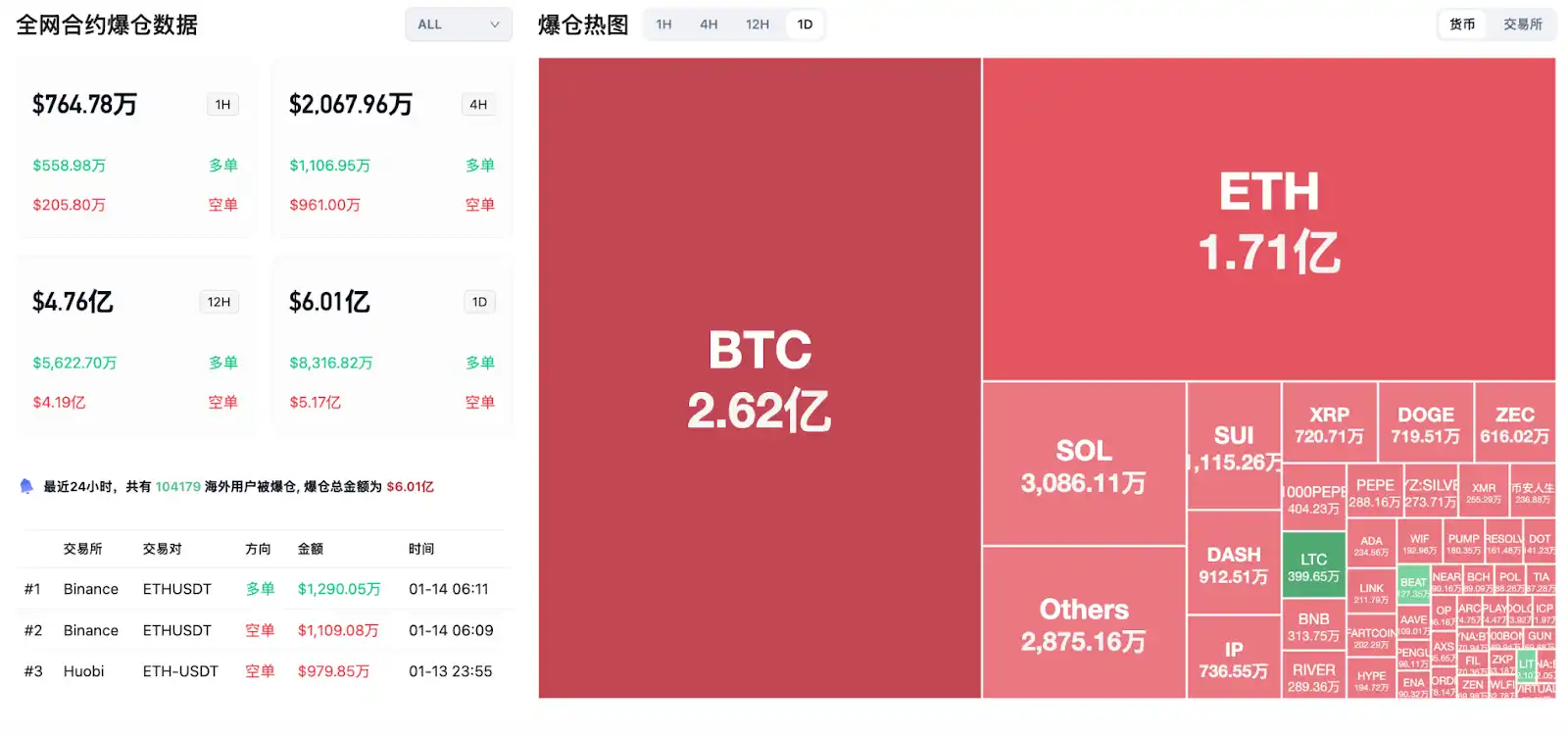
24-hour liquidation data: 104,179 people globally were liquidated, total liquidation amount was $601 million,其中BTC liquidations $262 million, ETH liquidations $171 million, SOL liquidations $30.86 million
3. ETF Flows (As of January 13)

  • Bitcoin ETF: +$754 million, none of the twelve ETFs had net outflows

  • Ethereum ETF: +$130 million, none of the nine ETFs had net outflows

  • XRP ETF: +$12.98 million

  • SOL ETF: +$5.91 million

4. Today's Outlook

  • Tom Lee urges BitMine shareholders to approve the proposal to increase authorized shares from 500 million to 50 billion by January 14th

  • BSC mainnet Fermi hard fork upgrade scheduled for January 14, 2026

  • Binance will list FOGO spot trading on January 15th and mark it with a seed tag

  • MANTRA: All ERC20 versions of OM will be deprecated on January 15th, please migrate as soon as possible

  • Aster: Phase 3 airdrop is open for claiming, will end on January 15, 2026

  • US Supreme Court postpones ruling on Trump tariff case, next ruling on January 14th

  • Federal Reserve releases the Beige Book" on economic conditions (January 15, 03:00)

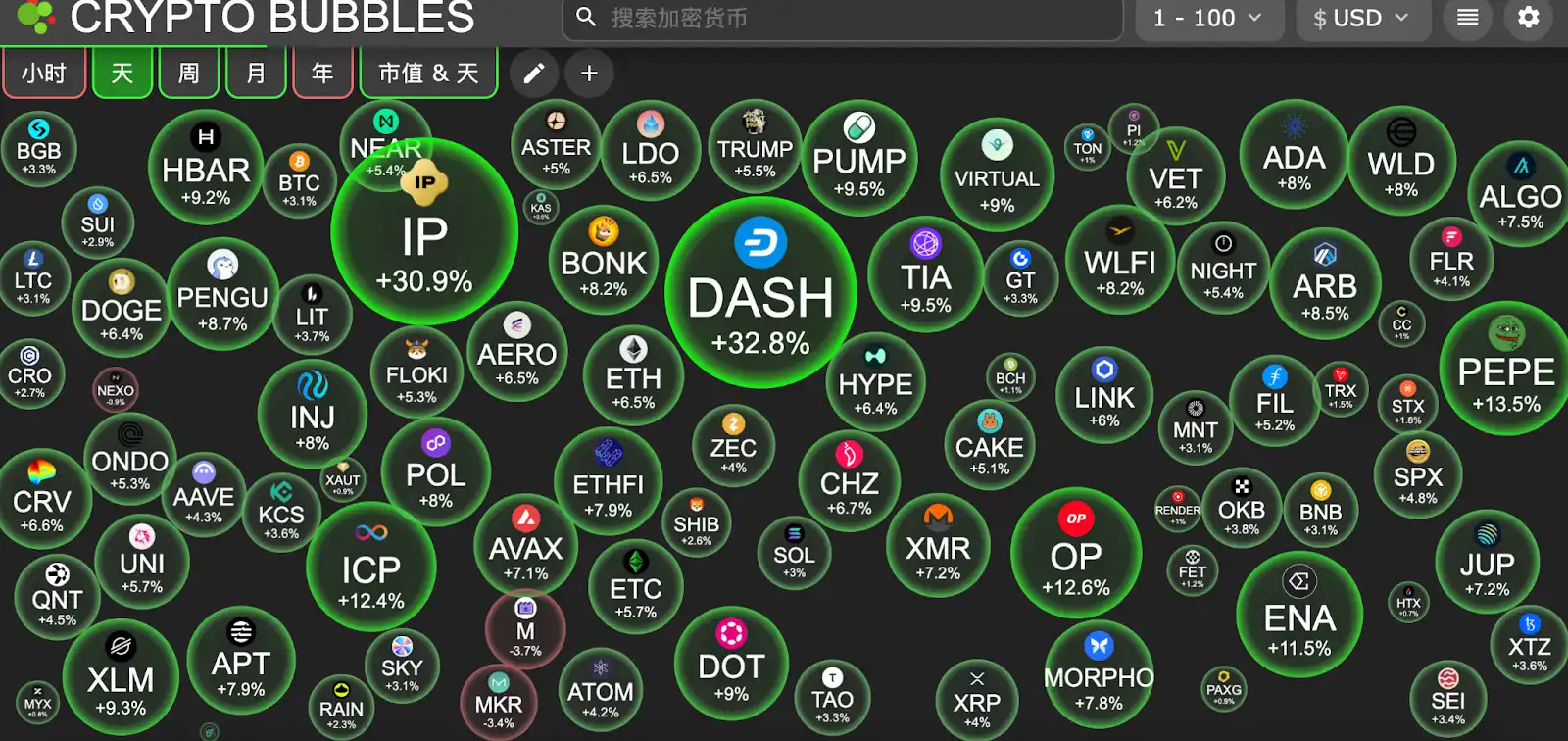
Today's top 100 coins by market cap, maximum gains: Dash up 32.7%, Story up 30.7%, Pepe up 13.5%, Optimism up 12.7%, Internet Computer up 12.3%.
5. Hot News

  • Corporate crypto holdings net increased by approximately 260,000 BTC in the past 6 months, three times the Bitcoin mining output during the same period

  • OpenSea Foundation is preparing for TGE, will consider historical trading volume and Treasures data

  • The top address for "Binance Life" has floating profits exceeding $2.63 million, with a return rate over 154,341.1%

  • DN token fell over 80% in 24 hours, DeepNode responded saying "working with market makers to resolve liquidity issues"

  • Spot silver approaches the $90 mark, hitting a new high again

  • Bitmine stakes another 94,400 ETH, worth $314 million

  • Zama will initiate token sales through CoinList and its own auction APP, FDV floor price is $55 million

  • SharpLink's staking收益 (staking收益 means staking rewards/yield) last week reached 500 ETH, cumulative收益 (收益 means rewards/yield)突破 (突破 means broke through) 11,000 ETH

  • Spot gold stands above $4620/oz, spot silver up over 3.00% intraday

  • US December unadjusted CPI year-on-year 2.7%, core CPI year-on-year 2.6%

  • "On-chain part-time stock investor" turns short on-chain gold, holdings reach $13 million

Связанные с этим вопросы

QWhat is the key support level for Bitcoin's upward movement according to multiple analysts mentioned in the article?

AThe key support level for Bitcoin's upward movement is $94,500, which is considered the lifeline for the bulls.

QWhat was the main reason for the temporary plunge in the A-share market on the afternoon of January 14th?

AThe temporary plunge was triggered by a notice from the Shanghai, Shenzhen, and Beijing Stock Exchanges announcing an increase in the minimum margin financing ratio from 80% to 100%.

QWhich precious metal reached a historic high with its total market capitalization surpassing $5 trillion, according to the article?

ASilver reached a historic high, surpassing the $90 mark, with its total market capitalization exceeding $5 trillion.

QWhat is the next core target price for Ethereum if it successfully breaks through and stabilizes above $3,300?

AThe next core target price for Ethereum is $4,000 if it successfully breaks through and stabilizes above $3,300.

QWhat was the overall net flow for Bitcoin ETFs as of January 13th?

AThe overall flow for Bitcoin ETFs was a net inflow of $754 million as of January 13th, with none of the twelve ETFs experiencing a net outflow.

Похожее

Fed's Internal Doves Flock to Hawkish Stance, Warsh's Debut "Between a Rock and a Hard Place"

U.S. Federal Reserve officials who previously advocated for rate cuts, including Governor Christopher Waller, have recently shifted their stance, with many now not ruling out the possibility of future rate hikes. This sets a challenging stage for new Fed Chair Kevin Warsh's first policy meeting. Appointed by President Trump based on his dovish views, Warsh now faces a committee where the debate has pivoted from "when to cut" to "whether to hike," driven by persistent inflation above 3%, a strong labor market, and supply-side pressures from AI infrastructure demands and geopolitical tensions. Key figures illustrate the shift. Governor Waller, once concerned about employment, now says data has pushed him toward considering rate increases. Even moderate voices like Governor Lisa Cook, while expecting inflation to ease, have indicated readiness to hike if it fails to do so. Long-time hawks such as regional Fed presidents Beth Hammack, Lorie Logan, and Neel Kashkari have grown more vocal, arguing that the real policy rate is effectively falling and that action may soon be needed. The upcoming Fed meeting is expected to keep rates steady but will likely remove the "easing bias" from its statement, signaling a neutral stance between cuts and hikes. The quarterly "dot plot" is anticipated to show most officials projecting no cuts this year, with some potentially indicating hikes. Chair Warsh, a critic of the Fed's reliance on forward guidance like the dot plot, must navigate communicating this pivot using tools he has questioned, all while steering policy in a direction counter to the preferences of the president who appointed him. The consensus suggests the Fed's next move could well be a rate increase.

marsbit5 мин. назад

Fed's Internal Doves Flock to Hawkish Stance, Warsh's Debut "Between a Rock and a Hard Place"

marsbit5 мин. назад

The Trillion-Yuan Market Cap 'Yi Zhong Tian': Who is the True Value King?

The article analyzes the three leading Chinese optical module companies, collectively nicknamed "Yi Zhong Tian": Xinyisheng, Zhongji Innolight, and TFC Optical Communication. It evaluates their "cost-performance" not by current stock price, but through three lenses: PEG ratio (growth vs. valuation), earnings quality, and premium/discount for certainty. Xinyisheng shows the most attractive PEG ratio and high profitability, but its valuation reflects discounts for risks like high customer concentration and reliance on overseas markets. Zhongji Innolight, the most expensive, commands a premium for its market leadership, dominant share in key products like 800G/1.6T modules, and higher earnings certainty, though it faces geopolitical risks. TFC Optical, as an upstream component supplier ("water seller"), has the highest gross margin and bets on the long-term CPO/NPO architecture trend, but trades at a high valuation with more stable, less explosive growth. The core argument is that while these companies dominate module assembly, the true profit pool and technological moat lie upstream in laser and switch chips, currently controlled by U.S. firms like Lumentum and Coherent. The long-term "cost-performance" for these Chinese leaders hinges on whether the domestic industry, exemplified by companies like Yuanjie Technology, can successfully move up the value chain into high-power laser chips. Otherwise, their high growth may remain confined to the lower-margin assembly segment.

marsbit15 мин. назад

The Trillion-Yuan Market Cap 'Yi Zhong Tian': Who is the True Value King?

marsbit15 мин. назад

Has the Crypto Market Bottomed? Here's What Institutions Think

The crypto market is in a period of significant debate, with leading institutions offering differing views on whether a bottom has been reached. Three prominent firms have published detailed analyses: * **Galaxy Digital** argues Bitcoin has **not yet bottomed**. Their analysis of 13 historical indicators across six dimensions (valuation, profit-taking, miner pressure, etc.) shows only four are fully met. They project a potential bottom range between $30k and $54k. * **NYDIG** states a bottom is **possible but not likely**. While metrics are close to historic bear market extremes, they note the absence of a classic panic-selling event. They also suggest increased institutional adoption may have structurally altered the market cycle, potentially leading to a shallower downturn. * **Standard Chartered Bank** asserts the **bottom has already occurred** at around $59k. They cite two key factors: potential US-Iran diplomatic progress and the anticipated SpaceX IPO, which they believe absorbed capital and caused ETF selling pressure that is now subsiding. They forecast a year-end price target of $100k. Despite the surface-level disagreement, the reports share critical common ground more valuable for long-term investors: 1. All three believe the market bottom will form **within this year**. 2. All agree the current price is **closer to the bottom than to previous highs**. 3. All maintain a **bullish long-term outlook** for Bitcoin and a new cycle. The core takeaway is that while the exact bottom price ($40k, $50k, or $60k) is debated, the consensus is that a bottom is imminent. For long-term holders, the primary focus should not be pinpointing the absolute low, but on the future potential for prices to reach $100k, $200k, or higher. The fundamental thesis for Bitcoin—sovereign debt accumulation, inflation, declining trust in centralized institutions, global digitization, and improved accessibility—remains intact and is arguably strengthening. The overall landscape is viewed as more favorable than in previous crypto winters.

marsbit25 мин. назад

Has the Crypto Market Bottomed? Here's What Institutions Think

marsbit25 мин. назад

The 'Chip' Challenge and Breakthroughs in China's Optical Industry Chain

China's Photonics Industry: Bottlenecks and Breakthroughs In the global AI race, computing chips dominate the narrative, but the underlying bottleneck increasingly defining the scale of AI clusters is light—or more specifically, optical connectivity. Optical modules, which translate electrical signals to light and vice versa, are crucial for connecting thousands of GPUs in AI data centers, preventing data congestion and ensuring efficient model training. High-speed modules (800G, 1.6T) are now standard, with performance hinging on advanced DSP (Digital Signal Processor) chips. This is where a critical dependency lies. Two US giants—Marvell and Broadcom—collectively dominate over 90% of the high-end DSP chip market. Chinese optical module leaders like Zhongji Innolight and Eoptolink rely on these chips to manufacture modules for overseas AI customers, primarily in North America. While this creates a supply chain vulnerability, complete decoupling is difficult. Marvell derives over half its revenue from Greater China, and the US firms depend on Chinese partners for chip packaging and optical components. The risk from laser chips (e.g., from Lumentum), another key component, is considered more manageable due to multiple global suppliers and faster progress in domestic alternatives from companies like YOFC and Accelink. To mitigate risks, China's industry is pursuing a multi-pronged strategy: diversifying supply chains and locking in long-term orders; fostering a domestic market ecosystem to adopt homegrown DSPs from firms like Huawei HiSilicon and CETC; accelerating R&D in high-speed DSPs and advanced packaging; and investing in next-gen technologies like silicon photonics and Co-Packaged Optics (CPO) to reduce reliance on discrete DSPs. The ultimate solution lies not in short-term博弈 but in persistent advancement of domestic high-end chip R&D and manufacturing. While challenges remain in performance, certification, and ecosystem building, China's vast domestic market and manufacturing base provide a crucial buffer, buying time for the industry to achieve greater technological independence.

marsbit39 мин. назад

The 'Chip' Challenge and Breakthroughs in China's Optical Industry Chain

marsbit39 мин. назад

Behind SpaceX's $2 Trillion Market Cap: Why Does Musk Always Have the Next Move Planned?

On June 12th, SpaceX debuted on the Nasdaq, reaching a valuation that briefly touched $2 trillion. This marked the culmination of a 24-year journey from its founding in 2002, driven by Elon Musk's frustration at the high cost of buying rockets. The company's path was defined by early failures, with its first three Falcon 1 launches ending in explosions before a successful 2008 flight opened the era of commercial spaceflight. Key to its model was a fixed-price NASA contract, incentivizing cost reduction. SpaceX mastered rocket reusability, first achieving a Falcon 9 landing in 2015, which drastically cut launch costs. This enabled its profitable Starlink satellite internet constellation, envisioned years before reusability was proven, to create an internal market for frequent launches. Similarly, the next-generation Starship rocket was in development long before its first flight, with its business case evolving from Mars colonization to supporting the emerging concept of in-orbit data centers for AI—a story now central to its valuation. The company's recent IPO, a reversal of its long-standing "no IPO" stance, is funding this ambitious "space-based compute" vision. While major tech players like Google, Blue Origin, and others are investing heavily, significant technical and cost hurdles remain. Ultimately, SpaceX's history is one of creating its own demand: first with Starlink and now with space-based AI compute, betting that its next rocket will enable its next giant market.

marsbit41 мин. назад

Behind SpaceX's $2 Trillion Market Cap: Why Does Musk Always Have the Next Move Planned?

marsbit41 мин. назад

Торговля

Спот
Фьючерсы

Популярные статьи

Тест по Bitcoin Биткоина

HTX Learn: Изучите Bitcoin halving и Заработаете Токены USDT

3.1k просмотров всегоОпубликовано 2024.04.16Обновлено 2024.04.16

Тест по Bitcoin  Биткоина

Что такое $BITCOIN

ЦИФРОВОЕ ЗОЛОТО ($BITCOIN): Комплексный анализ Введение в ЦИФРОВОЕ ЗОЛОТО ($BITCOIN) ЦИФРОВОЕ ЗОЛОТО ($BITCOIN) — это проект на основе блокчейна, работающий в сети Solana, который стремится объединить характеристики традиционных драгоценных металлов с инновациями децентрализованных технологий. Хотя он носит имя Биткойн, часто называемого “цифровым золотом” из-за его восприятия как средства хранения ценности, ЦИФРОВОЕ ЗОЛОТО является отдельным токеном, предназначенным для создания уникальной экосистемы в ландшафте Web3. Его цель — позиционировать себя как жизнеспособный альтернативный цифровой актив, хотя детали его применения и функциональности все еще развиваются. Что такое ЦИФРОВОЕ ЗОЛОТО ($BITCOIN)? ЦИФРОВОЕ ЗОЛОТО ($BITCOIN) — это токен криптовалюты, специально разработанный для использования в блокчейне Solana. В отличие от Биткойна, который выполняет широко признанную роль хранения ценности, этот токен, похоже, сосредоточен на более широких приложениях и характеристиках. Примечательные аспекты включают: Инфраструктура блокчейна: Токен построен на блокчейне Solana, известном своей способностью обрабатывать высокоскоростные и недорогие транзакции. Динамика предложения: ЦИФРОВОЕ ЗОЛОТО имеет максимальное предложение, ограниченное 100 квадриллионами токенов (100P $BITCOIN), хотя детали о его обращающемся предложении в настоящее время не раскрыты. Утилита: Хотя точные функциональные возможности не описаны, есть указания на то, что токен может быть использован для различных приложений, потенциально связанных с децентрализованными приложениями (dApps) или стратегиями токенизации активов. Кто создатель ЦИФРОВОГО ЗОЛОТА ($BITCOIN)? На данный момент личность создателей и команды разработчиков, стоящих за ЦИФРОВЫМ ЗОЛОТОМ ($BITCOIN), остается неизвестной. Эта ситуация типична для многих инновационных проектов в области блокчейна, особенно тех, которые связаны с децентрализованными финансами и феноменом мем-криптовалют. Хотя такая анонимность может способствовать культуре, ориентированной на сообщество, она усиливает опасения по поводу управления и ответственности. Кто инвесторы ЦИФРОВОГО ЗОЛОТА ($BITCOIN)? Доступная информация указывает на то, что у ЦИФРОВОГО ЗОЛОТА ($BITCOIN) нет известных институциональных спонсоров или значительных венчурных капиталовложений. Проект, похоже, функционирует по модели пирингового взаимодействия, сосредоточенной на поддержке и принятии сообществом, а не на традиционных путях финансирования. Его активность и ликвидность в основном сосредоточены на децентрализованных биржах (DEX), таких как PumpSwap, а не на устоявшихся централизованных торговых платформах, что еще больше подчеркивает его подход, ориентированный на grassroots. Как работает ЦИФРОВОЕ ЗОЛОТО ($BITCOIN) Операционные механизмы ЦИФРОВОГО ЗОЛОТА ($BITCOIN) можно подробно описать на основе его дизайна блокчейна и характеристик сети: Механизм консенсуса: Используя уникальный механизм доказательства истории (PoH) Solana в сочетании с моделью доказательства доли (PoS), проект обеспечивает эффективную валидацию транзакций, что способствует высокой производительности сети. Токеномика: Хотя конкретные дефляционные механизмы не были подробно описаны, большое максимальное предложение токенов подразумевает, что оно может быть предназначено для микротранзакций или нишевых случаев использования, которые еще предстоит определить. Интероперабельность: Существует потенциал для интеграции с более широкой экосистемой Solana, включая различные платформы децентрализованных финансов (DeFi). Однако детали относительно конкретных интеграций остаются неуточненными. Хронология ключевых событий Вот хронология, которая подчеркивает значимые вехи, касающиеся ЦИФРОВОГО ЗОЛОТА ($BITCOIN): 2023: Первоначальное развертывание токена происходит в блокчейне Solana, отмеченное его адресом контракта. 2024: ЦИФРОВОЕ ЗОЛОТО приобретает видимость, когда оно становится доступным для торговли на децентрализованных биржах, таких как PumpSwap, позволяя пользователям обменивать его на SOL. 2025: Проект наблюдает спорадическую торговую активность и потенциальный интерес к инициативам, возглавляемым сообществом, хотя на данный момент не зафиксировано никаких значительных партнерств или технических достижений. Критический анализ Сильные стороны Масштабируемость: Основная инфраструктура Solana поддерживает высокие объемы транзакций, что может повысить полезность $BITCOIN в различных сценариях транзакций. Доступность: Потенциально низкая цена торговли за токен может привлечь розничных инвесторов, способствуя более широкому участию благодаря возможностям дробного владения. Риски Отсутствие прозрачности: Отсутствие публично известных спонсоров, разработчиков или процесса аудита может вызвать скептицизм относительно устойчивости и надежности проекта. Волатильность рынка: Торговая активность сильно зависит от спекулятивного поведения, что может привести к значительной волатильности цен и неопределенности для инвесторов. Заключение ЦИФРОВОЕ ЗОЛОТО ($BITCOIN) является интригующим, но неоднозначным проектом в быстро развивающейся экосистеме Solana. Хотя он пытается использовать нарратив “цифрового золота”, его отход от установленной роли Биткойна как средства хранения ценности подчеркивает необходимость более четкого различения его предполагаемой утилиты и структуры управления. Будущее принятие и усвоение, вероятно, будут зависеть от решения текущей непрозрачности и более четкого определения его операционных и экономических стратегий. Примечание: Этот отчет охватывает синтезированную информацию, доступную на октябрь 2023 года, и с тех пор могут произойти события.

104 просмотров всегоОпубликовано 2025.05.13Обновлено 2025.05.13

Что такое $BITCOIN

Fractal Bitcoin: масштабирование Биткоина с помощью рекурсивной системы

Fractal Bitcoin — масштабное Layer-1-решнение, созданное на базе кода Биткоина, позволяющего достигать бесконечного масштабирования с помощью рекурсивного подхода.

2.3k просмотров всегоОпубликовано 2025.06.30Обновлено 2025.06.30

Fractal Bitcoin: масштабирование Биткоина с помощью рекурсивной системы

Обсуждения

Добро пожаловать в Сообщество HTX. Здесь вы сможете быть в курсе последних новостей о развитии платформы и получить доступ к профессиональной аналитической информации о рынке. Мнения пользователей о цене на BTC (BTC) представлены ниже.

活动图片