Trading Moment: Gold and Silver Hit New Highs, Ethereum Holds Firm at $3,000, Will Bitcoin See a 'Christmas Rally'?

marsbitОпубликовано 2025-12-22Обновлено 2025-12-22

Введение

Gold and silver hit record highs amid safe-haven demand, with gold surpassing $4,400 and silver reaching $69. Bitcoin consolidates around $88,000, as analysts debate potential "Santa rally" targets of $98,000–$100,000 or a drop to $70,000–$75,000. Ethereum holds near $3,000, with whale accumulation suggesting bullish sentiment. Altcoins like AAVE faced volatility, while NFT and GameFi sectors gained. Crypto ETFs saw outflows, except for Solana and XRP. Key events include large Bitcoin options expiry on December 26 and upcoming token unlocks.

Daily key market data review and trend analysis, produced by PANews.

1. Market Observation

Driven by expectations of Fed rate cuts in 2026 and escalating geopolitical tensions, the macro market is showing strong risk-off sentiment. Gold and silver prices both hit record highs, with spot gold breaking through $4,400 for the first time, up about 66% year-to-date; silver climbed above $69, poised for its best annual gain of over 100% since 1979. Platinum also surpassed $2,000 for the first time since 2008, with a year-to-date increase of over 120%. Although traders widely bet on two Fed rate cuts in 2026, Cleveland Fed President Beth Hammack, who will soon have an FOMC vote, believes there is no need to adjust rates in the coming months due to persistent high inflation, hinting that the neutral rate might be higher than commonly perceived. Ahead of the Christmas holiday, U.S. stock futures edged up, but the New York Stock Exchange will close early on Wednesday, Christmas Eve, and will be closed on Thursday for Christmas Day. Looking ahead, Goldman Sachs analysts predict gold will rise further to $4,900 per ounce next year, while TD Securities believes that although silver prices may pull back, 2026 will be a year led by platinum and palladium in commodity prices.

Bitcoin has been oscillating between $84,000 and $94,000 for a month, currently hovering around $88,000. Bullish analysts like AlphaBTC and Captain Faibik anticipate a "Santa Claus rally," believing the correction is over and the asset could soon break out and surge toward the $98,000 to $100,000 zone; Korinek_Trades, based on Elliott Wave theory, predicts the price could reach a new high of $150,000. Ignas points out that the massive options expiration on December 26 could push the price toward $96,000.

However, bearish voices are equally notable. Santiment founder Maksim Balashevich, analyzing social media sentiment, believes the market hasn't shown enough "panic" to confirm a bottom, and Bitcoin could still fall to $75,000. CryptoQuant analyst CryptoOnchain warns that due to a $1.4 billion inflow of BTC into Binance, the price might correct to the demand zone of $70,000 to $72,000. Analysts like Killa and Doctor Profit predict the market could experience months of consolidation before starting the next deep decline in Q1 2026, targeting $60,000. Fidelity's Jurrien Timmer believes the four-year cycle isn't over, and the bear market could last until 2026, with support between $65,000 and $75,000. On-chain data analyst Murphy notes that the $80,000 to $90,000 range has accumulated significant筹码, while $70,000 to $80,000 is a liquidity vacuum zone, likely to become strong support. Long-term, Galaxy Digital's Alex Thorn predicts BTC could reach $250,000 by the end of 2027, while Arthur Hayes believes the Fed's RMP program is essentially quantitative easing, and once the market realizes this, BTC will quickly surge toward $124,000 to $200,000.

Ethereum's trend is also at a critical juncture, consolidating around the $3,000 psychological level. Technical analysts Ted Pillows and Dami-Defi point out that ETH is in a contracting triangle pattern; if it can break above $3,000 and the 200-day moving average effectively, it could test $3,200 or even $4,200; if rejected, it might retest the support zone of $2,700 to $2,800. Marcus Corvinus also mentions that after breaking below the ascending channel, the price found support in the demand zone of $2,750 to $2,850 and is now at a crucial moment for direction selection. Man of Bitcoin倾向于 believes the price might first pull back to the $2,825 to $2,894 area before breaking upward. Notably, on-chain data shows positive signals; analyst CW发现, although small whale holdings have decreased, addresses holding over 10,000 ETH have been accumulating significantly since July, with their buying rate reaching historically high levels, indicating high expectations for a potential major rebound. Michaël van de Poppe analyzes from a market sentiment cycle perspective,认为 the current pessimistic rhetoric around ETH is similar to the "death" talk at $1,600, which often presents a contrarian opportunity.

In the altcoin market, the Aave project recently experienced sharp volatility. Its second-largest holder sold 230,000 AAVE at a loss of $13.45 million, causing the price to drop 12% from $176 to $156 briefly. Subsequently, the Aave community proposed transferring brand ownership and social accounts to DAO control, sparking market discussion about whether this truly embodies "decentralization." Additionally, BitMEX co-founder Arthur Hayes believes the "altseason" has always been here, but investors need to focus on new narratives rather than repeating history. He cited Solana's rise from $7 to nearly $300 and the rise of Hyperliquid as examples and expressed optimism about the potential of Ethena (ENA).

2. Key Data (As of December 22, 13:00 HKT)

(Data source: CoinAnk, Upbit, SoSoValue, CoinMarketCap)

  • Bitcoin: $88,833 (Year-to-date: -5.1%), Daily spot trading volume: $27.13 billion

  • Ethereum: $3,022 (Year-to-date: -9.33%), Daily spot trading volume: $25.11 billion

  • Fear & Greed Index: 24 (Fear)

  • Average GAS: BTC: 1.2 sat/vB, ETH: 0.04 Gwei

  • Market Dominance: BTC 58.5%, ETH 12.4%

  • Upbit 24-hour trading volume ranking: XRP, BTC, ETH, SOL, DOOD

  • 24-hour BTC Long/Short Ratio: 50.01% / 49.99%

  • Sector Performance: NFT sector up 8.48%, GameFi sector up 4.47%

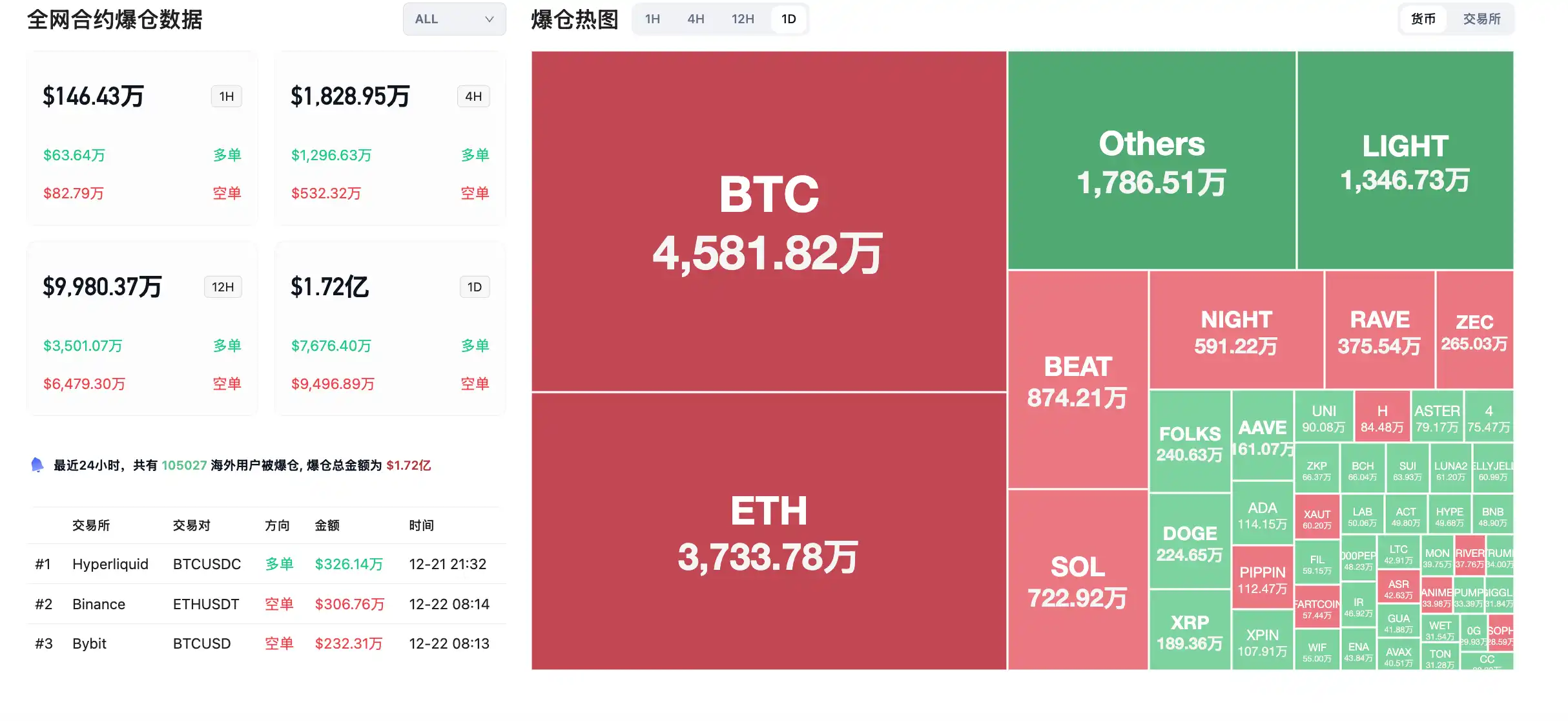
  • 24-hour Liquidation Data: 105,027 people liquidated globally, total liquidation amount $172 million, including BTC liquidations $45.818 million, ETH liquidations $37.3378 million, SOL liquidations $7.229 million

3. ETF Flows (As of December 21)

  • Bitcoin ETF: Net outflow of $497 million last week

  • Ethereum ETF: Net outflow of $644 million last week

  • Solana ETF: Net inflow of $66.55 million last week

  • XRP ETF: Net inflow of $82.04 million last week

4. Today's Outlook

  • Aster will launch the fifth phase of its airdrop on December 22, distributing 1.2% of the total supply.

  • Binance Wallet: Bitway (BTW) Pre-TGE activity will begin on December 22.

  • MetaPlanet's extraordinary general meeting will be held on December 22, with the preferred stock issuance proposal pending review.

  • The U.S. Bureau of Economic Analysis will release Q3 GDP data on December 23.

  • Binance will remove multiple leveraged trading pairs including DOT/FDUSD, ENA/FDUSD.

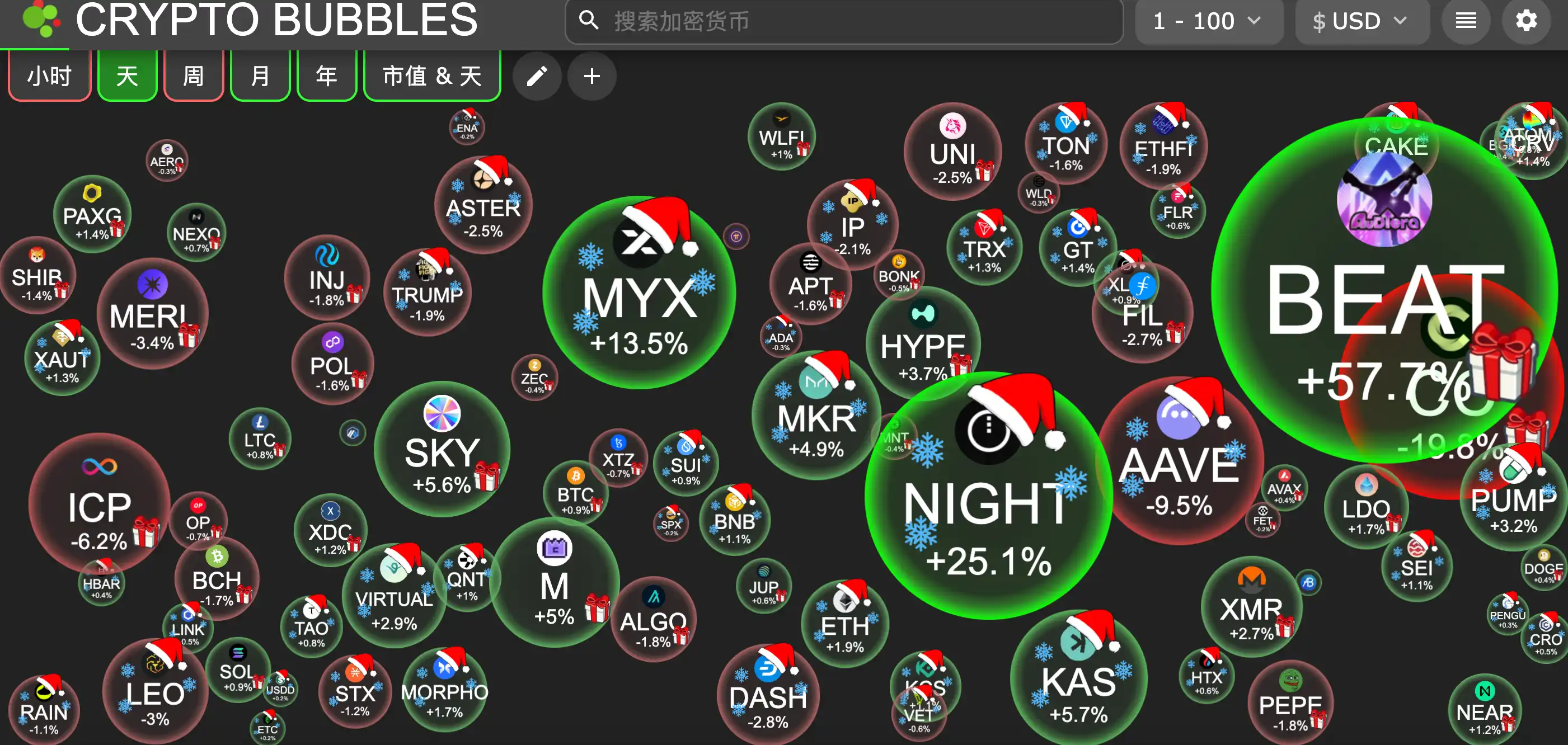
Today's top gainers among the top 100 coins by market cap: Audiera up 57.7%, Midnight up 25.1%, MYX Finance up 13.5%, Kaspa up 5.7%, Sky (prev. Maker) up 5.6%.

5. Hot News

  • Data: Tokens like H, XPL, SOON are set for large unlocks, with H's unlock valued at approximately $14.8 million.

  • Weekly Preview | Approximately $23 billion in Bitcoin options expire on December 26; Aster launches fifth phase airdrop activity.

  • Uniswap protocol fee switch proposal UNIfication reaches quorum, expected to take effect this week.

  • Data: Tokens like H, XPL, SOON will see large unlocks next week, with H's unlock valued at approximately $14.8 million.

  • Dragonfly Capital deposited 6 million MNT to Bybit in the past 7 days, worth $6.95 million.

  • NFT trading volume increased 11.31% to $68.98 million this week, with the number of buyers surging 50.28%.

  • Hilbert Group acquired high-frequency trading platform Enigma Nordic for $32 million.

  • Vitalik sold various tokens including UNI, BNB over two days.

  • Machi Big Brother坚持做多 net loss of about $3.515 million in the past month, with a win rate of 55.56%.

Связанные с этим вопросы

QWhat are the key factors driving the surge in gold and silver prices to record highs?

AThe surge in gold and silver prices is primarily driven by expectations of Fed rate cuts in 2026 and heightened geopolitical tensions, which have fueled strong safe-haven demand in the macro market.

QWhat is the current price range Bitcoin has been consolidating in, and what are the bullish price targets mentioned by analysts?

ABitcoin has been consolidating between $84,000 and $94,000 for a month. Bullish analysts like AlphaBTC and Captain Faibik anticipate a 'Santa Claus rally' with a potential breakout towards the $98,000 to $100,000 region, while Korinek_Trades predicts a new high of $150,000 based on Elliott Wave theory.

QWhat negative signals for Bitcoin's price are identified from on-chain and exchange data?

ANegative signals include a lack of 'panic' sentiment on social media suggesting a potential drop to $75,000, a $1.4 billion inflow of BTC into Binance indicating a possible correction to the $70,000-$72,000 demand zone, and analysts predicting a deeper drop to $60,000 after months of consolidation.

QWhat is the critical technical level for Ethereum's price, and what on-chain data suggests optimism for its future?

AEthereum is consolidating around the critical $3,000 level. On-chain data shows that addresses holding over 10,000 ETH have been accumulating significantly since July, with their buying rate at historically high levels, indicating strong confidence in a potential major rebound.

QWhich cryptocurrency ETFs saw net outflows last week, and which saw net inflows according to the data?

ALast week, Bitcoin ETFs saw a net outflow of $497 million and Ethereum ETFs saw a net outflow of $644 million. In contrast, Solana ETF saw a net inflow of $66.55 million and XRP ETF saw a net inflow of $82.04 million.

Похожее

The Essence of AI Layoffs: Why More AI Adoption Leads to More Corporate Anxiety?

The author, awaiting potential inclusion on an 8000-person layoff list, analyzes the true nature of recent "AI-driven" layoffs. They argue that while AI use, particularly tools like Claude for code generation, has skyrocketed and boosted developer output (e.g., 2-5x more code commits), this has not translated into proportional business growth or revenue. The core issue is a misalignment between increased "Input" (code) and tangible "Outcomes" (user value, revenue). AI acts as a costly B2B SaaS, inflating operational expenses without guaranteed returns. Two key problems emerge: 1) The friction that once filtered out bad ideas is gone, as AI allows cheap pursuit of even weak concepts. 2) Organizational "alignment tax"—the difficulty of coordinating across teams—becomes crippling when development velocity outpaces consensus-building. Thus, layoffs serve two immediate purposes: 1) To offset ballooning AI costs (Token consumption) and maintain cash flow, as rising input costs without outcome growth destroys unit economics. 2) To reduce organizational bloat and alignment friction by simply removing teams, thereby speeding up execution in the short term. Therefore, these layoffs are fundamentally caused by AI, even if AI doesn't directly replace roles. They represent a painful correction until companies learn to convert AI-driven productivity into real business outcomes and streamline organizational coordination to match the new pace of work. The cycle will continue until this learning curve is mastered.

marsbit2 мин. назад

The Essence of AI Layoffs: Why More AI Adoption Leads to More Corporate Anxiety?

marsbit2 мин. назад

Can the Solana Foundation and Google's Collaboration on Pay.sh Bridge the Payment Link Between Web2 and Web3 in the Agent Economy?

Solana Foundation, in collaboration with Google Cloud, has launched Pay.sh, a payment gateway designed to bridge the gap between AI agents and enterprise-grade service infrastructure. The initiative aims to solve a key bottleneck in the "agent economy": existing payment systems are ill-suited for autonomous AI agents. Traditional methods like credit cards require human verification, while newer on-chain protocols like x402 and MPP create a separate, Web3-native system that raises barriers for service providers. Pay.sh functions as a universal payment layer. It allows users to fund a Solana wallet via credit card or stablecoin, which then acts as an identity and payment proxy for AI agents. When an agent needs to access a paid API service (e.g., Google Cloud, Alibaba Cloud), Pay.sh handles the transaction seamlessly. It leverages the HTTP 402 status code ("Payment Required") to initiate payments, intelligently choosing between one-time transfers (x402-style) or session-based authorizations (MPC-style) based on the service's billing model. This spares agents from manual account registration and API key management. A key feature for service providers is low integration effort. They can adopt Pay.sh by providing a declarative configuration file, enabling features like tiered pricing, free tiers, and automatic revenue splitting to multiple addresses (e.g., for royalties, cloud costs). Providers can also list their APIs in a central Pay Skill Registry for agent discovery. The collaboration with Google Cloud provides crucial infrastructure for API proxying, traffic routing, and compliance logging, aiming to keep agent activities within regulated boundaries. By connecting Web2 services with Web3 payment rails, Pay.sh positions the Solana wallet as a foundational identity and payment tool for AI agents, potentially driving more transaction volume to the Solana ecosystem. However, the report notes challenges. The service registry currently lacks robust vetting, risking exposure to unauthorized or malicious third-party APIs. Pay.sh also inherits security and compatibility risks from its underlying payment protocols (x402, MPC). Furthermore, adoption may be hindered by varying regional data privacy and payment compliance regulations among API providers. Despite these hurdles, Pay.sh represents a significant step towards integrating Web2 and Web3 for autonomous agent commerce.

marsbit8 мин. назад

Can the Solana Foundation and Google's Collaboration on Pay.sh Bridge the Payment Link Between Web2 and Web3 in the Agent Economy?

marsbit8 мин. назад

Bitcoin's Bull-Bear Cycle Indicator Turns Positive for the First Time in 7 Months: End of Bear Market or False Breakout?

Bitcoin's "Bull-Bear Market Cycle Indicator" from CryptoQuant has turned positive for the first time since October 2025. This gauge, based on the P&L Index relative to its 365-day moving average, suggests a potential shift from a bear market phase. Concurrently, the Bull Score Index rose to a neutral reading of 50 in late April. The indicator's move into positive territory follows a roughly 35% price rebound from a low near $60,000 in February to above $81,000. The recovery over approximately three months was faster than the 12-month period observed during the 2022 bear market. However, analysts caution against premature optimism, citing a historical precedent from March 2022. Back then, the Bull Score Index briefly hit 50, but it proved to be a false signal as Bitcoin's price subsequently plunged further. Structural differences exist in the current cycle, including consistent inflows into spot Bitcoin ETFs and an increase in large holder addresses. Yet, some models, referencing the four-year halving cycle, suggest a potential deeper bottom near $50,000 might still be possible around late 2026. In summary, while on-chain data shows marked improvement and the worst panic may be over, market participants remain cautious. A convincing trend reversal confirmation likely requires Bitcoin to sustainably break above key resistance, such as the 200-day moving average near $82,000.

marsbit16 мин. назад

Bitcoin's Bull-Bear Cycle Indicator Turns Positive for the First Time in 7 Months: End of Bear Market or False Breakout?

marsbit16 мин. назад

How to Automate Any Workflow with Claude Skills (Complete Tutorial)

This is a comprehensive guide to mastering Claude Skills, a feature for creating permanent, reusable instruction sets that automate specific workflows. Unlike simple saved prompts, Skills function like trained employees, delivering consistent, high-quality outputs by defining the entire task process, standards, error handling, and output format. The guide is structured in four phases: **Phase 1: Installation (5 minutes).** Skills are folders containing a `SKILL.md` file. The user is instructed to find a relevant Skill online, install it, test it on a real task, and compare its performance to one-off prompts. **Phase 2: Building Your First Custom Skill.** Start by rigorously defining the Skill's purpose, trigger phrases, and providing a concrete example of perfect output. The `SKILL.md` file has two parts: a YAML frontmatter with a specific name/description/triggers, and a detailed, step-by-step workflow written in natural language with examples and quality standards. **Phase 3: Testing & Optimization for Production.** Test the Skill in three scenarios: 1) a standard, common task; 2) edge cases with missing or conflicting data; and 3) a pressure test with maximum complexity. Any failure indicates a needed instruction. Implement a weekly optimization cycle to continuously refine the Skill based on real usage. **Phase 4: Building a Complete Skill Library.** The goal is to create a team of Skills for all repetitive tasks. Examples are given for industries like real estate, marketing, finance, consulting, and e-commerce. The user should list their tasks, prioritize them, and build one new Skill per week, maintaining a master document to track their library. The conclusion emphasizes the compounding time savings: ten Skills saving 30 minutes each per week reclaims over 260 hours (6.5 work weeks) per year, fundamentally transforming one's work system.

marsbit39 мин. назад

How to Automate Any Workflow with Claude Skills (Complete Tutorial)

marsbit39 мин. назад

Торговля

Спот
Фьючерсы

Популярные статьи

Как купить HPP

Добро пожаловать на HTX.com! Мы сделали приобретение House Party Protocol (HPP) простым и удобным. Следуйте нашему пошаговому руководству и отправляйтесь в свое крипто-путешествие.Шаг 1: Создайте аккаунт на HTXИспользуйте свой адрес электронной почты или номер телефона, чтобы зарегистрироваться и бесплатно создать аккаунт на HTX. Пройдите удобную регистрацию и откройте для себя весь функционал.Создать аккаунтШаг 2: Перейдите в Купить криптовалюту и выберите свой способ оплатыКредитная/Дебетовая Карта: Используйте свою карту Visa или Mastercard для мгновенной покупки House Party Protocol (HPP).Баланс: Используйте средства с баланса вашего аккаунта HTX для простой торговли.Третьи Лица: Мы добавили популярные способы оплаты, такие как Google Pay и Apple Pay, для повышения удобства.P2P: Торгуйте напрямую с другими пользователями на HTX.Внебиржевая Торговля (OTC): Мы предлагаем индивидуальные услуги и конкурентоспособные обменные курсы для трейдеров.Шаг 3: Хранение House Party Protocol (HPP)После приобретения вами House Party Protocol (HPP) храните их в своем аккаунте на HTX. В качестве альтернативы вы можете отправить их куда-либо с помощью перевода в блокчейне или использовать для торговли с другими криптовалютами.Шаг 4: Торговля House Party Protocol (HPP)С легкостью торгуйте House Party Protocol (HPP) на спотовом рынке HTX. Просто зайдите в свой аккаунт, выберите торговую пару, совершайте сделки и следите за ними в режиме реального времени. Мы предлагаем удобный интерфейс как для начинающих, так и для опытных трейдеров.

88 просмотров всегоОпубликовано 2026.04.29Обновлено 2026.04.29

Как купить HPP

Что такое GENIUS

I. Введение в проект1. Что такое Genius?Genius (GENIUS) позиционируется как «конечный терминал на блокчейне», децентрализованная торговая платформа, ориентированная на конфиденциальность и скорость. Интегрируя технологии конфиденциальности высшего уровня, она стремится создать инфраструктуру торговли с конфиденциальностью нового поколения на таких сетях, как BNB Chain, позволяя пользователям взаимодействовать на блокчейне с бесшовным опытом, сопоставимым с централизованными биржами.2. Как работает Genius?Основная техническая архитектура Genius структурирована следующим образом:(1) Невидимость для цепочки: Пользователям не нужно вручную обрабатывать многоступенчатые одобрения для кросс-цепочных операций, упаковки активов или сложного управления газом.(2) Торговля без подписи: Благодаря интеграциям, таким как Turnkey, Genius позволяет мгновенно торговать без всплывающих подтверждений или авторизации на каждую транзакцию.(3) Аггрегатор аггрегаторов: Genius работает на основе лучшего в своем классе стека агрегации, интегрированного с более чем 150 DEX, утверждая о превосходной эффективности котировок по сравнению с конкурентными продуктами.(4) Управление аккаунтом: Платформа использует некастодиальную архитектуру и использует Turnkey и Lit Protocol для управления ключами, позволяя пользователям безопасно получать доступ к своим аккаунтам через пасскоды.3. Кто создал Genius?Согласно официальным Условиям обслуживания, Genius был разработан компанией Shuttle Labs, Inc. На основе официального аккаунта проекта в X, Райан Майер является одним из ключевых участников, способствующих итерации продукта, включая разработки, такие как внедрение протокола Ghost, а также более широкое вовлечение сообщества.Основатель Binance CZ официально присоединился к проекту в качестве советника с целью помочь команде создать более быструю и конфиденциальную торговлю на блокчейне.Кроме того, проект получил сильную поддержку от YZi Labs, которая инвестировала в Genius и работает вместе с Фондом Genius, ответственным за поддержание основного Протокола Моста Genius (GBP).4. Токеномика GeniusGENIUS — это родной токен экосистемы Genius. На данный момент проект не выпустил полный документ по токеномике.Согласно последним официальным раскрытиям, Genius включает дефляционный механизм, и 4,6% от общего объема токенов уже было сожжено в ходе ранней фазы запуска.Система Genius Points (GP):(1) Торговля за вознаграждение: Платформа создала пул вознаграждений в 200 миллионов Genius Points, и пользователи зарабатывают GP за каждую сделку, выполненную через терминал.(2) Уровни и значки: Genius предлагает систему значков на основе прогрессии от Умного до Бога, с более высокими уровнями, открывающими дополнительные привилегии и преимущества.(3) Родной доход: Пользователи, держащие определенные активы, такие как usdGG на панели управления, могут зарабатывать родной доход напрямую, не проходя через сложное стекинг.(4) Реферальные стимулы: Рефереры могут зарабатывать возвраты комиссии более 45%, выплачиваемые в USDC, а также дополнительные GP.5. Хронология и ключевые вехиМарт 2020: Официальный аккаунт проекта в X был создан, что ознаменовало начало его ранней подготовительной фазы.13 января 2026: Genius объявил о многомиллионной инвестиции от YZi Labs и одновременно подтвердил CZ в качестве советника для ускорения создания своей инфраструктуры торговли с конфиденциальностью.18 апреля 2026: Проект объявил, что протокол конфиденциальности Ghost будет запущен в ближайшее время.29 апреля 2026: Протокол Ghost официально открылся для первых 50 тестеров, что ознаменовало начало новой эры для торговли с конфиденциальностью на BNB Chain. В то же время команда подтвердила, что 4,6% токенов были сожжены.​II. Информация о токенах1) Основная информацияНазвание токена: GENIUS (Genius)III. Связанные ссылкиВебсайт: https://www.tradegenius.com/homeЭксплореры: https://bscscan.com/address/0x1f12b85aac097e43aa1555b2881e98a51090e9a6Социальные сети: https://x.com/GeniusTerminalПримечание: Введение в проект основано на материалах, опубликованных или предоставленных официальной командой проекта, и предназначено только для справки и не является инвестиционной рекомендацией. HTX не несет ответственности за любые прямые или косвенные убытки, возникшие в результате этого.

186 просмотров всегоОпубликовано 2026.04.29Обновлено 2026.05.12

Что такое GENIUS

Как купить GENIUS

Добро пожаловать на HTX.com! Мы сделали приобретение Genius (GENIUS) простым и удобным. Следуйте нашему пошаговому руководству и отправляйтесь в свое крипто-путешествие.Шаг 1: Создайте аккаунт на HTXИспользуйте свой адрес электронной почты или номер телефона, чтобы зарегистрироваться и бесплатно создать аккаунт на HTX. Пройдите удобную регистрацию и откройте для себя весь функционал.Создать аккаунтШаг 2: Перейдите в Купить криптовалюту и выберите свой способ оплатыКредитная/Дебетовая Карта: Используйте свою карту Visa или Mastercard для мгновенной покупки Genius (GENIUS).Баланс: Используйте средства с баланса вашего аккаунта HTX для простой торговли.Третьи Лица: Мы добавили популярные способы оплаты, такие как Google Pay и Apple Pay, для повышения удобства.P2P: Торгуйте напрямую с другими пользователями на HTX.Внебиржевая Торговля (OTC): Мы предлагаем индивидуальные услуги и конкурентоспособные обменные курсы для трейдеров.Шаг 3: Хранение Genius (GENIUS)После приобретения вами Genius (GENIUS) храните их в своем аккаунте на HTX. В качестве альтернативы вы можете отправить их куда-либо с помощью перевода в блокчейне или использовать для торговли с другими криптовалютами.Шаг 4: Торговля Genius (GENIUS)С легкостью торгуйте Genius (GENIUS) на спотовом рынке HTX. Просто зайдите в свой аккаунт, выберите торговую пару, совершайте сделки и следите за ними в режиме реального времени. Мы предлагаем удобный интерфейс как для начинающих, так и для опытных трейдеров.

158 просмотров всегоОпубликовано 2026.04.29Обновлено 2026.05.12

Как купить GENIUS

Обсуждения

Добро пожаловать в Сообщество HTX. Здесь вы сможете быть в курсе последних новостей о развитии платформы и получить доступ к профессиональной аналитической информации о рынке. Мнения пользователей о цене на A (A) представлены ниже.

活动图片