Tiger Research: Policy Catalysts and Liquidity Expansion Lock Bitcoin Valuation at $185,500 by Q1 2026

marsbitОпубликовано 2026-01-19Обновлено 2026-01-19

Введение

Tiger Research maintains a bullish outlook on Bitcoin, setting a Q1 2026 price target of $185,500, representing approximately 100% upside from current levels. The report cites a supportive macro backdrop, including continued Fed rate cuts and expanding global M2 liquidity, though the macro adjustment factor has been revised down to +25% from +35% due to slowing institutional inflows and geopolitical risks. Key catalysts include the potential passage of the CLARITY Act, which could bring major banks into the digital asset space. On-chain analysis indicates a solid support floor at $84,000 and resistance near $98,000, with metrics like MVRV-Z suggesting the market is at fair value. Despite recent ETF outflows and a 12% price correction, the overall market structure is deemed healthy, with corporate buying from entities like MicroStrategy providing consistent demand. The long-term bullish thesis remains intact.

This report is authored by Tiger Research, presenting our market outlook for Bitcoin in the first quarter of 2026, with a target price set at $185,500.

Key Points

  • Macro Stability, Slowing Momentum: The Federal Reserve's interest rate cut cycle and M2 money supply growth remain on track. However, $4.57 billion in ETF outflows have impacted short-term trends. The advancement of the CLARITY Act could be a key catalyst for attracting major banks to enter the market.

  • On-Chain Indicators Shift to Neutral: Buying demand around $84,000 has formed a solid bottom support level; meanwhile, $98,000, representing the cost basis for short-term holders, currently acts as the main resistance. Key indicators like MVRV-Z show the market is currently at fair value.

  • Target Price $185,500, Maintaining Bullish View: Based on a baseline valuation of $145,000 and a +25% macro factor adjustment, we set the target price at $185,500. This implies approximately 100% upside potential from the current price.

Macro Easing Continues, Growth Momentum Weakens

Bitcoin is currently trading around $96,000. Since our last report on October 23, 2025, the price has declined by 12%. Despite the recent pullback, the macro backdrop supporting Bitcoin remains solid.

Fed Path Maintains Dovish Stance

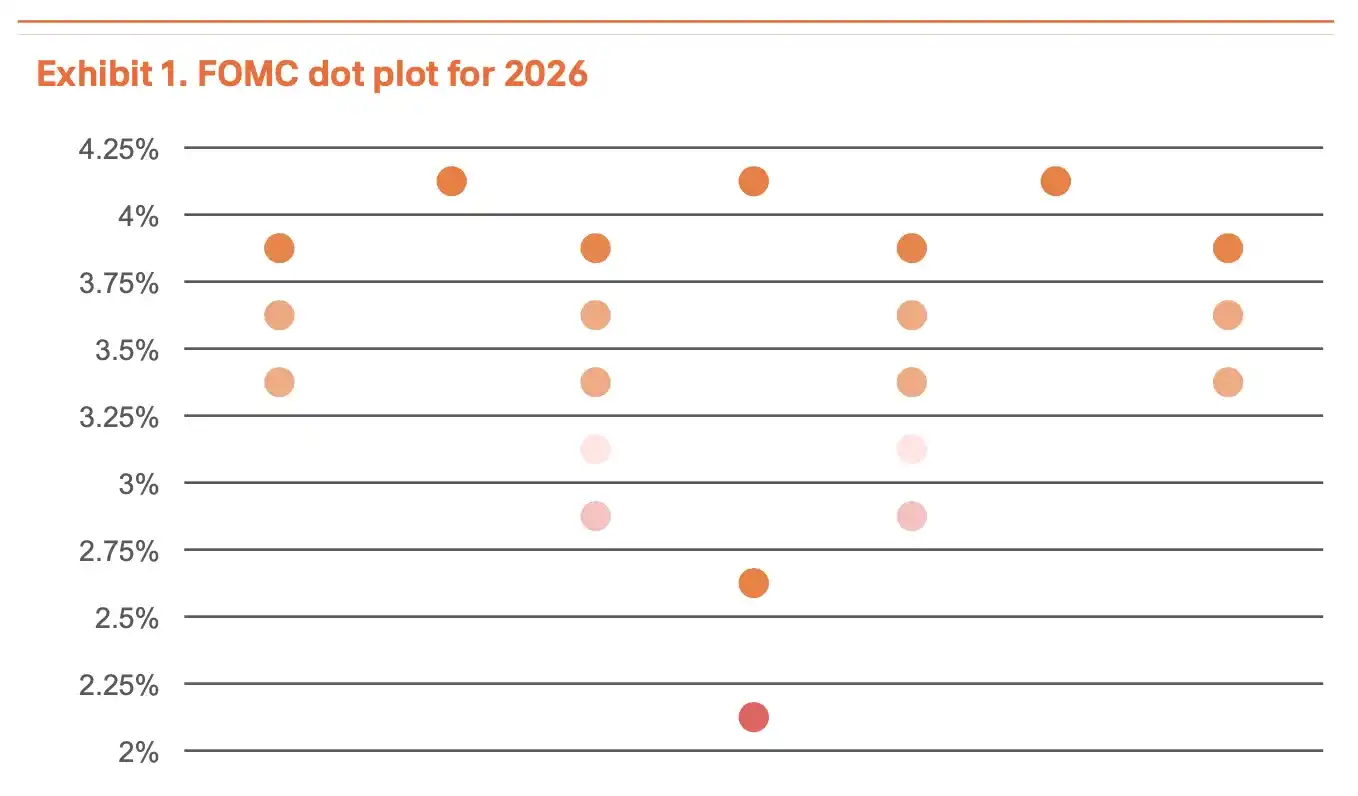
Source: Tiger Research

The Federal Reserve implemented three consecutive 25-basis-point rate cuts from September to December 2025, totaling a 75 bps reduction, with the current rate in the 3.50%–3.75% range. The December dot plot projects the rate to fall to 3.4% by the end of 2026. While a single 50 bps or larger cut is unlikely this year, the potential appointment of a more dovish successor by the Trump administration after Chair Powell's term ends in May could ensure the continuation of the monetary easing trend.

Institutional Outflows and Sustained Corporate Buying

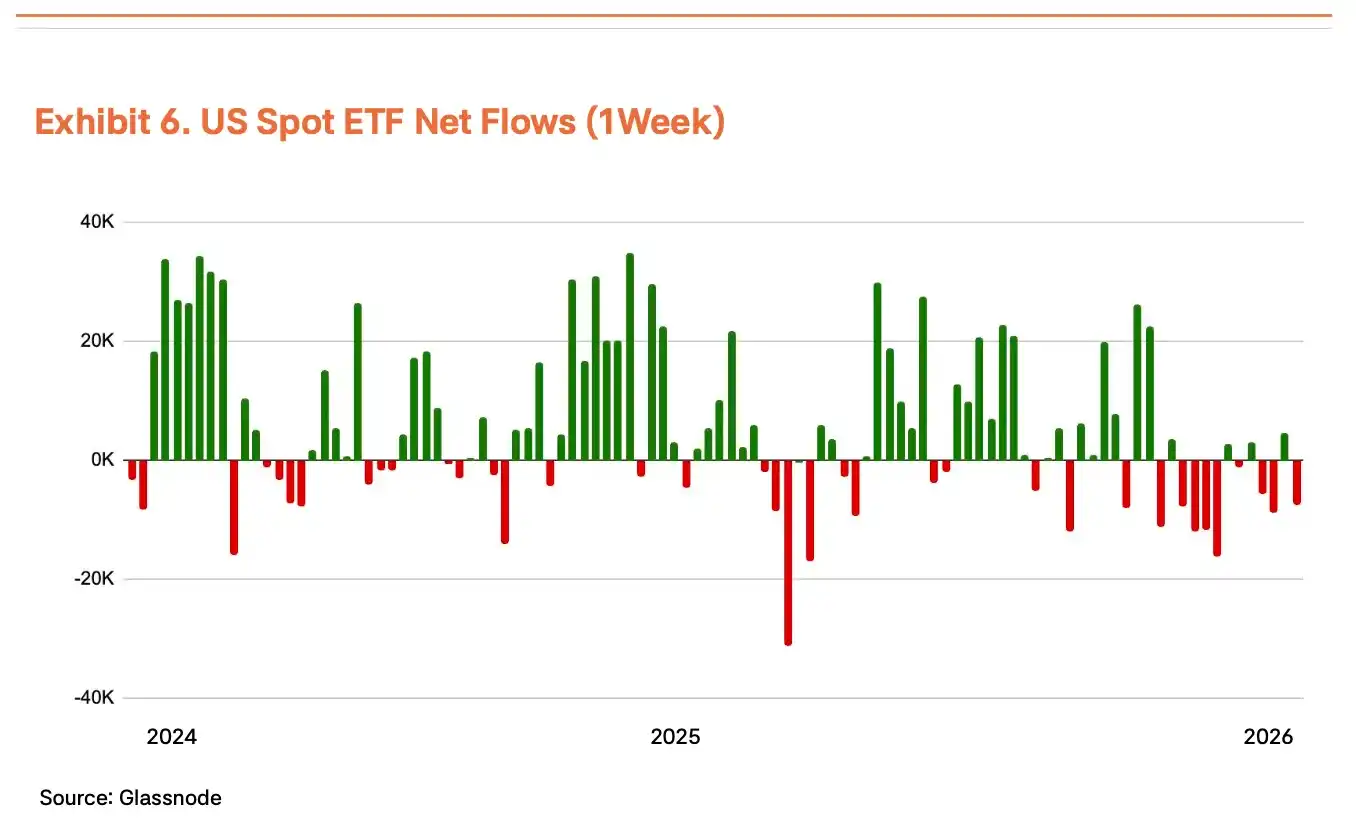
Despite a favorable macro environment, institutional demand has been weak recently. Spot ETFs recorded outflows of $4.57 billion in November and December, the largest since their launch. Annual net inflows reached $21.4 billion, down 39% from last year's $35.2 billion. While January's asset rebalancing brought some inflows, the sustainability of the rebound remains to be seen. Meanwhile, companies like MicroStrategy (holding 673,783 BTC, approx. 3.2% of supply), Metaplanet, and Mara continue to accumulate.

CLARITY Act as a Policy Catalyst

Against the backdrop of stagnant institutional demand, regulatory progress is becoming a potential driver. The CLARITY Act, passed by the House, clarifies the jurisdictional boundaries between the SEC and CFTC and allows banks to offer digital asset custody and staking services. Furthermore, the bill grants the CFTC regulatory authority over the digital commodity spot market, providing a clear legal framework for exchanges and brokers. The Senate Banking Committee is scheduled for review on January 15th. If passed, it could prompt long-hesitant traditional financial institutions to formally enter the market.

Abundant Liquidity, Bitcoin Performance Lags

Liquidity is another key variable besides regulation. Global M2 money supply hit a record high in Q4 2024 and continues its growth trend. Historically, Bitcoin often leads the liquidity cycle, typically rising before M2 peaks and consolidating during the peak phase. Current signs point to further liquidity expansion, suggesting Bitcoin still has upside potential. If equity market valuations appear stretched, capital could likely rotate into Bitcoin.

Macro Factor Adjusted Down to +25%, Outlook Remains Robust

Overall, the macro direction of rate cuts and liquidity expansion remains unchanged. However, considering slowing institutional inflows, uncertainty around the Fed leadership transition, and rising geopolitical risks, we have lowered our macro adjustment factor from +35% to +25%. Despite this reduction, the weighting remains in positive territory. We believe regulatory progress and continued M2 expansion will provide core support for medium to long-term appreciation.

$84,000 Support and $98,000 Resistance

On-chain indicators provide supplementary signals to the macro analysis. During the correction in November 2025, dip-buying was concentrated around $84,000, forming a clear support zone. Bitcoin has since broken above this range. The $98,000 level corresponds to the average cost basis of short-term holders, constituting a near-term psychological and technical resistance.

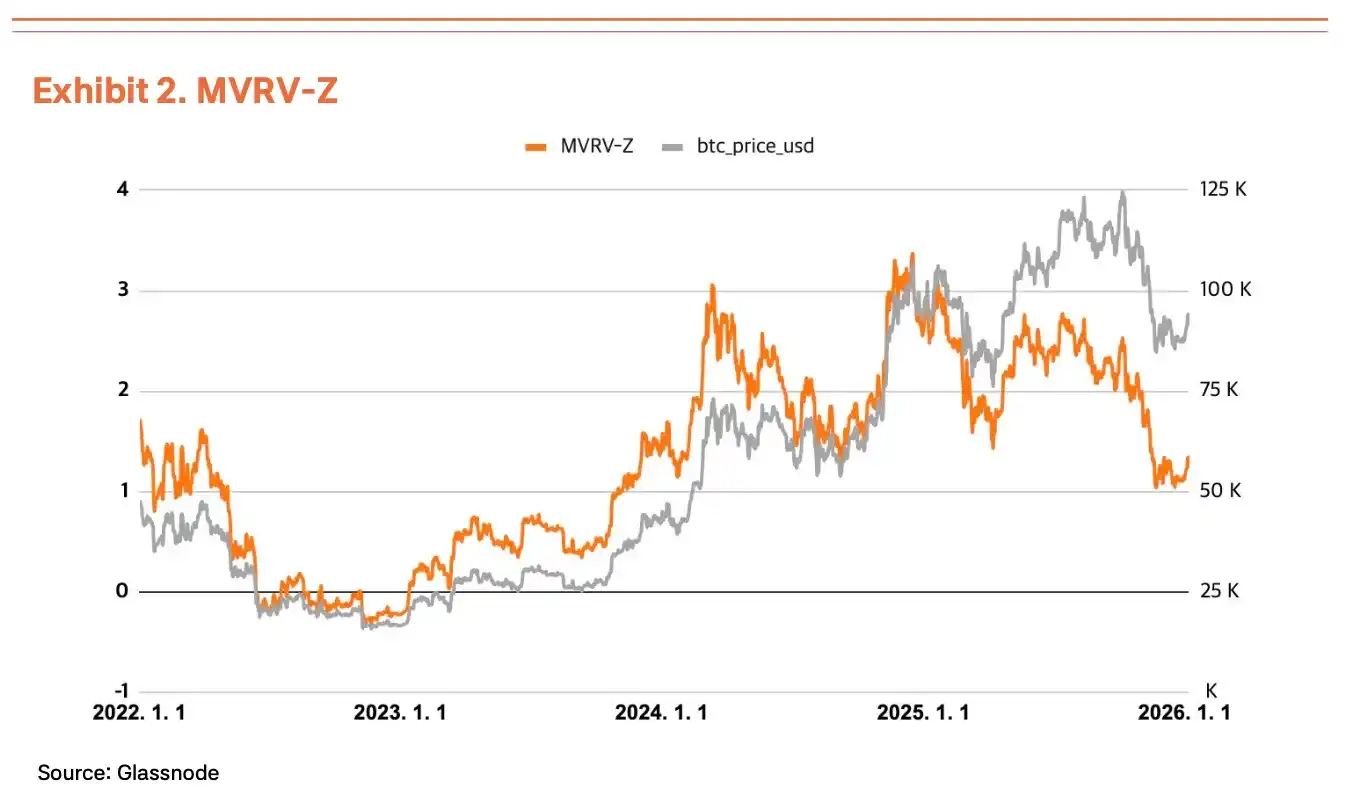
On-chain data shows market sentiment is shifting from short-term panic to neutral. Key indicators like MVRV-Z (1.25), NUPL (0.39), and aSOPR (1.00) have moved out of the undervalued zone into an equilibrium range. This means the possibility of explosive, panic-driven rallies has diminished, but the market structure remains healthy. Combined with the macro and regulatory backdrop, the basis for medium to long-term price appreciation remains statistically sound.

Notably, the current market structure is significantly different from previous cycles. The increased proportion of institutional and long-term capital reduces the probability of retail-driven panic sell-offs. Recent pullbacks have manifested more as gradual rebalancing. While short-term volatility is inevitable, the overall upward structure remains intact.

Target Price Adjusted to $185,500, Bullish Outlook Firm

Applying the TVM valuation framework, we derive a neutral baseline valuation of $145,000 for Q1 2026 (slightly below the previous report's $154,000). Combining a 0% fundamental adjustment and a +25% macro adjustment, we set the revised target price at $185,500.

We have raised the fundamental adjustment factor from -2% to 0%. Although network activity shows little change, renewed market focus on the BTCFi ecosystem has effectively offset some bearish signals. Concurrently, due to the aforementioned slowdown in institutional inflows and geopolitical factors, we have lowered the macro adjustment factor from +35% to +25%.

This target price reduction should not be interpreted as a bearish signal. Even after the adjustment, the model still indicates approximately 100% potential upside. The lower baseline price primarily reflects recent volatility, while Bitcoin's intrinsic value will continue to appreciate over the medium to long term. We view the recent pullback as a healthy rebalancing process, and our medium to long-term bullish outlook remains unchanged.

Связанные с этим вопросы

QWhat is the target price for Bitcoin set by Tiger Research for Q1 2026, and what is the expected upside from the current price?

AThe target price is $185,500, which implies an approximate 100% upside from the current price.

QWhat are the two key price levels identified by on-chain metrics that are currently significant for Bitcoin?

AOn-chain metrics show strong buy-side demand forming a solid support base around $84,000, while $98,000, which is the cost basis for short-term holders, acts as the main resistance level.

QAccording to the report, what recent legislative development could act as a key catalyst for traditional financial institutions to enter the Bitcoin market?

AThe passage of the CLARITY Act in the House, which clarifies regulatory jurisdiction and allows banks to offer digital asset custody and staking services, is a key catalyst. Its upcoming review in the Senate Banking Committee could prompt traditional institutions to formally enter the market.

QHow did Tiger Research adjust its macro adjustment factor in the valuation model, and what was the primary reason for this change?

ATiger Research adjusted the macro adjustment factor down from +35% to +25%, primarily due to slowing institutional inflows, uncertainty around the Federal Reserve leadership change, and rising geopolitical risks.

QWhat does the report state about the relationship between global M2 supply and Bitcoin's price cycle?

AHistorically, Bitcoin's price tends to lead the liquidity cycle, often rising before the M2 supply peaks and then consolidating during the peak phase. The report indicates that signs point to further M2 expansion, suggesting Bitcoin still has upside potential.

Похожее

$30 Billion DeFi Capital Exodus: LayerZero Stumbles, Chainlink Feasts

Following the major DeFi security incident involving Kelp DAO, a significant migration of funds is underway from the cross-chain protocol LayerZero to Chainlink's CCIP (Cross-Chain Interoperability Protocol). Over $30 billion in Total Value Locked (TVL) from protocols like Kelp DAO, Solv Protocol, Re, and Tydro has moved to Chainlink in the past week, driven by security concerns. LayerZero is facing a severe trust crisis after the attack. Initially denying responsibility, LayerZero Labs has now issued a public apology, acknowledging management oversights. These include a vulnerable "1/1" single-node configuration for its Decentralized Verification Network (DVN) and past misuse of a multi-signature wallet by a team member. The protocol's weekly bridge volume has slumped to near-historic lows of around $470 million. In contrast, Chainlink is experiencing a surge in adoption and activity. Its independent active addresses recently hit multi-month highs, and whales have been accumulating LINK tokens. Beyond DeFi, Chainlink is securing partnerships with traditional finance giants like DTCC, European stock exchange operator SIX Group, and asset manager Amundi. While LayerZero has announced security upgrades—such as migrating to stronger multi-signature configurations and developing a second DVN client—and contributed to a rescue fund, the event underscores that security is becoming a decisive competitive factor as DeFi matures.

marsbit34 мин. назад

$30 Billion DeFi Capital Exodus: LayerZero Stumbles, Chainlink Feasts

marsbit34 мин. назад

The $13 Trillion Repo Market Is Quietly Being Rewritten by Blockchain

The $13 trillion repurchase agreement (repo) market, a crucial artery for global short-term funding, is experiencing a significant transformation through blockchain technology. After years of limited impact in finance, blockchain is finding substantial adoption in repo transactions. Major institutions like JPMorgan Chase, HSBC, and Broadridge are deploying tokenized repo platforms, with daily volumes already reaching tens of billions of dollars. Traditional repo markets operate with fixed hours, rely on intermediaries, and involve manual, time-consuming processes. Tokenized repos, by contrast, use blockchain to create digital tokens representing cash and securities collateral. This enables near-instantaneous settlement, 24/7 trading, automated execution, and enhanced auditability. The key drivers for adoption include maturing technology, more receptive regulators, and growing client recognition of tangible benefits like reduced operational friction and capital efficiency. Analyses, such as one from Broadridge, indicate that moving a portion of repo activity onto blockchain can significantly reduce a bank's required liquidity buffers, potentially freeing up billions in capital. The infrastructure is also seen as foundational for a future of round-the-clock trading for traditional assets. Challenges remain, including the existence of fragmented blockchain networks, the need for stress testing under extreme market conditions, and the loss of operational flexibility compared to manual processes. However, the industry consensus is that these are implementation hurdles. Tokenized repo has moved beyond pilot stages to become one of blockchain's most concrete and impactful applications in traditional finance, marking a pivotal shift in how a core market functions.

marsbit34 мин. назад

The $13 Trillion Repo Market Is Quietly Being Rewritten by Blockchain

marsbit34 мин. назад

From Gas Limit to 'Keyed Nonces', How to Understand the Next Step in Ethereum Scalability?

Ethereum’s scalability efforts are shifting toward a user-centric approach—focusing not only on higher TPS, but on translating technical upgrades into lower costs, smoother operations, and better wallet experiences. Two recent developments highlight this direction: - **Raising the Gas Limit to 200 million**: Following the Fusaka upgrade that increased it to 60 million, a consensus has formed around a potential future increase to 200 million. This would boost Ethereum’s execution capacity, but it is planned alongside other upgrades—such as ePBS, Block-Level Access Lists (BAL), and EIP-8037—to manage state growth and keep node operation viable for average participants. - **Keyed Nonces (EIP-8250)**: This proposal aims to improve how transactions are queued. Instead of a single linear nonce per account, it introduces multiple independent nonce domains. This prevents different types of transactions—such as private payments, session keys, or batch operations—from blocking each other. Vitalik Buterin views this as a foundational step toward better privacy support and more flexible state scalability. Together, these upgrades are part of a broader move to push complexity from wallets, DApps, and relays back into the protocol layer. For everyday users, this means future Ethereum interactions could become less congested, more intuitive, and safer—especially as core improvements in account abstraction, cross-L2 interoperability, and node decentralization continue to progress. Ultimately, Ethereum is evolving to handle not just more transactions, but more varied and complex on-chain use cases while preserving its decentralized foundation.

marsbit57 мин. назад

From Gas Limit to 'Keyed Nonces', How to Understand the Next Step in Ethereum Scalability?

marsbit57 мин. назад

Торговля

Спот
Фьючерсы

Популярные статьи

Тест по Bitcoin Биткоина

HTX Learn: Изучите Bitcoin halving и Заработаете Токены USDT

3.0k просмотров всегоОпубликовано 2024.04.16Обновлено 2024.04.16

Тест по Bitcoin  Биткоина

Что такое $BITCOIN

ЦИФРОВОЕ ЗОЛОТО ($BITCOIN): Комплексный анализ Введение в ЦИФРОВОЕ ЗОЛОТО ($BITCOIN) ЦИФРОВОЕ ЗОЛОТО ($BITCOIN) — это проект на основе блокчейна, работающий в сети Solana, который стремится объединить характеристики традиционных драгоценных металлов с инновациями децентрализованных технологий. Хотя он носит имя Биткойн, часто называемого “цифровым золотом” из-за его восприятия как средства хранения ценности, ЦИФРОВОЕ ЗОЛОТО является отдельным токеном, предназначенным для создания уникальной экосистемы в ландшафте Web3. Его цель — позиционировать себя как жизнеспособный альтернативный цифровой актив, хотя детали его применения и функциональности все еще развиваются. Что такое ЦИФРОВОЕ ЗОЛОТО ($BITCOIN)? ЦИФРОВОЕ ЗОЛОТО ($BITCOIN) — это токен криптовалюты, специально разработанный для использования в блокчейне Solana. В отличие от Биткойна, который выполняет широко признанную роль хранения ценности, этот токен, похоже, сосредоточен на более широких приложениях и характеристиках. Примечательные аспекты включают: Инфраструктура блокчейна: Токен построен на блокчейне Solana, известном своей способностью обрабатывать высокоскоростные и недорогие транзакции. Динамика предложения: ЦИФРОВОЕ ЗОЛОТО имеет максимальное предложение, ограниченное 100 квадриллионами токенов (100P $BITCOIN), хотя детали о его обращающемся предложении в настоящее время не раскрыты. Утилита: Хотя точные функциональные возможности не описаны, есть указания на то, что токен может быть использован для различных приложений, потенциально связанных с децентрализованными приложениями (dApps) или стратегиями токенизации активов. Кто создатель ЦИФРОВОГО ЗОЛОТА ($BITCOIN)? На данный момент личность создателей и команды разработчиков, стоящих за ЦИФРОВЫМ ЗОЛОТОМ ($BITCOIN), остается неизвестной. Эта ситуация типична для многих инновационных проектов в области блокчейна, особенно тех, которые связаны с децентрализованными финансами и феноменом мем-криптовалют. Хотя такая анонимность может способствовать культуре, ориентированной на сообщество, она усиливает опасения по поводу управления и ответственности. Кто инвесторы ЦИФРОВОГО ЗОЛОТА ($BITCOIN)? Доступная информация указывает на то, что у ЦИФРОВОГО ЗОЛОТА ($BITCOIN) нет известных институциональных спонсоров или значительных венчурных капиталовложений. Проект, похоже, функционирует по модели пирингового взаимодействия, сосредоточенной на поддержке и принятии сообществом, а не на традиционных путях финансирования. Его активность и ликвидность в основном сосредоточены на децентрализованных биржах (DEX), таких как PumpSwap, а не на устоявшихся централизованных торговых платформах, что еще больше подчеркивает его подход, ориентированный на grassroots. Как работает ЦИФРОВОЕ ЗОЛОТО ($BITCOIN) Операционные механизмы ЦИФРОВОГО ЗОЛОТА ($BITCOIN) можно подробно описать на основе его дизайна блокчейна и характеристик сети: Механизм консенсуса: Используя уникальный механизм доказательства истории (PoH) Solana в сочетании с моделью доказательства доли (PoS), проект обеспечивает эффективную валидацию транзакций, что способствует высокой производительности сети. Токеномика: Хотя конкретные дефляционные механизмы не были подробно описаны, большое максимальное предложение токенов подразумевает, что оно может быть предназначено для микротранзакций или нишевых случаев использования, которые еще предстоит определить. Интероперабельность: Существует потенциал для интеграции с более широкой экосистемой Solana, включая различные платформы децентрализованных финансов (DeFi). Однако детали относительно конкретных интеграций остаются неуточненными. Хронология ключевых событий Вот хронология, которая подчеркивает значимые вехи, касающиеся ЦИФРОВОГО ЗОЛОТА ($BITCOIN): 2023: Первоначальное развертывание токена происходит в блокчейне Solana, отмеченное его адресом контракта. 2024: ЦИФРОВОЕ ЗОЛОТО приобретает видимость, когда оно становится доступным для торговли на децентрализованных биржах, таких как PumpSwap, позволяя пользователям обменивать его на SOL. 2025: Проект наблюдает спорадическую торговую активность и потенциальный интерес к инициативам, возглавляемым сообществом, хотя на данный момент не зафиксировано никаких значительных партнерств или технических достижений. Критический анализ Сильные стороны Масштабируемость: Основная инфраструктура Solana поддерживает высокие объемы транзакций, что может повысить полезность $BITCOIN в различных сценариях транзакций. Доступность: Потенциально низкая цена торговли за токен может привлечь розничных инвесторов, способствуя более широкому участию благодаря возможностям дробного владения. Риски Отсутствие прозрачности: Отсутствие публично известных спонсоров, разработчиков или процесса аудита может вызвать скептицизм относительно устойчивости и надежности проекта. Волатильность рынка: Торговая активность сильно зависит от спекулятивного поведения, что может привести к значительной волатильности цен и неопределенности для инвесторов. Заключение ЦИФРОВОЕ ЗОЛОТО ($BITCOIN) является интригующим, но неоднозначным проектом в быстро развивающейся экосистеме Solana. Хотя он пытается использовать нарратив “цифрового золота”, его отход от установленной роли Биткойна как средства хранения ценности подчеркивает необходимость более четкого различения его предполагаемой утилиты и структуры управления. Будущее принятие и усвоение, вероятно, будут зависеть от решения текущей непрозрачности и более четкого определения его операционных и экономических стратегий. Примечание: Этот отчет охватывает синтезированную информацию, доступную на октябрь 2023 года, и с тех пор могут произойти события.

99 просмотров всегоОпубликовано 2025.05.13Обновлено 2025.05.13

Что такое $BITCOIN

Fractal Bitcoin: масштабирование Биткоина с помощью рекурсивной системы

Fractal Bitcoin — масштабное Layer-1-решнение, созданное на базе кода Биткоина, позволяющего достигать бесконечного масштабирования с помощью рекурсивного подхода.

2.2k просмотров всегоОпубликовано 2025.06.30Обновлено 2025.06.30

Fractal Bitcoin: масштабирование Биткоина с помощью рекурсивной системы

Обсуждения

Добро пожаловать в Сообщество HTX. Здесь вы сможете быть в курсе последних новостей о развитии платформы и получить доступ к профессиональной аналитической информации о рынке. Мнения пользователей о цене на BTC (BTC) представлены ниже.

活动图片