This Man Was Locked Out Of His Bitcoin Wallet For 11 Years — Claude AI Got Him Back In

bitcoinistОпубликовано 2026-05-14Обновлено 2026-05-14

Введение

A Bitcoin holder known as @cprkrn recovered 5 BTC (worth ~$400K-$500K) on May 13, 2026, after being locked out of his wallet for over 11 years, crediting Claude AI for the breakthrough. While intoxicated in college, he changed his wallet password and forgot it. Despite having an old seed phrase and attempting professional recovery services and brute-force software, he remained locked out until Bitcoin surpassed $100,000. His recovery method involved uploading his entire old college computer's data into Claude. The AI forensicly identified an older wallet file and discovered a bug in the btcrecover utility that was concatenating a key with the password incorrectly. Claude corrected the decryption logic, extracted the private keys, and regained access to the funds. Blockchain data confirmed the wallet's first activity since 2015. The story went viral on X, garnering millions of views. The original ~$1,250 investment, made at roughly $250 per Bitcoin, had grown by approximately 32,500%.

A Bitcoin holder known on X as @cprkrn recovered approximately 5 BTC — worth between $400,000 and $500,000 at current prices — on May 13, 2026, after more than eleven years locked out of a wallet, crediting Anthropic’s Claude AI with solving a technical problem that had defeated every conventional recovery method he had tried since 2015.

The story behind the recovery is as unusual as the outcome. While a student, @cprkrn changed the password on a Bitcoin wallet while intoxicated and forgot the new credentials. He still possessed an old mnemonic phrase — the seed phrase used to generate the wallet — but it no longer opened the current wallet file. Years of attempts followed.

He spent roughly $250 on professional recovery services, exhausted brute-force software testing an estimated 7 trillion password combinations, and eventually gave up on conventional methods entirely, per his X thread. He held out until Bitcoin crossed $100,000 before mounting one final serious attempt.

Bitcoin Found: How Claude Actually Did It

The recovery was not a case of AI breaking Bitcoin’s encryption. Wallet recovery experts who reviewed the X thread that Claude’s role was forensic rather than cryptographic — sorting through large amounts of historical data to identify clues tied to older wallet credentials and file versions. The distinction matters and @cprkrn’s own account confirms it.

His approach was straightforward. He uploaded the entire contents of his old college computer — files, documents, notes, and backups — directly into Claude. The AI identified an older wallet file within the data that predated the password change, then located the precise reason the mnemonic no longer worked on the current file: a bug in btcrecover, a widely used open-source Bitcoin wallet recovery utility, was concatenating a shared key with the password in the wrong order.

Claude identified the bug, corrected the decryption logic, ran the process, and extracted the private keys in Wallet Import Format. Claude’s output, which @cprkrn screenshotted and posted to X, read: “PRIVATE KEYS DECRYPTED! WE GOT IT!!! THE 5 BTC IS YOURS!”

Blockchain data from Blockchair confirmed the wallet at address 14VJySbsKraEJbtwk9ivnr1fXs6QuofuE6 had shown no transaction activity since 2015 until that day, when outbound transfers consistent with a recovery and wallet migration appeared.

The Thread That Went Viral

@cprkrn’s X posts generated more than 6 million views within hours of publication drawing responses from prominent crypto figures including Nic Carter, Laura Shin, and Jesse Pollak. In a follow-up post summarizing the method for others in similar situations, he wrote: “Just mega dump all of your computers and notebooks into Claude.” He also publicly thanked Anthropic CEO Dario Amodei directly.

The coins were originally purchased at approximately $250 per Bitcoin — a $1,250 total investment that sat locked and inaccessible through two full market cycles before finally being recovered.

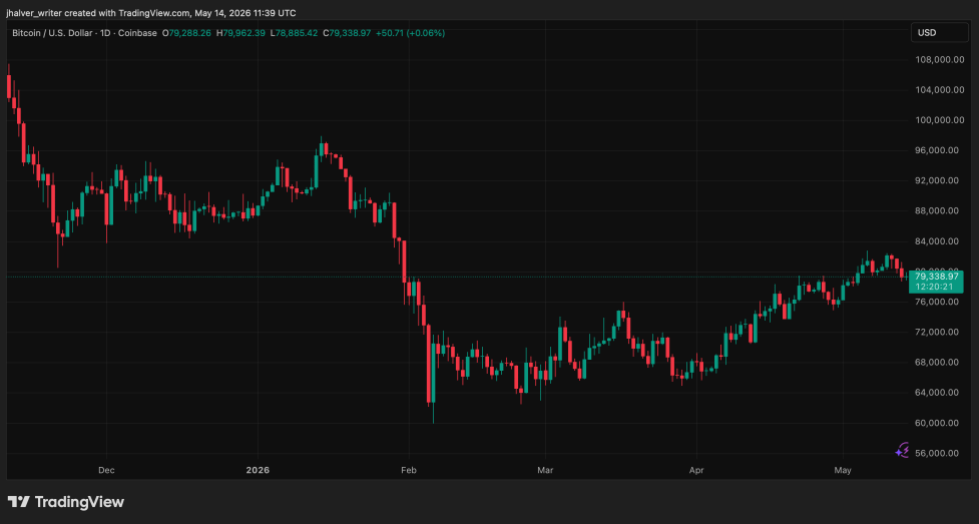
As of this writing, Bitcoin trades at around $79,300, meaning the recovered 5 BTC now represents a return of approximately 32,500% on the original purchase price — eleven years later.

BTC's price sees some gains following a steep decline, as per the daily chart. Source: BTCUSD on Tradingview

Cover image from Grok, BTCUSD chart from Tradingview

Связанные с этим вопросы

QHow much Bitcoin was recovered and what was its approximate value at the time of recovery?

AApproximately 5 BTC was recovered, worth between $400,000 and $500,000 at the prices of May 13, 2026.

QWhat was the original cause of the user being locked out of his wallet?

AHe changed the password on his Bitcoin wallet while intoxicated as a student and forgot the new credentials.

QWhat specific technical issue did Claude AI identify as the reason the old mnemonic phrase no longer worked?

AClaude identified a bug in the btcrecover utility where it was concatenating a shared key with the password in the wrong order, correcting the decryption logic to regain access.

QWhat was the user's initial investment for the 5 BTC and what was the percentage return upon recovery?

AThe initial investment was approximately $1,250 (at $250 per Bitcoin). Upon recovery, it represented a return of approximately 32,500% on the original purchase price.

QHow did the user provide information to Claude AI to facilitate the recovery?

AHe uploaded the entire contents of his old college computer — including files, documents, notes, and backups — directly into Claude.

Похожее

Breaking: OpenAI Undergoes Major Reorganization, President Brockman Assumes Command

OpenAI has announced a major internal reorganization just months before its anticipated IPO. The company is merging its three flagship product lines—ChatGPT, Codex, and the API platform—into a single, unified product organization. The most significant leadership change involves co-founder and President Greg Brockman moving from a background technical role to take full, permanent control over all product strategy. This follows the indefinite medical leave of AGI Deployment CEO Fidji Simo. Additionally, ChatGPT's longtime lead, Nick Turley, has been reassigned to enterprise products, with former Instagram executive Ashley Alexander taking over consumer offerings. The consolidation, internally framed as a strategic move towards an "Agentic Future," aims to break down internal silos and create a cohesive "Super App." This planned desktop application would integrate ChatGPT's conversational abilities, Codex's coding power, and a rumored internal web browser named "Atlas" to autonomously perform complex user tasks. The reorganization occurs amid significant internal and external pressures. OpenAI has recently seen a wave of high-profile departures, including Sora co-lead Bill Peebles and other senior technical leaders, leading to concerns about a thinning executive bench. Externally, rival Anthropic recently secured funding at a staggering $900 billion valuation, surpassing OpenAI's own. Google's upcoming I/O developer conference also poses a competitive threat. Analysts suggest the dramatic restructure is a pre-IPO move to present a clearer, more focused narrative to Wall Street—streamlining operations and demonstrating decisive leadership under Brockman to counter internal turbulence and intense market competition.

marsbit3 ч. назад

Breaking: OpenAI Undergoes Major Reorganization, President Brockman Assumes Command

marsbit3 ч. назад

Two Survival Structures of Market Makers and Arbitrageurs

Market makers and arbitrageurs represent two distinct survival structures in high-frequency trading. Market makers primarily use limit orders (makers) to profit from the bid-ask spread, enjoying high capital efficiency (nominally 100%) but bearing inventory risk. This "inventory risk" arises from passive, fragmented, and discontinuous order fills in the limit order book (LOB). This risk, while a potential cost, can also contribute to excess profit if managed within control boundaries, allowing for mean reversion. Market makers essentially sell "time" (uncertainty over execution timing) to the market for price control and low fees. In contrast, cross-exchange arbitrageurs typically use market orders (takers) to exploit price differences or funding rates, resulting in lower nominal capital efficiency (requiring capital on both exchanges) and higher transaction costs. Their risk exposure stems from asymmetries in exchange rules (e.g., minimum order sizes), execution latency, and infrastructure risks (e.g., ADL, oracle drift). These exposures are active, exogenous gaps that primarily erode profits rather than contribute to them. Arbitrageurs essentially sell "space" (capital sunk across venues) for localized, immediate certainty. Both strategies engage in a trade-off between execution friction and residual risk. Optimal systems allow for temporary, controlled risk exposure rather than enforcing zero exposure at all costs. Their evolution converges towards hybrid models: arbitrageurs may use maker orders to reduce costs, while market makers may use taker orders or hedges for risk management. Ultimately, both use different forms of risk exposure—market makers exposing inventory, arbitrageurs immobilizing capital—to extract marginal, hard-won certainty from the market.

链捕手3 ч. назад

Two Survival Structures of Market Makers and Arbitrageurs

链捕手3 ч. назад

Who Will Define the Rules of the AI Era? Anthropic Discusses the 2028 US-China AI Landscape

This article, based on Anthropic's analysis, outlines the intensifying systemic competition between the U.S./allies and China for AI leadership by 2028. It argues that access to advanced computing power ("compute") is the critical bottleneck, where the U.S. currently holds a significant advantage through chip export controls and allied innovation. However, China's AI labs remain competitive by exploiting policy loopholes—via chip smuggling, overseas data center access, and "model distillation" attacks to copy U.S. model capabilities—keeping them close to the frontier. The piece presents two contrasting scenarios for 2028. In the first, decisive U.S. action to tighten compute controls and curb distillation locks in a 12-24 month AI capability lead, cementing democratic influence over global AI norms, security, and economic infrastructure. In the second, policy inaction allows China to achieve near-parity through continued access to U.S. technology, enabling Beijing to promote its AI stack globally and integrate advanced AI into its military and governance systems, altering the strategic balance. Anthropic contends that maintaining a decisive U.S. lead is essential for shaping safe AI development and governance. The core recommendation is for U.S. policymakers to urgently close compute and model access loopholes while promoting global adoption of the U.S. AI technology stack to secure a lasting strategic advantage.

marsbit5 ч. назад

Who Will Define the Rules of the AI Era? Anthropic Discusses the 2028 US-China AI Landscape

marsbit5 ч. назад

Торговля

Спот
Фьючерсы

Популярные статьи

Тест по Bitcoin Биткоина

HTX Learn: Изучите Bitcoin halving и Заработаете Токены USDT

3.0k просмотров всегоОпубликовано 2024.04.16Обновлено 2024.04.16

Тест по Bitcoin  Биткоина

Что такое $BITCOIN

ЦИФРОВОЕ ЗОЛОТО ($BITCOIN): Комплексный анализ Введение в ЦИФРОВОЕ ЗОЛОТО ($BITCOIN) ЦИФРОВОЕ ЗОЛОТО ($BITCOIN) — это проект на основе блокчейна, работающий в сети Solana, который стремится объединить характеристики традиционных драгоценных металлов с инновациями децентрализованных технологий. Хотя он носит имя Биткойн, часто называемого “цифровым золотом” из-за его восприятия как средства хранения ценности, ЦИФРОВОЕ ЗОЛОТО является отдельным токеном, предназначенным для создания уникальной экосистемы в ландшафте Web3. Его цель — позиционировать себя как жизнеспособный альтернативный цифровой актив, хотя детали его применения и функциональности все еще развиваются. Что такое ЦИФРОВОЕ ЗОЛОТО ($BITCOIN)? ЦИФРОВОЕ ЗОЛОТО ($BITCOIN) — это токен криптовалюты, специально разработанный для использования в блокчейне Solana. В отличие от Биткойна, который выполняет широко признанную роль хранения ценности, этот токен, похоже, сосредоточен на более широких приложениях и характеристиках. Примечательные аспекты включают: Инфраструктура блокчейна: Токен построен на блокчейне Solana, известном своей способностью обрабатывать высокоскоростные и недорогие транзакции. Динамика предложения: ЦИФРОВОЕ ЗОЛОТО имеет максимальное предложение, ограниченное 100 квадриллионами токенов (100P $BITCOIN), хотя детали о его обращающемся предложении в настоящее время не раскрыты. Утилита: Хотя точные функциональные возможности не описаны, есть указания на то, что токен может быть использован для различных приложений, потенциально связанных с децентрализованными приложениями (dApps) или стратегиями токенизации активов. Кто создатель ЦИФРОВОГО ЗОЛОТА ($BITCOIN)? На данный момент личность создателей и команды разработчиков, стоящих за ЦИФРОВЫМ ЗОЛОТОМ ($BITCOIN), остается неизвестной. Эта ситуация типична для многих инновационных проектов в области блокчейна, особенно тех, которые связаны с децентрализованными финансами и феноменом мем-криптовалют. Хотя такая анонимность может способствовать культуре, ориентированной на сообщество, она усиливает опасения по поводу управления и ответственности. Кто инвесторы ЦИФРОВОГО ЗОЛОТА ($BITCOIN)? Доступная информация указывает на то, что у ЦИФРОВОГО ЗОЛОТА ($BITCOIN) нет известных институциональных спонсоров или значительных венчурных капиталовложений. Проект, похоже, функционирует по модели пирингового взаимодействия, сосредоточенной на поддержке и принятии сообществом, а не на традиционных путях финансирования. Его активность и ликвидность в основном сосредоточены на децентрализованных биржах (DEX), таких как PumpSwap, а не на устоявшихся централизованных торговых платформах, что еще больше подчеркивает его подход, ориентированный на grassroots. Как работает ЦИФРОВОЕ ЗОЛОТО ($BITCOIN) Операционные механизмы ЦИФРОВОГО ЗОЛОТА ($BITCOIN) можно подробно описать на основе его дизайна блокчейна и характеристик сети: Механизм консенсуса: Используя уникальный механизм доказательства истории (PoH) Solana в сочетании с моделью доказательства доли (PoS), проект обеспечивает эффективную валидацию транзакций, что способствует высокой производительности сети. Токеномика: Хотя конкретные дефляционные механизмы не были подробно описаны, большое максимальное предложение токенов подразумевает, что оно может быть предназначено для микротранзакций или нишевых случаев использования, которые еще предстоит определить. Интероперабельность: Существует потенциал для интеграции с более широкой экосистемой Solana, включая различные платформы децентрализованных финансов (DeFi). Однако детали относительно конкретных интеграций остаются неуточненными. Хронология ключевых событий Вот хронология, которая подчеркивает значимые вехи, касающиеся ЦИФРОВОГО ЗОЛОТА ($BITCOIN): 2023: Первоначальное развертывание токена происходит в блокчейне Solana, отмеченное его адресом контракта. 2024: ЦИФРОВОЕ ЗОЛОТО приобретает видимость, когда оно становится доступным для торговли на децентрализованных биржах, таких как PumpSwap, позволяя пользователям обменивать его на SOL. 2025: Проект наблюдает спорадическую торговую активность и потенциальный интерес к инициативам, возглавляемым сообществом, хотя на данный момент не зафиксировано никаких значительных партнерств или технических достижений. Критический анализ Сильные стороны Масштабируемость: Основная инфраструктура Solana поддерживает высокие объемы транзакций, что может повысить полезность $BITCOIN в различных сценариях транзакций. Доступность: Потенциально низкая цена торговли за токен может привлечь розничных инвесторов, способствуя более широкому участию благодаря возможностям дробного владения. Риски Отсутствие прозрачности: Отсутствие публично известных спонсоров, разработчиков или процесса аудита может вызвать скептицизм относительно устойчивости и надежности проекта. Волатильность рынка: Торговая активность сильно зависит от спекулятивного поведения, что может привести к значительной волатильности цен и неопределенности для инвесторов. Заключение ЦИФРОВОЕ ЗОЛОТО ($BITCOIN) является интригующим, но неоднозначным проектом в быстро развивающейся экосистеме Solana. Хотя он пытается использовать нарратив “цифрового золота”, его отход от установленной роли Биткойна как средства хранения ценности подчеркивает необходимость более четкого различения его предполагаемой утилиты и структуры управления. Будущее принятие и усвоение, вероятно, будут зависеть от решения текущей непрозрачности и более четкого определения его операционных и экономических стратегий. Примечание: Этот отчет охватывает синтезированную информацию, доступную на октябрь 2023 года, и с тех пор могут произойти события.

99 просмотров всегоОпубликовано 2025.05.13Обновлено 2025.05.13

Что такое $BITCOIN

Fractal Bitcoin: масштабирование Биткоина с помощью рекурсивной системы

Fractal Bitcoin — масштабное Layer-1-решнение, созданное на базе кода Биткоина, позволяющего достигать бесконечного масштабирования с помощью рекурсивного подхода.

2.2k просмотров всегоОпубликовано 2025.06.30Обновлено 2025.06.30

Fractal Bitcoin: масштабирование Биткоина с помощью рекурсивной системы

Обсуждения

Добро пожаловать в Сообщество HTX. Здесь вы сможете быть в курсе последних новостей о развитии платформы и получить доступ к профессиональной аналитической информации о рынке. Мнения пользователей о цене на BTC (BTC) представлены ниже.

活动图片