The First Wave of Bitcoin Treasury Companies Is Beginning to Collapse

marsbitОпубликовано 2025-12-19Обновлено 2025-12-19

Введение

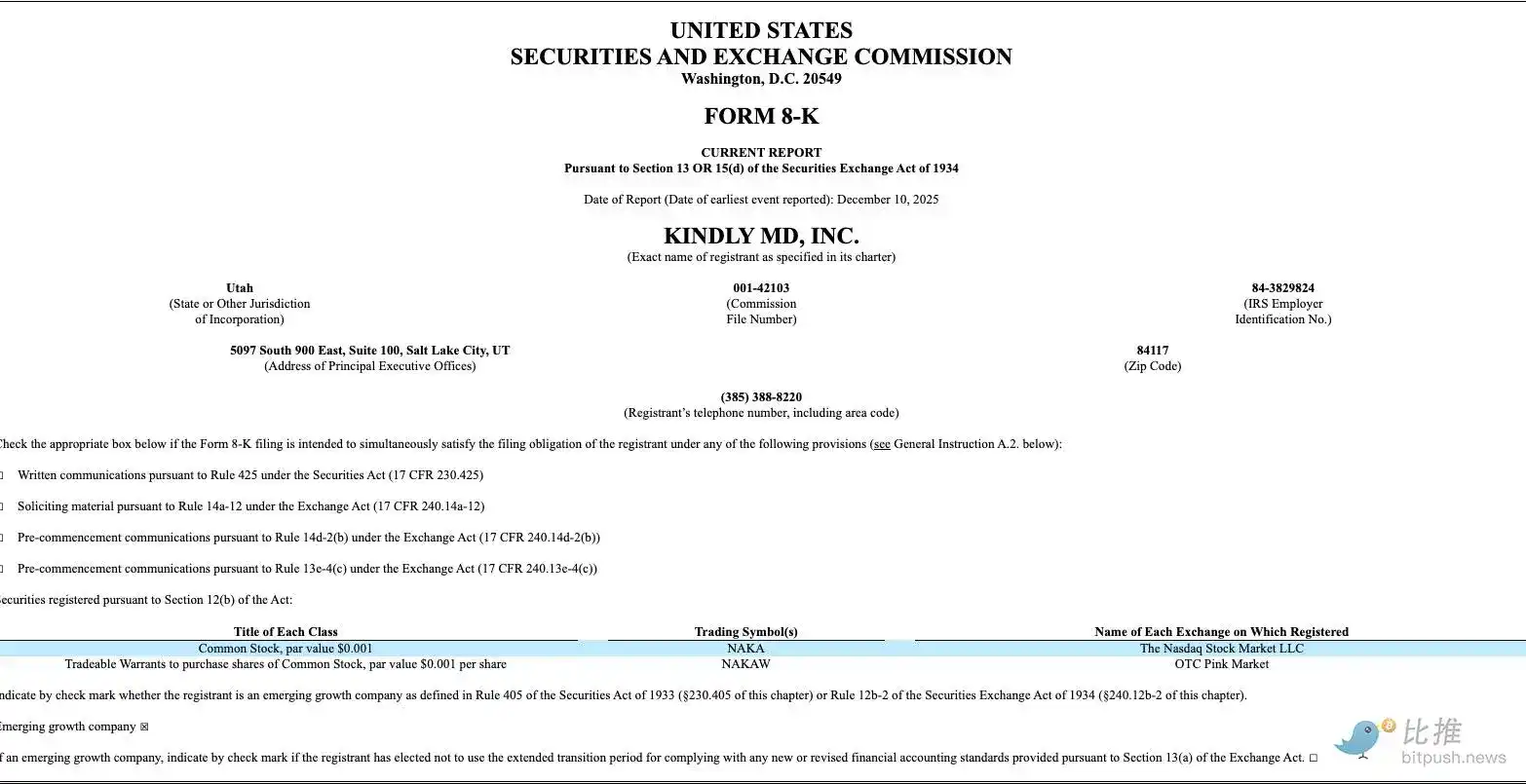
The first wave of Bitcoin treasury companies is facing a severe shakeout, as seen with KindlyMD (NAKA) receiving a Nasdaq compliance notice for its stock trading below $1. This signals a broader sector-wide crisis where investors are scrutinizing these firms' fundamentals—cash flow, financing capabilities, and resilience during market downturns—rather than just their Bitcoin holdings. Imitators of the Strategy (MSTR) model are under pressure, with stocks like American Bitcoin (ABTC) and ProCap Financial (BRR) falling over 68% and 70% in a month, respectively. Even Ethereum-focused firms like Bitmine Immersion Technologies (BMNR) are underperforming their underlying assets. Key differentiators are now the scale of Bitcoin holdings and the mNAV (market cap to net asset value) ratio. MSTR, with 671,268 BTC, trades at an mNAV of ~0.8x, while smaller firms like NAKA (~0.35x mNAV) trade at discounts, and ABTC (~3.5x mNAV) faces volatile premiums. The market shift is from "how much Bitcoin can you buy" to "can you avoid selling during volatility." Notably, about 65 of 100 tracked Bitcoin treasury companies bought at prices above current levels, resulting in unrealized losses. At least five firms have already offloaded 1,883 BTC during the recent sell-off. Industry analysts like Matt Zhang of Hivemind Capital view this as a Darwinian cleansing, where only companies with stable operational cash flows and robust capital structures will survive without relying on continuous financin...

Author: Bootly

Bitcoin treasury companies are undergoing a brutal screening.

Not long ago, Nasdaq's compliance reminder to KindlyMD (NAKA) regarding its minimum stock price pushed the "Bitcoin Treasury Company" sector into a more brutal and realistic phase: from storytelling and capturing premiums to being forced to answer hard questions like "Where does cash flow come from? Can financing continue? Will coins be sold during extreme market conditions?"

According to Nasdaq rules, the company needs to have its stock price close at $1 or above for at least 10 consecutive trading days by June 8, 2026, to regain compliance.

For "treasury companies" whose lifeblood is their ability to raise capital in the market, such notices often trigger a chain reaction of financing discounts, liquidity contraction, and valuation repricing.

The market's patience seems to be running out.

Imitators Under Collective Pressure: The Market is "Voting with its Feet"

If MicroStrategy (MSTR) is the originator of this model, then the past year has seen the emergence of a whole batch of followers trying to replicate its path. But recent stock performance shows that investors are pricing these "imitators" much more harshly.

Over the past month, KindlyMD (NAKA) stock fell about 39%;

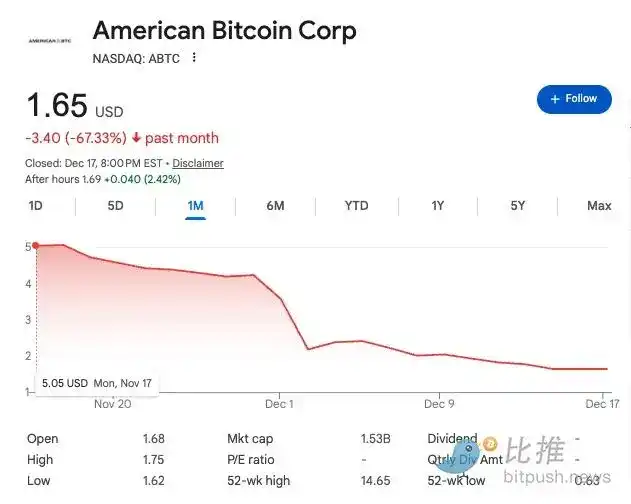
American Bitcoin (ABTC), associated with Eric Trump, fell nearly 68%;

ProCap Financial (BRR), involving Anthony Pompliano, fell nearly 70%.

This deceleration is not an isolated case but a sector-wide phenomenon. Even among Ethereum treasury companies, the situation hasn't improved. Taking Bitmine Immersion Technologies (BMNR) as an example, this company, whose core asset is holding ETH, has seen its stock price fall by over 30% since the crypto market's significant correction last October, while Ethereum itself fell about 25% in the same period.

This means that during a downturn, these companies not only fail to provide a "buffer" but often exhibit higher volatility than the underlying assets.

Who Gets a Premium, Who Gets Discounted

If we further dissect the situation of different companies, the differences are particularly clear in two metrics: coin holdings and mNAV (Market Cap / Net Asset Value). The former determines the company's scale in the crypto asset narrative, while the latter reflects whether the market is still willing to pay a premium for its continued financing ability.

Looking at public data from sources like Bitcoin Treasuries, the divergence between companies is already very apparent.

Core Data Comparison of Major Bitcoin Treasury Companies

Company Primary Asset Coin Holdings Holding Value (Est.) Current Market Cap mNAV
MicroStrategy (MSTR) BTC 671,268 BTC ≈$57.7B ≈$46.0B ≈0.8x
KindlyMD (NAKA) BTC 5,398 BTC ≈$465M ≈$161M ≈0.35x
American Bitcoin (ABTC) BTC 5,098 BTC ≈$439M ≈$2.0B ≈3.5x
ProCap Financial (BRR) BTC 4,951 BTC ≈$435M Below Holding Value <1x

Note: Holdings and valuation data are based on public tracking sources like Bitcoin Treasuries; market cap is an estimated range for the period.

The signal from this data is not complicated:

The market is no longer pricing based on "whether Bitcoin is held" itself, but is reassessing the company's capital structure, financing flexibility, and going concern ability.

KindlyMD's mNAV falling below 0.4x means its stock is seen by the market as a "high-risk vehicle below its book asset value"; while American Bitcoin still maintains a high premium, its sharp stock retreat shows that this premium itself is extremely unstable.

Among all companies, the change in MicroStrategy (MSTR) is the most representative. Earlier this year, its mNAV was once above 1.5x, but as Bitcoin entered a high-volatility phase in Q4, this metric quickly converged towards the asset value and recently fell to around 0.8x.

This change is not a simple "valuation correction" but a shift in market focus:

From "how many more coins can be bought" to "whether coins will be forced to be sold during volatile periods."

It is in this context that MicroStrategy announced the establishment of a cash reserve of approximately $1.44 billion to cover dividend and debt interest payments for the next ~21 months, explicitly reducing the possibility of selling Bitcoin in extreme market conditions.

The Underlying Reality: Most Companies Actually Bought at High Prices

If we zoom out, the fragility of the industry as a whole is more directly reflected in the statistics.

According to Bitcoin Treasuries' summary, among the current ~100 Bitcoin treasury companies with calculable cost bases, 65 bought Bitcoin above the current price. In other words, the industry as a whole is suffering large-scale unrealized losses.

More notably, during the recent accelerated market decline phase, at least 5 companies have collectively sold 1,883 Bitcoins. This behavior itself creates a clear tension with the narrative of "long-term holding and weathering cycles."

As Matt Zhang, founder of Hivemind Capital, stated, this phase is more like an "industry shakeout." He revealed in a Yahoo Finance interview that his team evaluated over 100 digital asset treasury companies this year, ultimately investing in only about ten, and bluntly stated that a significant portion of them might gradually become "irrelevant."

In his view, even if more traditional companies incorporate Bitcoin or Ethereum into their balance sheets in the future, this alone will not constitute long-term competitiveness. The real watershed is: whether they have stable operational cash flow and whether they can maintain the treasury structure without relying on continuous financing.

Analysts at Galaxy Digital pointed out that this industry turmoil is actually a "Darwinian screening period." As risk appetite weakens and financing costs rise, companies without business support, relying solely on asset appreciation stories, will be forced to consolidate, sell, or exit the market entirely.

This judgment is highly consistent with the conclusions of some institutional research: the treasury strategy has not been negated, but has evolved from "concept arbitrage" to a comprehensive competition around capital structure, cash management, and risk control.

Conclusion

The Nasdaq notice received by KindlyMD might be just the beginning. It reminds the market, and these companies:

During periods of loose liquidity and one-sided asset appreciation, "buying coins" alone was enough to support valuations; but when the cycle reverses, what the market truly cares about is whether you can survive the turbulence.

This round of adjustment will not make all Bitcoin treasury companies disappear, but it will definitely redefine who gets to stay on stage.

Looking back at the end of the year, this is perhaps the moment when the first batch of "Bitcoin treasury companies" is being grilled by the market, and also the starting point for the next phase of industry differentiation.

Связанные с этим вопросы

QWhat is the core issue facing Bitcoin treasury companies according to the article?

AThe core issue is a market shift from valuing these companies based on their Bitcoin holdings and growth narratives to scrutinizing their fundamental business viability, including cash flow sources, ongoing financing capabilities, and the risk of being forced to sell Bitcoin during extreme market volatility.

QWhich company received a Nasdaq compliance notice, and what does it signify for the sector?

AKindlyMD (ticker: NAKA) received a Nasdaq notice for failing to maintain a minimum bid price of $1. This signifies a critical point for the sector, indicating that investor patience is waning and companies reliant on capital markets for funding face potential liquidity crunches, financing discounts, and valuation repricing.

QHow does the article illustrate the performance gap between 'originator' and 'imitator' Bitcoin treasury companies?

AThe article illustrates the gap by comparing the market performance and valuation metrics. The originator, MicroStrategy (MSTR), while seeing its premium shrink, maintains a market cap closer to its net asset value (mNAV ~0.8x). In contrast, many imitators like KindlyMD (mNAV ~0.35x) trade at a significant discount, and others like American Bitcoin (ABTC), despite a high mNAV (~3.5x), have seen their stock prices plummet, showing their premiums are unstable.

QWhat key metric does the article use to show market sentiment shifting towards these companies?

AThe article uses the mNAV (market capitalization to Net Asset Value) ratio as a key metric. A high mNAV indicates the market is paying a premium for the company's future financing and growth potential, while a low or declining mNAV (often below 1x) shows the market is discounting the stock, valuing it below its underlying assets due to perceived operational or financial risk.

QWhat is the 'Darwinian screening period' for Bitcoin treasury companies, as described in the article?

AThe 'Darwinian screening period' refers to a phase of industry consolidation and shakeout. As risk appetite weakens and financing becomes more difficult, companies without stable operational cash flows or a sustainable business model beyond holding appreciating assets will be forced to consolidate, sell their assets, or exit the market entirely. Only those with robust capital structures and risk management will survive.

Похожее

Торговля

Спот
Фьючерсы

Популярные статьи

Тест по Bitcoin Биткоина

HTX Learn: Изучите Bitcoin halving и Заработаете Токены USDT

3.0k просмотров всегоОпубликовано 2024.04.16Обновлено 2024.04.16

Тест по Bitcoin  Биткоина

Что такое $BITCOIN

ЦИФРОВОЕ ЗОЛОТО ($BITCOIN): Комплексный анализ Введение в ЦИФРОВОЕ ЗОЛОТО ($BITCOIN) ЦИФРОВОЕ ЗОЛОТО ($BITCOIN) — это проект на основе блокчейна, работающий в сети Solana, который стремится объединить характеристики традиционных драгоценных металлов с инновациями децентрализованных технологий. Хотя он носит имя Биткойн, часто называемого “цифровым золотом” из-за его восприятия как средства хранения ценности, ЦИФРОВОЕ ЗОЛОТО является отдельным токеном, предназначенным для создания уникальной экосистемы в ландшафте Web3. Его цель — позиционировать себя как жизнеспособный альтернативный цифровой актив, хотя детали его применения и функциональности все еще развиваются. Что такое ЦИФРОВОЕ ЗОЛОТО ($BITCOIN)? ЦИФРОВОЕ ЗОЛОТО ($BITCOIN) — это токен криптовалюты, специально разработанный для использования в блокчейне Solana. В отличие от Биткойна, который выполняет широко признанную роль хранения ценности, этот токен, похоже, сосредоточен на более широких приложениях и характеристиках. Примечательные аспекты включают: Инфраструктура блокчейна: Токен построен на блокчейне Solana, известном своей способностью обрабатывать высокоскоростные и недорогие транзакции. Динамика предложения: ЦИФРОВОЕ ЗОЛОТО имеет максимальное предложение, ограниченное 100 квадриллионами токенов (100P $BITCOIN), хотя детали о его обращающемся предложении в настоящее время не раскрыты. Утилита: Хотя точные функциональные возможности не описаны, есть указания на то, что токен может быть использован для различных приложений, потенциально связанных с децентрализованными приложениями (dApps) или стратегиями токенизации активов. Кто создатель ЦИФРОВОГО ЗОЛОТА ($BITCOIN)? На данный момент личность создателей и команды разработчиков, стоящих за ЦИФРОВЫМ ЗОЛОТОМ ($BITCOIN), остается неизвестной. Эта ситуация типична для многих инновационных проектов в области блокчейна, особенно тех, которые связаны с децентрализованными финансами и феноменом мем-криптовалют. Хотя такая анонимность может способствовать культуре, ориентированной на сообщество, она усиливает опасения по поводу управления и ответственности. Кто инвесторы ЦИФРОВОГО ЗОЛОТА ($BITCOIN)? Доступная информация указывает на то, что у ЦИФРОВОГО ЗОЛОТА ($BITCOIN) нет известных институциональных спонсоров или значительных венчурных капиталовложений. Проект, похоже, функционирует по модели пирингового взаимодействия, сосредоточенной на поддержке и принятии сообществом, а не на традиционных путях финансирования. Его активность и ликвидность в основном сосредоточены на децентрализованных биржах (DEX), таких как PumpSwap, а не на устоявшихся централизованных торговых платформах, что еще больше подчеркивает его подход, ориентированный на grassroots. Как работает ЦИФРОВОЕ ЗОЛОТО ($BITCOIN) Операционные механизмы ЦИФРОВОГО ЗОЛОТА ($BITCOIN) можно подробно описать на основе его дизайна блокчейна и характеристик сети: Механизм консенсуса: Используя уникальный механизм доказательства истории (PoH) Solana в сочетании с моделью доказательства доли (PoS), проект обеспечивает эффективную валидацию транзакций, что способствует высокой производительности сети. Токеномика: Хотя конкретные дефляционные механизмы не были подробно описаны, большое максимальное предложение токенов подразумевает, что оно может быть предназначено для микротранзакций или нишевых случаев использования, которые еще предстоит определить. Интероперабельность: Существует потенциал для интеграции с более широкой экосистемой Solana, включая различные платформы децентрализованных финансов (DeFi). Однако детали относительно конкретных интеграций остаются неуточненными. Хронология ключевых событий Вот хронология, которая подчеркивает значимые вехи, касающиеся ЦИФРОВОГО ЗОЛОТА ($BITCOIN): 2023: Первоначальное развертывание токена происходит в блокчейне Solana, отмеченное его адресом контракта. 2024: ЦИФРОВОЕ ЗОЛОТО приобретает видимость, когда оно становится доступным для торговли на децентрализованных биржах, таких как PumpSwap, позволяя пользователям обменивать его на SOL. 2025: Проект наблюдает спорадическую торговую активность и потенциальный интерес к инициативам, возглавляемым сообществом, хотя на данный момент не зафиксировано никаких значительных партнерств или технических достижений. Критический анализ Сильные стороны Масштабируемость: Основная инфраструктура Solana поддерживает высокие объемы транзакций, что может повысить полезность $BITCOIN в различных сценариях транзакций. Доступность: Потенциально низкая цена торговли за токен может привлечь розничных инвесторов, способствуя более широкому участию благодаря возможностям дробного владения. Риски Отсутствие прозрачности: Отсутствие публично известных спонсоров, разработчиков или процесса аудита может вызвать скептицизм относительно устойчивости и надежности проекта. Волатильность рынка: Торговая активность сильно зависит от спекулятивного поведения, что может привести к значительной волатильности цен и неопределенности для инвесторов. Заключение ЦИФРОВОЕ ЗОЛОТО ($BITCOIN) является интригующим, но неоднозначным проектом в быстро развивающейся экосистеме Solana. Хотя он пытается использовать нарратив “цифрового золота”, его отход от установленной роли Биткойна как средства хранения ценности подчеркивает необходимость более четкого различения его предполагаемой утилиты и структуры управления. Будущее принятие и усвоение, вероятно, будут зависеть от решения текущей непрозрачности и более четкого определения его операционных и экономических стратегий. Примечание: Этот отчет охватывает синтезированную информацию, доступную на октябрь 2023 года, и с тех пор могут произойти события.

99 просмотров всегоОпубликовано 2025.05.13Обновлено 2025.05.13

Что такое $BITCOIN

Fractal Bitcoin: масштабирование Биткоина с помощью рекурсивной системы

Fractal Bitcoin — масштабное Layer-1-решнение, созданное на базе кода Биткоина, позволяющего достигать бесконечного масштабирования с помощью рекурсивного подхода.

2.2k просмотров всегоОпубликовано 2025.06.30Обновлено 2025.06.30

Fractal Bitcoin: масштабирование Биткоина с помощью рекурсивной системы

Обсуждения

Добро пожаловать в Сообщество HTX. Здесь вы сможете быть в курсе последних новостей о развитии платформы и получить доступ к профессиональной аналитической информации о рынке. Мнения пользователей о цене на BTC (BTC) представлены ниже.

活动图片