Supported by 20+ Institutions: How Does Sui's New Primitive Hashi Rewrite the Rules of Bitcoin Financial Trust?

marsbitОпубликовано 2026-04-15Обновлено 2026-04-15

Введение

Sui has introduced Hashi, a new decentralized Bitcoin (BTC)抵押原语 (primitive) designed to enable trust-minimized and secure use of native BTC in DeFi on the Sui blockchain, backed by over 20 major institutions. Hashi allows users to抵押 Bitcoin without transferring custody to centralized entities. BTC remains on the Bitcoin network in a dedicated address, while a抵押凭证 is generated on Sui. This凭证, representing the locked BTC, can be used in Sui's smart contracts for lending, borrowing, and other DeFi activities. The system relies on Sui validators for security, with a Guardian Layer for additional protection against risks like validator collusion. Key to Hashi is its role as a "primitive"—a foundational building block for developers. It provides a standardized interface to integrate native BTC抵押 capabilities into applications like lending protocols, structured products, and RWA strategies, reducing development barriers. Institutional support spans custody (e.g., BitGo, Cobo), trading (e.g., FalconX, Bullish), security (e.g., OtterSec, Certora), and protocols (e.g., Suilend, Scallop). This ecosystem support aims to facilitate large-scale institutional BTC adoption into DeFi upon mainnet launch. Hashi addresses core trust issues in Bitcoin金融 by prioritizing non-custodial security, transparency, and composability, potentially unlocking Bitcoin's $1.4 trillion market cap for decentralized finance without sacrificing user control.

Author: Deep Tide TechFlow

While market attention is being drawn away by U.S. stocks, AI, and gold, Sui recently announced a new move:

Hashi, a Bitcoin collateral primitive based on Sui, is about to launch and has garnered support from top-tier institutions.

Bitcoin finance, a topic that has been discussed for a long time but remains unresolved:

As the largest on-chain asset treasury with a market cap exceeding $1.4 trillion, the proportion of Bitcoin used in DeFi is still less than 0.22%.

The core reason it remains unresolved is not due to insufficient functionality but the wrong premise of trust. In many past attempts, users were often misled—you thought your Bitcoin was in your hands, but it was actually on someone else’s ledger. The collapses of Celsius, Voyager, Genesis, and other projects have repeatedly sounded the alarm for the logic of "sacrificing trust for efficiency."

Especially synthetic Bitcoin, although it has attracted a considerable number of retail users, this structure has failed to convert a large amount of Bitcoin into DeFi capital and cannot attract institutions and large asset holders who require stronger guarantees.

This is precisely the important opportunity for the launch of Sui’s new developer primitive Hashi:

Reconstructing the most critical trust base for Bitcoin finance.

Enabling native BTC collateral to be organized more transparently in Sui’s smart contract environment—no wrapping, no synthesizing, no handing over keys to any centralized entity—and turning this capability into directly reusable interfaces.
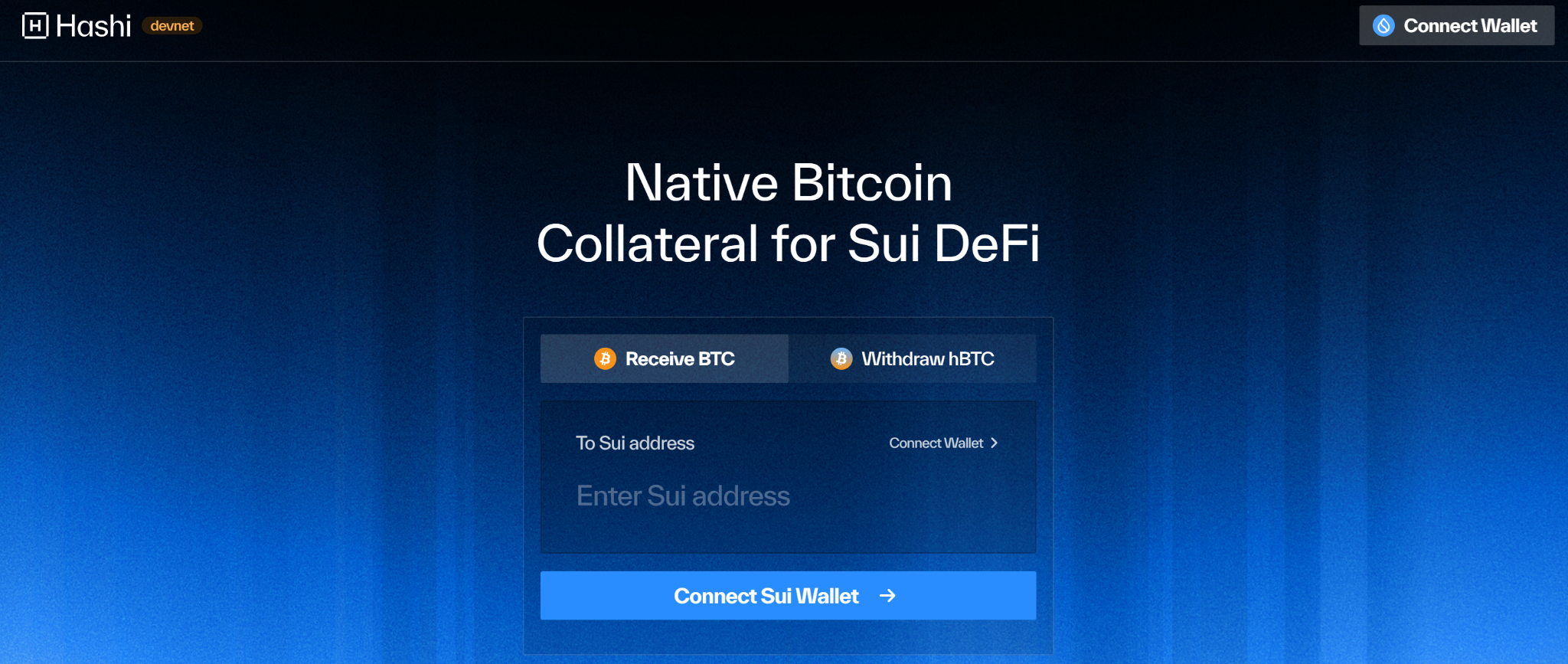
Hashi Native BTC Programmability: BTC Stays on the Chain, Collateral Rights Enter the Sui Network

The design philosophy of Hashi can be summarized in one sentence:

Assets remain on the Bitcoin network, rights exist on the Sui network—both occur simultaneously without interference.

Suppose you have one Bitcoin and want to use it as collateral to borrow some USDC.

In most past solutions:

You either deposit BTC into a centralized platform to obtain a borrowing limit or accept Wrapped BTC. Your Bitcoin, at some point, must be handed over to someone else, essentially trading "trust in an entity" for "programmability."

With Hashi:

  • Deposit: Users deposit BTC into a dedicated address (a unique Bitcoin deposit address generated by Hashi for their Sui address). The private key for this address does not belong to any single entity but is collectively managed by the validators on the Sui network. The BTC can only be moved if enough validators reach a consensus. This means no single entity can run away with your money unless they control more than one-third of the entire Sui validator network.
  • Proof Generation: Validators simultaneously monitor the Bitcoin network. Once they confirm your BTC is locked in, a corresponding collateral proof is generated on the Sui chain. This proof is not a newly issued token or a wrapped asset; it is an on-chain certificate proving that a real BTC is locked, and you are its owner.
  • As Collateral: With this proof, you can borrow money, participate in DeFi, or set up yield strategies in Sui’s smart contracts. All rules are written in code and executed automatically, with no room for interference.
  • Repayment and Withdrawal: After repayment, validators automatically release the native BTC on the Bitcoin mainnet through MPC threshold signatures, which can be withdrawn to any Bitcoin address without manual intervention.
  • Guardian Layer: To prevent extreme situations (such as validator collusion), Hashi additionally introduces a Guardian Layer as a secondary check and backup protection, primarily monitoring large withdrawals or abnormal thresholds to prevent potential systemic risks.
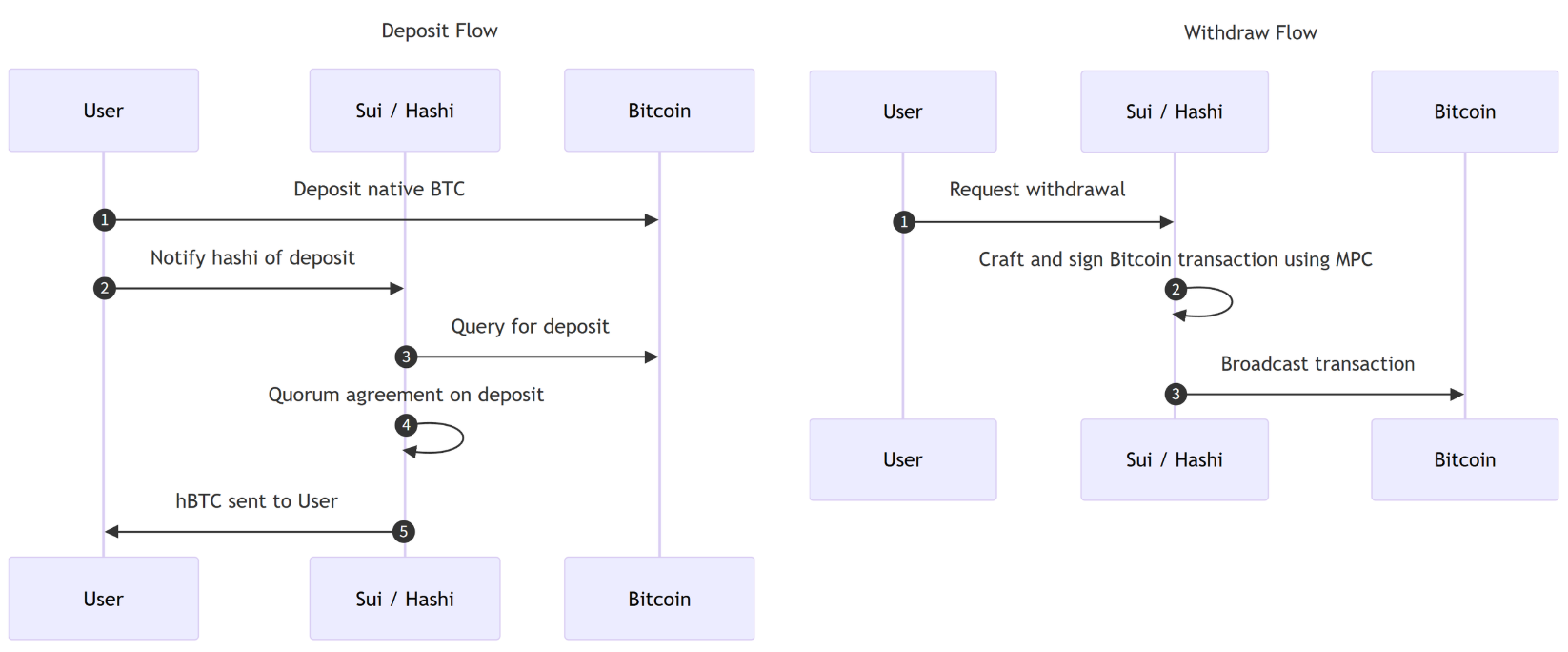
Throughout the entire lifecycle:

BTC always remains on the Bitcoin mainnet and is not moved into any platform’s internal account;

No single centralized entity has exclusive control of the private key;

What circulates on Sui is the collateral right backed by real BTC, reopening the programmability of native BTC;

And the only entities users need to trust are the validator network and the smart contract.
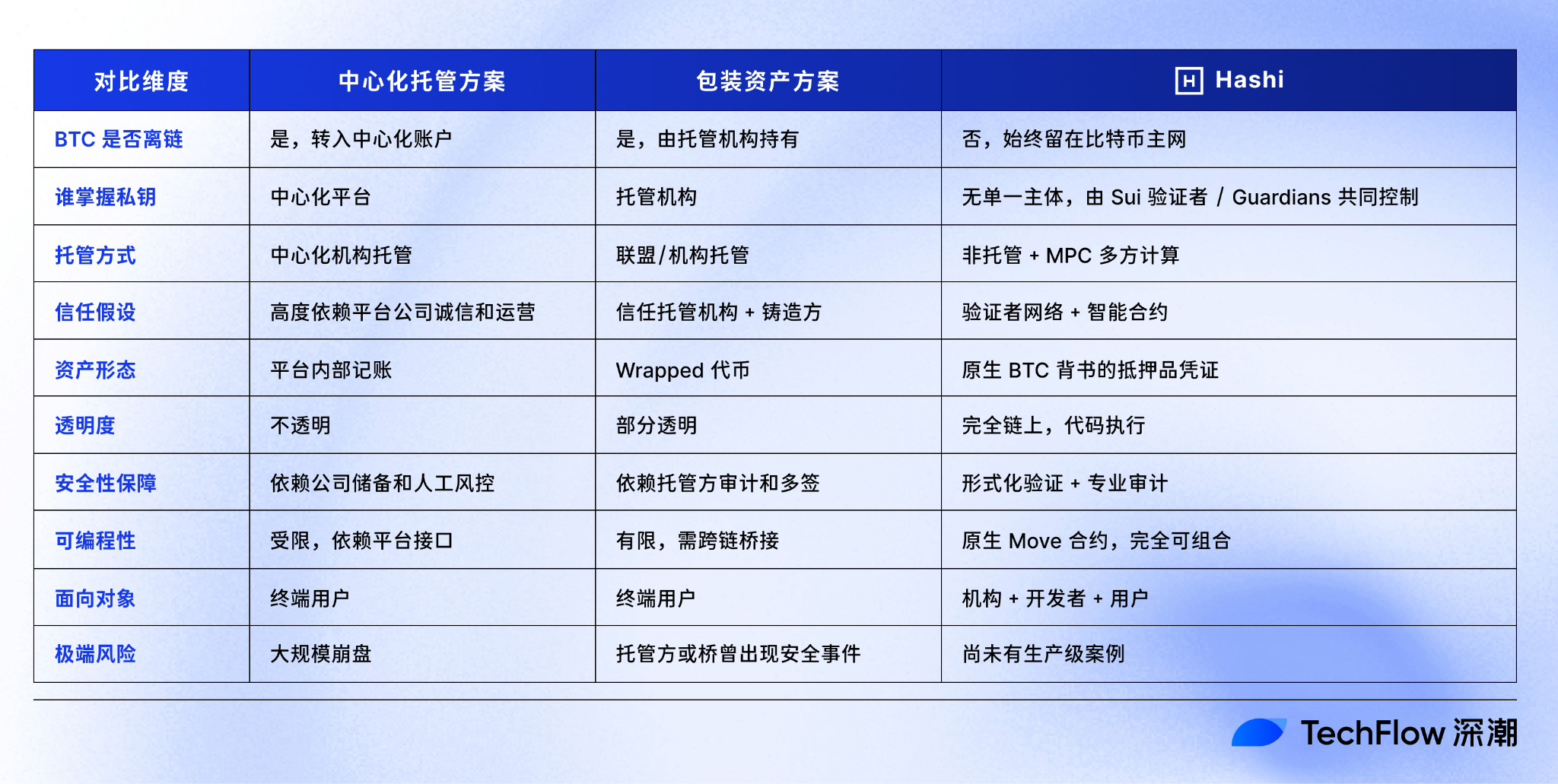
Simply put, Hashi is committed to enabling the collateral relationship of native BTC to be directly recognized by the on-chain financial system, with minimal trust placed in centralized entities.

During stable market conditions, users may perceive little difference, but in extreme situations like platform collapses or liquidity crises, it is the difference between whether your BTC is still there or not.

Not a Product, but a "Primitive": A Directly Reusable "Standard Brick"

From a design perspective, Hashi is a more decentralized, trust-minimized, and secure transparent Bitcoin financial solution.

However, if Hashi is understood solely as a single "solution," its most potential aspect might be missed.

It is important to note that for a long time, Sui has been striving to evolve from "a chain" to "a complete set of developer infrastructure." Whether it’s launching Walrus, Seal, or Nautilus, the goal has been to achieve full-stack nativity from execution, storage, permission control to off-chain computation, providing convenience for developers and building the necessary foundation for ecosystem prosperity.

This time, facing Bitcoin finance is no exception.

According to the official definition:

Hashi is the first decentralized Bitcoin collateral primitive developed by Mysten Labs, allowing developers to actively handle UTXOs from the Bitcoin network in Sui’s native smart contract language.

The key word is "primitive."

In the context of blockchain and DeFi, a primitive often refers to a fundamental building block or underlying infrastructure component. It is like a "standard brick" in Lego:

It is not an end product for ordinary users but a basic module for developers to build products.

Just as TCP/IP is not an app but all apps run on it; Hashi is not a product, but lending platforms, yield strategies, and structured products can all be built on it.

In other words, Hashi does not provide a closed financial service but an underlying capability, enabling native BTC to become collateral that Sui smart contracts can directly call.

As for what this collateral is used for, how it is used, and under what rules, Hashi does not interfere—it leaves it to the contracts, developers, and the market.
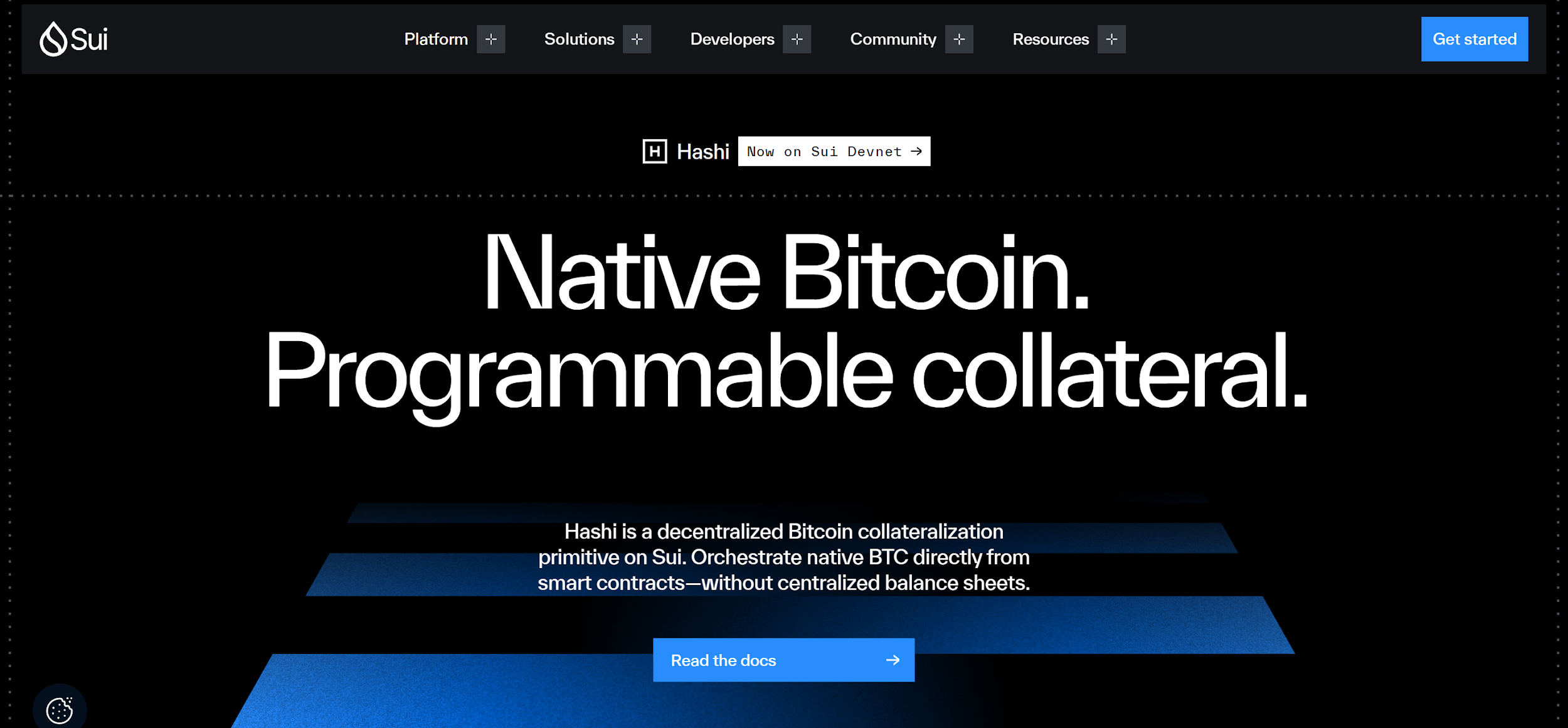
Before Hashi, if developers wanted to build a protocol with BTC as collateral, they faced numerous challenges: either accept the trust risks of centralized custody or implement the complex logic of native BTC collateral from scratch.

As a primitive, Hashi turns this difficult problem into a directly reusable interface.

Now, when building specific products, developers can directly call the mechanisms provided by Hashi, enabling their protocols to inherently possess native BTC collateral capabilities without having to solve underlying problems again, significantly reducing development barriers and time costs.

Users, whether institutional or retail, will, through products built on Hashi, for the first time truly gain the ability to earn yields with Bitcoin without giving up control over it. In the initial phase, lending will be the first use case for Hashi, allowing BTC to be lent out or used as collateral to borrow stablecoins. In the future, Hashi’s scenarios will gradually expand to vaults, insurance, structured products, credit derivatives, and RWA yield strategies.

Bitcoin is the asset with the broadest global consensus and deepest liquidity, but in the past, this wealth was almost invisible to the on-chain financial world: it is massive but not programmable; it is valuable but cannot be directly perceived and called by smart contracts.

Therefore, when Hashi turns the native BTC collateral capability into an interface that any developer can directly call, the upper-layer application space it can leverage far exceeds any specific product or protocol.

And the correctness of this judgment is already answered by the extensive institutional support Hashi has received.

Institutional Day One Support: Building a Complete Ecosystem Around Hashi

Currently, Hashi is live on Sui Devnet, primarily for developer testing and auditing, and has not yet entered the production environment. However, it has already received explicit support commitments from several leading industry institutions.

In terms of infrastructure: Including BitGo, Blockdaemon, Cobo, Ledger, and other major institutions, directly bridging institutional BTC from cold storage into on-chain collateral scenarios.

In terms of trading and liquidity: Including FalconX, Bullish, CF Benchmarks, and other major institutions, providing Hashi with reliable pricing, liquidity exits, and institutional-grade counterparty support.

In terms of security and compliance: Multiple teams, including security auditing firm OtterSec, smart contract formal verification security company Certora, and cryptography and zero-knowledge proof research and engineering team Asymptotic, have chosen to support Hashi and will conduct smart contract audits, formal verification, cryptography, and zero-knowledge proof research before Hashi’s mainnet launch.

At the same time, projects including Suilend, Scallop, NAVI Protocol, Matrixdock, and Bluefin have announced they will integrate Hashi to unleash on-chain financial potential, enabling retail and institutional users to quickly access BTC collateral lending experiences.

In addition, Soter Insure, a provider of institutional-grade insurance solutions, has announced a partnership with Hashi to bring built-in institutional-grade insurance mechanisms as a risk protection layer.

These institutions represent thousands of billions of dollars in Bitcoin nominal value and mature compliance infrastructure. Their commitment to integration at the Hashi Devnet stage means that once Hashi officially launches, large-scale institutional Bitcoin assets will have the practical conditions to enter on-chain scenarios.

At the same time, looking at these 20+ institutions together, an interesting fact emerges: they almost cover every环节 of a complete Bitcoin financial ecosystem:

From Bitcoin security custody, on-chain collateral, price pricing, liquidity support, lending protocols, yield strategies, RWA integration, to security audits and user entry, an end-to-end chain has already taken shape.

In other words, behind this list of supporters, a complete ecosystem map of Bitcoin finance围绕 the Hashi primitive will be ready from day one of Hashi’s mainnet launch.

Conclusion

Of course, Hashi is still in the Devnet stage. It has not yet undergone long-term testing in the mainnet environment, with real asset scale and extreme market fluctuations. Its production-level performance still needs time to verify. The path of Bitcoin finance will not immediately become smooth just because a new primitive emerges.

However, judging from the integration commitments of over 20 leading institutions in custody, liquidity, security, and protocol layers from day one, market recognition of this path is clear enough.

The story of Bitcoin finance has been told for many years, but the real breakthrough point has never been about "what can be done" but "why trust."

Past solutions, whether centralized custody or wrapped assets, essentially required users to make the same choice: either give up control for yield or hold the keys but be excluded from on-chain finance.

Hashi attempts to rewrite the question itself: making the collateral capability of native BTC an underlying interface that developers can directly call, enabling Bitcoin’s sleeping trillion-dollar treasury to be truly "seen" by the smart contract world in a non-custodial, verifiable, and composable way for the first time.

Reconstructing trust is often harder than stacking functions.

If the endgame of Bitcoin finance is to make Bitcoin truly the native collateral of on-chain finance, then what Hashi is doing may be laying the first pile for this bridge.


Связанные с этим вопросы

QWhat is Hashi and how does it aim to change Bitcoin financial trust rules?

AHashi is a decentralized Bitcoin collateral primitive developed on Sui that enables native BTC to be used as programmable collateral in DeFi without requiring users to relinquish custody to centralized entities. It reconstructs the trust foundation by allowing BTC to remain on the Bitcoin network while its collateral rights are represented on Sui, managed collectively by validators without single-point control.

QHow does Hashi's deposit and抵押 process work technically?

AUsers deposit BTC into a unique Bitcoin address generated by Hashi for their Sui address. The private key of this address is collectively managed by Sui validators, requiring consensus for any movement. Validators monitor the Bitcoin network, confirm the deposit, and issue a抵押凭证 on Sui, which serves as proof of locked BTC. This凭证 can then be used in Sui's smart contracts for DeFi activities like borrowing.

QWhy is Hashi described as a 'primitive' rather than a product?

AHashi is termed a 'primitive' because it functions as a foundational building block or底层 infrastructure component for developers, not an end-user product. It provides a reusable interface that allows developers to integrate native BTC collateral capabilities directly into their applications (e.g., lending platforms, yield strategies) without rebuilding the complex underlying logic, thereby reducing development barriers and costs.

QWhich types of institutions have supported Hashi, and what roles do they play?

AHashi has garnered support from over 20 institutions across custody and infrastructure (e.g., BitGo, Cobo), trading and liquidity (e.g., FalconX, Bullish), security and compliance (e.g., OtterSec, Certora), and DeFi protocols (e.g., Suilend, Scallop). These institutions provide essential services like secure custody, liquidity, auditing, and integration, forming a comprehensive ecosystem for Bitcoin financial services on Sui.

QWhat are the potential risks or limitations of Hashi mentioned in the article?

AHashi is still in the Devnet phase and has not yet been tested in a mainnet environment with real assets and extreme market conditions. Its production-level performance requires further validation. Additionally, while it minimizes trust in centralized entities, it still relies on Sui validators and smart contract security, with a Guardian Layer added as a secondary check for risks like validator collusion.

Похожее

Where the AI Bubble Really Is: Which Layer of Players Are Naked

AI Bubble: Where It Really Is and Who's Swimming Naked This analysis dissects the AI industry not as a single entity but as a five-layer pyramid, arguing that bubbles are concentrated in specific tiers, not uniformly distributed. **Key Distinction from the 2000 Dot-com Bubble:** Unlike 2000, where companies had stock prices before revenue, today's leading AI players have massive, contract-backed revenue driving their valuations. Core infrastructure demand is real, with every GPU running at full capacity for paying customers. **The Five-Layer Pyramid & Bubble Assessment:** * **L0 (Fab/Manufacturing) & Top L4 (Leading AI Apps): NO BUBBLE.** Companies like TSMC, NVIDIA, major cloud providers (Microsoft, Google, Meta, Amazon), and top AI labs have real revenues and orders. Supply is tightly constrained by TSMC's disciplined capacity control and physical limits like power/land for data centers, preventing a supply glut. * **L1 (Memory): BATTLEGROUND.** Sky-high HBM margins could signal a new structural cycle or a classic "boom before bust." The oligopoly of three major players may enforce supply discipline, making this a high-stakes bet. * **L2 (Interconnect/Optical Modules): BUBBLE TERRITORY.** Companies like Lumentum and AAOI have seen stock surges (4-10x) far outpacing revenue growth. This hardware segment has lower physical barriers to expansion than fabs, allowing speculation. It mirrors the 2000 bubble's epicenter—optics. * **L3 (Infrastructure/"GPU Landlords"): VULNERABLE.** GPU leasing companies profit from the current compute shortage but own no long-term moat. Their business model relies on a temporary bottleneck that will ease as big tech expands and new tech (e.g., potential space-based data centers) emerges. * **L4 Long Tail (VC-backed Startups): STRONG BUBBLE SIGNALS.** VC funding concentration in AI is twice that of the 1999 peak. Many startups with little revenue use the valuation logic of successful giants to justify their own, creating high risk of a "valuation crunch" when funding dries up. **Critical Risks to Monitor:** 1. **GPU Depreciation & Accounting:** Companies extending the assumed useful life of GPUs artificially boost profits. The true economic life depends on future generational leaps from NVIDIA. 2. **"GPU Credit" & Off-Balance-Sheet Leverage:** Emerging structures where shell companies borrow to buy GPUs and lease them out (with chipmakers sometimes investing) move debt off major balance sheets. This echoes the "vendor financing" of 2000 and the securitization risks of 2008, though currently small-scale. 3. **TSMC Abandoning Caution:** If the primary supply bottleneck (TSMC's conservative capacity planning) breaks, runaway supply could trigger a bust. 4. **Algorithmic Efficiency Breakthrough:** A major leap in software efficiency could drastically reduce the need for raw compute hardware, undermining the investment thesis. **Conclusion:** The AI boom is expensive and has frothy areas, but its core is underpinned by real demand and physical supply constraints. The bubble risk is layered: most present in optical components, GPU leasing, and the long-tail startup ecosystem, while the foundational chip manufacturing and leading application layers remain relatively solid—for now.

marsbit15 мин. назад

Where the AI Bubble Really Is: Which Layer of Players Are Naked

marsbit15 мин. назад

Standing in the Light: A Comprehensive Guide to the Optical Module and CPO Supply Chain

"Standing in the Light: Understanding the Optical Module and CPO Industry Chain" This article analyzes the critical role of optical communication technology, specifically optical modules and Co-Packaged Optics (CPO), as the "nervous system" for modern AI data centers. With exponential growth in AI computational demands (e.g., NVIDIA's Vera Rubin architecture), traditional electrical interconnects using copper cables face severe bottlenecks in bandwidth, power consumption, and signal integrity over distance. The core function of an optical module is to act as a "translator," converting electrical signals from chips into optical signals for transmission over fiber (and vice-versa). Key internal components include lasers, modulators, photodetectors, drivers, and DSP chips. The industry is currently transitioning from 800G to 1.6T modules. However, the future lies in CPO. This next-generation technology integrates the optical engine directly with the switch ASIC/XPU on the same package substrate, drastically reducing power consumption (by ~3.5x according to NVIDIA), overcoming bandwidth density limits, and minimizing signal attenuation compared to traditional pluggable modules. Key challenges for CPO include advanced packaging capacity (dominated by TSMC), thermal management, repairability, and standardization. The article details the broader technology landscape, including Near-Packaged Optics (NPO, a pragmatic intermediate step), Linear-drive Pluggable Optics (LPO), Optical I/O (OIO for chip-level integration), and Optical Circuit Switches (OCS). A comprehensive CPO industry chain is mapped, highlighting shifting power dynamics: * **Architecture Definers:** NVIDIA, Broadcom, and Marvell now hold greater influence. * **Advanced Packaging & Manufacturing:** TSMC is central; Fabrinet is a key EMS player. * **Lasers ("The Heart"):** A strategic bottleneck. EML lasers are led by Lumentum and Coherent (both receiving major NVIDIA investments). CW lasers, favored for CPO/silicon photonics, see strong Chinese players like Source Photonics and Sicoya. * **Silicon Photonics Chips:** The mainstream path for CPO engines, with key players like Broadcom, Intel, Marvell, and China's Accelink. * **Fiber Connectivity Components:** A major new, high-growth market created by CPO, including Fiber Array Units (FAU), Polarization-Maintaining Fiber (PMF), and MPO connectors. Companies like Tianfu Communication and US Conec are leaders. * **Fiber & Cable:** Experiencing a super-cycle (e.g., Corning, Yangtze Optical Fiber). * **PCB/Substrates:** Requiring advanced materials (e.g., Shengyi Tech). * **DSP & SerDes:** Functions are integrated into switch ASICs in the CPO era (e.g., Broadcom, Astera Labs). * **Optical Module Makers:** Transitioning from standalone module suppliers to providers of optical engines and NPO/LPO solutions while riding the current pluggable boom (e.g., Zhongji Innolight, Eoptolink). The investment timeline is segmented: Short-term (2026-2027) features the "last feast" for pluggable modules and CPO's initial rollout. Medium-term (2027-2029) will see CPO expand and NPO peak. Long-term (2029-2032+) involves CPO/OIO penetration into intra-rack scaling. In conclusion, optical interconnects are fundamental to AI infrastructure. The competitive landscape sees US firms leading in architecture and high-end chips, TSMC in advanced packaging, and Chinese firms holding strong positions in modules, connectivity components, CW lasers, and fiber/cable. The future belongs to companies that can navigate the technological shift from "selling shovels" (modules) to "building highways" (CPO/OIO infrastructure).

marsbit25 мин. назад

Standing in the Light: A Comprehensive Guide to the Optical Module and CPO Supply Chain

marsbit25 мин. назад

Торговля

Спот
Фьючерсы

Популярные статьи

Тест по Bitcoin Биткоина

HTX Learn: Изучите Bitcoin halving и Заработаете Токены USDT

3.1k просмотров всегоОпубликовано 2024.04.16Обновлено 2024.04.16

Тест по Bitcoin  Биткоина

Что такое $BITCOIN

ЦИФРОВОЕ ЗОЛОТО ($BITCOIN): Комплексный анализ Введение в ЦИФРОВОЕ ЗОЛОТО ($BITCOIN) ЦИФРОВОЕ ЗОЛОТО ($BITCOIN) — это проект на основе блокчейна, работающий в сети Solana, который стремится объединить характеристики традиционных драгоценных металлов с инновациями децентрализованных технологий. Хотя он носит имя Биткойн, часто называемого “цифровым золотом” из-за его восприятия как средства хранения ценности, ЦИФРОВОЕ ЗОЛОТО является отдельным токеном, предназначенным для создания уникальной экосистемы в ландшафте Web3. Его цель — позиционировать себя как жизнеспособный альтернативный цифровой актив, хотя детали его применения и функциональности все еще развиваются. Что такое ЦИФРОВОЕ ЗОЛОТО ($BITCOIN)? ЦИФРОВОЕ ЗОЛОТО ($BITCOIN) — это токен криптовалюты, специально разработанный для использования в блокчейне Solana. В отличие от Биткойна, который выполняет широко признанную роль хранения ценности, этот токен, похоже, сосредоточен на более широких приложениях и характеристиках. Примечательные аспекты включают: Инфраструктура блокчейна: Токен построен на блокчейне Solana, известном своей способностью обрабатывать высокоскоростные и недорогие транзакции. Динамика предложения: ЦИФРОВОЕ ЗОЛОТО имеет максимальное предложение, ограниченное 100 квадриллионами токенов (100P $BITCOIN), хотя детали о его обращающемся предложении в настоящее время не раскрыты. Утилита: Хотя точные функциональные возможности не описаны, есть указания на то, что токен может быть использован для различных приложений, потенциально связанных с децентрализованными приложениями (dApps) или стратегиями токенизации активов. Кто создатель ЦИФРОВОГО ЗОЛОТА ($BITCOIN)? На данный момент личность создателей и команды разработчиков, стоящих за ЦИФРОВЫМ ЗОЛОТОМ ($BITCOIN), остается неизвестной. Эта ситуация типична для многих инновационных проектов в области блокчейна, особенно тех, которые связаны с децентрализованными финансами и феноменом мем-криптовалют. Хотя такая анонимность может способствовать культуре, ориентированной на сообщество, она усиливает опасения по поводу управления и ответственности. Кто инвесторы ЦИФРОВОГО ЗОЛОТА ($BITCOIN)? Доступная информация указывает на то, что у ЦИФРОВОГО ЗОЛОТА ($BITCOIN) нет известных институциональных спонсоров или значительных венчурных капиталовложений. Проект, похоже, функционирует по модели пирингового взаимодействия, сосредоточенной на поддержке и принятии сообществом, а не на традиционных путях финансирования. Его активность и ликвидность в основном сосредоточены на децентрализованных биржах (DEX), таких как PumpSwap, а не на устоявшихся централизованных торговых платформах, что еще больше подчеркивает его подход, ориентированный на grassroots. Как работает ЦИФРОВОЕ ЗОЛОТО ($BITCOIN) Операционные механизмы ЦИФРОВОГО ЗОЛОТА ($BITCOIN) можно подробно описать на основе его дизайна блокчейна и характеристик сети: Механизм консенсуса: Используя уникальный механизм доказательства истории (PoH) Solana в сочетании с моделью доказательства доли (PoS), проект обеспечивает эффективную валидацию транзакций, что способствует высокой производительности сети. Токеномика: Хотя конкретные дефляционные механизмы не были подробно описаны, большое максимальное предложение токенов подразумевает, что оно может быть предназначено для микротранзакций или нишевых случаев использования, которые еще предстоит определить. Интероперабельность: Существует потенциал для интеграции с более широкой экосистемой Solana, включая различные платформы децентрализованных финансов (DeFi). Однако детали относительно конкретных интеграций остаются неуточненными. Хронология ключевых событий Вот хронология, которая подчеркивает значимые вехи, касающиеся ЦИФРОВОГО ЗОЛОТА ($BITCOIN): 2023: Первоначальное развертывание токена происходит в блокчейне Solana, отмеченное его адресом контракта. 2024: ЦИФРОВОЕ ЗОЛОТО приобретает видимость, когда оно становится доступным для торговли на децентрализованных биржах, таких как PumpSwap, позволяя пользователям обменивать его на SOL. 2025: Проект наблюдает спорадическую торговую активность и потенциальный интерес к инициативам, возглавляемым сообществом, хотя на данный момент не зафиксировано никаких значительных партнерств или технических достижений. Критический анализ Сильные стороны Масштабируемость: Основная инфраструктура Solana поддерживает высокие объемы транзакций, что может повысить полезность $BITCOIN в различных сценариях транзакций. Доступность: Потенциально низкая цена торговли за токен может привлечь розничных инвесторов, способствуя более широкому участию благодаря возможностям дробного владения. Риски Отсутствие прозрачности: Отсутствие публично известных спонсоров, разработчиков или процесса аудита может вызвать скептицизм относительно устойчивости и надежности проекта. Волатильность рынка: Торговая активность сильно зависит от спекулятивного поведения, что может привести к значительной волатильности цен и неопределенности для инвесторов. Заключение ЦИФРОВОЕ ЗОЛОТО ($BITCOIN) является интригующим, но неоднозначным проектом в быстро развивающейся экосистеме Solana. Хотя он пытается использовать нарратив “цифрового золота”, его отход от установленной роли Биткойна как средства хранения ценности подчеркивает необходимость более четкого различения его предполагаемой утилиты и структуры управления. Будущее принятие и усвоение, вероятно, будут зависеть от решения текущей непрозрачности и более четкого определения его операционных и экономических стратегий. Примечание: Этот отчет охватывает синтезированную информацию, доступную на октябрь 2023 года, и с тех пор могут произойти события.

99 просмотров всегоОпубликовано 2025.05.13Обновлено 2025.05.13

Что такое $BITCOIN

Fractal Bitcoin: масштабирование Биткоина с помощью рекурсивной системы

Fractal Bitcoin — масштабное Layer-1-решнение, созданное на базе кода Биткоина, позволяющего достигать бесконечного масштабирования с помощью рекурсивного подхода.

2.3k просмотров всегоОпубликовано 2025.06.30Обновлено 2025.06.30

Fractal Bitcoin: масштабирование Биткоина с помощью рекурсивной системы

Обсуждения

Добро пожаловать в Сообщество HTX. Здесь вы сможете быть в курсе последних новостей о развитии платформы и получить доступ к профессиональной аналитической информации о рынке. Мнения пользователей о цене на BTC (BTC) представлены ниже.

活动图片