South Korea To Probe Crypto Exchanges, Tighten Regulations After Bithumb $40B Bitcoin Error

bitcoinistОпубликовано 2026-02-10Обновлено 2026-02-10

Введение

Following a significant incident where South Korea's Bithumb exchange mistakenly distributed 620,000 Bitcoin (worth over $40 billion) to users due to an employee error, financial regulators are launching a comprehensive probe into local crypto exchanges. Although most of the funds were recovered, the event exposed critical weaknesses in internal controls and ledger management systems. In response, the Financial Supervisory Service (FSS), alongside other agencies, has formed an emergency task force to inspect exchanges' reserves, management practices, and operational conditions. The findings will influence upcoming legislation, including the second phase of the Virtual Asset User Protection Act, aimed at addressing structural vulnerabilities and preventing market manipulation. Authorities are considering measures to confiscate illicit profits and restrict fund outflows from suspicious accounts.

South Korean regulators have announced an inspection of local crypto exchanges and improved measures to address regulatory “blind spots” following Bithumb’s $40 billion Bitcoin (BTC) payment error.

New Task Force To Review Crypto Exchanges’ Practices

On Monday, South Korean financial authorities announced they will step up their efforts to regulate the crypto industry and foster a trustworthy trading environment for digital assets, local news outlets reported.

Following the “ghost Bitcoin” incident at Bithumb, South Korea’s second-largest cryptocurrency exchange, the Financial Supervisory Service (FSS)’s Governor Lee Chan-jin revealed an inspection of local exchanges and emphasized the need for improved legislation.

As reported by Bitcoinist, Bithumb accidentally distributed 620,000 Bitcoin, worth over $40 billion, to 249 users participating in the exchange’s “random box” promotional event due to an employee’s mistake.

Although 99% of the BTC were recovered, the incident raised serious concerns about the crypto exchange’s internal controls. Notably, Bithumb held 175 BTC in its own books, and less than 50,000 Bitcoin between its own assets and customer-held assets, according to a regulatory filing from last year.

This means that the exchange’s system failed to block the irregular transaction, distributing assets that did not actually exist to users and distorting market prices.

“The so-called ghost Bitcoin incident clearly revealed that, beyond a mere input error, there are structural weaknesses in internal controls and ledger management systems of cryptocurrency exchanges,” said Kim Jiho, a spokesperson for the ruling Democratic Party, in a Saturday briefing.

Meanwhile, the FSS Governor affirmed that the “incident bluntly exposed the structural flaws in virtual asset trading systems,” adding, “There are many aspects of the case that we view as extremely serious.”

As a result, the FSS, alongside the Korean Financial Intelligence Unit (KoFIU), the Financial Supervisory Service (FSS), and the Digital Asset eXchange Alliance (DAXA), formed an emergency task force to organize follow-up measures and review industrywide practices.

The reports noted that the task force plans to examine Bithumb and other domestic exchanges’ virtual asset reserves, management practices, operational conditions, and internal control systems.

“We will carry out planned investigations into major high-risk areas in the virtual asset market where unfair trading practices, such as market manipulation and the dissemination of false information, are a concern,” Lee stated.

Regulators To Address ‘Structural Vulnerabilities’

The FSS Governor also warned that the process could be escalated into a full investigation if any illegal activities are revealed, adding that the incident would be reflected in the long-awaited Second Phase of the Virtual Asset User Protection Act, which is expected to serve as a comprehensive framework for the entire industry.

“While we are drawing up the second phase of virtual asset legislation, measures to address structural vulnerabilities at exchanges, exposed by the recent Bithumb incident, will be reflected,” Lee declared.

“As virtual assets are being incorporated into the legacy financial system, there remains the task of strengthening the regulatory and supervisory framework. This could serve as an opportunity to put the system in place properly,” he continued.

It’s worth noting that South Korean financial authorities are reportedly considering introducing a system to prevent suspects from hiding or withdrawing unrealized profits from market manipulation related to crypto assets.

The Financial Services Commission (FSC) revealed last month that it is exploring the proposal for prosecution measures against suspects of crypto asset price manipulation, as some officials consider that there’s a need “to complement the current Virtual Asset User Protection Act by implementing measures for the confiscation of criminal proceeds or the preservation of recovery funds in advance.”

The measure would limit fund outflows, such as withdrawals, transfers, and payments from a crypto-related account suspected of obtaining illicit gains through typical market manipulation tactics.

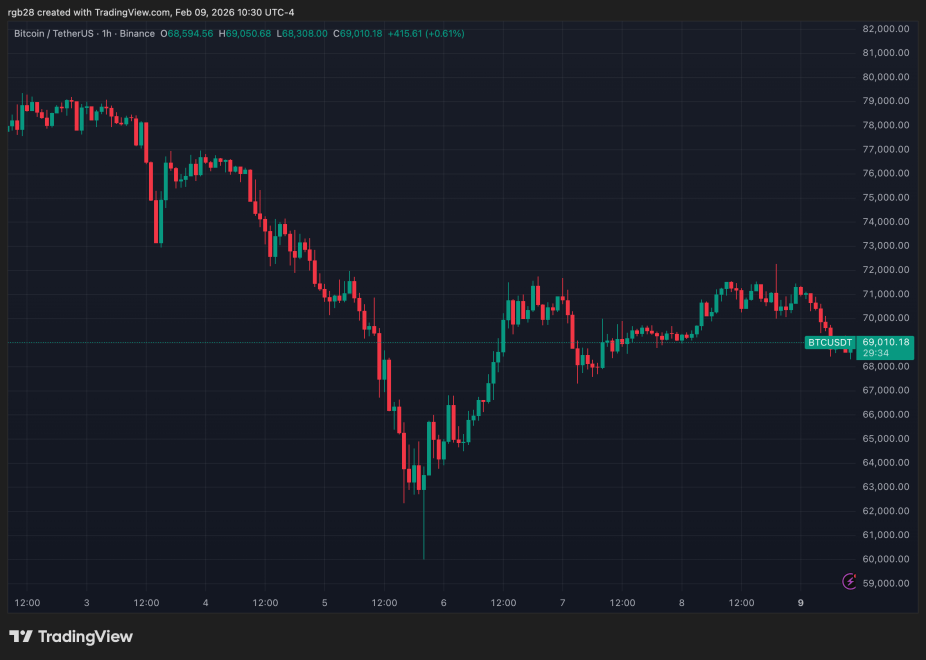
Bitcoin trades at $69,010 in the one-week chart. Source: BTCUSDT on TradingView

Связанные с этим вопросы

QWhat was the main reason that triggered South Korean regulators to probe crypto exchanges and tighten regulations?

AThe main reason was the 'ghost Bitcoin' incident at Bithumb, where an employee's mistake led to the accidental distribution of 620,000 Bitcoin (worth over $40 billion) to users, exposing serious structural weaknesses in internal controls and ledger management systems.

QWhich organizations formed an emergency task force in response to the Bithumb incident?

AThe Financial Supervisory Service (FSS), the Korean Financial Intelligence Unit (KoFIU), and the Digital Asset eXchange Alliance (DAXA) formed an emergency task force to organize follow-up measures and review industrywide practices.

QWhat aspects of crypto exchanges will the task force examine?

AThe task force will examine virtual asset reserves, management practices, operational conditions, and internal control systems of Bithumb and other domestic exchanges.

QHow will the Bithumb incident influence future legislation in South Korea?

AThe incident will be reflected in the long-awaited Second Phase of the Virtual Asset User Protection Act, which aims to address structural vulnerabilities at exchanges and serve as a comprehensive framework for the industry.

QWhat additional measure are South Korean authorities considering to combat market manipulation in crypto assets?

AAuthorities are considering introducing a system to prevent suspects from hiding or withdrawing unrealized profits from market manipulation by limiting fund outflows, such as withdrawals, transfers, and payments from crypto-related accounts suspected of obtaining illicit gains.

Похожее

$292 Million KelpDAO Cross-Chain Bridge Hack: Who Should Foot the Bill?

On April 18, 2026, an attacker stole 116,500 rsETH (worth ~$292M) from KelpDAO’s cross-chain bridge in 46 minutes—the largest DeFi exploit of 2026. The stolen assets were deposited into Aave V3 as collateral, causing $177–200M in bad debt and triggering a cascade of losses across nine DeFi protocols. Aave’s TVL dropped by ~$6B overnight. This legal analysis argues that KelpDAO and LayerZero Labs share concurrent liability, with fault apportioned 60%/40%. KelpDAO negligently configured its bridge with a 1-of-1 decentralized verifier network (DVN)—a single point of failure—despite LayerZero’s explicit recommendation of a 2-of-3 setup. LayerZero, which operated the compromised DVN, failed to secure its RPC infrastructure against a known poisoning attack vector. Both protocols’ terms of service cap liability at $200 (KelpDAO) or $50 (LayerZero), but these limits are likely unenforceable due to unconscionability, gross negligence exceptions, and potential securities law invalidation (if rsETH is deemed a security under the Howey test). Aave’s governance also faces fiduciary duty claims for raising rsETH’s loan-to-value ratio to 93%—far above competitors’ 72–75%—without adequately assessing bridge risks, amplifying the systemic fallout. Practical recovery targets include LayerZero Labs (a registered Canadian entity), KelpDAO’s founders, auditors, and identifiable Aave governance delegates. The incident underscores escalating legal risks for DeFi protocols, infrastructure providers, and governance participants.

marsbit17 мин. назад

$292 Million KelpDAO Cross-Chain Bridge Hack: Who Should Foot the Bill?

marsbit17 мин. назад

Insider Trading in War: 5 People Involved, the Highest Earner Was Arrested

On April 24, the U.S. Department of Justice arrested U.S. Army Special Forces Staff Sergeant Gannon Ken Van Dyke for insider trading related to the capture of Venezuelan President Nicolás Maduro on January 3. Van Dyke allegedly profited over $400,000 by placing bets on a prediction market, Polymarket, using insider knowledge of the covert operation. According to the indictment, Van Dyke registered an account (0x31a5) on December 26 and made a series of bets predicting Maduro’s capture and U.S. military involvement in Venezuela. He withdrew most of his funds on the day of the operation and attempted to obscure his tracks by transferring assets through crypto and brokerage accounts. This case marks the first time the DOJ has prosecuted insider trading on Polymarket. PolyBeats had previously identified five suspicious accounts, including Van Dyke’s—the highest earner—in January. The other accounts, with profits ranging from $34,000 to $145,000, remain under unofficial scrutiny but have not been charged. Their lower profits, indirect access to information, and unclear legal boundaries may complicate prosecution. Polymarket has since strengthened its market integrity rules, explicitly prohibiting trading based on confidential or insider information. Van Dyke’s arrest, nearly four months after his trades, signals increased regulatory attention and the persistent traceability of blockchain-based transactions.

marsbit18 мин. назад

Insider Trading in War: 5 People Involved, the Highest Earner Was Arrested

marsbit18 мин. назад

Bitwise: Bullish on Bitcoin's Performance in the Second Half of the Year, AI and Regulation Will Spark a New Altcoin Season

Bitwise CIO Matt Hougan and Research Lead Ryan Rasmussen express strong bullish sentiment on Bitcoin's long-term prospects, suggesting that its $1 million price target may be too conservative. They argue Bitcoin serves a dual role: as digital gold and a potential global settlement asset, especially amid declining trust in traditional monetary systems. Despite a weak Q1 2026 where nearly all crypto assets and prices saw double-digit declines, the analysts remain optimistic due to strong forward-looking catalysts, including institutional adoption via Bitcoin ETFs from major firms like Morgan Stanley and Goldman Sachs. Geopolitical instability, such as Iran’s mention of using Bitcoin for international payments, increases the value of Bitcoin’s “out-of-the-money call option” as a non-political, global settlement currency. This enhances its appeal beyond a mere store of value. . Additionally, Hougan highlights that a clearer regulatory token framework under current SEC leadership, combined with AI efficiency gains and high-performance blockchains, could fuel a new “altseason” by late 2026. This may lead to a wave of legitimate, value-capturing token projects, unlike the earlier ICO boom. . Bitwise also announced an Avalanche ETF, citing its unique architecture and rapid growth in real-world asset (RWA) tokenization, which has surged 10x to nearly $30 billion in two years. The firm believes Layer 1 blockchains are still early in their growth cycle, with significant potential ahead.

marsbit1 ч. назад

Bitwise: Bullish on Bitcoin's Performance in the Second Half of the Year, AI and Regulation Will Spark a New Altcoin Season

marsbit1 ч. назад

Торговля

Спот
Фьючерсы

Популярные статьи

Тест по Bitcoin Биткоина

HTX Learn: Изучите Bitcoin halving и Заработаете Токены USDT

3.0k просмотров всегоОпубликовано 2024.04.16Обновлено 2024.04.16

Тест по Bitcoin  Биткоина

Что такое $BITCOIN

ЦИФРОВОЕ ЗОЛОТО ($BITCOIN): Комплексный анализ Введение в ЦИФРОВОЕ ЗОЛОТО ($BITCOIN) ЦИФРОВОЕ ЗОЛОТО ($BITCOIN) — это проект на основе блокчейна, работающий в сети Solana, который стремится объединить характеристики традиционных драгоценных металлов с инновациями децентрализованных технологий. Хотя он носит имя Биткойн, часто называемого “цифровым золотом” из-за его восприятия как средства хранения ценности, ЦИФРОВОЕ ЗОЛОТО является отдельным токеном, предназначенным для создания уникальной экосистемы в ландшафте Web3. Его цель — позиционировать себя как жизнеспособный альтернативный цифровой актив, хотя детали его применения и функциональности все еще развиваются. Что такое ЦИФРОВОЕ ЗОЛОТО ($BITCOIN)? ЦИФРОВОЕ ЗОЛОТО ($BITCOIN) — это токен криптовалюты, специально разработанный для использования в блокчейне Solana. В отличие от Биткойна, который выполняет широко признанную роль хранения ценности, этот токен, похоже, сосредоточен на более широких приложениях и характеристиках. Примечательные аспекты включают: Инфраструктура блокчейна: Токен построен на блокчейне Solana, известном своей способностью обрабатывать высокоскоростные и недорогие транзакции. Динамика предложения: ЦИФРОВОЕ ЗОЛОТО имеет максимальное предложение, ограниченное 100 квадриллионами токенов (100P $BITCOIN), хотя детали о его обращающемся предложении в настоящее время не раскрыты. Утилита: Хотя точные функциональные возможности не описаны, есть указания на то, что токен может быть использован для различных приложений, потенциально связанных с децентрализованными приложениями (dApps) или стратегиями токенизации активов. Кто создатель ЦИФРОВОГО ЗОЛОТА ($BITCOIN)? На данный момент личность создателей и команды разработчиков, стоящих за ЦИФРОВЫМ ЗОЛОТОМ ($BITCOIN), остается неизвестной. Эта ситуация типична для многих инновационных проектов в области блокчейна, особенно тех, которые связаны с децентрализованными финансами и феноменом мем-криптовалют. Хотя такая анонимность может способствовать культуре, ориентированной на сообщество, она усиливает опасения по поводу управления и ответственности. Кто инвесторы ЦИФРОВОГО ЗОЛОТА ($BITCOIN)? Доступная информация указывает на то, что у ЦИФРОВОГО ЗОЛОТА ($BITCOIN) нет известных институциональных спонсоров или значительных венчурных капиталовложений. Проект, похоже, функционирует по модели пирингового взаимодействия, сосредоточенной на поддержке и принятии сообществом, а не на традиционных путях финансирования. Его активность и ликвидность в основном сосредоточены на децентрализованных биржах (DEX), таких как PumpSwap, а не на устоявшихся централизованных торговых платформах, что еще больше подчеркивает его подход, ориентированный на grassroots. Как работает ЦИФРОВОЕ ЗОЛОТО ($BITCOIN) Операционные механизмы ЦИФРОВОГО ЗОЛОТА ($BITCOIN) можно подробно описать на основе его дизайна блокчейна и характеристик сети: Механизм консенсуса: Используя уникальный механизм доказательства истории (PoH) Solana в сочетании с моделью доказательства доли (PoS), проект обеспечивает эффективную валидацию транзакций, что способствует высокой производительности сети. Токеномика: Хотя конкретные дефляционные механизмы не были подробно описаны, большое максимальное предложение токенов подразумевает, что оно может быть предназначено для микротранзакций или нишевых случаев использования, которые еще предстоит определить. Интероперабельность: Существует потенциал для интеграции с более широкой экосистемой Solana, включая различные платформы децентрализованных финансов (DeFi). Однако детали относительно конкретных интеграций остаются неуточненными. Хронология ключевых событий Вот хронология, которая подчеркивает значимые вехи, касающиеся ЦИФРОВОГО ЗОЛОТА ($BITCOIN): 2023: Первоначальное развертывание токена происходит в блокчейне Solana, отмеченное его адресом контракта. 2024: ЦИФРОВОЕ ЗОЛОТО приобретает видимость, когда оно становится доступным для торговли на децентрализованных биржах, таких как PumpSwap, позволяя пользователям обменивать его на SOL. 2025: Проект наблюдает спорадическую торговую активность и потенциальный интерес к инициативам, возглавляемым сообществом, хотя на данный момент не зафиксировано никаких значительных партнерств или технических достижений. Критический анализ Сильные стороны Масштабируемость: Основная инфраструктура Solana поддерживает высокие объемы транзакций, что может повысить полезность $BITCOIN в различных сценариях транзакций. Доступность: Потенциально низкая цена торговли за токен может привлечь розничных инвесторов, способствуя более широкому участию благодаря возможностям дробного владения. Риски Отсутствие прозрачности: Отсутствие публично известных спонсоров, разработчиков или процесса аудита может вызвать скептицизм относительно устойчивости и надежности проекта. Волатильность рынка: Торговая активность сильно зависит от спекулятивного поведения, что может привести к значительной волатильности цен и неопределенности для инвесторов. Заключение ЦИФРОВОЕ ЗОЛОТО ($BITCOIN) является интригующим, но неоднозначным проектом в быстро развивающейся экосистеме Solana. Хотя он пытается использовать нарратив “цифрового золота”, его отход от установленной роли Биткойна как средства хранения ценности подчеркивает необходимость более четкого различения его предполагаемой утилиты и структуры управления. Будущее принятие и усвоение, вероятно, будут зависеть от решения текущей непрозрачности и более четкого определения его операционных и экономических стратегий. Примечание: Этот отчет охватывает синтезированную информацию, доступную на октябрь 2023 года, и с тех пор могут произойти события.

99 просмотров всегоОпубликовано 2025.05.13Обновлено 2025.05.13

Что такое $BITCOIN

Fractal Bitcoin: масштабирование Биткоина с помощью рекурсивной системы

Fractal Bitcoin — масштабное Layer-1-решнение, созданное на базе кода Биткоина, позволяющего достигать бесконечного масштабирования с помощью рекурсивного подхода.

2.2k просмотров всегоОпубликовано 2025.06.30Обновлено 2025.06.30

Fractal Bitcoin: масштабирование Биткоина с помощью рекурсивной системы

Обсуждения

Добро пожаловать в Сообщество HTX. Здесь вы сможете быть в курсе последних новостей о развитии платформы и получить доступ к профессиональной аналитической информации о рынке. Мнения пользователей о цене на BTC (BTC) представлены ниже.

活动图片