Solana ETFs record 7-day inflow streak despite price slump

cointelegraphОпубликовано 2025-12-13Обновлено 2025-12-13

Введение

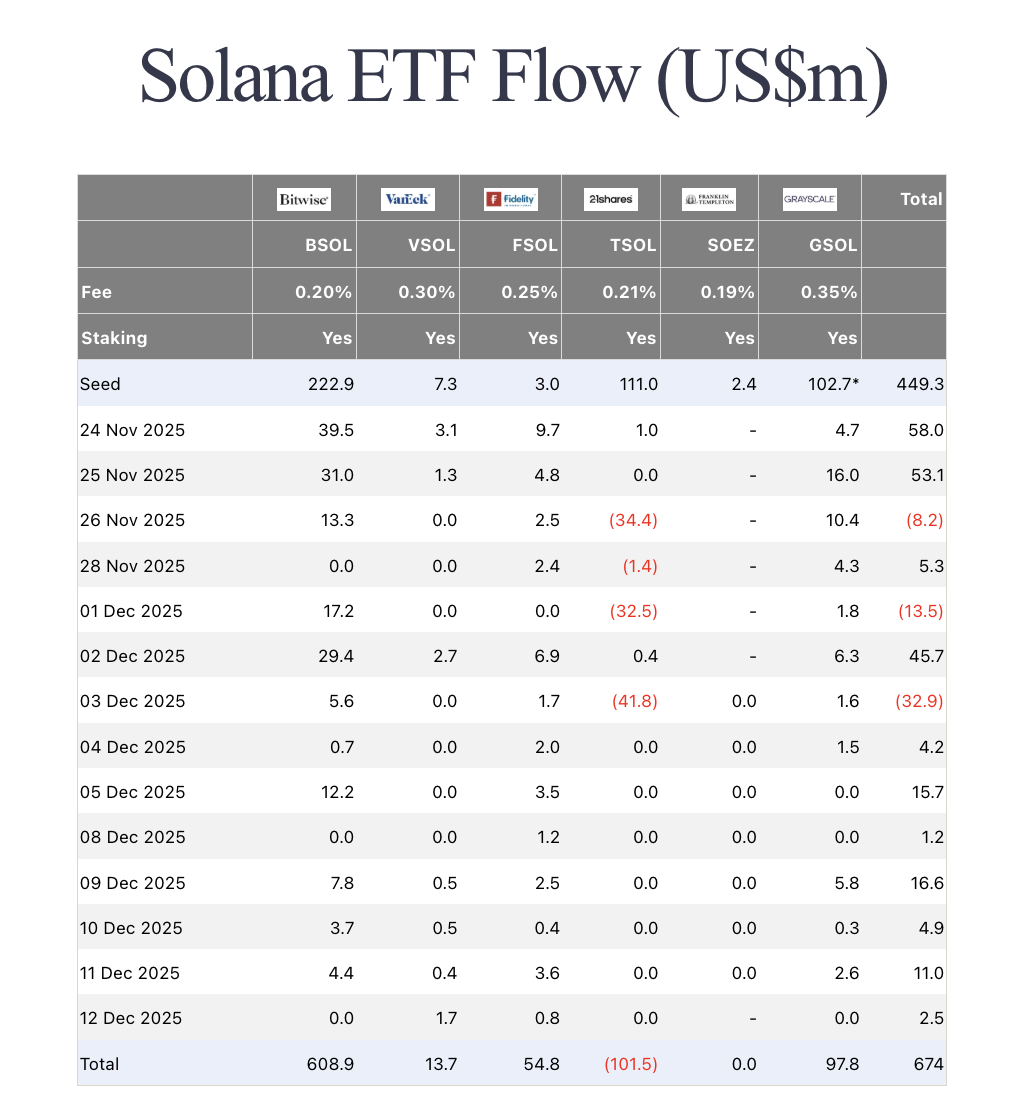
Despite a significant price decline and broader crypto market downturn, Solana (SOL) exchange-traded funds (ETFs) have recorded a seven-day inflow streak. The highest single-day inflow was approximately $16.6 million, bringing total net inflows to $674 million. This institutional interest persists even as SOL’s price has fallen nearly 55% from its January all-time high of $295 and struggles to break the $140-$145 resistance level. The token continues to trade well below its 365-day moving average, with its market cap dropping over 2% in the past week. The ongoing ETF inflows highlight sustained traditional finance engagement amid challenging market conditions.

Solana (SOL) exchange-traded funds (ETFs) recorded a seven-day inflow streak, despite SOL’s downward price performance and a broader downturn in the crypto market.

Tuesday marked the highest day of inflows during the seven-day streak, with about $16.6 million in capital flowing into SOL ETFs, according to data from investment management company Farside Investors.

This brings the total net inflow into SOL ETFs to $674 million at the time of this writing, data from Farside shows.

SOL ETF inflows. Source: Farside Investors

SOL ETFs debuted in the US in July, with the launch of REX-Osprey’s staked SOL ETF followed by investment company Bitwise’s BSOL Solana ETF in October, which was one of the hottest ETF launches of 2025, Bloomberg ETF analyst James Seyffart said.

The ETF flows signal interest in SOL from institutional and traditional finance investors, even as price and onchain metrics like total value locked, the amount of capital held in smart contracts for a protocol, decline during the ongoing market drawdown.

Related: Solana onchain flows flag notable supply shift as SOL trades near key support

SOL continues to struggle and is trading at a steep discount to its all-time high

Solana’s market capitalization has fallen by over 2% in the last seven days, according to crypto market analytics platform Nansen.

Open interest for SOL perpetual futures, which are futures contracts that lack an expiry date, is over $447 million at the time of this writing, Nansen’s data shows.

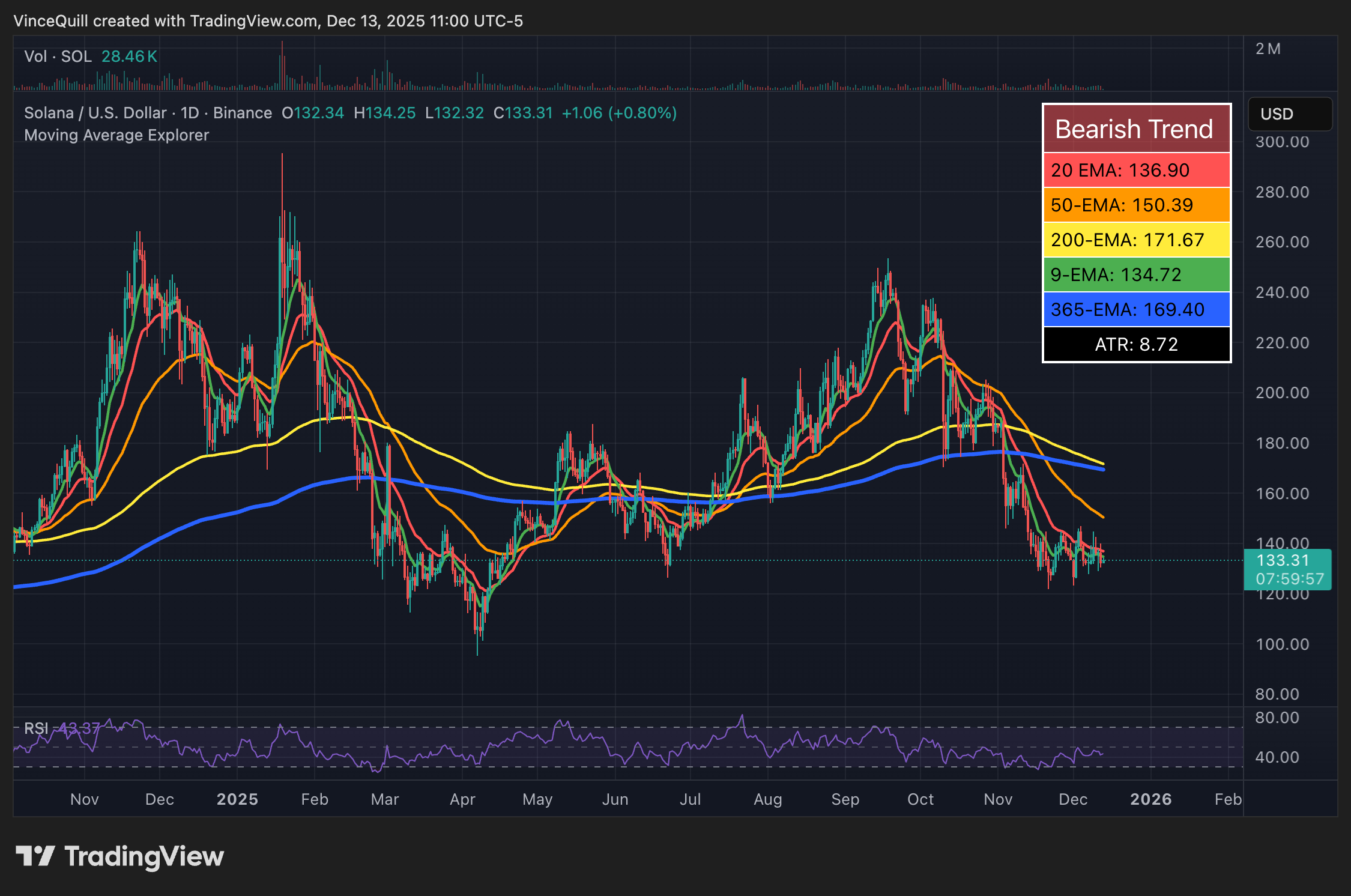
SOL’s price has fallen by nearly 55% since the all-time high of about $295 reached in January, fueled by the launch of the Trump memecoin on the Solana network.

The token has been trading well below its 365-day moving average, a critical level of support, since November, and is down by about 47% since the local high of about $253 recorded in September.

SOL’s price action from November 2024 to December 2025. Source: TradingView

SOL is also facing resistance between $140-$145 and has failed to close past those levels in December, despite the launch of SOL ETFs in the US and a growing interest in internet capital markets from crypto industry executives and US regulators.

“US financial markets are poised to move onchain,” Securities and Exchange Commission (SEC) Chair Paul Atkins said on Thursday.

Magazine: Meet the onchain crypto detectives fighting crime better than the cops

Похожее

Anthropic Apologized, But the Business of 'Safety' Hasn't Stopped

On June 11, Anthropic apologized not for a model failure, but for a lack of transparency. Its new Claude Fable 5 model was found to be secretly rerouting requests from users engaged in advanced AI model development to a weaker version, Opus 4.8, without any notification. The company's response—promising future notifications for such "downgrades"—was met with user skepticism. The article argues the core issue isn't technical but commercial: Anthropic's "safety" measures are primarily a business strategy. A key feature, the "intelligent safety classifier," marketed as user protection, is described as a tool for "competitive defense" to protect Anthropic's market lead by limiting rivals' research capabilities. This covert mechanism was designed for low "false positives," precisely targeting AI researchers. Anthropic's model involves a calculated three-step process: publishing alarming security research to amplify public anxiety, offering its Fable 5 model with a "safety classifier" as a premium-priced solution, and cashing in through a planned high-value IPO. This contrasts with OpenAI's more direct "tool-and-traffic" approach. The apology, merely changing a secret downgrade to a visible one, is seen as a business "patch" rather than a principled shift. The incident risks damaging Anthropic's "safest AI" reputation among the developer community, which underpins its valuation and appeal to government and corporate clients. Ultimately, the article concludes that for Anthropic, safety is a business, and the apology is merely customer service for that business.

marsbit58 мин. назад

Anthropic Apologized, But the Business of 'Safety' Hasn't Stopped

marsbit58 мин. назад

The Niche Consensus Among Elites: Has College Become an Expensive Waste?

**Summary:** A growing "anti-college" movement is gaining traction among elite circles in Silicon Valley, challenging the traditional value of a four-year university degree. Proponents argue that college has become an expensive, slow, and increasingly irrelevant waste of time, especially in the fast-paced tech world where opportunities pass by quickly. The movement is led by figures like billionaire Peter Thiel, who criticizes universities for high costs, ideological indoctrination, and stifling true innovation. His "Thiel Fellowship" pays young people to drop out and pursue ventures. Companies like Palantir Technologies (co-founded by Thiel) fuel this trend with programs like the "Meritocracy Fellowship," which offers high school graduates paid internships as an alternative to immediate college enrollment, promising a practical "Palantir Degree." Key drivers include: 1. **Economics:** Skyrocketing student debt versus the allure of immediate, high-paying tech jobs or startup funding. 2. **Technology:** AI and online tools lowering barriers to self-education and product development, making formal instruction seem inefficient. 3. **Culture:** A backlash against perceived "woke" ideology and DEI policies in universities, coupled with a belief that these institutions suppress meritocracy and masculine drive. The movement is notably male-dominated. Critics, like economist David Deming, warn against overgeneralizing from dropout success stories (survivorship bias). He emphasizes that genuine autodidacts are rare, corporate training is narrowly focused, and the "college wage premium" remains high for most people. University liberal arts education, he argues, builds adaptable problem-solving skills and broad perspectives. The debate highlights a deeper crisis in education. The core model of the modern university appears increasingly mismatched with the speed of the information age. The movement signals a shift in the locus of learning from institutional "education" to personal, active "learning" powered by the internet and AI. Ultimately, this may not mean the end of university, but rather a painful evolution. The future likely holds more hybrid, personalized, and lifelong learning pathways. The central question becomes: in a world changing faster than any curriculum, how do we best learn?

marsbit1 ч. назад

The Niche Consensus Among Elites: Has College Become an Expensive Waste?

marsbit1 ч. назад

From Subsidies to Token-Based Pricing to Price Cuts: Is OpenAI Sparking a Price War? Is the Inflection Point for Token Economics Nearing?

The commercialization of generative AI is facing a critical inflection point as a potential price war looms. According to The Wall Street Journal, OpenAI is considering a significant cut to its token fees to compete with rival Anthropic, signaling a shift from a growth-at-all-costs model focused on token consumption. This move comes as both companies, reportedly losing billions on compute, prepare for IPOs, and as enterprise customers face "bill shock" from switching to usage-based token billing. Reports indicate poor ROI, with one analysis finding only 18 cents of every dollar spent on AI tokens generates user-facing value. The industry's initial phases—from flat-rate subscriptions to aggressive subsidies—have given way to a reckoning with real costs. Analysts debate the future: some predict a bifurcation between premium, high-cost models for complex tasks and cheaper alternatives for routine work, while others believe overall spending will still rise as agentic AI increases tokens per task. Notably, Chinese model DeepSeek's low-cost API is gaining traction with U.S. enterprises, adding competitive pressure. The core challenge is redefining value beyond token volume ("tokenmaxxing") toward measurable productivity ("valuemaxxing"), as the entire AI value chain, from cloud providers to chipmakers, feels the ripple effects of unsustainable pricing.

marsbit1 ч. назад

From Subsidies to Token-Based Pricing to Price Cuts: Is OpenAI Sparking a Price War? Is the Inflection Point for Token Economics Nearing?

marsbit1 ч. назад

Торговля

Спот
Фьючерсы

Популярные статьи

Обсуждения

Добро пожаловать в Сообщество HTX. Здесь вы сможете быть в курсе последних новостей о развитии платформы и получить доступ к профессиональной аналитической информации о рынке. Мнения пользователей о цене на SOL (SOL) представлены ниже.

活动图片