$SOL Drops to $97, Hints at Further Crash as $MAXI’s Presale Booms

bitcoinistОпубликовано 2026-02-04Обновлено 2026-02-04

Введение

Solana (SOL) has broken below the critical $100 support level, trading as low as $97, which may trigger a liquidation cascade of over-leteraged long positions. Technical indicators, including RSI, suggest further downside risk, with potential support near $78. As institutional inflows slow, retail capitulation risks increase. Meanwhile, capital is rotating into speculative assets like Maxi Doge ($MAXI), an Ethereum-based meme token that has raised $4.5M in its presale. $MAXI integrates gamified trading competitions and staking rewards, targeting traders seeking high volatility and returns amid broader market stagnation. Whale accumulation and built-in utility mechanisms aim to sustain liquidity and reduce sell pressure at launch.

Solana has officially breached the psychological $100 barrier, trading down to $97. That’s a problem. The breakdown of this critical support level isn’t just a technical glitch, it represents a liquidation cascade of over-leveraged long positions that simply failed to defend the triple-digit zone.

Technical indicators are flashing warnings we haven’t seen since the post-FTX capitulation. The Relative Strength Index (RSI) on the weekly chart has failed to reset, suggesting sellers aren’t done yet. If the $97 floor gives way?

Volume profile analysis points to a nasty liquidity vacuum down to the $78 range. That matters for one reason: institutional flows, which buoyed SOL throughout Q1, are decelerating. The real risk is that retail traders, exhausted by the chop, might capitulate just as smart money starts hunting for higher-beta assets.

While the ‘Ethereum Killer’ bleeds, capital isn’t exiting the ecosystem entirely, it’s rotating. Experienced traders know the drill: when Layer 1 majors stumble, liquidity flows downstream into speculative assets that promise the volatility the market craves.

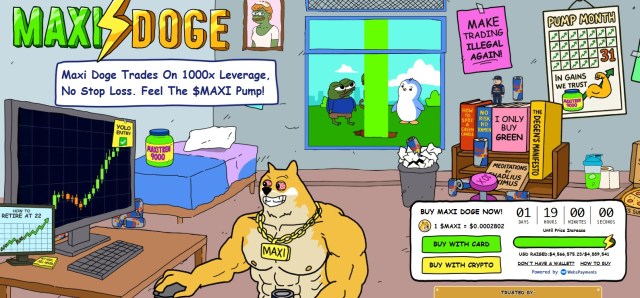
As Solana struggles to find its footing, a new heavyweight on Ethereum is absorbing that liquidity: Maxi Doge ($MAXI).

Buy $MAXI here.

Maxi Doge Flexes Strength With $4.4M Raise

While the broader market retraces, Maxi Doge ($MAXI) is capitalizing on the demand for high-leverage culture. Calling itself the ‘Leverage King,’ the project goes beyond standard meme tokenomics by integrating a community-driven trading ecosystem.

Frankly, the numbers speak for themselves: the project has already secured $4.5M in its presale, signaling that traders are hedging blue-chip losses with high-upside plays.

The hook here is the gamification of volatility. Maxi Doge introduces Holder-Only Trading Competitions where users compete for leaderboard rewards, directly feeding the retail need for ‘1000x energy’ even when the macro market is crabbing.

Unlike static meme coins that rely solely on vibes, $MAXI uses a Maxi Fund treasury to back liquidity and fund partnerships. That puts a fundamental floor under the narrative.

What most coverage misses is that meme coins with built-in utility loops tend to retain liquidity longer than pure hype tokens. By anchoring the community around the concept of ‘never skipping leg-day,’ Maxi Doge aligns itself with the aggressive psychology of the current crypto cohort.

Get your $MAXI today.

Smart Money Accumulation Signals Divergence

The most telling signal for Maxi Doge isn’t the viral marketing, it’s the on-chain behavior.

While retail investors panic-sell SOL at $97, deep pockets are rotating into $MAXI.

With the token currently priced at $0.0002802, the whales are positioning themselves before the presale concludes. Plus, the protocol incentivizes holding through dynamic APY staking, distributing rewards daily from a 5% allocation pool. That mechanism helps reduce sell pressure on launch day, a common pitfall for presale tokens.

The divergence is stark. Solana is fighting to hold a two-year support level; Maxi Doge is seeing accelerating inflows. For traders tired of watching their Layer 1 bags bleed, the ‘lift, trade, repeat’ ethos offers a high-energy alternative to the current stagnation.

Check the presale details before the next price increase.

Disclaimer: This article is for informational purposes only and does not constitute financial advice. Cryptocurrency markets, especially presales and meme tokens, are highly volatile. $SOL losing the $97 support level could lead to further downside, and new tokens carry inherent risks.

Always conduct your own due diligence.

Связанные с этим вопросы

QWhat is the current price of Solana (SOL) and what critical support level has it broken?

ASolana (SOL) is currently trading at $97, and it has broken the critical psychological support level of $100.

QAccording to the article, what is the potential downside target for SOL if the $97 support fails?

AVolume profile analysis points to a downside liquidity vacuum reaching the $78 range if the $97 support level gives way.

QWhat project on the Ethereum network is mentioned as a beneficiary of capital rotating away from Solana?

AMaxi Doge ($MAXI) on the Ethereum network is mentioned as absorbing the liquidity that is rotating away from Solana.

QHow much funding has the Maxi Doge ($MAXI) presale raised according to the article?

AThe Maxi Doge ($MAXI) presale has raised $4.5 million.

QWhat mechanism does Maxi Doge use to incentivize holding and reduce sell pressure on launch day?

AMaxi Doge uses dynamic APY staking, distributing rewards daily from a 5% allocation pool, to incentivize holding and reduce sell pressure on launch day.

Похожее

From Return to Resignation: Chen Hang's 437 Days at DingTalk

The 437-Day Return and Departure of Chen Hang at DingTalk This article chronicles the 437-day period from March 31, 2025, to June 11, 2026, when Chen Hang (also known as "No Move") returned as CEO of DingTalk, the enterprise communication platform he originally founded, only to later step down. Chen Hang, the creator of DingTalk in 2015, was brought back by Alibaba in 2025 after the company acquired his subsequent startup, HHO. His return was driven by Alibaba's renewed focus on AI and DingTalk's strategic role as its key to-B AI application. However, his aggressive management style, marked by strict work policies like mandatory clock-ins and extended hours, quickly caused internal friction and was criticized as being at odds with Alibaba's culture. Despite the internal turmoil, Chen Hang drove significant product launches. In August 2025, he unveiled "AI DingTalk 1.0," featuring new products like the AI-native entry point "DingTalk ONE." By March 2026, he announced "Wukong," touted as the world's first enterprise-grade AI-native work platform, representing a fundamental rebuild of DingTalk's architecture. The turning point came in early June 2026. A detailed internal post criticizing DingTalk's work culture went viral, followed by a public critique from a former executive. This prompted an unprecedented public rebuke from the Alibaba Partners Committee, which stated such management was not aligned with company values. One day later, on June 11, Alibaba announced Chen Hang's departure. He was succeeded by Chen Yusen, a 32-year-old technical expert known for founding cybersecurity firm Changting Technology. While Chen Hang's tenure laid the technical foundation for DingTalk's AI transformation with "Wukong," his leadership style ultimately led to his replacement as the company seeks a new direction under younger leadership.

marsbit11 мин. назад

From Return to Resignation: Chen Hang's 437 Days at DingTalk

marsbit11 мин. назад

The 2026 Landscape of Decentralized AI: Why Blockchain is the Inevitable 'Antidote' for AI?

Decentralized AI 2026 Landscape: Why Blockchain is AI's Essential "Antidote" Centralized AI faces structural bottlenecks—expensive compute, concentrated control, unverifiable outputs, and difficult data access—that cannot be solved by capital or code alone. Blockchain offers a path to make intelligence open, verifiable, and economically accessible. The decentralized AI stack comprises: * **Infrastructure:** The foundation with compute, verifiable inference, distributed training, data/storage, and privacy/verification layers. Projects like Akash, Render, and Filecoin provide cheaper, decentralized alternatives for raw resources. * **Middleware:** The coordination layer for agent discovery, identity, and commerce. Key players include Bittensor (a network of specialized AI subnets), Virtuals (an agent economy OS), and frameworks providing agent identity and tooling. * **Applications & Services:** Dominated by Agentic Finance (AI agents executing on-chain actions based on natural language) and Agentic Payments (machine-to-machine transactions using blockchain as a settlement layer). Projects like Giza, Infinit Labs, and x402 are enabling these use cases. Key trends for 2026-2027 show AI demand outgrowing infrastructure, compute becoming an asset class, and tokenomics emerging as a structural advantage for coordinating capital, compute, and data. While still early—with adoption uneven and revenue often trailing token incentives—projects like Bittensor, NEAR, and Venice demonstrate decentralized AI is evolving from a narrative into a new model for coordinating intelligence.

Foresight News31 мин. назад

The 2026 Landscape of Decentralized AI: Why Blockchain is the Inevitable 'Antidote' for AI?

Foresight News31 мин. назад

Торговля

Спот
Фьючерсы

Популярные статьи

Обсуждения

Добро пожаловать в Сообщество HTX. Здесь вы сможете быть в курсе последних новостей о развитии платформы и получить доступ к профессиональной аналитической информации о рынке. Мнения пользователей о цене на SOL (SOL) представлены ниже.

活动图片