Shenzhen Longgang District Plans to Launch Special "Lobster Ten" Policy

marsbitОпубликовано 2026-03-09Обновлено 2026-03-09

Введение

Shenzhen's Longgang District is drafting a special policy package, "Ten Measures for OpenClaw" (龙虾十条), to support the development of the open-source AI agent project OpenClaw and One Person Companies (OPCs). The policy aims to position Longgang as a global hub for AI agent entrepreneurship. OpenClaw, a popular local-first AI automation gateway that connects various large models and messaging platforms (like WeChat and DingTalk), allows users to perform tasks via natural language commands. The proposed measures include free deployment services, subsidies for data, hardware (e.g., 30% off AI NAS devices), and model usage (30% reimbursement for calling major domestic LLMs, up to ¥1 million annually). It also offers up to three months of free computing power for new OPCs, rewards for innovative applications (up to ¥2 million), and support for talent (including relocation subsidies, housing, and office space discounts). Additional features include capital investment (up to ¥10 million for early-stage projects), export services, and competitions to attract global developers and individual entrepreneurs. The policy is set to take effect in 2026 for a three-year term.

Source: 21st Century Business Herald

Reporter: Lin Dianchi

An open-source AI agent project named OpenClaw, which has attracted attention due to its icon resembling a red lobster, has recently gone viral, making "raising lobsters" the new trend in the AI community.

OpenClaw is an open-source, local-first AI agent platform and automation gateway. It does not come with built-in large models but connects to various mainstream large models and instant messaging platforms through a unified gateway. This allows users to drive AI to perform practical tasks locally or in the cloud—such as browser operations, file processing, and email organization—using natural language via everyday chat interfaces like WeChat, DingTalk, and Feishu, achieving "chat as operation." As one of the phenomenal AI projects of 2026, it has garnered over 260,000 stars on GitHub.

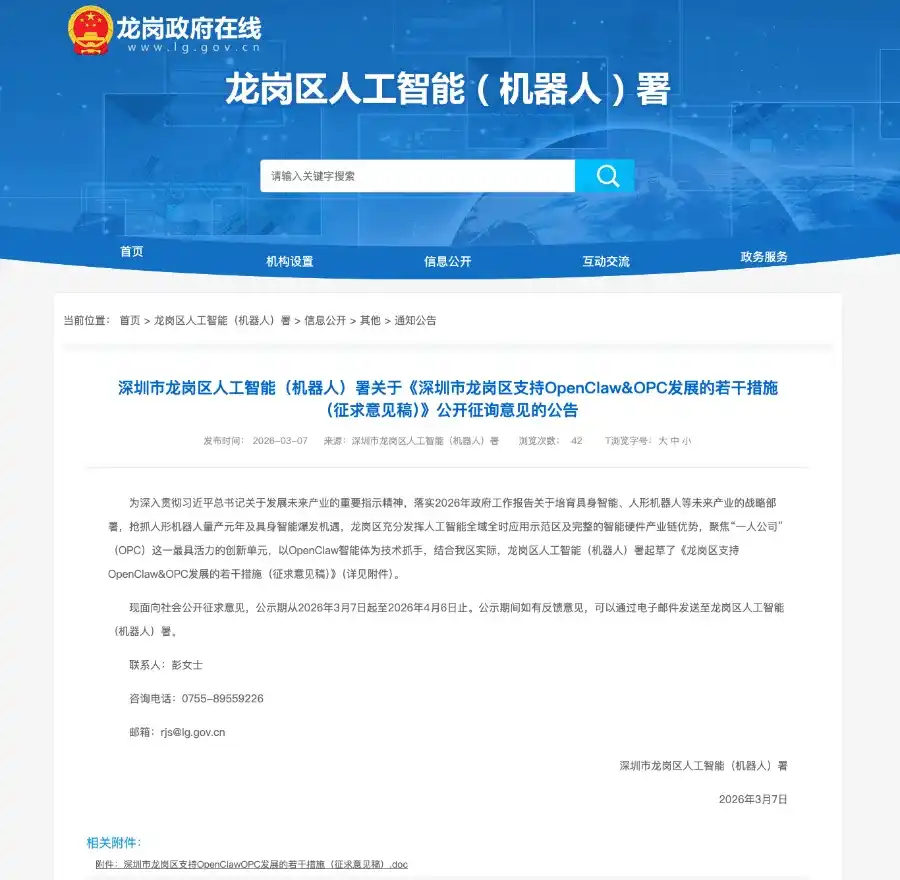
To seize the opportunities presented by the intelligent economy, Shenzhen's Longgang District released the "Several Measures of Shenzhen Longgang District to Support the Development of OpenClaw & OPC (Draft for Solicitation of Comments)" (hereinafter referred to as the "Lobster Ten") on March 7. The policy aims to make "zero-cost startup" its core highlight, extending an olive branch to global AI agent developers and OPC (One Person Company) entrepreneurs, and positioning the district as the preferred destination for global AI agent entrepreneurship.

This year's government work report首次提出 the concept of "intelligent agents," explicitly calling for "cultivating new forms of intelligent economy" and emphasizing "supporting entrepreneurial forms adapted to the AI era." The introduction of the "Lobster Ten" is a rapid and precise response to this strategic deployment.

Free Deployment, Data Subsidies, Hardware Subsidies

Addressing the key needs in the evolution of AI agents from "seeing and speaking" to "doing and acting," the "Lobster Ten" introduces a series of comprehensive services, focusing on supporting OpenClaw—a project hailed as the "operating hand" of AI agents.

Free deployment, ready to use out of the box. The policy encourages platform companies to create "Lobster Service Zones," offering free OpenClaw deployment services to developers, eliminating the hassle of complex environment setup. The government will provide corresponding subsidies to the platforms, truly enabling developers to "move in with just a suitcase."

Data elements, open and shared. Longgang plans to open large-scale, high-quality, desensitized public data in areas such as low-altitude economy, smart transportation, healthcare, and urban governance, reducing the cost of using public data. Enterprises purchasing data governance, labeling, and other services for OpenClaw development will receive a 50% subsidy on the fees; those purchasing plug-and-play "Lobster Box" (AI NAS) hardware will receive a 30% subsidy based on the market price.

Encouraging innovation, rewarding applications. To incentivize technological breakthroughs, Longgang plans to offer subsidies of up to 2 million yuan to enterprises that contribute key code to international mainstream communities or develop and list skill packages for Longgang's advantageous industries, subject to approval. Additionally, the "OpenClaw Digital Employee Application Voucher" will be implemented, supporting enterprises in purchasing or building solutions with a 40% subsidy on investment, up to 2 million yuan per enterprise annually. Each year, a selection of demonstration projects with deep applications in areas like smart manufacturing and smart governance will be recognized with titles and rewards of up to 1 million yuan.

Three Months of Free Computing Power, 30% Subsidy on Large Model Usage Fees

With the advancement of AI technology, it is becoming a reality for one person to operate a competitive company (OPC, One Person Company) with the help of intelligent tools and a complete supply chain. Increasing numbers of "super individuals" juggling multiple roles are emerging.

In 2026, the "Shenzhen Plan for Building a Leading Hub for AI OPC Entrepreneurship Ecology (2026-2027)" was officially issued, explicitly proposing the construction of an industrial cluster and an innovation-active AI OPC entrepreneurship ecology.

In line with this trend, Longgang District has tailored support measures for this new entrepreneurial form in the proposed policy, helping "individuals" start with light loads.

Regarding computing power and model subsidies, to address the computing power and model bottlenecks in the early stages of entrepreneurship, newly入驻 recognized OPC community enterprises will receive up to three months of free computing power. Eligible AIGC enterprises in the district that use domestic leading large models for creation and production will receive a 30% subsidy on actual usage fees, with each enterprise eligible for up to 1 million yuan annually.

Regarding scenario对接, Longgang plans to select示范场景 projects with industry leadership annually, providing support of up to 50% of the actual project investment, not exceeding 4 million yuan, to help innovative technologies quickly find application stages.

Community operations, ecological support. Recognized OPC communities will receive up to 4 million yuan in annual support for their operating institutions, fostering a "tropical rainforest"般的 entrepreneurial ecology.

Talent settlement, housing保障. The policy plans to provide tiered settlement subsidies for talent of up to 100,000 yuan, offer up to two months of free accommodation and 18 months of discounted office space for newly registered OPC enterprises, creating a growth environment that starts "from a single desk." The "Longgang District OPC Person of the Year" award will be established, with winners receiving up to 100,000 yuan in rewards and comprehensive services such as medical care and children's education.

To adapt to this "light-asset, high-innovation" entrepreneurial model, Longgang has precisely launched a series of "cost-reduction" measures to create an OPC创业友好城区. Eligible OPC projects will have access to industrial space at 30-70% of market rent; the district has taken the lead in establishing "OPC专属咨询窗口" (OPC exclusive consultation windows)配套 "一人公司"开办指南 (one-person company startup guides); entrepreneurs can complete business registration within 3 working days through the "开办企业一窗通" (one-stop business startup window), enabling a easy start.

Three Major Moves to Promote OPC Growth

To ensure OPC entrepreneurial dreams take root and grow, the policy brings together three key elements—capital, global expansion, and competitions—to build a full-chain support system.

In terms of capital empowerment, Longgang plans to coordinate the use of the科技 innovation 'seed fund', the artificial intelligence industry母基金, and others to provide投融资 channels for seed-stage OPC projects with high technological content and strong innovation capabilities (especially youth talent projects). Eligible projects can receive up to 10 million yuan in equity investment support.

Regarding global expansion services, Longgang plans to leverage the district's international service base for enterprises to specifically establish OPC "出海服务站" (global expansion service stations), integrating one-stop services such as market expansion, cross-border logistics, and compliance consulting. It will also provide premium support for eligible export credit insurance, helping enterprises explore global markets worry-free.

In terms of attracting talent through competitions, Longgang plans to host brand events like "OPC Hackathons" and innovation and entrepreneurship competitions, offering winning teams rewards of up to 500,000 yuan. This aims to discover and储备一批优秀创业团队与个人 (a batch of excellent entrepreneurial teams and individuals), continuously injecting fresh blood into industrial development.

It is reported that the measures are currently open for public comment and are planned to take effect from 2026, valid for 3 years. The head of the Longgang District Artificial Intelligence (Robotics) Office stated: "Workstations are ready, computing power is prepared, funds are in place. Longgang sincerely invites global developers, geeks, and super individuals to gather in Longgang to jointly define the new form of the intelligent economy. Particularly regarding the safety concerns everyone has, we will establish strict technical standards and regulatory mechanisms to ensure full lifecycle security and controllability from data collection and storage to application, while promoting domestic substitution to reduce reliance on external risks. For example, in identity authentication and permission management, we will enable mandatory dual-factor authentication and set passwords that meet complexity requirements with regular changes. During operation, the principle of least privilege will be followed, using普通用户权限 (standard user permissions) rather than管理员权限 (administrator privileges); strictly limit its file system access scope, only opening necessary working directories, and prohibiting access to any paths containing sensitive data."

Связанные с этим вопросы

QWhat is the core feature of the 'Lobster Ten Articles' policy introduced by Longgang District, Shenzhen?

AThe core feature is 'zero-cost startup', providing comprehensive support including free deployment, data subsidies, hardware subsidies, and computing power incentives to attract global AI developers and OPC entrepreneurs.

QWhat specific subsidies does the policy offer for data and hardware related to OpenClaw development?

AIt offers a 50% subsidy for data governance and annotation services, and a 30% subsidy for purchasing 'Lobster Box' (AI NAS) hardware at market price.

QHow does the policy support One Person Company (OPC) startups in terms of computing power and model usage?

AIt provides three months of free computing power for newly入驻 OPC community enterprises and a 30% subsidy on调用 fees for using domestic leading large models, with a maximum of 1 million RMB per year per enterprise.

QWhat financial support is available for OPC startups through capital empowerment under this policy?

AEligible OPC projects can receive up to 10 million RMB in equity investment support through seed funds and AI industry母基金, particularly for early-stage projects with high technological content.

QWhat measures are mentioned to ensure security and compliance in the development and application of AI technologies like OpenClaw?

AStrict technical standards and regulatory mechanisms will be established, including mandatory dual authentication, regular password changes, minimal permission principles, restricted file system access, and promoting domestic alternatives to reduce external dependency risks.

Похожее

Has the 'Digital Gold' Narrative for BTC Failed?

**Title: Has the "Digital Gold" Narrative for Bitcoin Failed?** The article argues that Bitcoin's "digital gold" narrative remains valid despite a recent sharp price decline (from a peak near $126k in Oct 2025 to briefly under $61k in Feb 2026). It presents a long-term investment framework based on three core points: **1. Viewing Bitcoin as an Asset:** Bitcoin is presented as a superior potential store of value compared to gold. Key arguments are its absolute scarcity (21 million cap), superior portability, and transparent auditability via its public ledger. While acknowledging its current use in early, volatile stages (~3-4% global adoption), the author draws parallels to the early, disruptive phases of the internet and e-commerce. **2. Understanding the Recent Downturn:** The current ~50% correction is framed as a predictable, consensus-driven cycle following its post-halving peak (the 2024 halving preceded the Oct 2025 high). A crucial factor is a historic "changing of hands": the influx of new institutional buyers via ETFs allowed early, low-cost holders (miners, OG believers) to take profits. The author notes that while severe, Bitcoin's historical drawdowns (e.g., 93% in 2011, 77% in 2021-22) have been progressively smaller, suggesting maturing holder structure and decreasing volatility over time. **3. The Long-Term Perspective:** The long-term thesis hinges on Bitcoin capturing a portion of gold's market value. With Bitcoin's market cap at ~$1.4 trillion (at $70k) versus gold's ~$20 trillion, significant upside potential exists if the "digital gold" narrative is partially realized. However, the author strongly cautions that short-term risks remain, the bottom is unpredictable, and high volatility is inherent. The real risk is not Bitcoin failing but poor personal position management (over-leverage, wrong capital) and a lack of deep understanding, which can force investors out during severe downturns. The conclusion uses Amazon's 95% crash post-2000 dot-com bubble and subsequent 42x recovery as an analogy. The ultimate question is not if Bitcoin's price will rise, but if an investor's strategy and conviction can withstand the volatility to see the long-term play out. The recent divergence (gold up, Bitcoin down) is posed not as a narrative failure, but as potential evidence of this ongoing, painful transition from a speculative asset to a mainstream allocation.

marsbit2 ч. назад

Has the 'Digital Gold' Narrative for BTC Failed?

marsbit2 ч. назад

Has BTC's 'Digital Gold' Narrative Failed?

The article discusses Bitcoin's "digital gold" narrative, its recent price drop, and long-term outlook through the perspective of "Jason". It argues the narrative is not a failure but that Bitcoin represents a superior, new asset class due to its fixed supply (21 million), portability, and auditability. The piece compares its current ~3-4% global adoption rate to early internet/e-commerce, suggesting significant growth potential. Regarding the 2025-2026 price decline (from ~$126k to briefly under $61k), the author views it as a predictable, consensus-driven sell-off within Bitcoin's ~4-year cycle post-halving, exacerbated by a major "handover" from early, low-cost holders to new institutional buyers via ETFs. A key observation is that historical peak-to-trough drawdowns have lessened over time (e.g., 93% in 2011 to ~50% in 2026), indicating maturing volatility as holder structure changes. For the long term, the author uses a simple framework: Bitcoin's total market cap (~$1.4T at $70k) is only about 7% of gold's (~$20T). Even capturing 30-50% of gold's value would imply substantial upside. However, the article strongly cautions against viewing this as investment advice, emphasizing extreme volatility and the critical importance of risk management, position sizing, and deep fundamental understanding to survive severe drawdowns. It concludes by drawing a parallel to Amazon's 95% crash in 2000 and subsequent 42x recovery, stressing that the key is surviving market cycles to realize long-term potential.

链捕手2 ч. назад

Has BTC's 'Digital Gold' Narrative Failed?

链捕手2 ч. назад

From Code to Cognition: A Ten-Thousand-Word Guide to the Evolution of the Robot Brain

"From Code to Cognition: The Evolution of Robot Brains" The journey of robotic intelligence has shifted dramatically from manually coded systems to AI-driven brains. For decades, robots relied on layered software stacks—perception, state estimation, planning, control—each handcrafted. While predictable, they lacked adaptability. The 2010s saw deep learning revolutionize perception (e.g., object detection) and control (via reinforcement learning), but learned skills remained narrow. The arrival of Large Language Models (LLMs) marked a turning point. LLMs acted as high-level planners, interpreting natural language instructions and generating sequences of actions for traditional robotic systems to execute. However, true integration came with Visual-Language-Action (VLA) models, which fused vision, language, and motion prediction into a single network. Pioneered by models like RT-2 and open-source projects like OpenVLA, VLAs enable robots to reason and act directly from visual input and commands. The most advanced humanoid robots now employ a "dual-brain" architecture: a slow-thinking, large VLA (System 2) for reasoning and planning, and a fast-reacting, small network (System 1) for high-frequency motion control, sometimes with an even lower-level System 0 for balance. This split balances cognition with the physics of real-time movement. Computation is split between onboard hardware (e.g., NVIDIA Jetson) for safety-critical control loops and cloud/edge servers for non-critical tasks like learning and interfaces. A crucial driver is the open-source ecosystem—models like GR00T and OpenVLA allow startups to build upon pre-trained brains and fine-tune them with their own data, accelerating development. Despite progress, current systems struggle with recovery from errors, sample inefficiency, and long-horizon tasks. This has spurred the rise of **World Models**—neural networks that predict the consequences of actions. By simulating possible futures before acting (like NVIDIA Cosmos or Meta V-JEPA), robots can plan, recover, and generalize better. This represents the next frontier: shifting intelligence from learned reactions to an internal model of physics and cause-and-effect. The field is rapidly evolving. While not yet at its "ChatGPT moment," the convergence of cheaper hardware, scalable simulation, and world models points toward robots that are increasingly capable, adaptive, and useful. The question is shifting from "what can robots do?" to "what *should* they do?"

marsbit3 ч. назад

From Code to Cognition: A Ten-Thousand-Word Guide to the Evolution of the Robot Brain

marsbit3 ч. назад

AI Bubble Is Bursting

The AI Bubble is Bursting: A Necessary Purge on the Path to Ubiquitous Intelligence Market volatility has reignited debates about an AI bubble, with figures like Ray Dalio pointing to high valuations. However, this parallels the dot-com bubble, which, despite its crash, laid the physical infrastructure for today's internet era. The current AI investment frenzy, with tech giants planning trillions in infrastructure spending far outstripping current AI application revenues, appears similarly imbalanced. This 'bubble' is seen as an inevitable phase for a disruptive technology, paying the "innovation tax." Critically, AI inference costs have plummeted over 99.7% since 2023, making intelligence nearly free at the margin. This hasn't reduced spending but has instead unlocked massive new demand, as seen in enterprise AI cloud expenditure tripling. This follows the Jevons Paradox: efficiency gains lead to greater total consumption. The market is now entering a cleansing phase, weeding out speculative ventures lacking real moats. The deeper shift is a move from capital expenditure (CapEx) on hardware to value creation in operational expenditure (OpEx) through AI applications that solve real industry problems. While infrastructure valuations are high, rapid earnings growth from widespread AI adoption across sectors—from manufacturing and finance to law and healthcare—may digest these valuations over time. Ultimately, this creative destruction will leave behind robust infrastructure and optimized models, cheaply powering an AI-augmented future for all industries, much as the internet became indispensable after its own bubble burst. The core productive potential remains undiminished.

链捕手3 ч. назад

AI Bubble Is Bursting

链捕手3 ч. назад

Торговля

Спот
Фьючерсы

Популярные статьи

Неделя обучения по популярным токенам (2): 2026 может стать годом приложений реального времени, сектор AI продолжает оставаться в тренде

2025 год — год институциональных инвесторов, в будущем он будет доминировать в приложениях реального времени.

1.8k просмотров всегоОпубликовано 2025.12.16Обновлено 2025.12.16

Неделя обучения по популярным токенам (2): 2026 может стать годом приложений реального времени, сектор AI продолжает оставаться в тренде

Обсуждения

Добро пожаловать в Сообщество HTX. Здесь вы сможете быть в курсе последних новостей о развитии платформы и получить доступ к профессиональной аналитической информации о рынке. Мнения пользователей о цене на AI (AI) представлены ниже.

活动图片