Ripple Unveils ‘Institutional DeFi’ Roadmap For The XRP Ledger

bitcoinistОпубликовано 2026-02-07Обновлено 2026-02-07

Введение

Ripple has released an "Institutional DeFi" roadmap for the XRP Ledger (XRPL), positioning XRP as a core settlement and liquidity asset for payments, foreign exchange, collateral, and on-ledger credit. The plan aims to transform XRPL into a compliant financial operating system for institutions, with features like permissioned markets, privacy tools, and lending protocols. Key components already live include Token Escrow, Batch Transactions, and Credentials for KYC/AML. Upcoming 2026 releases include a Permissioned DEX, confidential transfers using zero-knowledge proofs, and the XLS-66 Lending Protocol for on-ledger credit markets. The roadmap is designed to drive both direct and indirect demand for XRP through increased transaction activity and protocol-level usage.

Ripple on Thursday published an “Institutional DeFi” roadmap for the XRP Ledger (XRPL), positioning XRP as a protocol-level settlement and liquidity primitive across payments, FX, collateral workflows, and on-ledger credit. The company’s pitch is straightforward: compliance tooling and asset-layer primitives are already live on mainnet, with lending, privacy, and permissioned market infrastructure slated to round out a more institution-friendly stack over the coming quarters.

The Institutional DeFi Roadmap For The XRP Ledger

In its post, Ripple framed the roadmap as an evolution from a fast settlement network into something closer to a full financial operating environment for regulated workflows. The blog argues that with “native onchain privacy, permissioned markets, and institutional lending” expected “in the coming months,” XRPL is aiming to become “an end-to-end operating system for real-world finance,” with institutions able to run compliant processes without pushing additional complexity onto end users.

RippleX summarized the roadmap in a companion post, saying XRP sits “at the center of settlement, FX, collateral, and onchain credit,” and that 2026 focus areas include lending, privacy, and permissioned on-chain markets.

The roadmap leans heavily on the idea that XRP demand can be driven both directly and indirectly. Directly, Ripple points to new functionality that could increase transaction volume and asset issuance, raising demand for network resources. Indirectly, it highlights XRP’s role in base-layer mechanics such as reserve requirements, transaction fees (which burn XRP), and bridging in FX and lending flows.

Ripple organizes this into three institutional pillars: payments/FX, collateral/liquidity, and credit/financing. On payments and FX, it emphasizes “Permissioned Domains,” where access is gated via “Credentials” (e.g., KYC/AML attestations), and a planned Permissioned DEX that would extend XRPL’s existing exchange rails into controlled, regulated contexts for secondary markets in FX, stablecoins, and tokenized assets. In those permissioned market flows, Ripple says XRP functions as an auto-bridge asset between tokens and stablecoins, while each transaction consumes fees paid in XRP.

On collateral and liquidity, Ripple spotlights Token Escrow and Batch Transactions as building blocks for conditional settlement and atomic delivery-versus-payment workflows, alongside the Multi-Purpose Token (MPT) standard, which it describes as a way to embed metadata and restrictions for complex instruments without custom contracts. The thesis here is that tokenized collateral issuance, escrowed settlement, and DvP-style flows expand on-ledger activity that still depends on XRP reserves and fees at the protocol layer.

The most explicit “institutional DeFi” expansion comes in credit. Ripple says XRPL v3.1.0 will introduce native on-ledger credit markets via a lending stack built around Single-Asset Vaults and the XLS-66 Lending Protocol, designed for fixed-term, underwritten loans with repayment automation. Underwriting and risk management remain off-chain, while the loan contracts and mechanics live on-ledger.

What Ripple Says Is Next

Ripple’s post distinguishes between primitives already available and a near-term pipeline. Live today, it lists MPT, Credentials, Permissioned Domains, transaction “Simulate” tooling for preflight-style risk reduction, “Deep Freeze” controls for issuers, Token Escrow and Batch Transactions, plus an XRPL EVM sidechain bridged via Axelar for Solidity-based deployments that tap XRPL liquidity and identity features.

On the roadmap, Ripple highlights a Permissioned DEX targeted for Q2, the XLS-65/66 lending protocol for later in 2026, “Confidential Transfers” for MPTs using zero-knowledge proofs in Q1, and “Smart Escrows” and MPT DEX integration in Q2—alongside an “Institutional DeFi Portal” intended to bundle tokenization, lending, and payments exploration in one place.

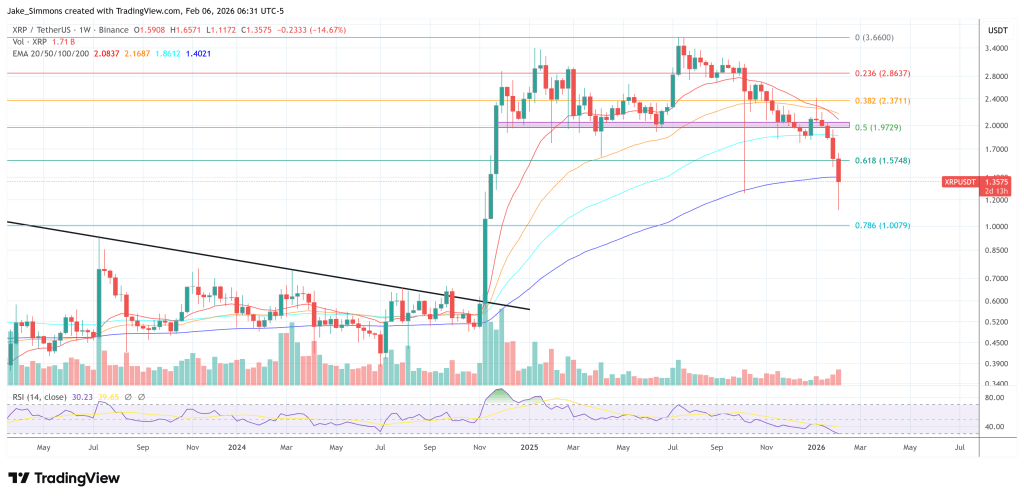
At press time, XRP traded at $1.35.

XRP needs a weekly close above the 200-week EMA, 1-week chart | Source: XRPUSDT on TradingView.com

Похожее

The Niche Consensus Among Elites: Has College Become an Expensive Waste?

**Summary:** A growing "anti-college" movement is gaining traction among elite circles in Silicon Valley, challenging the traditional value of a four-year university degree. Proponents argue that college has become an expensive, slow, and increasingly irrelevant waste of time, especially in the fast-paced tech world where opportunities pass by quickly. The movement is led by figures like billionaire Peter Thiel, who criticizes universities for high costs, ideological indoctrination, and stifling true innovation. His "Thiel Fellowship" pays young people to drop out and pursue ventures. Companies like Palantir Technologies (co-founded by Thiel) fuel this trend with programs like the "Meritocracy Fellowship," which offers high school graduates paid internships as an alternative to immediate college enrollment, promising a practical "Palantir Degree." Key drivers include: 1. **Economics:** Skyrocketing student debt versus the allure of immediate, high-paying tech jobs or startup funding. 2. **Technology:** AI and online tools lowering barriers to self-education and product development, making formal instruction seem inefficient. 3. **Culture:** A backlash against perceived "woke" ideology and DEI policies in universities, coupled with a belief that these institutions suppress meritocracy and masculine drive. The movement is notably male-dominated. Critics, like economist David Deming, warn against overgeneralizing from dropout success stories (survivorship bias). He emphasizes that genuine autodidacts are rare, corporate training is narrowly focused, and the "college wage premium" remains high for most people. University liberal arts education, he argues, builds adaptable problem-solving skills and broad perspectives. The debate highlights a deeper crisis in education. The core model of the modern university appears increasingly mismatched with the speed of the information age. The movement signals a shift in the locus of learning from institutional "education" to personal, active "learning" powered by the internet and AI. Ultimately, this may not mean the end of university, but rather a painful evolution. The future likely holds more hybrid, personalized, and lifelong learning pathways. The central question becomes: in a world changing faster than any curriculum, how do we best learn?

marsbit9 мин. назад

The Niche Consensus Among Elites: Has College Become an Expensive Waste?

marsbit9 мин. назад

From Subsidies to Token-Based Pricing to Price Cuts: Is OpenAI Sparking a Price War? Is the Inflection Point for Token Economics Nearing?

The commercialization of generative AI is facing a critical inflection point as a potential price war looms. According to The Wall Street Journal, OpenAI is considering a significant cut to its token fees to compete with rival Anthropic, signaling a shift from a growth-at-all-costs model focused on token consumption. This move comes as both companies, reportedly losing billions on compute, prepare for IPOs, and as enterprise customers face "bill shock" from switching to usage-based token billing. Reports indicate poor ROI, with one analysis finding only 18 cents of every dollar spent on AI tokens generates user-facing value. The industry's initial phases—from flat-rate subscriptions to aggressive subsidies—have given way to a reckoning with real costs. Analysts debate the future: some predict a bifurcation between premium, high-cost models for complex tasks and cheaper alternatives for routine work, while others believe overall spending will still rise as agentic AI increases tokens per task. Notably, Chinese model DeepSeek's low-cost API is gaining traction with U.S. enterprises, adding competitive pressure. The core challenge is redefining value beyond token volume ("tokenmaxxing") toward measurable productivity ("valuemaxxing"), as the entire AI value chain, from cloud providers to chipmakers, feels the ripple effects of unsustainable pricing.

marsbit13 мин. назад

From Subsidies to Token-Based Pricing to Price Cuts: Is OpenAI Sparking a Price War? Is the Inflection Point for Token Economics Nearing?

marsbit13 мин. назад

Торговля

Спот
Фьючерсы

Популярные статьи

Что такое XRP 2.0

XRP 2.0: Новая грань в мире криптовалют Введение в XRP 2.0 В постоянно развивающейся сфере криптовалют появляются новые проекты, стремящиеся к вниманию и внедрению. Один из таких многообещающих проектов - это XRP 2.0, новая криптовалюта, созданная для использования передовых технологий блокчейна и надежных методов шифрования. Хотя название вызывает ассоциации с XRP от Ripple, важно отметить, что XRP 2.0 функционирует независимо, сосредоточив внимание на повышении безопасности сделок, конфиденциальности и масштабируемости. Поскольку цифровая финансовая среда все больше принимает децентрализованные решения, XRP 2.0 намерена внести значимый вклад в web3 и общее расширение криптопроектов. Что такое XRP 2.0? XRP 2.0 в своей основе - это проект криптовалюты, цель которого - создать безопасную и децентрализованную экосистему цифровой валюты. Его базовая технология интегрирует сложные принципы блокчейна с современными методами шифрования. Основная цель XRP 2.0 - утвердиться как надежная и эффективная платформа, позволяющая быстро осуществлять транзакции с приоритетом на улучшенную защиту конфиденциальности для своих пользователей. Проект рекламируется как решение многих недостатков, с которыми сталкиваются существующие криптовалюты, предлагая систему, способную обрабатывать более высокий объем транзакций с улучшенной скоростью и конфиденциальностью. Эта универсальность позиционирует XRP 2.0 как значимого конкурента на рынке, переполненном различными цифровыми валютами. Кто создатель XRP 2.0? Идентичность создателя XRP 2.0 была обозначена как «Уилбур». Однако исчерпывающие данные о Уилбуре или связанном с ним проекте остаются неясными. Анонимность многих создателей криптовалют не является редким явлением в этой отрасли и часто применяется для сохранения определенной степени конфиденциальности и безопасности. Кто инвесторы XRP 2.0? <pна данный момент конкретная информация о инвестиционных фондах или организациях, поддерживающих xrp 2.0, не доступна публично. в секторе криптовалют поддержка репутабельными инвесторами может существенно повлиять на кредитоспособность и успех проекта, однако прозрачность в отношении финансовых спонсоров 2.0 еще была установлена. Как работает XRP 2.0? XRP 2.0 выделяется использованием сочетания технологий блокчейна и продвинутых алгоритмов шифрования, что обеспечивает безопасные и децентрализованные транзакции. Его инновационная структура включает уникальные функции, разработанные для повышения вовлеченности пользователей и расширения функциональности за пределами традиционных транзакций с криптовалютами. Среди этих функций XRP 2.0 интегрирует возможности с искусственным интеллектом, такие как текст в изображение и текст в речь. Эти дополнения разработаны для улучшения интерактивной работы пользователей, способствуя более широкому применению в различных секторах. Соединяя технологические достижения с дизайном, ориентированным на пользователя, XRP 2.0 стремится привлечь внимание разнообразных индивидуумов и предприятий, стремящихся интегрировать решения с криптовалютой в свои бизнес-процессы. Хронология XRP 2.0 Для понимания XRP 2.0 необходимо рассмотреть ключевые события, которые определили его путь до сих пор: 23 июля 2023 года: XRP 2.0 представлен как новый проект криптовалюты, стремящийся революционизировать возможности безопасных и децентрализованных транзакций в области блокчейна. 8 сентября 2023 года: Запуск другого проекта, XRP20, который представляет собой токен ERC-20 на блокчейне Ethereum и не имеет отношения к XRP 2.0. 13 ноября 2023 года: XRP Ledger подвергается значительному обновлению с выпуском программного обеспечения серверов rippled версии 2.0.0. Важно отметить, что это развитие не связано с проектом криптовалюты XRP 2.0. Ключевые моменты о XRP 2.0 Чтобы выделить суть XRP 2.0, возникают несколько критически важных факторов: Уникальные особенности: Включение таких функций, как основанные на ИИ текст в изображение и текст в речь, дополнительно разнообразит потенциальные приложения XRP 2.0. Технология блокчейна: Структура использует современные механизмы блокчейна и протоколы шифрования, обеспечивая безопасную и децентрализованную среду для транзакций. Масштабируемость и конфиденциальность: XRP 2.0 придает приоритет повышенным мерам защиты конфиденциальности в процессах транзакций и масштабируемости, необходимой для привлечения растущей базы пользователей. Нет связи с Ripple: Важно отметить, что, несмотря на свое название, XRP 2.0 не имеет никаких отношений или сотрудничества с XRP от Ripple, что отличает его операционные рамки и цели в экосистеме криптовалют. Заключение XRP 2.0 представляет собой амбициозное начинание в сфере криптовалют, стремясь предложить сочетание безопасности, конфиденциальности и эффективности в цифровых транзакциях. Интегрируя сложные технологии и удобные функции, проект стремится расширить горизонты того, что может достичь криптовалюта в современной цифровой экономике. Хотя анонимность его создателя и отсутствие раскрытых инвесторов могут вызвать вопросы у некоторых, акцент XRP 2.0 на передовых функциональных возможностях и децентрализации увеличивает его привлекательность на фоне все более переполненного крипто-рынка. Поскольку мир криптовалют продолжает развиваться, XRP 2.0 может еще стать ключевым игроком в расширении безопасных и масштабируемых блокчейн-решений.

198 просмотров всегоОпубликовано 2024.04.05Обновлено 2024.12.03

Что такое XRP 2.0

Неделя обучения по популярным токенам 13: запуск основной сети HIP-4 ожидается в середине 2026 года на фоне смещения фокуса рынка к масштабируемому внедрению ключевых криптоактивов, включая XRP

HIP-4 представит децентрализованные рынки прогнозов без разрешений, бинарные (исходные) контракты и опционы 0DTE.

1.3k просмотров всегоОпубликовано 2026.04.22Обновлено 2026.04.22

Неделя обучения по популярным токенам 13: запуск основной сети HIP-4 ожидается в середине 2026 года на фоне смещения фокуса рынка к масштабируемому внедрению ключевых криптоактивов, включая XRP

Обсуждения

Добро пожаловать в Сообщество HTX. Здесь вы сможете быть в курсе последних новостей о развитии платформы и получить доступ к профессиональной аналитической информации о рынке. Мнения пользователей о цене на XRP (XRP) представлены ниже.

活动图片