Ripple CTO Explains How The XRP Ledger ‘Will Take Over The World’

bitcoinistОпубликовано 2025-12-24Обновлено 2025-12-24

Введение

Ripple CTO David Schwartz emphasized that sustained usage, real value movement, and institutional-grade infrastructure are key to the XRP Ledger's global adoption. He highlighted metrics like over 4 billion transactions processed, consistent 4-5 second settlement, and minimal fees. Schwartz stressed the importance of deep liquidity and real-world asset tokenization, noting involvement from major institutions like Guggenheim and Franklin Templeton. He distinguished between mere token issuance and active on-chain financial activity, asserting that practical financial products—not retail speculation—will drive mainstream adoption. At the time of reporting, XRP was trading at $1.88.

On a Token Relations webinar for the XRP ecosystem on Dec. 20, Ripple CTO David Schwartz was asked the sort of question that usually produces a tidy dashboard answer, what on-chain metrics actually matter, what’s “real” economic activity, and what trends are showing up across the ledger (and, yes, the ETF chatter in the background). He went straight to the point: usage that sticks, value that moves, and the boring-but-decisive plumbing that financial institutions actually care about will “take over the world.”

How Ripple Wants To Make The XRPL Mainstream

“I definitely focus on metrics that show sustained usage and real value moving through the network,” Schwartz said. “Transaction activity is probably the clearest signal. The XRP ledger has now processed more than four billion transactions with pretty consistent settlement in about four to five seconds at a fairly predictable fee.”

That’s the pitch in one breath: scale, predictable finality, and fees so low you don’t have to pretend they’re a feature.“You know, a transaction on the XRP ledger costs a tiny fraction of a penny,” the Ripple CTO added. “It’s not trying to extract value from people’s transactions. That’s trying to enable people to do what they need to do.”

Then he pivoted to liquidity, the kind of line XRP holders love to hear, but framed as infrastructure rather than tribal scoreboard-watching. “Liquidity is another huge factor,” Schwartz said. “XRP is a top five digital asset by market capitalization and has been for I think 10 years now, about 109 billion dollars deep global liquidity for real financial activity. That depth matters.”

The bigger point he kept coming back to was momentum in actual network use, not just “we issued a token and it sat there.”

“The XRP ledger itself is now one of the top 10 blockchains for real world activity this year with a rate of increase that’s just absolutely astonishing from a use case that was you know almost unthinkable just a year ago,” he said. “We now have institutional issuers like Guggenheim, Ondo [Finance], Aberdeen [Standard Investments], Franklin [Templeton].”

And then the part that’s meant to separate “RWA theater” from RWAs that matter: “And it’s not just issuance, you know, it wouldn’t be super exciting if they were just sort of issuing an asset on chain that just sort of sat on chain,” the Ripple CTO said. “What’s interesting is that these assets are actually moving and settling on chain. So the financial activity is getting the benefit.”

That little distinction is where a lot of tokenization narratives either hold up or collapse. Anybody can “issue” a thing on a ledger. The harder bit is getting it to behave like financial infrastructure, moving, settling, plugging into workflows that aren’t built for crypto vibes.

Schwartz also threw a bit of cold water on the current retail mix. XRPL has users who love the tech (and users who love leverage), but he was pretty blunt that this isn’t the endgame.

But obviously that’s not how we’re going to take over the world. We’re going to take over the world with solid financial products that solve real world use cases. And we are actually starting to see that now enabled by things like stablecoins and tokenized real world assets that let us handle these use cases like payments and like reasonable investments, tokenized money, market funds and treasuries,” he said. “

And retail might follow the institutions, not the other way around. The Ripple CTO pointed to “more than 500,000 new wallets” created, framing it as early evidence that institutional rails can drag everyday users in behind them.

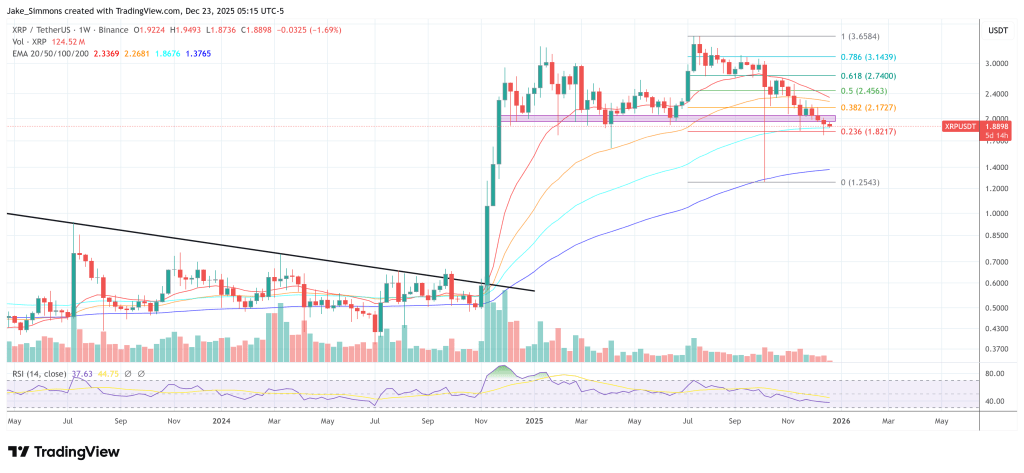
At press time, XRP traded at $1.88.

XRP falls below key support, 1-week chart | Source: XRPUSDT on TradingView.com

Связанные с этим вопросы

QWhat are the three key metrics that Ripple CTO David Schwartz believes will help the XRP Ledger 'take over the world'?

AThe three key metrics are sustained usage, real value moving through the network, and the 'boring-but-decisive plumbing' (reliable infrastructure) that financial institutions care about.

QAccording to Schwartz, what is the current transaction fee and settlement time on the XRP Ledger?

AA transaction costs a tiny fraction of a penny and settles in about four to five seconds.

QWhat distinction does Schwartz make to separate real 'tokenization' from mere issuance?

AHe states that it's not exciting to just issue an asset on-chain; what matters is that the assets are actually moving, settling, and being used for financial activity, thereby getting the full benefit of the infrastructure.

QHow does Schwartz describe the current growth and ranking of the XRP Ledger in terms of real-world activity?

AHe said the XRP Ledger is now one of the top 10 blockchains for real-world activity this year, with a rate of increase that is 'absolutely astonishing' from a use case that was almost unthinkable a year ago.

QWhat does Schwartz suggest is the primary driver for mass adoption of the XRP Ledger, and what evidence does he cite?

AHe suggests that solid financial products solving real-world use cases, enabled by institutional adoption (like stablecoins and tokenized assets), will be the primary driver. He cites the creation of more than 500,000 new wallets as early evidence that institutional rails can attract everyday users.

Похожее

Standing in the Light: A Comprehensive Guide to the Optical Module and CPO Supply Chain

"Standing in the Light: Understanding the Optical Module and CPO Industry Chain" This article analyzes the critical role of optical communication technology, specifically optical modules and Co-Packaged Optics (CPO), as the "nervous system" for modern AI data centers. With exponential growth in AI computational demands (e.g., NVIDIA's Vera Rubin architecture), traditional electrical interconnects using copper cables face severe bottlenecks in bandwidth, power consumption, and signal integrity over distance. The core function of an optical module is to act as a "translator," converting electrical signals from chips into optical signals for transmission over fiber (and vice-versa). Key internal components include lasers, modulators, photodetectors, drivers, and DSP chips. The industry is currently transitioning from 800G to 1.6T modules. However, the future lies in CPO. This next-generation technology integrates the optical engine directly with the switch ASIC/XPU on the same package substrate, drastically reducing power consumption (by ~3.5x according to NVIDIA), overcoming bandwidth density limits, and minimizing signal attenuation compared to traditional pluggable modules. Key challenges for CPO include advanced packaging capacity (dominated by TSMC), thermal management, repairability, and standardization. The article details the broader technology landscape, including Near-Packaged Optics (NPO, a pragmatic intermediate step), Linear-drive Pluggable Optics (LPO), Optical I/O (OIO for chip-level integration), and Optical Circuit Switches (OCS). A comprehensive CPO industry chain is mapped, highlighting shifting power dynamics: * **Architecture Definers:** NVIDIA, Broadcom, and Marvell now hold greater influence. * **Advanced Packaging & Manufacturing:** TSMC is central; Fabrinet is a key EMS player. * **Lasers ("The Heart"):** A strategic bottleneck. EML lasers are led by Lumentum and Coherent (both receiving major NVIDIA investments). CW lasers, favored for CPO/silicon photonics, see strong Chinese players like Source Photonics and Sicoya. * **Silicon Photonics Chips:** The mainstream path for CPO engines, with key players like Broadcom, Intel, Marvell, and China's Accelink. * **Fiber Connectivity Components:** A major new, high-growth market created by CPO, including Fiber Array Units (FAU), Polarization-Maintaining Fiber (PMF), and MPO connectors. Companies like Tianfu Communication and US Conec are leaders. * **Fiber & Cable:** Experiencing a super-cycle (e.g., Corning, Yangtze Optical Fiber). * **PCB/Substrates:** Requiring advanced materials (e.g., Shengyi Tech). * **DSP & SerDes:** Functions are integrated into switch ASICs in the CPO era (e.g., Broadcom, Astera Labs). * **Optical Module Makers:** Transitioning from standalone module suppliers to providers of optical engines and NPO/LPO solutions while riding the current pluggable boom (e.g., Zhongji Innolight, Eoptolink). The investment timeline is segmented: Short-term (2026-2027) features the "last feast" for pluggable modules and CPO's initial rollout. Medium-term (2027-2029) will see CPO expand and NPO peak. Long-term (2029-2032+) involves CPO/OIO penetration into intra-rack scaling. In conclusion, optical interconnects are fundamental to AI infrastructure. The competitive landscape sees US firms leading in architecture and high-end chips, TSMC in advanced packaging, and Chinese firms holding strong positions in modules, connectivity components, CW lasers, and fiber/cable. The future belongs to companies that can navigate the technological shift from "selling shovels" (modules) to "building highways" (CPO/OIO infrastructure).

marsbit9 мин. назад

Standing in the Light: A Comprehensive Guide to the Optical Module and CPO Supply Chain

marsbit9 мин. назад

Торговля

Спот
Фьючерсы

Популярные статьи

Что такое XRP 2.0

XRP 2.0: Новая грань в мире криптовалют Введение в XRP 2.0 В постоянно развивающейся сфере криптовалют появляются новые проекты, стремящиеся к вниманию и внедрению. Один из таких многообещающих проектов - это XRP 2.0, новая криптовалюта, созданная для использования передовых технологий блокчейна и надежных методов шифрования. Хотя название вызывает ассоциации с XRP от Ripple, важно отметить, что XRP 2.0 функционирует независимо, сосредоточив внимание на повышении безопасности сделок, конфиденциальности и масштабируемости. Поскольку цифровая финансовая среда все больше принимает децентрализованные решения, XRP 2.0 намерена внести значимый вклад в web3 и общее расширение криптопроектов. Что такое XRP 2.0? XRP 2.0 в своей основе - это проект криптовалюты, цель которого - создать безопасную и децентрализованную экосистему цифровой валюты. Его базовая технология интегрирует сложные принципы блокчейна с современными методами шифрования. Основная цель XRP 2.0 - утвердиться как надежная и эффективная платформа, позволяющая быстро осуществлять транзакции с приоритетом на улучшенную защиту конфиденциальности для своих пользователей. Проект рекламируется как решение многих недостатков, с которыми сталкиваются существующие криптовалюты, предлагая систему, способную обрабатывать более высокий объем транзакций с улучшенной скоростью и конфиденциальностью. Эта универсальность позиционирует XRP 2.0 как значимого конкурента на рынке, переполненном различными цифровыми валютами. Кто создатель XRP 2.0? Идентичность создателя XRP 2.0 была обозначена как «Уилбур». Однако исчерпывающие данные о Уилбуре или связанном с ним проекте остаются неясными. Анонимность многих создателей криптовалют не является редким явлением в этой отрасли и часто применяется для сохранения определенной степени конфиденциальности и безопасности. Кто инвесторы XRP 2.0? <pна данный момент конкретная информация о инвестиционных фондах или организациях, поддерживающих xrp 2.0, не доступна публично. в секторе криптовалют поддержка репутабельными инвесторами может существенно повлиять на кредитоспособность и успех проекта, однако прозрачность в отношении финансовых спонсоров 2.0 еще была установлена. Как работает XRP 2.0? XRP 2.0 выделяется использованием сочетания технологий блокчейна и продвинутых алгоритмов шифрования, что обеспечивает безопасные и децентрализованные транзакции. Его инновационная структура включает уникальные функции, разработанные для повышения вовлеченности пользователей и расширения функциональности за пределами традиционных транзакций с криптовалютами. Среди этих функций XRP 2.0 интегрирует возможности с искусственным интеллектом, такие как текст в изображение и текст в речь. Эти дополнения разработаны для улучшения интерактивной работы пользователей, способствуя более широкому применению в различных секторах. Соединяя технологические достижения с дизайном, ориентированным на пользователя, XRP 2.0 стремится привлечь внимание разнообразных индивидуумов и предприятий, стремящихся интегрировать решения с криптовалютой в свои бизнес-процессы. Хронология XRP 2.0 Для понимания XRP 2.0 необходимо рассмотреть ключевые события, которые определили его путь до сих пор: 23 июля 2023 года: XRP 2.0 представлен как новый проект криптовалюты, стремящийся революционизировать возможности безопасных и децентрализованных транзакций в области блокчейна. 8 сентября 2023 года: Запуск другого проекта, XRP20, который представляет собой токен ERC-20 на блокчейне Ethereum и не имеет отношения к XRP 2.0. 13 ноября 2023 года: XRP Ledger подвергается значительному обновлению с выпуском программного обеспечения серверов rippled версии 2.0.0. Важно отметить, что это развитие не связано с проектом криптовалюты XRP 2.0. Ключевые моменты о XRP 2.0 Чтобы выделить суть XRP 2.0, возникают несколько критически важных факторов: Уникальные особенности: Включение таких функций, как основанные на ИИ текст в изображение и текст в речь, дополнительно разнообразит потенциальные приложения XRP 2.0. Технология блокчейна: Структура использует современные механизмы блокчейна и протоколы шифрования, обеспечивая безопасную и децентрализованную среду для транзакций. Масштабируемость и конфиденциальность: XRP 2.0 придает приоритет повышенным мерам защиты конфиденциальности в процессах транзакций и масштабируемости, необходимой для привлечения растущей базы пользователей. Нет связи с Ripple: Важно отметить, что, несмотря на свое название, XRP 2.0 не имеет никаких отношений или сотрудничества с XRP от Ripple, что отличает его операционные рамки и цели в экосистеме криптовалют. Заключение XRP 2.0 представляет собой амбициозное начинание в сфере криптовалют, стремясь предложить сочетание безопасности, конфиденциальности и эффективности в цифровых транзакциях. Интегрируя сложные технологии и удобные функции, проект стремится расширить горизонты того, что может достичь криптовалюта в современной цифровой экономике. Хотя анонимность его создателя и отсутствие раскрытых инвесторов могут вызвать вопросы у некоторых, акцент XRP 2.0 на передовых функциональных возможностях и децентрализации увеличивает его привлекательность на фоне все более переполненного крипто-рынка. Поскольку мир криптовалют продолжает развиваться, XRP 2.0 может еще стать ключевым игроком в расширении безопасных и масштабируемых блокчейн-решений.

198 просмотров всегоОпубликовано 2024.04.05Обновлено 2024.12.03

Что такое XRP 2.0

Неделя обучения по популярным токенам 13: запуск основной сети HIP-4 ожидается в середине 2026 года на фоне смещения фокуса рынка к масштабируемому внедрению ключевых криптоактивов, включая XRP

HIP-4 представит децентрализованные рынки прогнозов без разрешений, бинарные (исходные) контракты и опционы 0DTE.

1.3k просмотров всегоОпубликовано 2026.04.22Обновлено 2026.04.22

Неделя обучения по популярным токенам 13: запуск основной сети HIP-4 ожидается в середине 2026 года на фоне смещения фокуса рынка к масштабируемому внедрению ключевых криптоактивов, включая XRP

Обсуждения

Добро пожаловать в Сообщество HTX. Здесь вы сможете быть в курсе последних новостей о развитии платформы и получить доступ к профессиональной аналитической информации о рынке. Мнения пользователей о цене на XRP (XRP) представлены ниже.

活动图片