Recent Mass Shutdowns of DeFi Protocols: They All Have One Thing in Common

marsbitОпубликовано 2026-03-06Обновлено 2026-03-06

Введение

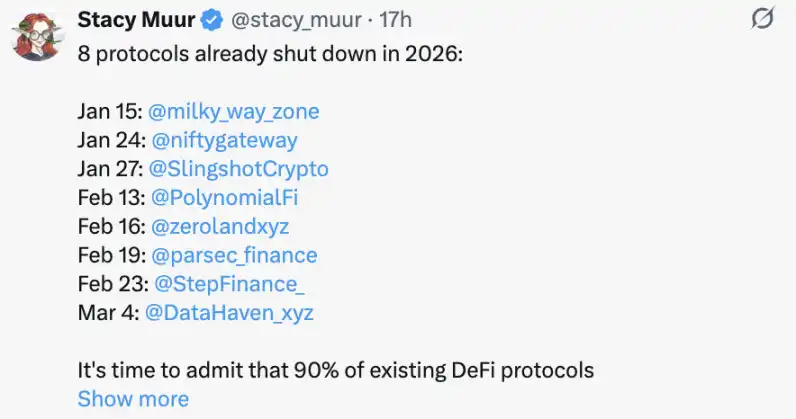
In recent months, multiple DeFi protocols have announced shutdowns, not due to exit scams but because of a lack of users, funding, or both. Projects like Angle Protocol, Polynomial, MilkyWay, and Step Finance—despite having functional products and significant past traction—were unable to sustain operations. Common challenges included an inability to attract liquidity (especially critical in derivatives), failure to achieve product-market fit, and high costs of expanding to new chains or narratives. Many teams pivoted repeatedly to chase trends like restaking or real-world assets but ran out of capital before finding sustainable demand. Others, like ZeroLend, suffered from deploying on smaller blockchains that lost liquidity during market downturns. Despite these failures, the projects shut down responsibly, allowing users to withdraw funds and avoiding reckless token launches—a sign of industry maturation compared to the reckless exits of 2022.

Author: Ignas

Compiled by: Chopper, Foresight News

Over the past two months, at least 10 crypto protocols have announced their closure. Not rug pulls, but due to no users, no money, or both.

Not to mention mining companies like BlockFills and lending platforms freezing withdrawals. Just yesterday, Angle also announced (https://x.com/AngleProtocol/status/2029161525580112263) the gradual shutdown of its EURA and USDA stablecoins, despite having reached a Total Value Locked (TVL) of $250 million and having strong business partnerships.

Angle stated bluntly in the announcement, "The decentralized stablecoin landscape has completely changed. Yield-bearing stablecoins today are essentially just branded wrappers over existing vaults and lending protocols; there's no longer a need to maintain a separate, independent infrastructure."

These shuttered projects almost all had functional products:

  • Polynomial processed a cumulative trading volume of $4 billion across 70 markets
  • MilkyWay's TVL once reached $250 million
  • Step Finance had a peak of 300,000 monthly active users

I've used, or at least tried, these products. The technology wasn't the issue, but no one was willing to pay the fees needed for the projects to survive.

MilkyWay is a typical example: four pivots in less than two years. Starting with Celestia liquid staking, then moving to restaking, RWA tokenization, and crypto debit cards for rent payments... each pivot chased the hype of the moment.

Their description of the restaking pivot is poignant: "We identified the restaking opportunity early, designed the system, TVL to $250M, completed security audits, and were ready to launch. But the market moved on from restaking faster than anyone anticipated."

In the end, they had to admit the funding wouldn't last long enough to find product-market fit.

The Polynomial team was brutally honest about the reason for failure, offering a lesson for all perpetual contract projects: "In derivatives, good tech is useless. We improved execution speed, optimized UX, built innovative infrastructure, but none of it mattered. Traders go where the liquidity is. We didn't have it. Everything else is just a nice-to-have feature."

The conclusion is even harsher: "Liquidity is the only moat in derivatives. You can't beat liquidity with innovation, you can't beat it with marketing, you can't beat it with development."

ZeroLend's shutdown sounds a warning bell for dApps trying to launch on multiple blockchains. They bet on supporting projects on niche chains like Manta, Zircuit, and Xlayer, but when the market turned bearish, liquidity on these chains dried up, and oracle providers stopped their services.

Ultimately, operating at a long-term loss was unsustainable.

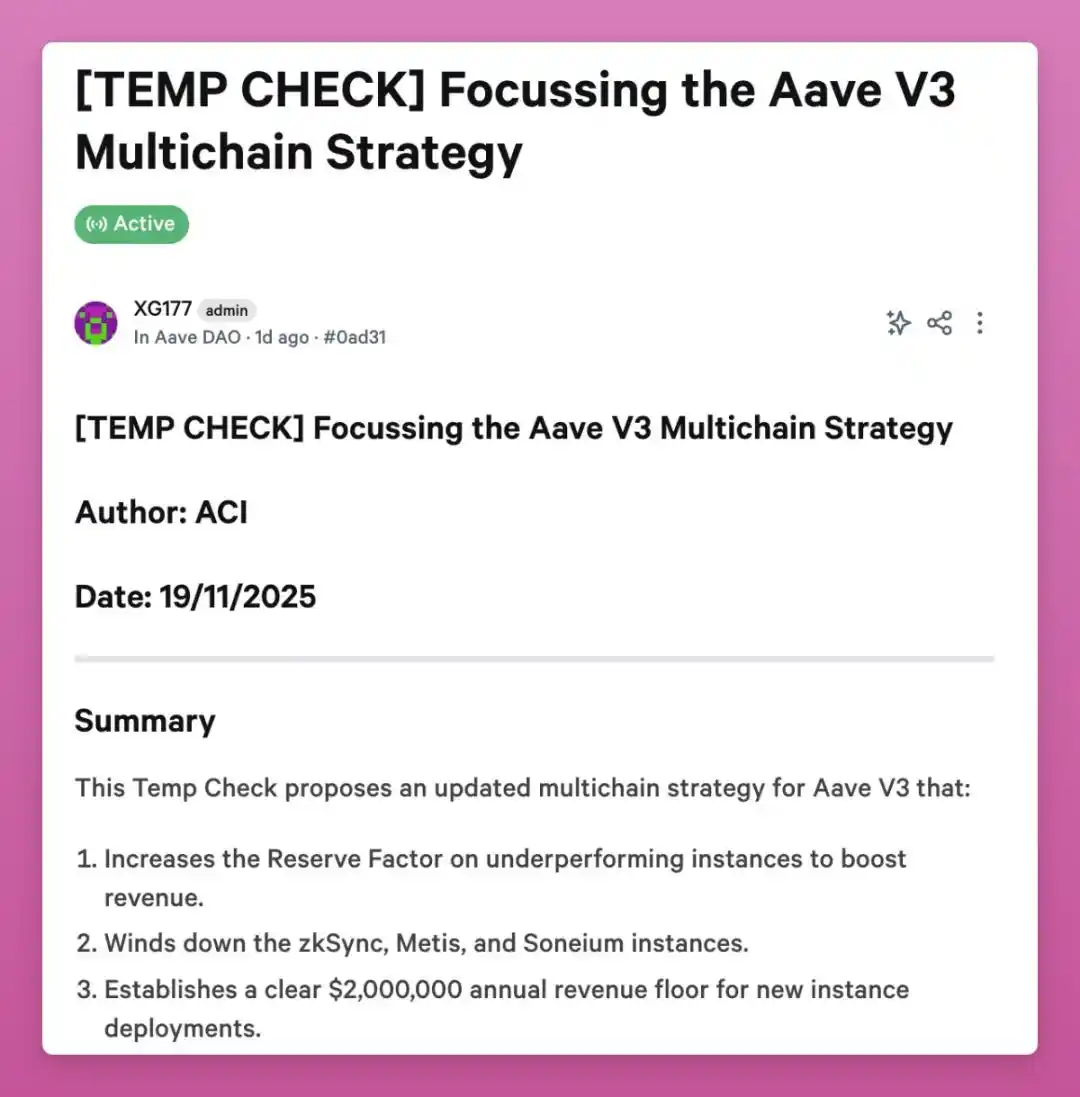
Aave recently also voted to shut down services on several chains, citing the same reason of unprofitable operation.

Then there's Parsec, once a legendary tool in the circle used to track Terra, 3AC, and the stETH depeg. But the team admitted, "After the FTX collapse, DeFi spot trading, lending, and leverage never returned to their former state. The market changed, on-chain behavior changed, and we didn't truly understand it."

Simply put, the market moved on, and we were left behind. The market is cruel.

Slingshot was acquired and completely shut down. Eden cut 80% of its unprofitable products, keeping only the core business.

As they said, "The 80/20 rule became a reality; the products that cost us 80% of our expenses brought in only 20% of the revenue."

Finally, Step Finance's case is more unique: it was hacked for $26 million on January 31st, which was a death sentence. "We tried fundraising, acquisition, nothing worked."

What's the common thread among these deceased projects? They failed to adapt to the ever-changing market and lacked sufficient capital to pivot again.

Each team bet on a particular ecosystem experiencing explosive growth, but the growth either wasn't fast enough or didn't happen at all. Celestia DeFi never truly took off, on-chain derivatives struggled to compete with Hyperliquid, and even established platforms like dYdX and GMX are having a hard time.

And expanding into new chains and narrative areas is costly.

For players like me, moving funds from one platform to another is effortless and cheap. But applications need to invest significant time and financial resources to prepare for potential new user bases.

The good news is, these were all "dignified deaths." All projects gave users time to withdraw funds; the teams didn't run away or issue tokens to cash out. Compared to the outright rug pulls of 2022, the industry has indeed learned to die responsibly.

Связанные с этим вопросы

QWhat is the common reason behind the recent shutdowns of multiple DeFi protocols?

AThe common reason is that these protocols failed to adapt to the rapidly changing market conditions and lacked sufficient funding to pivot or sustain operations, despite having functional products.

QAccording to Angle Protocol, why did they decide to shut down their stablecoin operations?

AAngle Protocol stated that the decentralized stablecoin landscape has fundamentally changed, and yield-bearing stablecoins are now essentially just branded wrappers over existing vaults and lending protocols, making it unnecessary to maintain independent infrastructure.

QWhat did Polynomial identify as the only moat in the derivatives space?

APolynomial identified liquidity as the only moat in the derivatives space, emphasizing that innovation, marketing, or development cannot overcome the advantage of liquidity.

QWhat lesson did ZeroLend's shutdown provide for decentralized applications?

AZeroLend's shutdown served as a warning for dApps launching on multiple blockchains, as betting on smaller chains like Manta and Xlayer led to liquidity drying up and oracle services halting when the bear market hit.

QHow did the shutdowns of these protocols demonstrate responsible behavior compared to past incidents?

AThese protocols allowed users time to withdraw funds, did not engage in exit scams, and avoided issuing worthless tokens, showing that the industry has learned to 'die responsibly' compared to the outright fraud seen in 2022.

Похожее

Cook's Curtain Call and Ternus Takes the Helm: The Disruption and Reboot of Apple's 4 Trillion Dollar Empire

Tim Cook has officially announced he will step down as CEO of Apple in September, transitioning to executive chairman after a 15-year tenure during which he grew the company’s market value from around $350 billion to nearly $4 trillion. He will be succeeded by John Ternus, a 50-year-old hardware engineering veteran who has been groomed for the role through increasing public visibility and internal responsibility. Ternus’s appointment signals a strategic shift toward hardware and engineering leadership, with Johny Srouji—head of Apple Silicon—taking on an expanded role as Chief Hardware Officer. This consolidation aims to strengthen Apple’s core technological capabilities. However, Cook’s departure highlights a significant unresolved issue: Apple’s delayed and fragmented approach to artificial intelligence. Despite early efforts, such as hiring John Giannandrea from Google in 2018, Apple’s AI initiatives—particularly around Siri—have struggled with internal restructuring and reliance on external partnerships, including with Google. The transition comes at a critical moment as Apple faces paradigm shifts with the rise of artificial general intelligence (ASI). The company’s closed ecosystem of hardware, software, and services—once a major advantage—now presents challenges in adapting to an AI-centric world where intelligence may matter more than the device itself. Ternus must quickly articulate a clear AI strategy, possibly starting at WWDC, to reassure markets and redefine Apple’s role in a new technological era. His task is not only to maintain Apple’s operational excellence but also to reinvigorate its capacity to innovate and lead in the age of AI.

marsbit20 мин. назад

Cook's Curtain Call and Ternus Takes the Helm: The Disruption and Reboot of Apple's 4 Trillion Dollar Empire

marsbit20 мин. назад

Торговля

Спот
Фьючерсы

Популярные статьи

Как купить ONE

Добро пожаловать на HTX.com! Мы сделали приобретение Harmony (ONE) простым и удобным. Следуйте нашему пошаговому руководству и отправляйтесь в свое крипто-путешествие.Шаг 1: Создайте аккаунт на HTXИспользуйте свой адрес электронной почты или номер телефона, чтобы зарегистрироваться и бесплатно создать аккаунт на HTX. Пройдите удобную регистрацию и откройте для себя весь функционал.Создать аккаунтШаг 2: Перейдите в Купить криптовалюту и выберите свой способ оплатыКредитная/Дебетовая Карта: Используйте свою карту Visa или Mastercard для мгновенной покупки Harmony (ONE).Баланс: Используйте средства с баланса вашего аккаунта HTX для простой торговли.Третьи Лица: Мы добавили популярные способы оплаты, такие как Google Pay и Apple Pay, для повышения удобства.P2P: Торгуйте напрямую с другими пользователями на HTX.Внебиржевая Торговля (OTC): Мы предлагаем индивидуальные услуги и конкурентоспособные обменные курсы для трейдеров.Шаг 3: Хранение Harmony (ONE)После приобретения вами Harmony (ONE) храните их в своем аккаунте на HTX. В качестве альтернативы вы можете отправить их куда-либо с помощью перевода в блокчейне или использовать для торговли с другими криптовалютами.Шаг 4: Торговля Harmony (ONE)С легкостью торгуйте Harmony (ONE) на спотовом рынке HTX. Просто зайдите в свой аккаунт, выберите торговую пару, совершайте сделки и следите за ними в режиме реального времени. Мы предлагаем удобный интерфейс как для начинающих, так и для опытных трейдеров.

604 просмотров всегоОпубликовано 2024.04.12Обновлено 2025.06.06

Как купить ONE

Обсуждения

Добро пожаловать в Сообщество HTX. Здесь вы сможете быть в курсе последних новостей о развитии платформы и получить доступ к профессиональной аналитической информации о рынке. Мнения пользователей о цене на ONE (ONE) представлены ниже.

活动图片