Rare Sight: Gold's 30-Day Volatility Surges to 44%, Exceeding Bitcoin and Hitting Highest Level Since 2008

华尔街日报Опубликовано 2026-02-02Обновлено 2026-02-02

Введение

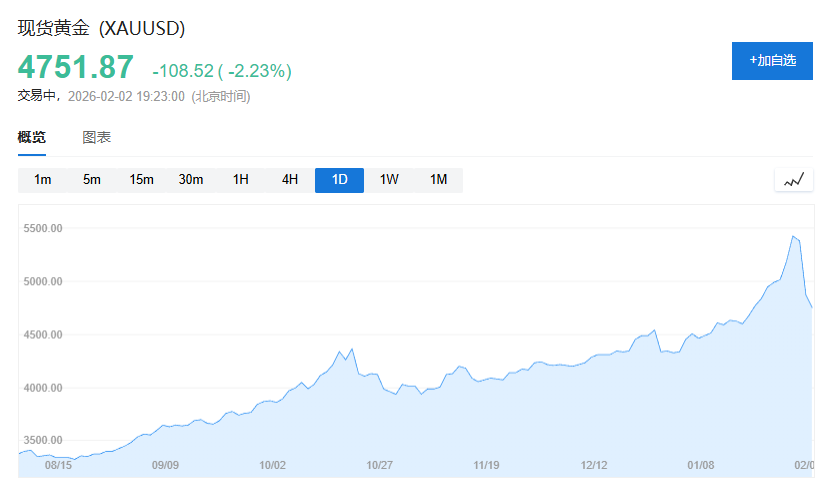
The gold market is experiencing its most extreme price volatility since the 2008 financial crisis, with its 30-day volatility surging to over 44%, surpassing even that of Bitcoin, which stands at around 39%. This marks a significant role reversal, as gold is typically viewed as a more stable safe-haven asset compared to the notoriously volatile cryptocurrency. The surge in gold's volatility follows a record-breaking rally driven by economic uncertainty, geopolitical risks, and strong investor inflows, including significant retail participation. However, the rapid ascent was followed by a sharp correction, with spot gold plunging nearly $1,000 in just two trading sessions. Meanwhile, Bitcoin has not benefited from the same factors driving gold's rally. Instead, it fell to a 10-month low, down more than 40% from its October peak. Despite the turbulence in traditional markets, Bitcoin has not seen a rotation of funds from gold, making gold the more volatile asset in the short term. Nevertheless, gold has significantly outperformed Bitcoin over the past 12 months, rising about 66% compared to Bitcoin’s 21% decline.

The gold market is experiencing its most intense price volatility since the 2008 financial crisis, with its volatility rate now surpassing that of Bitcoin—known for its wild swings—highlighting how this traditional safe-haven asset has entered a period of intense fluctuation after a rapid rally.

According to data compiled by Bloomberg, the 30-day volatility of gold has climbed to over 44%, the highest level since the 2008 financial crisis. This figure exceeds Bitcoin's volatility of around 39%, which is often referred to as "digital gold."

This marks an unusual role reversal. Gold is typically seen as a more stable store of value than cryptocurrencies, which are known for being susceptible to speculation. Since Bitcoin's inception 17 years ago, gold's volatility has exceeded Bitcoin's on only two occasions, the most recent being in May of last year when former U.S. President Donald Trump's tariff threats escalated trade tensions.

Safe-Haven Demand Drives Gold to Record Highs

Economic uncertainty has pushed precious metal prices to record highs that have stunned even seasoned market participants. Earlier this year, an already hot rally accelerated sharply, as investors flocked in due to renewed concerns over geopolitical risks, currency devaluation, and the Federal Reserve's independence. A wave of retail buying further inflated the market bubble.

Some traders say the previous rally had gone too far, too fast, followed by a dramatic reversal. In just two trading sessions, spot gold plummeted by as much as $1,000, briefly approaching the $4,400 mark.

Bitcoin has failed to benefit from the same forces driving gold higher. The token fell to a 10-month low on Monday, extending its weekend sell-off, with a cumulative decline of over 40% since its October peak. Despite facing geopolitical pressures, a weaker U.S. dollar, and extreme volatility in the metals market, Bitcoin has not seen a rotation of funds from precious metals, making gold the more volatile investment for now.

Nevertheless, gold maintains its status as the superior safe-haven asset. Over the past 12 months, gold has risen by about 66%, while Bitcoin has fallen by 21%.

Связанные с этим вопросы

QWhat is the 30-day volatility of gold and why is it significant?

AThe 30-day volatility of gold has climbed to over 44%, marking its highest level since the 2008 financial crisis. This is significant because it has surpassed the volatility of Bitcoin (around 39%), which is unusual as gold is considered a more stable store of value compared to the typically speculative cryptocurrency.

QHow does the current volatility of gold compare to Bitcoin's historical volatility?

AGold's current 30-day volatility of over 44% is higher than Bitcoin's volatility of about 39%. This represents a rare role reversal, as gold's volatility has only exceeded Bitcoin's twice since Bitcoin's inception 17 years ago, with the last occurrence being in May of last year due to trade tensions.

QWhat factors have driven gold prices to record highs recently?

AGold prices have been driven to record highs by economic uncertainty, including concerns over geopolitical risks, currency devaluation, and the Federal Reserve's independence. A surge in investor inflows, particularly from retail buyers, further accelerated the rally and created a market bubble.

QHow has Bitcoin performed compared to gold amid recent market volatility?

ABitcoin has underperformed compared to gold, falling to a 10-month low and declining over 40% from its October peak. Despite similar market pressures, it did not benefit from the same safe-haven demand that boosted gold, and no significant capital rotation from precious metals into Bitcoin occurred.

QWhat has been the 12-month performance difference between gold and Bitcoin?

AOver the past 12 months, gold has risen approximately 66%, while Bitcoin has fallen 21%, reinforcing gold's status as the superior safe-haven asset despite its recent increase in volatility.

Похожее

Google TPU Shipments Revised Up by 50%

Recent industry research indicates a significant upward revision in the shipments of Google's TPU (Tensor Processing Unit) chips. Previous expectations for 2027 were set at around 10 million units, but new estimates now point to 15 million units, a 50% increase. This substantial boost directly translates to higher demand across the entire supporting supply chain. Google's TPU clusters utilize a standardized all-optical interconnect architecture. Consequently, key hardware components are deeply integrated and scaled in fixed ratios with the chips. The 15 million TPU target will drive corresponding demand increases for NPO optical engines (roughly a 1:1 match), 1.6T optical modules, OCS optical switches, high-end server power supplies, fiber optics & MPO connectors, and liquid cooling solutions. Among these, liquid cooling is highlighted as the sector experiencing the most significant transformation and offering the most stable potential for excess returns. As next-generation TPU chips reach power levels where traditional air cooling is insufficient, liquid cooling becomes essential. 2026 is forecasted as the first year of substantial adoption for Google's liquid cooling solutions. This shift, coupled with delivery and capacity bottlenecks faced by incumbent overseas manufacturers, is creating a prime window for domestic Chinese suppliers to enter and secure Google's core supply chain. The market size for Google-specific liquid cooling is projected to potentially triple from a baseline of hundreds of billions to around 300 billion units by 2028. The logic for the fiber optic sector is also being rewritten. Once considered a cyclical commodity tied to telecom operator procurement, fiber is now a strategic and scarce resource for AI Data Centers (AIDC). A severe supply-demand imbalance, driven by the long lead time for preform production (18-24 months) and surging demand from cloud giants, is supporting strong performance. Chinese fiber manufacturers are well-positioned to capture a significant share of global AIDC demand, with exports potentially reaching 200-300 million core kilometers in 2026. Overall, the investment focus within the AI computing industry is shifting from pure "chip performance speculation" towards the more certain incremental growth in computing infrastructure and its supporting ecosystem. The upward revision in Google TPU shipments, along with the potential for further doubling by 2028, is seen as solidifying performance visibility for the entire supporting supply chain over the next two years.

marsbit30 мин. назад

Google TPU Shipments Revised Up by 50%

marsbit30 мин. назад

What Wall Street Really Wants After the Crypto Story Recedes

The tide of speculative crypto narratives has receded, revealing Wall Street's true objective: building a controlled, yield-generating, and compliant financial pipeline on distributed ledgers. They are migrating core functions onto blockchains, not for decentralization, but for efficiency and new revenue streams. Key developments include BlackRock's BUIDL fund, a tokenized treasury fund acting as a foundational reserve asset, and the rise of Securitize, which is going public and partnering with the NYSE to build a 24/7 digital securities trading and settlement system. This signals a major shift of securities clearing to blockchain technology. To make volatile assets like Bitcoin palatable for institutional investors, firms like BlackRock and Goldman Sachs are creating "covered call" ETFs (e.g., BITA). These products systematically sell options on Bitcoin holdings, transforming price volatility into stable monthly income, effectively repackaging crypto as a yield-bearing asset. Stablecoins are being positioned not as speculative tools but as efficient payment rails. Companies like Stripe and Mastercard are integrating them for instant, low-cost merchant settlements and cross-border card payments, respectively. Critically, new legislation like the GENIUS Act shapes them as non-interest-bearing, heavily regulated extensions of the US dollar system. In summary, Wall Street is quietly constructing a parallel, blockchain-based financial infrastructure featuring tokenized traditional assets, structured crypto yields, and programmable dollar pipelines—all under its control and fully integrated with existing regulatory and credit frameworks.

marsbit47 мин. назад

What Wall Street Really Wants After the Crypto Story Recedes

marsbit47 мин. назад

Tying Itself to SpaceX: Cursor's $60 Billion Rise

This article recounts the rapid rise of AI-powered coding startup Cursor and its 25-year-old MIT graduate CEO, Michael Truell. Launched in 2023, Cursor achieved explosive growth, reaching over 10 billion USD in revenue by late 2025. However, its journey highlights a central dilemma for AI application companies: dependence on foundational model providers. Cursor initially relied heavily on Anthropic's models but faced an existential threat when Anthropic launched its own competing coding tool, Claude Code. In response, Cursor declared an internal emergency in early 2026 and accelerated development of its own model, Composer. To secure the immense computing power needed, Truell struck a pivotal deal with Elon Musk's SpaceX in April 2026. The collaboration grants Cursor access to SpaceX's supercomputing resources for Composer, while SpaceX's Grok model benefits from Cursor's programming data. The agreement includes a potential 600 billion USD acquisition of Cursor by SpaceX later in the year, though a substantial termination fee is in place if the deal falls through. The story explores Cursor's intense, sometimes controversial hiring practices involving lengthy unpaid "work trials," its complex partnership-turned-rivalry with Anthropic, and its high-stakes gamble to ensure independence through the SpaceX alliance. The core question remains: will Cursor evolve into a defining, independent "generational" software company, or become a key piece in a tech giant's AI arsenal?

marsbit51 мин. назад

Tying Itself to SpaceX: Cursor's $60 Billion Rise

marsbit51 мин. назад

Warsh's Debut: Will the FED Chair Who Knows Crypto Best Bring Surprises or Shocks to the Market?

Kevin Warsh, the new Federal Reserve Chairman, prepares for his inaugural press conference amidst a challenging macroeconomic landscape: resurgent inflation, a bond market sell-off, and political pressure from President Trump for rate cuts. Uniquely, Warsh holds indirect investments in over 20 crypto and Web3 entities (e.g., Solana, dYdX), making him the first Fed Chair with disclosed crypto exposure. His stance may combine a hawkish, inflation-focused monetary policy with a crypto-friendly regulatory philosophy that shifts from Powell’s “same risk, same rule” approach toward a framework acknowledging blockchain’s productivity value. Warsh’s leadership could impact crypto markets across three dimensions: a paradigm shift in regulation (potentially accelerating pro-innovation legislation and stable币 rules), a re-pricing of risk premiums based on clearer communication and his view of AI as a structural disinflationary force, and a long-term reallocation of global institutional capital driven by increased legitimacy. Two potential scenarios for the press conference are outlined. A “positive surprise” would involve a dovish-leaning tone on rates coupled with signals of regulatory openness, potentially boosting crypto asset valuations. Conversely, a “negative shock” would see a more hawkish-than-expected stance on inflation and rates, triggering a broad risk-asset selloff that crypto markets would not escape. While ethics rules required Warsh to divest his crypto holdings upon confirmation, his deep understanding of the technology may fundamentally lower policy uncertainty and build a more receptive long-term foundation for digital assets’ integration into the mainstream financial system.

marsbit11 ч. назад

Warsh's Debut: Will the FED Chair Who Knows Crypto Best Bring Surprises or Shocks to the Market?

marsbit11 ч. назад

Торговля

Спот
Фьючерсы

Популярные статьи

Тест по Bitcoin Биткоина

HTX Learn: Изучите Bitcoin halving и Заработаете Токены USDT

3.1k просмотров всегоОпубликовано 2024.04.16Обновлено 2024.04.16

Тест по Bitcoin  Биткоина

Что такое $BITCOIN

ЦИФРОВОЕ ЗОЛОТО ($BITCOIN): Комплексный анализ Введение в ЦИФРОВОЕ ЗОЛОТО ($BITCOIN) ЦИФРОВОЕ ЗОЛОТО ($BITCOIN) — это проект на основе блокчейна, работающий в сети Solana, который стремится объединить характеристики традиционных драгоценных металлов с инновациями децентрализованных технологий. Хотя он носит имя Биткойн, часто называемого “цифровым золотом” из-за его восприятия как средства хранения ценности, ЦИФРОВОЕ ЗОЛОТО является отдельным токеном, предназначенным для создания уникальной экосистемы в ландшафте Web3. Его цель — позиционировать себя как жизнеспособный альтернативный цифровой актив, хотя детали его применения и функциональности все еще развиваются. Что такое ЦИФРОВОЕ ЗОЛОТО ($BITCOIN)? ЦИФРОВОЕ ЗОЛОТО ($BITCOIN) — это токен криптовалюты, специально разработанный для использования в блокчейне Solana. В отличие от Биткойна, который выполняет широко признанную роль хранения ценности, этот токен, похоже, сосредоточен на более широких приложениях и характеристиках. Примечательные аспекты включают: Инфраструктура блокчейна: Токен построен на блокчейне Solana, известном своей способностью обрабатывать высокоскоростные и недорогие транзакции. Динамика предложения: ЦИФРОВОЕ ЗОЛОТО имеет максимальное предложение, ограниченное 100 квадриллионами токенов (100P $BITCOIN), хотя детали о его обращающемся предложении в настоящее время не раскрыты. Утилита: Хотя точные функциональные возможности не описаны, есть указания на то, что токен может быть использован для различных приложений, потенциально связанных с децентрализованными приложениями (dApps) или стратегиями токенизации активов. Кто создатель ЦИФРОВОГО ЗОЛОТА ($BITCOIN)? На данный момент личность создателей и команды разработчиков, стоящих за ЦИФРОВЫМ ЗОЛОТОМ ($BITCOIN), остается неизвестной. Эта ситуация типична для многих инновационных проектов в области блокчейна, особенно тех, которые связаны с децентрализованными финансами и феноменом мем-криптовалют. Хотя такая анонимность может способствовать культуре, ориентированной на сообщество, она усиливает опасения по поводу управления и ответственности. Кто инвесторы ЦИФРОВОГО ЗОЛОТА ($BITCOIN)? Доступная информация указывает на то, что у ЦИФРОВОГО ЗОЛОТА ($BITCOIN) нет известных институциональных спонсоров или значительных венчурных капиталовложений. Проект, похоже, функционирует по модели пирингового взаимодействия, сосредоточенной на поддержке и принятии сообществом, а не на традиционных путях финансирования. Его активность и ликвидность в основном сосредоточены на децентрализованных биржах (DEX), таких как PumpSwap, а не на устоявшихся централизованных торговых платформах, что еще больше подчеркивает его подход, ориентированный на grassroots. Как работает ЦИФРОВОЕ ЗОЛОТО ($BITCOIN) Операционные механизмы ЦИФРОВОГО ЗОЛОТА ($BITCOIN) можно подробно описать на основе его дизайна блокчейна и характеристик сети: Механизм консенсуса: Используя уникальный механизм доказательства истории (PoH) Solana в сочетании с моделью доказательства доли (PoS), проект обеспечивает эффективную валидацию транзакций, что способствует высокой производительности сети. Токеномика: Хотя конкретные дефляционные механизмы не были подробно описаны, большое максимальное предложение токенов подразумевает, что оно может быть предназначено для микротранзакций или нишевых случаев использования, которые еще предстоит определить. Интероперабельность: Существует потенциал для интеграции с более широкой экосистемой Solana, включая различные платформы децентрализованных финансов (DeFi). Однако детали относительно конкретных интеграций остаются неуточненными. Хронология ключевых событий Вот хронология, которая подчеркивает значимые вехи, касающиеся ЦИФРОВОГО ЗОЛОТА ($BITCOIN): 2023: Первоначальное развертывание токена происходит в блокчейне Solana, отмеченное его адресом контракта. 2024: ЦИФРОВОЕ ЗОЛОТО приобретает видимость, когда оно становится доступным для торговли на децентрализованных биржах, таких как PumpSwap, позволяя пользователям обменивать его на SOL. 2025: Проект наблюдает спорадическую торговую активность и потенциальный интерес к инициативам, возглавляемым сообществом, хотя на данный момент не зафиксировано никаких значительных партнерств или технических достижений. Критический анализ Сильные стороны Масштабируемость: Основная инфраструктура Solana поддерживает высокие объемы транзакций, что может повысить полезность $BITCOIN в различных сценариях транзакций. Доступность: Потенциально низкая цена торговли за токен может привлечь розничных инвесторов, способствуя более широкому участию благодаря возможностям дробного владения. Риски Отсутствие прозрачности: Отсутствие публично известных спонсоров, разработчиков или процесса аудита может вызвать скептицизм относительно устойчивости и надежности проекта. Волатильность рынка: Торговая активность сильно зависит от спекулятивного поведения, что может привести к значительной волатильности цен и неопределенности для инвесторов. Заключение ЦИФРОВОЕ ЗОЛОТО ($BITCOIN) является интригующим, но неоднозначным проектом в быстро развивающейся экосистеме Solana. Хотя он пытается использовать нарратив “цифрового золота”, его отход от установленной роли Биткойна как средства хранения ценности подчеркивает необходимость более четкого различения его предполагаемой утилиты и структуры управления. Будущее принятие и усвоение, вероятно, будут зависеть от решения текущей непрозрачности и более четкого определения его операционных и экономических стратегий. Примечание: Этот отчет охватывает синтезированную информацию, доступную на октябрь 2023 года, и с тех пор могут произойти события.

104 просмотров всегоОпубликовано 2025.05.13Обновлено 2025.05.13
Что такое $BITCOIN

Fractal Bitcoin: масштабирование Биткоина с помощью рекурсивной системы

Fractal Bitcoin — масштабное Layer-1-решнение, созданное на базе кода Биткоина, позволяющего достигать бесконечного масштабирования с помощью рекурсивного подхода.

2.3k просмотров всегоОпубликовано 2025.06.30Обновлено 2025.06.30

Fractal Bitcoin: масштабирование Биткоина с помощью рекурсивной системы

Обсуждения

Добро пожаловать в Сообщество HTX. Здесь вы сможете быть в курсе последних новостей о развитии платформы и получить доступ к профессиональной аналитической информации о рынке. Мнения пользователей о цене на BTC (BTC) представлены ниже.

活动图片