Pro-XRP Lawyer Deaton Claims JPMorgan Is Manipulating Bitcoin, Just Like Silver

bitcoinistОпубликовано 2026-02-05Обновлено 2026-02-05

Введение

Pro-XRP lawyer John Deaton accuses JPMorgan and CEO Jamie Dimon of manipulating Bitcoin's price using futures markets, similar to alleged past suppression of silver. He claims heavy shorting in paper markets is stifling Bitcoin's price action despite strong physical demand and favorable macro conditions. Deaton argues this is a coordinated effort by traditional banks to control the "Digital Gold" narrative and slow crypto adoption. The allegation follows JPMorgan's 2020 $920 million settlement for manipulative practices in precious metals futures. Meanwhile, silver recently experienced extreme volatility, dropping sharply from record highs, with rumors alleging JPMorgan's trading involvement. XRP trades at $1.43.

John E. Deaton, a pro-XRP attorney who has become a prominent voice in US crypto policy circles, is alleging that large banks, naming JPMorgan and CEO Jamie Dimon, are using “paper markets” to suppress bitcoin’s price, arguing the setup resembles past precious-metals playbooks where heavy futures positioning allegedly muted spot-market signals.

Deaton’s comments followed a widely shared remark from Galaxy Digital CEO Mike Novogratz, who told Bloomberg that “Bitcoin was not supposed to act like this. Something went wrong. I think we’re getting close to the bottom, but we’ll see.” Deaton framed the disconnect as especially notable given what he called supportive macro tailwinds and a friendlier political backdrop for crypto.

Are Bitcoin, XRP And Altcoins Manipulated?

“Novogratz is right — the math isn’t mathing,” Deaton wrote on X. “When gold hits all-time highs and Bitcoin stalls despite the same macro tailwinds + a very friendly crypto administration — you have to look at the paper markets. We’ve seen this movie before with Silver — heavy shorting via futures can suppress price action even when physical demand is through the roof.”

He pushed the argument further, casting the moment as a structural shift rather than a temporary market quirk. “I believe we are seeing the same bank playbook being run on BTC. I also believe we are watching the Financialization of Bitcoin and Crypto in real-time,” Deaton said.

“The same players who spent years suppressing Silver prices with paper contracts are now using the same tools on BTC and other crypto assets. It’s not a failure of the tech — it’s a coordinated effort by the old guard to keep the Digital Gold narrative in a cage.”

Deaton also tied market-structure claims to the policy fight in Washington, pointing to a widening rift between large banks and crypto-native firms. “We see the old guard — JPMorgan and Jamie Dimon — publicly attacking the new guard — Coinbase and Brian Armstrong,” he wrote, arguing banks were simultaneously lobbying to slow crypto legislation while applying similar leverage in derivatives markets.

While Deaton’s bitcoin claim is an allegation, JPMorgan has faced major penalties tied to manipulative conduct in precious-metals futures.

In September 2020, the US Commodity Futures Trading Commission ordered JPMorgan Chase & Co. and subsidiaries to pay $920.2 million (including $311.7 million in restitution, $172.0 million in disgorgement, and a $436.4 million civil monetary penalty) for manipulative and deceptive conduct and spoofing in precious metals and US Treasury futures that the CFTC said spanned “at least eight years.”

The Department of Justice, in a parallel resolution, said JPMorgan entered into a deferred prosecution agreement tied to two wire-fraud counts and paid more than $920 million in combined penalties, disgorgement, and victim compensation. DOJ court documents described the precious-metals scheme as occurring roughly between March 2008 and August 2016, involving unlawful trading in markets including gold and silver futures.

Deaton’s post lands as silver itself has been violently repriced. Spot silver hit a record $121.64 on Jan.29 before sliding sharply down to around $73.575 on February 5, 2026. The current rumor making the rounds on X is simple: JPMorgan opened large shorts around the $120 top, then covered into the slide near $78 as delivery hit.

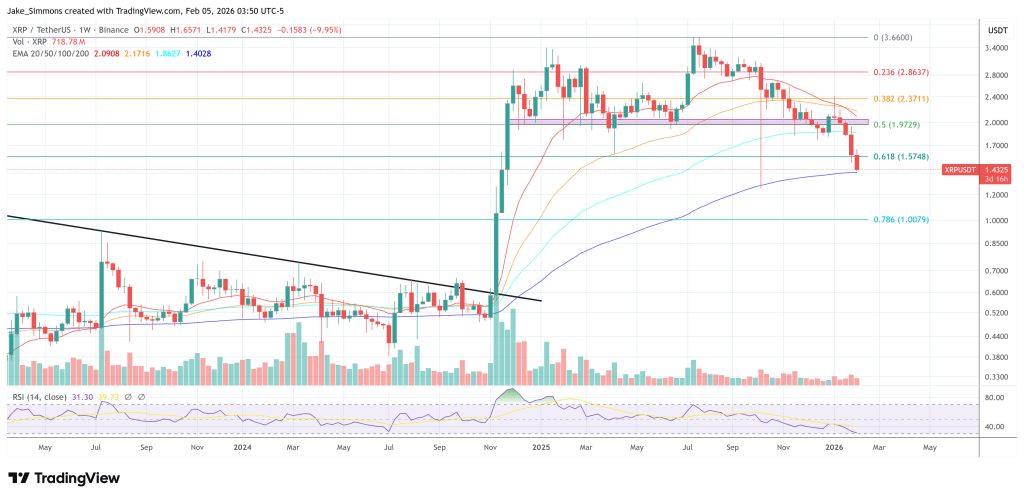
At press time, XRP traded at $1.43.

XRP falls to the 200-week EMA, 1-week chart | Source: XRPUSDT on TradingView.com

Связанные с этим вопросы

QWhat is the main allegation made by pro-XRP lawyer John Deaton against JPMorgan in the cryptocurrency market?

AJohn Deaton alleges that JPMorgan and other large banks are using 'paper markets' and heavy shorting via futures contracts to suppress the price of Bitcoin, similar to their past manipulative conduct in precious metals like silver.

QAccording to the article, what historical precedent does Deaton cite to support his claim of market manipulation?

ADeaton cites the historical precedent of JPMorgan's manipulative and deceptive conduct in precious-metals futures, for which the bank was ordered to pay over $920 million in penalties by the CFTC and DOJ for spoofing and wire fraud spanning at least eight years.

QHow does Mike Novogratz's comment about Bitcoin's price action relate to Deaton's argument?

AMike Novogratz remarked that 'Bitcoin was not supposed to act like this' and that 'something went wrong,' which Deaton used to frame the disconnect between supportive macro tailwinds and Bitcoin's stalled price, arguing it points to manipulation in the paper markets.

QWhat does Deaton mean by the 'Financialization of Bitcoin and Crypto' and who does he blame for it?

ADeaton means that traditional financial players, specifically naming JPMorgan and Jamie Dimon as the 'old guard,' are using derivatives and futures markets to exert control and suppress prices, which he calls a coordinated effort to keep the 'Digital Gold narrative in a cage.'

QWhat specific event in the silver market is mentioned as a current rumor on social media platform X?

AThe current rumor on X is that JPMorgan opened large short positions in silver around its record high of $121.64 and then covered those shorts during the sharp price slide down to around $73.575, profiting from the manipulation.

Похожее

Understanding Hash in One Article: The "Browser Miner" on Ethereum

Hash is an Ethereum-based ERC-20 token described as a "browser-minable post-quantum token." Its key features include enabling browser-based GPU mining without specialized hardware, a fixed supply cap of 21 million tokens, immutable and permissionless smart contracts with no team allocation or pre-mining, and an emphasis on post-quantum security using Keccak256 hashing. The mining mechanism is a simplified on-chain proof-of-work where miners solve unique challenges tied to their wallet address. Key design elements prevent answer theft, with epochs resetting every 100 blocks (~20 minutes) and a per-block minting limit. Emission follows a Bitcoin-like halving schedule every 100,000 mints, starting at 100 tokens per mint. Projections suggest all tokens could be mined within approximately 294 days if a target rate of one mint per minute is sustained. Hash emphasizes "post-quantum" security by leveraging hash-based primitives like Keccak256, which are considered more resistant to quantum attacks compared to elliptic-curve cryptography. While not a fully post-quantum asset, it aligns with Ethereum's broader post-quantum research narrative. The project completed its Genesis sale at $0.03 and began trading on Uniswap, with its price reaching around $0.19. The initial circulating supply is small, with 5% sold in Genesis and 5% allocated to liquidity. The majority (47.6% of total supply) is allocated to early-stage mining, leading to a front-loaded emission schedule. This structure, combined with low initial liquidity, makes Hash a high-volatility, high-risk project dependent on sustained miner participation and market demand to absorb new supply.

marsbit1 мин. назад

Understanding Hash in One Article: The "Browser Miner" on Ethereum

marsbit1 мин. назад

OpenAI's Largest Internal Wealth Creation: 600 People Cash Out a Total of $6.6 Billion, 75 Take Home the Maximum $30 Million Each

A Wall Street Journal report reveals OpenAI's unprecedented pre-IPO wealth creation. In a single employee stock sale last October, over 600 current and former employees sold shares, collectively cashing out approximately $6.6 billion. Due to high investor demand, the company tripled the individual sale cap to $30 million, with about 75 employees selling the maximum amount. This event represents the largest such transaction in tech industry history for a private company. OpenAI's valuation was $500 billion for this tender offer. Employees with over two years of tenure were eligible, allowing many post-ChatGPT hires their first liquidity event. The company's stock has reportedly grown over 100-fold in seven years. Following a restructuring, employees collectively hold about 26% of OpenAI. The scale of executive wealth is also staggering. In court testimony related to Elon Musk's lawsuit, President and co-founder Greg Brockman confirmed his OpenAI stake is worth around $30 billion. Analysis indicates about 165 current and former employees hold a combined ~$164.9 billion in equity, averaging nearly $1 billion per person in paper wealth. OpenAI's per-employee stock-based compensation is estimated to be 34 times the average of major tech firms before their IPOs. OpenAI continues its rapid ascent, closing a $122 billion funding round at an $852 billion valuation in March. With monthly revenue hitting $2 billion, over 900 million weekly ChatGPT users, and plans for a potential trillion-dollar IPO in late 2026, this wealth-creation engine shows no signs of stopping.

链捕手24 мин. назад

OpenAI's Largest Internal Wealth Creation: 600 People Cash Out a Total of $6.6 Billion, 75 Take Home the Maximum $30 Million Each

链捕手24 мин. назад

Understanding CPO (Co-Packaged Optics) in One Article: Why Nvidia Is Willing to Spend $3.2 Billion on a Fiber?

NVIDIA and Corning announced a multi-year strategic partnership on May 6, 2026, with NVIDIA committing up to $3.2 billion to support Corning's U.S. expansion. This investment will triple Corning's manufacturing plants and significantly boost its optical fiber and communications production capacity. The core driver behind this massive investment is the fundamental shift from copper to optical interconnect technology within AI data centers. As GPU clusters scale, copper wires face critical limitations: severe signal attenuation over distance, high energy consumption for signal integrity, and excessive heat generation. Optical fiber, transmitting light instead of electrical signals, solves these issues with minimal loss, near-light speed, and lower power needs. The article outlines a three-stage evolution of data center interconnect: 1. **Traditional Copper Interconnects:** The mainstream solution of the 2010s, now being phased out due to scaling bottlenecks. 2. **Pluggable Optical Modules:** The current mainstream, where modules convert electrical signals to light externally. This process still introduces energy loss and latency. 3. **CPO (Co-Packaged Optics):** The next-generation technology where the optical engine is integrated directly with the GPU chip package. This drastically reduces the electrical signal travel distance to mere millimeters, slashing power consumption and latency while boosting data density. NVIDIA CEO Jensen Huang has identified CPO as an essential core technology for AI infrastructure. NVIDIA's investment signifies a strategic shift from being a buyer to actively controlling its supply chain for critical components. With demand for specialized optical fiber far outstripping supply—evidenced by soaring prices—securing long-term manufacturing capacity has become a competitive necessity. While Corning's expansion may pressure some suppliers, a projected global fiber supply gap of 5-15% over the next few years creates a significant opportunity window, particularly for Chinese manufacturers competitive in optical preforms, chips, and modules. Ultimately, NVIDIA's move is not about chasing a trend but an engineering imperative. The transition to light-based interconnects like CPO is driven by the physical limits of copper, marking a definitive step in the ongoing AI computing revolution.

marsbit49 мин. назад

Understanding CPO (Co-Packaged Optics) in One Article: Why Nvidia Is Willing to Spend $3.2 Billion on a Fiber?

marsbit49 мин. назад

Торговля

Спот
Фьючерсы

Популярные статьи

Тест по Bitcoin Биткоина

HTX Learn: Изучите Bitcoin halving и Заработаете Токены USDT

3.0k просмотров всегоОпубликовано 2024.04.16Обновлено 2024.04.16

Тест по Bitcoin  Биткоина

Что такое $BITCOIN

ЦИФРОВОЕ ЗОЛОТО ($BITCOIN): Комплексный анализ Введение в ЦИФРОВОЕ ЗОЛОТО ($BITCOIN) ЦИФРОВОЕ ЗОЛОТО ($BITCOIN) — это проект на основе блокчейна, работающий в сети Solana, который стремится объединить характеристики традиционных драгоценных металлов с инновациями децентрализованных технологий. Хотя он носит имя Биткойн, часто называемого “цифровым золотом” из-за его восприятия как средства хранения ценности, ЦИФРОВОЕ ЗОЛОТО является отдельным токеном, предназначенным для создания уникальной экосистемы в ландшафте Web3. Его цель — позиционировать себя как жизнеспособный альтернативный цифровой актив, хотя детали его применения и функциональности все еще развиваются. Что такое ЦИФРОВОЕ ЗОЛОТО ($BITCOIN)? ЦИФРОВОЕ ЗОЛОТО ($BITCOIN) — это токен криптовалюты, специально разработанный для использования в блокчейне Solana. В отличие от Биткойна, который выполняет широко признанную роль хранения ценности, этот токен, похоже, сосредоточен на более широких приложениях и характеристиках. Примечательные аспекты включают: Инфраструктура блокчейна: Токен построен на блокчейне Solana, известном своей способностью обрабатывать высокоскоростные и недорогие транзакции. Динамика предложения: ЦИФРОВОЕ ЗОЛОТО имеет максимальное предложение, ограниченное 100 квадриллионами токенов (100P $BITCOIN), хотя детали о его обращающемся предложении в настоящее время не раскрыты. Утилита: Хотя точные функциональные возможности не описаны, есть указания на то, что токен может быть использован для различных приложений, потенциально связанных с децентрализованными приложениями (dApps) или стратегиями токенизации активов. Кто создатель ЦИФРОВОГО ЗОЛОТА ($BITCOIN)? На данный момент личность создателей и команды разработчиков, стоящих за ЦИФРОВЫМ ЗОЛОТОМ ($BITCOIN), остается неизвестной. Эта ситуация типична для многих инновационных проектов в области блокчейна, особенно тех, которые связаны с децентрализованными финансами и феноменом мем-криптовалют. Хотя такая анонимность может способствовать культуре, ориентированной на сообщество, она усиливает опасения по поводу управления и ответственности. Кто инвесторы ЦИФРОВОГО ЗОЛОТА ($BITCOIN)? Доступная информация указывает на то, что у ЦИФРОВОГО ЗОЛОТА ($BITCOIN) нет известных институциональных спонсоров или значительных венчурных капиталовложений. Проект, похоже, функционирует по модели пирингового взаимодействия, сосредоточенной на поддержке и принятии сообществом, а не на традиционных путях финансирования. Его активность и ликвидность в основном сосредоточены на децентрализованных биржах (DEX), таких как PumpSwap, а не на устоявшихся централизованных торговых платформах, что еще больше подчеркивает его подход, ориентированный на grassroots. Как работает ЦИФРОВОЕ ЗОЛОТО ($BITCOIN) Операционные механизмы ЦИФРОВОГО ЗОЛОТА ($BITCOIN) можно подробно описать на основе его дизайна блокчейна и характеристик сети: Механизм консенсуса: Используя уникальный механизм доказательства истории (PoH) Solana в сочетании с моделью доказательства доли (PoS), проект обеспечивает эффективную валидацию транзакций, что способствует высокой производительности сети. Токеномика: Хотя конкретные дефляционные механизмы не были подробно описаны, большое максимальное предложение токенов подразумевает, что оно может быть предназначено для микротранзакций или нишевых случаев использования, которые еще предстоит определить. Интероперабельность: Существует потенциал для интеграции с более широкой экосистемой Solana, включая различные платформы децентрализованных финансов (DeFi). Однако детали относительно конкретных интеграций остаются неуточненными. Хронология ключевых событий Вот хронология, которая подчеркивает значимые вехи, касающиеся ЦИФРОВОГО ЗОЛОТА ($BITCOIN): 2023: Первоначальное развертывание токена происходит в блокчейне Solana, отмеченное его адресом контракта. 2024: ЦИФРОВОЕ ЗОЛОТО приобретает видимость, когда оно становится доступным для торговли на децентрализованных биржах, таких как PumpSwap, позволяя пользователям обменивать его на SOL. 2025: Проект наблюдает спорадическую торговую активность и потенциальный интерес к инициативам, возглавляемым сообществом, хотя на данный момент не зафиксировано никаких значительных партнерств или технических достижений. Критический анализ Сильные стороны Масштабируемость: Основная инфраструктура Solana поддерживает высокие объемы транзакций, что может повысить полезность $BITCOIN в различных сценариях транзакций. Доступность: Потенциально низкая цена торговли за токен может привлечь розничных инвесторов, способствуя более широкому участию благодаря возможностям дробного владения. Риски Отсутствие прозрачности: Отсутствие публично известных спонсоров, разработчиков или процесса аудита может вызвать скептицизм относительно устойчивости и надежности проекта. Волатильность рынка: Торговая активность сильно зависит от спекулятивного поведения, что может привести к значительной волатильности цен и неопределенности для инвесторов. Заключение ЦИФРОВОЕ ЗОЛОТО ($BITCOIN) является интригующим, но неоднозначным проектом в быстро развивающейся экосистеме Solana. Хотя он пытается использовать нарратив “цифрового золота”, его отход от установленной роли Биткойна как средства хранения ценности подчеркивает необходимость более четкого различения его предполагаемой утилиты и структуры управления. Будущее принятие и усвоение, вероятно, будут зависеть от решения текущей непрозрачности и более четкого определения его операционных и экономических стратегий. Примечание: Этот отчет охватывает синтезированную информацию, доступную на октябрь 2023 года, и с тех пор могут произойти события.

99 просмотров всегоОпубликовано 2025.05.13Обновлено 2025.05.13

Что такое $BITCOIN

Fractal Bitcoin: масштабирование Биткоина с помощью рекурсивной системы

Fractal Bitcoin — масштабное Layer-1-решнение, созданное на базе кода Биткоина, позволяющего достигать бесконечного масштабирования с помощью рекурсивного подхода.

2.2k просмотров всегоОпубликовано 2025.06.30Обновлено 2025.06.30

Fractal Bitcoin: масштабирование Биткоина с помощью рекурсивной системы

Обсуждения

Добро пожаловать в Сообщество HTX. Здесь вы сможете быть в курсе последних новостей о развитии платформы и получить доступ к профессиональной аналитической информации о рынке. Мнения пользователей о цене на BTC (BTC) представлены ниже.

活动图片