Iran Launches Bitcoin-Based Maritime Insurance Platform 'HormuzSafe', Claims Annual Revenue Could Exceed $100 Billion

marsbitОпубликовано 2026-05-20Обновлено 2026-05-20

Введение

Iran has launched "HormuzSafe," a Bitcoin-based maritime insurance platform for shipping through the Strait of Hormuz, aiming for potential annual revenue exceeding $10 billion. The platform, announced by Iranian semi-official media, offers "cryptographically verifiable insurance policies" settled in Bitcoin for Iranian shippers and cargo owners. However, its operational status is unconfirmed, and analysts highlight significant challenges including Bitcoin's price volatility, risks of violating U.S. sanctions, and the controversial background of some involved figures. This initiative is part of Iran's broader strategy to institutionalize control over the critical waterway—which handles roughly 20% of global seaborne oil trade—following its closure after U.S.-Israel airstrikes in late February. Iran has also established the Persian Gulf Strait Authority (PGSA) to manage traffic and fees. While positioning Bitcoin as a sanctions-resistant settlement layer, the platform faces skepticism regarding its technical feasibility, user adoption, and the potential for it to be confused with existing crypto-related shipping scams.

Shenchao Digest: Iran's Ministry of Economy has launched a Bitcoin-settled maritime insurance platform called 'Hormuz Safe', targeting Iranian shipowners and cargo owners transiting the Strait of Hormuz with 'cryptographically verifiable insurance policies'. Iranian state media claims the platform could generate over $100 billion in annual revenue.

However, independent verification of whether the platform is actually operational has not been obtained. Its feasibility faces severe challenges due to Bitcoin's high volatility, compliance risks from US sanctions, and the controversial background of its alleged backer, Babak Zanjani. This represents Iran's most prominent attempt to convert its military control over the Strait of Hormuz into a crypto-financial product.

Iran is attempting to turn one of the world's most critical maritime chokepoints into a Bitcoin-settled insurance market.

According to a Bloomberg report on May 18, Iran's semi-official Fars news agency, citing documents from the country's Ministry of Economic Affairs and Finance, reported that Iran has launched a Bitcoin-backed maritime insurance service named 'Hormuz Safe' for Iranian shipping companies and cargo owners wishing to pass through the Strait of Hormuz.

Fars stated that the plan could generate over $100 billion in revenue for Iran but did not provide a timeframe or operational details.

Since the US and Israeli airstrikes on Iran on February 28, Iran has effectively closed the Strait of Hormuz. In peacetime, the strait handles about 20% of global seaborne oil trade and 20% of liquefied natural gas exports.

The Iranian government and the Islamic Revolutionary Guard Corps (IRGC) have since sought to formalize control over the waterway, including charging tolls and other fees. The insurance service is the latest link in its chain of revenue-generating tools.

Crypto-Verified Policies, Bitcoin Instant Settlement

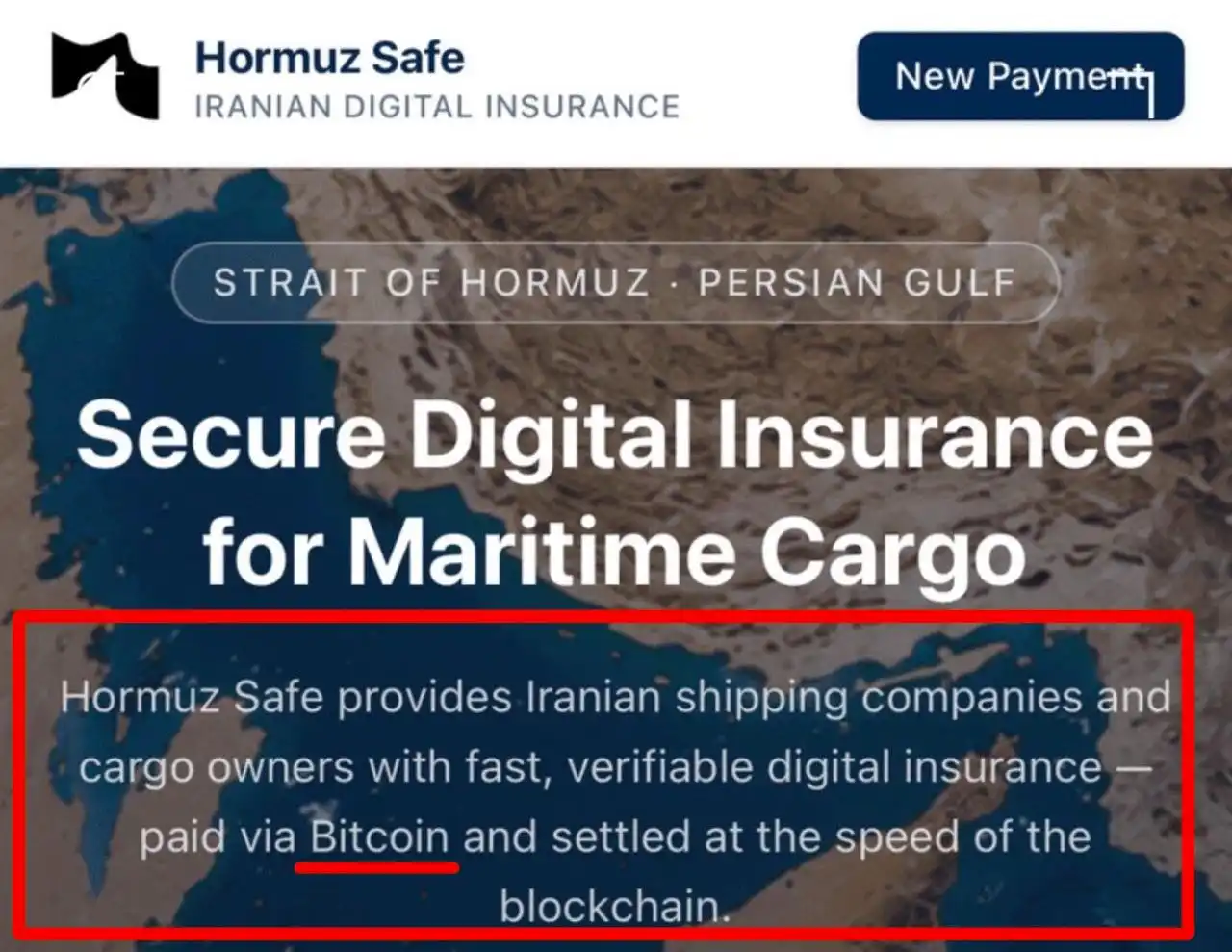
According to a screenshot of the 'Hormuz Safe' website shared by Fars, the platform claims to provide Iranian shipping companies and cargo owners with 'fast, verifiable digital insurance'. As reported by Bitcoin Magazine, coverage includes risks such as vessel inspection, seizure, and confiscation, but war damage claims are excluded.

Fars quoted the description from the website hormuzsafe.ir, stating that the platform will provide 'cryptographically verifiable insurance policies' for cargo transiting the Persian Gulf, the Strait of Hormuz, and surrounding waters, with payments settled in Bitcoin. Coverage begins the moment the cargo is confirmed on the blockchain, and the cargo owner will receive a signed receipt. The website currently appears inaccessible outside Iran.

According to Bitcoin Magazine, Iran's Ministry of Economy began advancing this insurance plan from late April (early Ordibehesht in the Persian calendar). In April, Hamid Hosseini, spokesman for the Iranian Oil, Gas, and Petrochemical Products Exporters Union, told the Financial Times that shipping companies could settle Strait of Hormuz passage fees using non-dollar currencies like Bitcoin or Chinese Yuan.

Accelerating Institutionalization: From Tolls to Insurance Platform

Hormuz Safe is not an isolated move but the latest component of an entire institutional framework Iran is building around the Strait of Hormuz.

According to Bitcoin Magazine, in March 2026, the Iranian parliament passed the 'Strait of Hormuz Management Plan', formalizing into law the toll system operated by the IRGC since mid-March. Under this framework, the IRGC charges fees to ships passing through the strait; operators must submit information on vessel ownership, cargo type, destination, and crew to obtain a passage permit code.

Fees start at about $1 per barrel of oil, with fully loaded oil tankers facing charges up to $2 million, payable in Chinese Yuan.

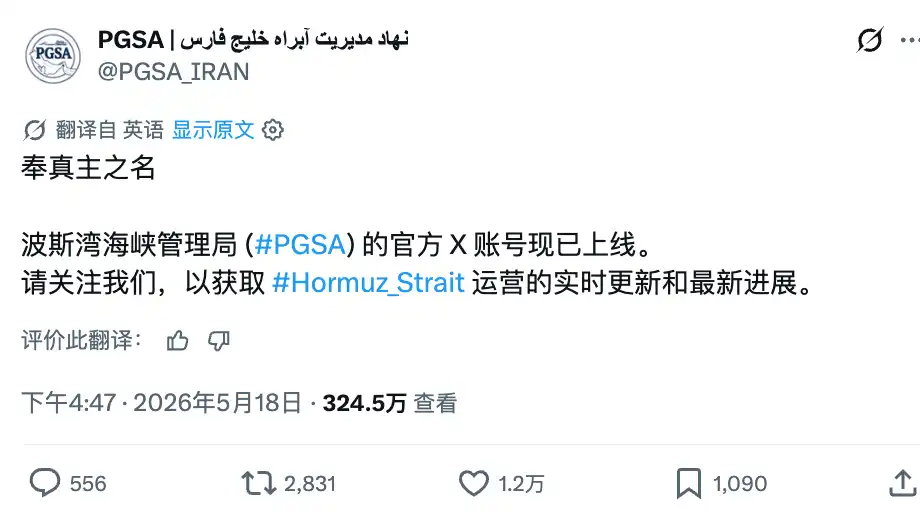
On May 18, Iran's Supreme National Security Council announced the formal establishment of the 'Persian Gulf Strait Authority' (PGSA) and opened an official account on X.

According to Euronews, the agency is positioned as an administrative entity to manage Strait of Hormuz traffic and collect tolls, operating in coordination with the IRGC Navy.

Ships must submit complete information, including ownership, insurance, crew lists, cargo declarations, and planned routes, via the PGSA's official email for approval and payment before receiving passage permits.

Ebrahim Azizi, chairman of the National Security and Foreign Policy Committee of the Iranian parliament, stated on X that only commercial vessels cooperating with Iran will benefit from this mechanism, and parties involved in US-Israeli military operations will be banned from using the route.

According to Windward intelligence analysis, as of May 18, strait traffic remains only about 38% of pre-conflict levels, with central Qeshm-Larak anchorage showing fixed dark vessel positioning for six consecutive days. Approximately 369 IRGC fast boats are concentrated in a single area about 30 nautical miles northeast of Khasab, shifting from coastal patrols to a presence in the main body of the strait.

Volatility, Sanctions Risks, and Shadow of Fraud

Several analysts have expressed skepticism about the practical feasibility of Hormuz Safe.

Bloomberg points out that, unlike stablecoins pegged to the US dollar, Bitcoin's price is highly volatile, limiting its adoption as a payment method. Foreign shipowners may be reluctant to use the mechanism for fear of violating US sanctions against Iran.

Ryan Yoon, senior analyst at Tiger Research, told Decrypt that the platform's technical and legal feasibility is 'highly questionable'; despite the announcement of its launch, no actual users have been confirmed. Shipping companies using Hormuz Safe would face the risk of 'immediate expulsion from the global financial system'.

Cake Wallet CEO Vikrant Sharma told BeInCrypto that Bitcoin can reduce some payment friction but is not a clean path to bypass the sanctions system. Liquidity at the scale of maritime insurance is a limiting factor. Activity on public blockchains can be monitored, and any exchange, broker, custodian, or counterparty tied to the US dollar brings compliance risks.

Sam Lyman, Research Director at the Bitcoin Policy Institute, explained Iran's logic from another angle: Bitcoin's core appeal lies in the fact that 'no one can freeze it'.

According to Decrypt, since the war began, crypto 'safe passage fee' scams have proliferated. Scammers impersonate Iranian authorities, demanding Bitcoin or USDT from ship operators. Hormuz Safe appears to be an independent national-level plan, but the line between genuine and fake is extremely blurred in the current environment.

The Bigger Picture: Iran Building a De-dollarized Maritime Financial System

According to Bitcoin Magazine data, Iran's crypto ecosystem was estimated at $7.8 billion in 2025, with IRGC-linked transactions accounting for about 50% of the country's total crypto volume (as of Q4 2025). The Iranian government has reportedly used mined Bitcoin to fund imports and hedge against oil revenue losses, with a stated national mining cost of about $1,300 per coin.

CoinDesk's analysis was quite precise: an insurance structure is more sophisticated than directly charging tolls. On paper, cargo owners are not paying for passage but purchasing insurance and financial responsibility certificates for sailing in waters that Tehran claims it can secure. This allows Iran to monetize its geographical advantage in a more palatable way.

A comment by Hacker News user everdrive received high votes in the tech community: The post-WWII US-led world order was partly built on the premise that the US military kept international waters open. Iran challenging the US at this level is astonishing. Everyone knew Iran had the capacity to close the strait if backed into a corner, but the arrival of this outcome still exposes serious policy-level miscalculations.

Regardless of whether Hormuz Safe ultimately operates at scale, the signal it sends is clear: Iran is building a complete set of administrative governance and financial infrastructure around the Strait of Hormuz, converting military blockade into a sustainable sovereign revenue mechanism, with Bitcoin serving as the settlement layer for this system.

Связанные с этим вопросы

QWhat is 'Hormuz Safe' and what is its primary purpose?

A'Hormuz Safe' is a Bitcoin-based maritime insurance platform launched by Iran's Ministry of Economy. Its primary purpose is to offer 'cryptographically verifiable insurance policies' to Iranian shipping companies and cargo owners for voyages passing through the Strait of Hormuz, with settlements to be made in Bitcoin.

QWhat are the main challenges and risks associated with the 'Hormuz Safe' platform, according to the article?

AThe main challenges and risks include: Bitcoin's high price volatility making it an unstable payment method; the risk of users violating US sanctions against Iran, potentially leading to exclusion from the global financial system; unconfirmed operational status and user adoption; and concerns about the feasibility of its legal and technical framework.

QWhat institutional frameworks is Iran building around the Strait of Hormuz alongside the 'Hormuz Safe' platform?

AIran is building a broader institutional framework for the Strait of Hormuz, including the passage of the 'Strait of Hormuz Management Plan' in March 2026 to formalize transit fees, and the establishment of the 'Persian Gulf Strait Authority' (PGSA) in May 2026 to manage traffic and collect fees, operating alongside the Islamic Revolutionary Guard Corps (IRGC) Navy.

QHow is Iran reportedly using Bitcoin within its national economy according to the article?

AThe article states that Iran's crypto ecosystem was estimated at $7.8 billion in 2025, with IRGC-linked transactions accounting for about 50% of the country's total crypto volume. The government reportedly uses Bitcoin mined domestically (at a cost of around $1,300 per coin) to fund imports and hedge against losses in oil revenues.

QBeyond simple transit fees, what strategic advantage does the 'Hormuz Safe' insurance model offer Iran, according to analysts?

AAnalysts, such as from CoinDesk, note that the insurance model is more sophisticated than direct transit fees. It allows Iran to monetize its geographic control by having cargo owners pay for insurance and financial responsibility certificates for sailing in waters Tehran claims to secure, rather than directly paying a toll. This makes the revenue stream more palatable and packageable internationally.

Похожее

Warsh's First Day in Office, Markets Deliver a 'Wake-up Call': Rate Hike Expected This Year

On his first day in office, newly inaugurated Federal Reserve Chairman Warsh received a stark market warning, with expectations now fully pricing in a 25-basis-point interest rate hike this year. The shift was triggered by hawkish remarks from Fed Governor Waller, who stated that inflation is now the key policy "driver" and that the odds of a hike or cut are evenly split. This sent short-term Treasury yields higher. Waller signaled a significant pivot in his stance, citing disappointing inflation and labor data. He suggested removing "easing bias" language from Fed statements and did not rule out future rate increases if inflation fails to recede, though he noted immediate action isn't warranted without signs of unanchored inflation expectations. Chairman Warsh faces immediate pressure at his first FOMC meeting in June. With the preferred inflation gauge at a three-year high, analysts warn that failing to hike could be interpreted as an implicit easing of policy. The geopolitical situation in the Middle East is adding to existing price pressures. The market's expectation for a hike contrasts sharply with earlier forecasts for multiple cuts. While long-term Treasury yields have been contained by lower energy prices recently, analysts note they remain under structural upward pressure. Warsh's swearing-in at the White House highlights political scrutiny over Fed independence. However, the market has made it clear that inflation is the most urgent challenge, leaving the new chairman little time to settle in.

marsbit10 ч. назад

Warsh's First Day in Office, Markets Deliver a 'Wake-up Call': Rate Hike Expected This Year

marsbit10 ч. назад

Has Microsoft Lost Its Way in the AI Race, and Can Copilot Bring It Back on Track?

Microsoft, once seen as an early AI frontrunner due to its investment in OpenAI, is navigating a strategic shift amid increased competition. Its initial reliance on OpenAI’s GPT models has been complicated by OpenAI’s growing ambitions as a direct competitor, rapid advancements from rivals like Claude and Gemini, and the disruptive rise of AI agents, which challenge its traditional SaaS business model. These factors contributed to stock declines and slower-than-expected adoption of its flagship Copilot products. In response, CEO Satya Nadella has taken a hands-on role in product development, signaling the urgency of change. Microsoft is pivoting from a model-centric strategy to a "model-agnostic" enterprise platform approach. It aims to become the foundational layer connecting various AI models—from OpenAI, Anthropic, or its own new "Superintelligence" team—with enterprise workflows, data, security, and cloud services. Recent organizational changes merged consumer and enterprise Copilot teams to accelerate innovation, exemplified by new products like Copilot Tasks and Copilot Cowork. However, this transformation comes at a high cost. Microsoft faces massive capital expenditures, potentially reaching ~$190 billion by 2026, to support AI infrastructure. While its platform strategy shows early signs of traction with growing Azure AI revenue, it must balance startup-like agility with the reliability expected by enterprise clients. The core challenge is no longer being the sole AI winner but defending its position as the essential enterprise software entry point amidst rapid technological commoditization and the shift towards always-on AI agents.

marsbit10 ч. назад

Has Microsoft Lost Its Way in the AI Race, and Can Copilot Bring It Back on Track?

marsbit10 ч. назад

Торговля

Спот
Фьючерсы

Популярные статьи

Тест по Bitcoin Биткоина

HTX Learn: Изучите Bitcoin halving и Заработаете Токены USDT

3.0k просмотров всегоОпубликовано 2024.04.16Обновлено 2024.04.16

Тест по Bitcoin  Биткоина

Что такое $BITCOIN

ЦИФРОВОЕ ЗОЛОТО ($BITCOIN): Комплексный анализ Введение в ЦИФРОВОЕ ЗОЛОТО ($BITCOIN) ЦИФРОВОЕ ЗОЛОТО ($BITCOIN) — это проект на основе блокчейна, работающий в сети Solana, который стремится объединить характеристики традиционных драгоценных металлов с инновациями децентрализованных технологий. Хотя он носит имя Биткойн, часто называемого “цифровым золотом” из-за его восприятия как средства хранения ценности, ЦИФРОВОЕ ЗОЛОТО является отдельным токеном, предназначенным для создания уникальной экосистемы в ландшафте Web3. Его цель — позиционировать себя как жизнеспособный альтернативный цифровой актив, хотя детали его применения и функциональности все еще развиваются. Что такое ЦИФРОВОЕ ЗОЛОТО ($BITCOIN)? ЦИФРОВОЕ ЗОЛОТО ($BITCOIN) — это токен криптовалюты, специально разработанный для использования в блокчейне Solana. В отличие от Биткойна, который выполняет широко признанную роль хранения ценности, этот токен, похоже, сосредоточен на более широких приложениях и характеристиках. Примечательные аспекты включают: Инфраструктура блокчейна: Токен построен на блокчейне Solana, известном своей способностью обрабатывать высокоскоростные и недорогие транзакции. Динамика предложения: ЦИФРОВОЕ ЗОЛОТО имеет максимальное предложение, ограниченное 100 квадриллионами токенов (100P $BITCOIN), хотя детали о его обращающемся предложении в настоящее время не раскрыты. Утилита: Хотя точные функциональные возможности не описаны, есть указания на то, что токен может быть использован для различных приложений, потенциально связанных с децентрализованными приложениями (dApps) или стратегиями токенизации активов. Кто создатель ЦИФРОВОГО ЗОЛОТА ($BITCOIN)? На данный момент личность создателей и команды разработчиков, стоящих за ЦИФРОВЫМ ЗОЛОТОМ ($BITCOIN), остается неизвестной. Эта ситуация типична для многих инновационных проектов в области блокчейна, особенно тех, которые связаны с децентрализованными финансами и феноменом мем-криптовалют. Хотя такая анонимность может способствовать культуре, ориентированной на сообщество, она усиливает опасения по поводу управления и ответственности. Кто инвесторы ЦИФРОВОГО ЗОЛОТА ($BITCOIN)? Доступная информация указывает на то, что у ЦИФРОВОГО ЗОЛОТА ($BITCOIN) нет известных институциональных спонсоров или значительных венчурных капиталовложений. Проект, похоже, функционирует по модели пирингового взаимодействия, сосредоточенной на поддержке и принятии сообществом, а не на традиционных путях финансирования. Его активность и ликвидность в основном сосредоточены на децентрализованных биржах (DEX), таких как PumpSwap, а не на устоявшихся централизованных торговых платформах, что еще больше подчеркивает его подход, ориентированный на grassroots. Как работает ЦИФРОВОЕ ЗОЛОТО ($BITCOIN) Операционные механизмы ЦИФРОВОГО ЗОЛОТА ($BITCOIN) можно подробно описать на основе его дизайна блокчейна и характеристик сети: Механизм консенсуса: Используя уникальный механизм доказательства истории (PoH) Solana в сочетании с моделью доказательства доли (PoS), проект обеспечивает эффективную валидацию транзакций, что способствует высокой производительности сети. Токеномика: Хотя конкретные дефляционные механизмы не были подробно описаны, большое максимальное предложение токенов подразумевает, что оно может быть предназначено для микротранзакций или нишевых случаев использования, которые еще предстоит определить. Интероперабельность: Существует потенциал для интеграции с более широкой экосистемой Solana, включая различные платформы децентрализованных финансов (DeFi). Однако детали относительно конкретных интеграций остаются неуточненными. Хронология ключевых событий Вот хронология, которая подчеркивает значимые вехи, касающиеся ЦИФРОВОГО ЗОЛОТА ($BITCOIN): 2023: Первоначальное развертывание токена происходит в блокчейне Solana, отмеченное его адресом контракта. 2024: ЦИФРОВОЕ ЗОЛОТО приобретает видимость, когда оно становится доступным для торговли на децентрализованных биржах, таких как PumpSwap, позволяя пользователям обменивать его на SOL. 2025: Проект наблюдает спорадическую торговую активность и потенциальный интерес к инициативам, возглавляемым сообществом, хотя на данный момент не зафиксировано никаких значительных партнерств или технических достижений. Критический анализ Сильные стороны Масштабируемость: Основная инфраструктура Solana поддерживает высокие объемы транзакций, что может повысить полезность $BITCOIN в различных сценариях транзакций. Доступность: Потенциально низкая цена торговли за токен может привлечь розничных инвесторов, способствуя более широкому участию благодаря возможностям дробного владения. Риски Отсутствие прозрачности: Отсутствие публично известных спонсоров, разработчиков или процесса аудита может вызвать скептицизм относительно устойчивости и надежности проекта. Волатильность рынка: Торговая активность сильно зависит от спекулятивного поведения, что может привести к значительной волатильности цен и неопределенности для инвесторов. Заключение ЦИФРОВОЕ ЗОЛОТО ($BITCOIN) является интригующим, но неоднозначным проектом в быстро развивающейся экосистеме Solana. Хотя он пытается использовать нарратив “цифрового золота”, его отход от установленной роли Биткойна как средства хранения ценности подчеркивает необходимость более четкого различения его предполагаемой утилиты и структуры управления. Будущее принятие и усвоение, вероятно, будут зависеть от решения текущей непрозрачности и более четкого определения его операционных и экономических стратегий. Примечание: Этот отчет охватывает синтезированную информацию, доступную на октябрь 2023 года, и с тех пор могут произойти события.

99 просмотров всегоОпубликовано 2025.05.13Обновлено 2025.05.13

Что такое $BITCOIN

Fractal Bitcoin: масштабирование Биткоина с помощью рекурсивной системы

Fractal Bitcoin — масштабное Layer-1-решнение, созданное на базе кода Биткоина, позволяющего достигать бесконечного масштабирования с помощью рекурсивного подхода.

2.3k просмотров всегоОпубликовано 2025.06.30Обновлено 2025.06.30

Fractal Bitcoin: масштабирование Биткоина с помощью рекурсивной системы

Обсуждения

Добро пожаловать в Сообщество HTX. Здесь вы сможете быть в курсе последних новостей о развитии платформы и получить доступ к профессиональной аналитической информации о рынке. Мнения пользователей о цене на BTC (BTC) представлены ниже.

活动图片