If You’re Waiting For The Bitcoin Bottom, This Pundit Says You Should Be Looking At This Quarter

bitcoinistОпубликовано 2026-06-05Обновлено 2026-06-05

Введение

Bitcoin is currently testing the $60,000 support level, with market sentiment in "extreme fear." Crypto analyst Ardi points to a historical pattern where Bitcoin has bottomed in the fourth quarter during previous bear market cycles (e.g., November 2014, December 2018, November 2022). Given that it's only the second quarter of 2026, this suggests the current correction may not yet be over. The current correction is 245 days old, shorter than previous cycles. Other analysts like Benjamin Cowen, Ali Martinez, and CryptoQuant also align on a late 2026 bottom (around October-December), citing cycle durations and technical indicators. BTC is currently trading near $63,000, down over 6% in 24 hours and at risk of breaking below $60,000 due to ongoing ETF outflows.

Bitcoin is steadily pushing towards $60,000 and is trading close to its February 6 wick bottom. The crypto market sentiment is now back in extreme fear, and there have been multiple questions on when Bitcoin will eventually register a correction bottom.

Crypto pundit Ardi believes the answer may be found less in the current candle and more in the calendar, especially since we are still in the second quarter of the year, while past bear market lows have usually arrived much later in the year.

Bitcoin’s Bottom History Has A Favourite Season

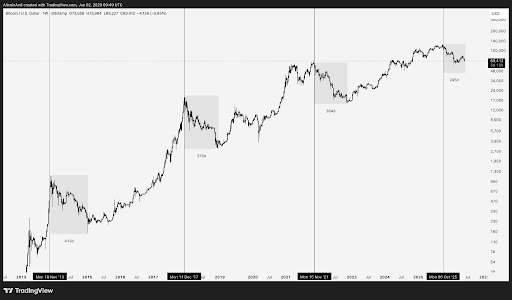
Crypto pundit Ardi, posting on X alongside a weekly Bitcoin chart that encompasses over a decade of price history, laid out a pattern that has held without exception across every prior market cycle.

According to the pundit, Bitcoin has always bottomed in the fourth quarter during its bear market years, and that makes the current price action more difficult for bulls to defend from registering another bottom. The point is that the year is still in the second quarter, meaning Bitcoin would need to hold above the $60,000 region for another six months to break from the historical pattern.

Source: Chart from Ardi on X

The Bitcoin weekly candlestick chart below captures this trend very clearly. Bitcoin’s 2013 cycle correction lasted 413 days before bottoming in November 2014, the 2017 bear cycle correction lasted 378 days before the December 2018 low, and the 2021 cycle bear market lasted 364 days before BTC bottomed in November 2022.

The current correction is at 245 days from the October 2025 high of $126,000, leaving room for more time if the market continues to mirror previous bear-market structures.

Consensus On Q4 2026

Ardi is not the only market watcher pointing to late 2026 as the more likely period for a cycle bottom. Popular crypto analyst and founder of Into the Cryptoverse, Benjamin Cowen, also noted that Bitcoin’s four-year cycle is still in play, given that the current cycle top in October 2025 arrived within one week of when it historically does. His base case for the current cycle low is October 2026.

Other analysts have reached similar conclusions through different methodologies. Ali Martinez pins October 2026 as the likely bottom based on the average duration of prior bear markets. Xanrox places the bottom in September or October, with recovery expected to begin in November or December.

CryptoQuant points to October through December, coinciding with what would be a sub-zero MVRV Z-Score, while technical signals, including the Bitcoin Repetition Fractal Cycle, are also pointing to October 2026 as the month everything will change.

At the time of writing, BTC is trading at $62,950 after a 6.2% decline over the past 24 hours. The drop has pushed BTC to its lowest level in four months, leaving the cryptocurrency at risk of losing the $60,000 support as outflows from Spot Bitcoin ETFs continue to weigh on market sentiment.

BTC trading at $62,570 on the 1D chart | Source: BTCUSDT on Tradingview.com

Связанные с этим вопросы

QAccording to crypto pundit Ardi, in which quarter has Bitcoin historically bottomed during bear markets?

AAccording to crypto pundit Ardi, Bitcoin has historically always bottomed in the fourth quarter during its bear market years.

QWhat is the current status of the Bitcoin price and market sentiment as mentioned in the article?

ABitcoin is trading around $62,950, having declined over 6% in 24 hours, and is at risk of losing the $60,000 support. The overall crypto market sentiment is back in 'extreme fear'.

QHow long has the current Bitcoin correction lasted from its October 2025 high, and how does it compare to past cycles?

AThe current correction has lasted 245 days from the October 2025 high of $126,000. This is shorter than previous cycles, which lasted 413 days (2014), 378 days (2018), and 364 days (2022) before bottoming.

QWhich month does analyst Benjamin Cowen identify as his base case for the current cycle low, and why?

ABenjamin Cowen's base case for the current cycle low is October 2026. He notes that Bitcoin's four-year cycle is still in play, as the October 2025 cycle top arrived within one week of its historical timing.

QWhat are some other methodologies or indicators mentioned that point to a late 2026 bottom for Bitcoin?

AOther methodologies pointing to a late 2026 bottom include: Ali Martinez's analysis based on average prior bear market durations, Xanrox's technical signals pointing to September/October, CryptoQuant's expectation of a sub-zero MVRV Z-Score in Q4, and the Bitcoin Repetition Fractal Cycle.

Похожее

UBS: The Crowdedness of A-Share Tech Stocks Is Far From Reaching Historical Peaks

UBS: A-share tech stocks still far from peak crowding levels A-shares' technology sector has seen a strong rebound, with trading activity hitting record highs, raising concerns about market crowding. However, UBS Securities argues that a key indicator of institutional positioning suggests the current crowding level remains well below historical peaks. While the large-cap tech sector's share of total A-share trading volume and market capitalization have reached historical highs, the overweight ratio of domestic mutual funds in this sector stood at 9.9% in Q1 2026. This is down from 11.6% in Q3 2025 and significantly lower than the historical peak of 14.1% in Q4 2015. It also pales in comparison to the historical peak overweight of 18.7% for the consumer sector. UBS notes that typical cycles from a low to a peak in fund overweighting last about three years, and the current outperformance of the tech/growth style has lasted less than two years since the policy pivot in September 2024. UBS expects A-share earnings recovery to accelerate, providing fundamental support. It forecasts 2026 A-share profit growth to rise to 11% from 3.9% in 2025. Non-financial A-share profits grew 11.8% YoY in Q1 2026, with gross and net profit margins at their highest since 2023. Persistent fund inflows, the expansion of thematic ETFs, and a recovery in private fund issuance are supporting market liquidity. In tactical allocation, UBS favors growth and cyclical styles under its "slow bull" base case, with overweight ratings on six sectors: Electronics (benefiting from semiconductor inventory recovery and AI innovation), Communications (driven by AI computing demand), Machinery (aided by domestic capex recovery), Non-ferrous Metals (due to rising copper/aluminum prices), Chemicals (supported by anti-involution policies), and Electrical Equipment (driven by policy support and AI data center power demand).

marsbit50 мин. назад

UBS: The Crowdedness of A-Share Tech Stocks Is Far From Reaching Historical Peaks

marsbit50 мин. назад

Should You Buy SpaceX Stock at $1.7 Trillion? Here's What the Market Is Worried About

SpaceX is preparing for a massive IPO aiming to raise around $75 billion at a valuation of approximately $1.75 trillion. While its achievements in reusable rockets and the profitable Starlink satellite internet service are clear, the market is concerned about the aggressive valuation. Key issues include: the current $1.75 trillion valuation, which is about 94 times 2025 revenue, seems to price in not just existing businesses but also unproven future ventures like AI infrastructure and orbital data centers. Financially, while Starlink is profitable, the AI division, bolstered by the acquisition of xAI, is incurring massive losses and consuming the majority of capital expenditures. This acquisition also introduced complex related-party financing arrangements and debt onto SpaceX's balance sheet. Furthermore, corporate governance poses a challenge. SpaceX's dual-class share structure ensures founder Elon Musk retains absolute control, limiting ordinary shareholders' influence over high-risk, long-term strategic decisions. The future success of ambitious projects like the Starship rocket—critical for lowering costs and enabling new services—remains a significant variable for the valuation. In summary, the market's apprehension (FUD) centers not on doubting SpaceX's past technological triumphs but on questioning how much premium public investors should pay for a future that combines proven profits with highly speculative and capital-intensive new ventures, all under a governance structure that offers limited shareholder oversight.

marsbit1 ч. назад

Should You Buy SpaceX Stock at $1.7 Trillion? Here's What the Market Is Worried About

marsbit1 ч. назад

Торговля

Спот
Фьючерсы

Популярные статьи

Тест по Bitcoin Биткоина

HTX Learn: Изучите Bitcoin halving и Заработаете Токены USDT

3.1k просмотров всегоОпубликовано 2024.04.16Обновлено 2024.04.16

Тест по Bitcoin  Биткоина

Что такое $BITCOIN

ЦИФРОВОЕ ЗОЛОТО ($BITCOIN): Комплексный анализ Введение в ЦИФРОВОЕ ЗОЛОТО ($BITCOIN) ЦИФРОВОЕ ЗОЛОТО ($BITCOIN) — это проект на основе блокчейна, работающий в сети Solana, который стремится объединить характеристики традиционных драгоценных металлов с инновациями децентрализованных технологий. Хотя он носит имя Биткойн, часто называемого “цифровым золотом” из-за его восприятия как средства хранения ценности, ЦИФРОВОЕ ЗОЛОТО является отдельным токеном, предназначенным для создания уникальной экосистемы в ландшафте Web3. Его цель — позиционировать себя как жизнеспособный альтернативный цифровой актив, хотя детали его применения и функциональности все еще развиваются. Что такое ЦИФРОВОЕ ЗОЛОТО ($BITCOIN)? ЦИФРОВОЕ ЗОЛОТО ($BITCOIN) — это токен криптовалюты, специально разработанный для использования в блокчейне Solana. В отличие от Биткойна, который выполняет широко признанную роль хранения ценности, этот токен, похоже, сосредоточен на более широких приложениях и характеристиках. Примечательные аспекты включают: Инфраструктура блокчейна: Токен построен на блокчейне Solana, известном своей способностью обрабатывать высокоскоростные и недорогие транзакции. Динамика предложения: ЦИФРОВОЕ ЗОЛОТО имеет максимальное предложение, ограниченное 100 квадриллионами токенов (100P $BITCOIN), хотя детали о его обращающемся предложении в настоящее время не раскрыты. Утилита: Хотя точные функциональные возможности не описаны, есть указания на то, что токен может быть использован для различных приложений, потенциально связанных с децентрализованными приложениями (dApps) или стратегиями токенизации активов. Кто создатель ЦИФРОВОГО ЗОЛОТА ($BITCOIN)? На данный момент личность создателей и команды разработчиков, стоящих за ЦИФРОВЫМ ЗОЛОТОМ ($BITCOIN), остается неизвестной. Эта ситуация типична для многих инновационных проектов в области блокчейна, особенно тех, которые связаны с децентрализованными финансами и феноменом мем-криптовалют. Хотя такая анонимность может способствовать культуре, ориентированной на сообщество, она усиливает опасения по поводу управления и ответственности. Кто инвесторы ЦИФРОВОГО ЗОЛОТА ($BITCOIN)? Доступная информация указывает на то, что у ЦИФРОВОГО ЗОЛОТА ($BITCOIN) нет известных институциональных спонсоров или значительных венчурных капиталовложений. Проект, похоже, функционирует по модели пирингового взаимодействия, сосредоточенной на поддержке и принятии сообществом, а не на традиционных путях финансирования. Его активность и ликвидность в основном сосредоточены на децентрализованных биржах (DEX), таких как PumpSwap, а не на устоявшихся централизованных торговых платформах, что еще больше подчеркивает его подход, ориентированный на grassroots. Как работает ЦИФРОВОЕ ЗОЛОТО ($BITCOIN) Операционные механизмы ЦИФРОВОГО ЗОЛОТА ($BITCOIN) можно подробно описать на основе его дизайна блокчейна и характеристик сети: Механизм консенсуса: Используя уникальный механизм доказательства истории (PoH) Solana в сочетании с моделью доказательства доли (PoS), проект обеспечивает эффективную валидацию транзакций, что способствует высокой производительности сети. Токеномика: Хотя конкретные дефляционные механизмы не были подробно описаны, большое максимальное предложение токенов подразумевает, что оно может быть предназначено для микротранзакций или нишевых случаев использования, которые еще предстоит определить. Интероперабельность: Существует потенциал для интеграции с более широкой экосистемой Solana, включая различные платформы децентрализованных финансов (DeFi). Однако детали относительно конкретных интеграций остаются неуточненными. Хронология ключевых событий Вот хронология, которая подчеркивает значимые вехи, касающиеся ЦИФРОВОГО ЗОЛОТА ($BITCOIN): 2023: Первоначальное развертывание токена происходит в блокчейне Solana, отмеченное его адресом контракта. 2024: ЦИФРОВОЕ ЗОЛОТО приобретает видимость, когда оно становится доступным для торговли на децентрализованных биржах, таких как PumpSwap, позволяя пользователям обменивать его на SOL. 2025: Проект наблюдает спорадическую торговую активность и потенциальный интерес к инициативам, возглавляемым сообществом, хотя на данный момент не зафиксировано никаких значительных партнерств или технических достижений. Критический анализ Сильные стороны Масштабируемость: Основная инфраструктура Solana поддерживает высокие объемы транзакций, что может повысить полезность $BITCOIN в различных сценариях транзакций. Доступность: Потенциально низкая цена торговли за токен может привлечь розничных инвесторов, способствуя более широкому участию благодаря возможностям дробного владения. Риски Отсутствие прозрачности: Отсутствие публично известных спонсоров, разработчиков или процесса аудита может вызвать скептицизм относительно устойчивости и надежности проекта. Волатильность рынка: Торговая активность сильно зависит от спекулятивного поведения, что может привести к значительной волатильности цен и неопределенности для инвесторов. Заключение ЦИФРОВОЕ ЗОЛОТО ($BITCOIN) является интригующим, но неоднозначным проектом в быстро развивающейся экосистеме Solana. Хотя он пытается использовать нарратив “цифрового золота”, его отход от установленной роли Биткойна как средства хранения ценности подчеркивает необходимость более четкого различения его предполагаемой утилиты и структуры управления. Будущее принятие и усвоение, вероятно, будут зависеть от решения текущей непрозрачности и более четкого определения его операционных и экономических стратегий. Примечание: Этот отчет охватывает синтезированную информацию, доступную на октябрь 2023 года, и с тех пор могут произойти события.

99 просмотров всегоОпубликовано 2025.05.13Обновлено 2025.05.13

Что такое $BITCOIN

Fractal Bitcoin: масштабирование Биткоина с помощью рекурсивной системы

Fractal Bitcoin — масштабное Layer-1-решнение, созданное на базе кода Биткоина, позволяющего достигать бесконечного масштабирования с помощью рекурсивного подхода.

2.3k просмотров всегоОпубликовано 2025.06.30Обновлено 2025.06.30

Fractal Bitcoin: масштабирование Биткоина с помощью рекурсивной системы

Обсуждения

Добро пожаловать в Сообщество HTX. Здесь вы сможете быть в курсе последних новостей о развитии платформы и получить доступ к профессиональной аналитической информации о рынке. Мнения пользователей о цене на BTC (BTC) представлены ниже.

活动图片