How to Earn $300,000 a Year by Counting Musk's Tweets?

比推Опубликовано 2026-02-21Обновлено 2026-02-21

Введение

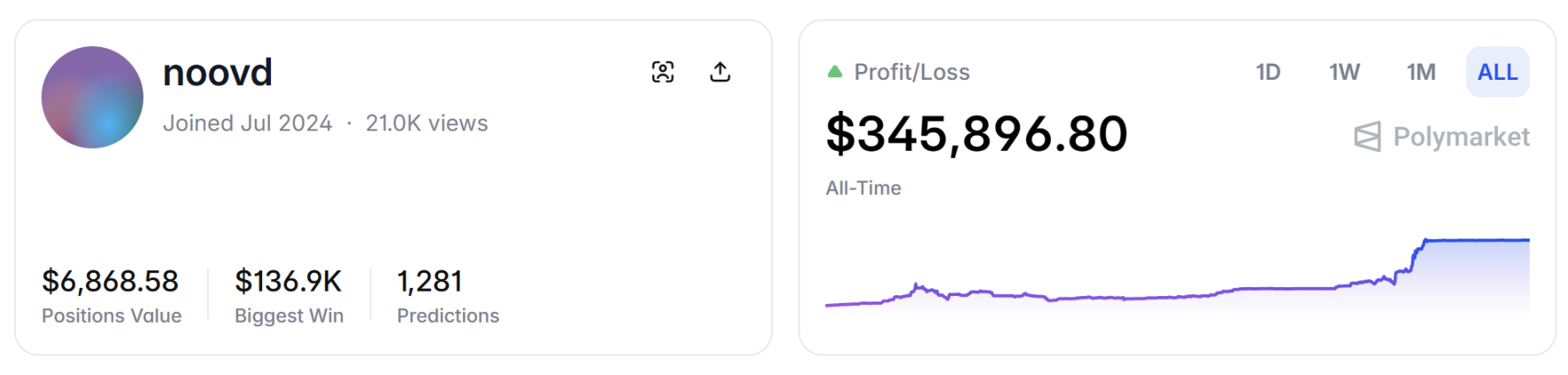
An anonymous trader known as "noovd" has reportedly earned over $345,000 in profit since July 2024 by accurately predicting the number of tweets Elon Musk would post each week on the prediction market Polymarket. The user placed 1,281 bets, with the largest single win exceeding $136,000. Noovd’s strategy focused exclusively on betting "Yes" on narrow, often undervalued tweet-count ranges (e.g., 260–279 or 420–439 tweets per week), which were typically priced as low as 2–24 cents due to market underestimation. Using a proprietary quantitative model trained on Musk’s tweet data since 2022, noovd identified mispriced probabilities—often realizing 8–20x expected value advantages. Key to the model’s success was incorporating variables like day-of-week patterns, real-world events (e.g., SpaceX launches, Tesla earnings), and mid-week recalculations to narrow the probable outcome range. The trader’s high-conviction, concentrated bets—often risking thousands per position—allowed for outsized returns, such as a 4,311% gain on a $1,569 bet. Noovd’s edge stemmed from deep data analysis, disciplined execution, and exploiting persistent market inefficiencies. The case illustrates how specialized expertise in a narrow domain can yield significant returns, emphasizing data over intuition in prediction markets.

Author: Ma He, Foresight News

Original Title: He Made $300,000 by Counting Musk's Tweets


Polymarket is home to many top-tier, profit-savvy minds. A player with the nickname noovd (0x063aeee10fbfd55b6def10da28e87a601e7deb4b) has earned hundreds of thousands in profits simply by predicting the number of tweets from the world's wealthiest man, Elon Musk.

According to the official homepage, he only joined in July 2024 but has already netted $345,000. This player has made 1,281 predictions, with the single largest win being $136,000, and currently holds positions worth $6,877.

Looking at his profit curve, it was almost flat for the first few months, but starting from late 2025, it suddenly shot up with several near-vertical spikes, each surge originating from the same source: interval bets on how many tweets Elon Musk would post per week.

As the world's richest billionaire, Musk certainly has no incentive to manipulate the market.

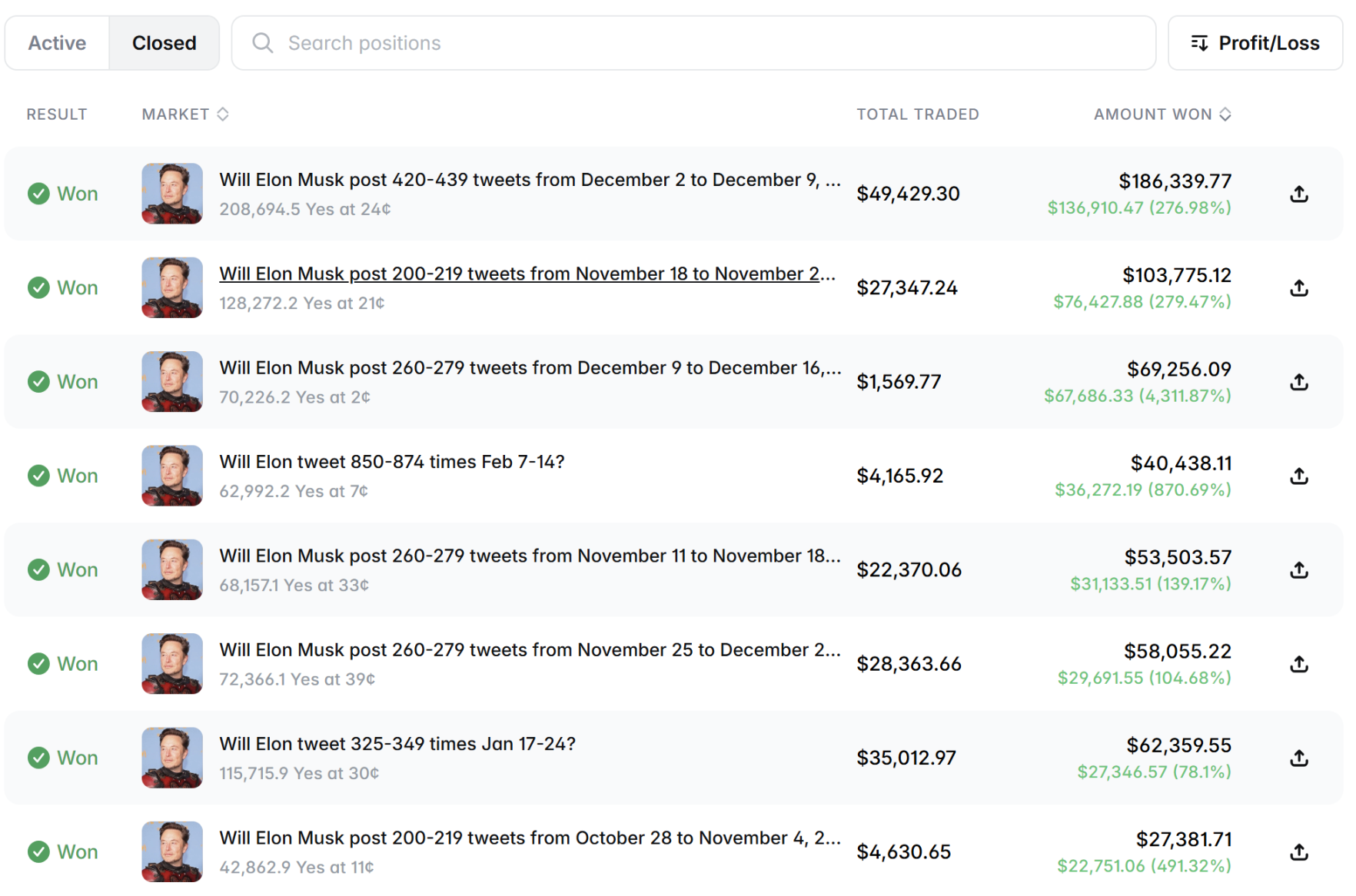
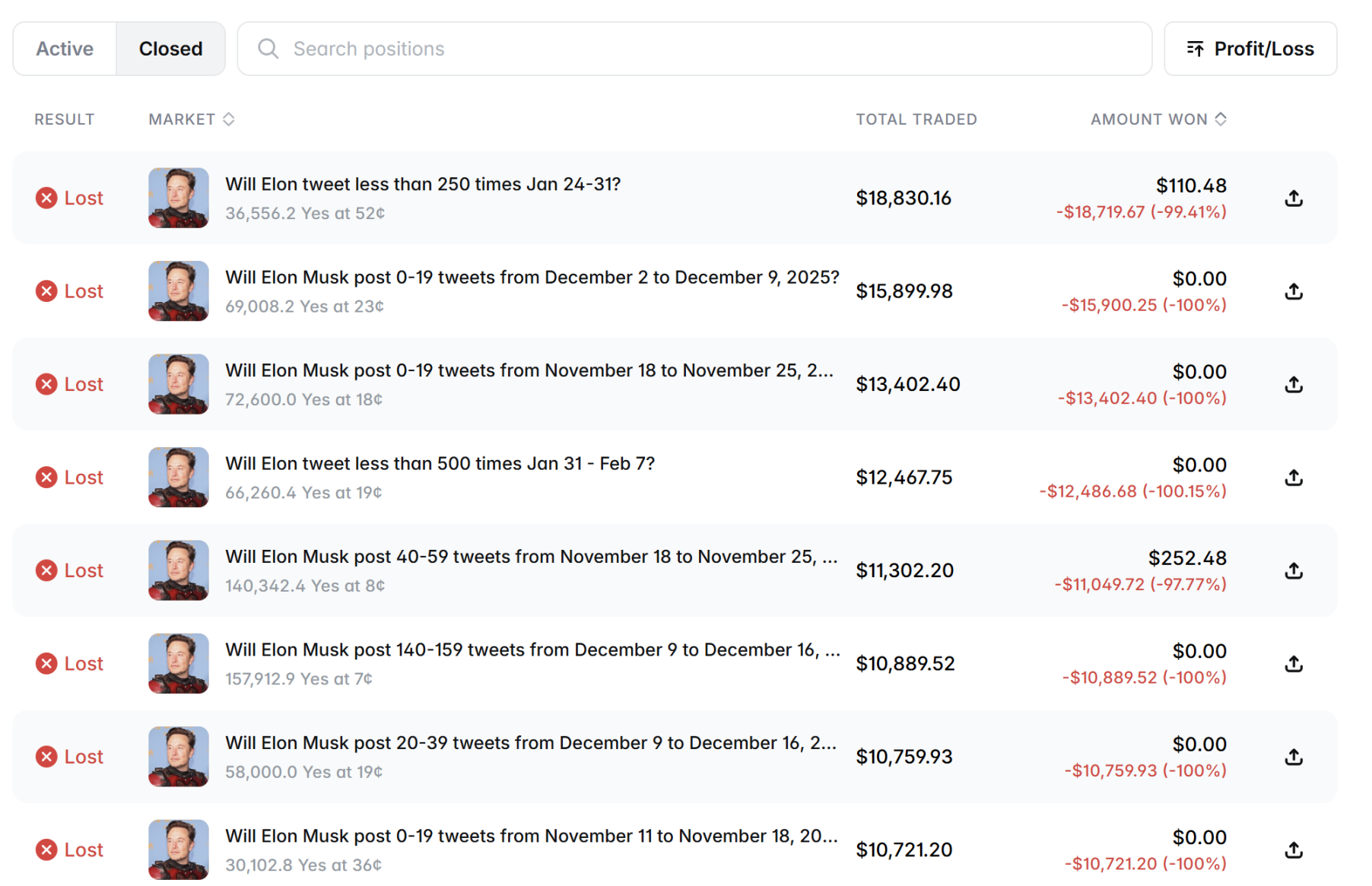
He doesn't guess NBA scores or bet on various political events; he sticks to this one track. Looking at his settled records, the top eight profits all come from betting "Yes" on "Will Musk post between X and Y tweets this week?"

Polymarket breaks down Musk's weekly tweet count into over a dozen mutually exclusive intervals, each spanning about 20 tweets—200-219, 220-239......420-439, and even extreme intervals like 850-874. Retail investors, faced with so many choices, often pick something in the middle, buying a little at 35-50 cents for psychological comfort. What about the edge intervals? Their prices often drop to 2-24 cents, even when the actual probability is clearly 15-30%.

noovd feasts on these undervalued bargains. He only buys "Yes," never "No," never sells early, and never diversifies or hedges. When he places a bet, his positions range from $4,000 to $30,000, with an average entry price between 2-39 cents. Once his model confirms, he goes all in and waits for Sunday's settlement. His brilliance lies in having a real-time rhythm model that others don't see. He doesn't rely on hunches like "Musk will probably post more this week"; instead, he feeds his model with daily tweet data since 2022, updating it daily.

Musk's posting habits from Monday to Friday, the weekend lulls, the weight of catalysts like Starlink launches, Tesla earnings, DOGE news, and xAI new features—all are quantified. By Wednesday or Thursday, he can already precisely calculate how many tweets are needed each remaining day to land exactly within a specific 20-tweet interval.

While the market is still guessing blindly with historical averages, he has compressed the error margin to within ±10-15 tweets. If he detects that a 2-cent interval has an actual probability of 18-25%, he goes heavy. The single-bet expected value advantage often reaches 8-20x. One big win can wipe out dozens of small losses and then some.

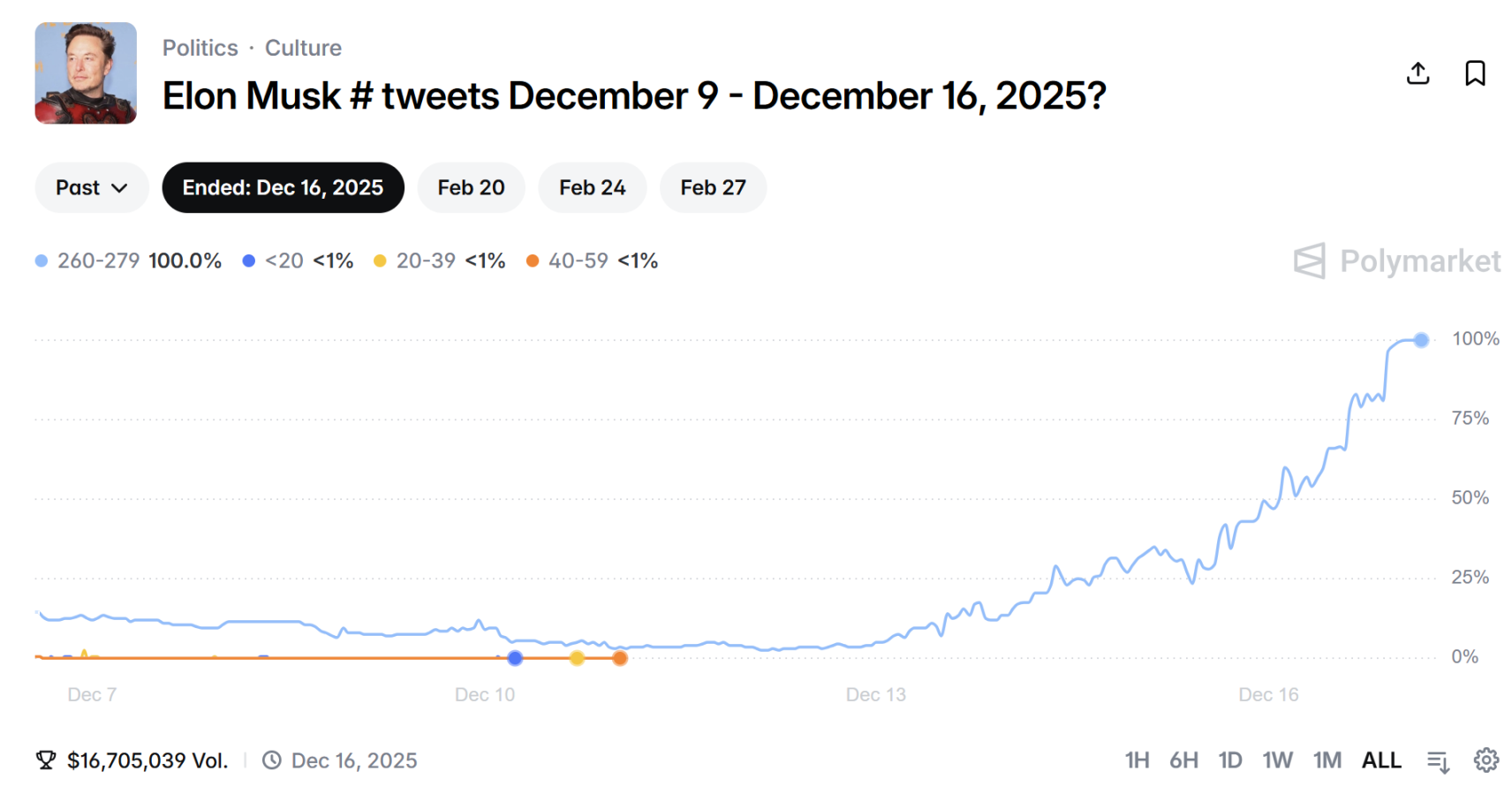
Take the prediction for December 9-16, 2025, for example. By Wednesday night, Musk had already posted 130+ tweets, leaving four days where he needed 32-35 tweets per day to precisely hit the 260-279 interval. That week had no explosive news, but discussions about xAI and Tesla were ongoing. The market, however, priced this interval extremely low because everyone thought "either it'll be平淡 180-220, or it'll shoot straight to 400+".

noovd's model might have captured some pattern of Musk's "sporadic activity." The player bought in at an average price of 2¢, investing about $1,569, and ultimately profited $67,686.33—a return of 4,311.87%.

He entered when the odds were extremely skewed, using minimal cost to lock in this narrow profit interval. This is a typical "deep out-of-the-money options" strategy, betting on the long-tail opportunities of probability distributions.

While the previous case already boasts an astonishing 43x return, the next case became his most profitable bet.

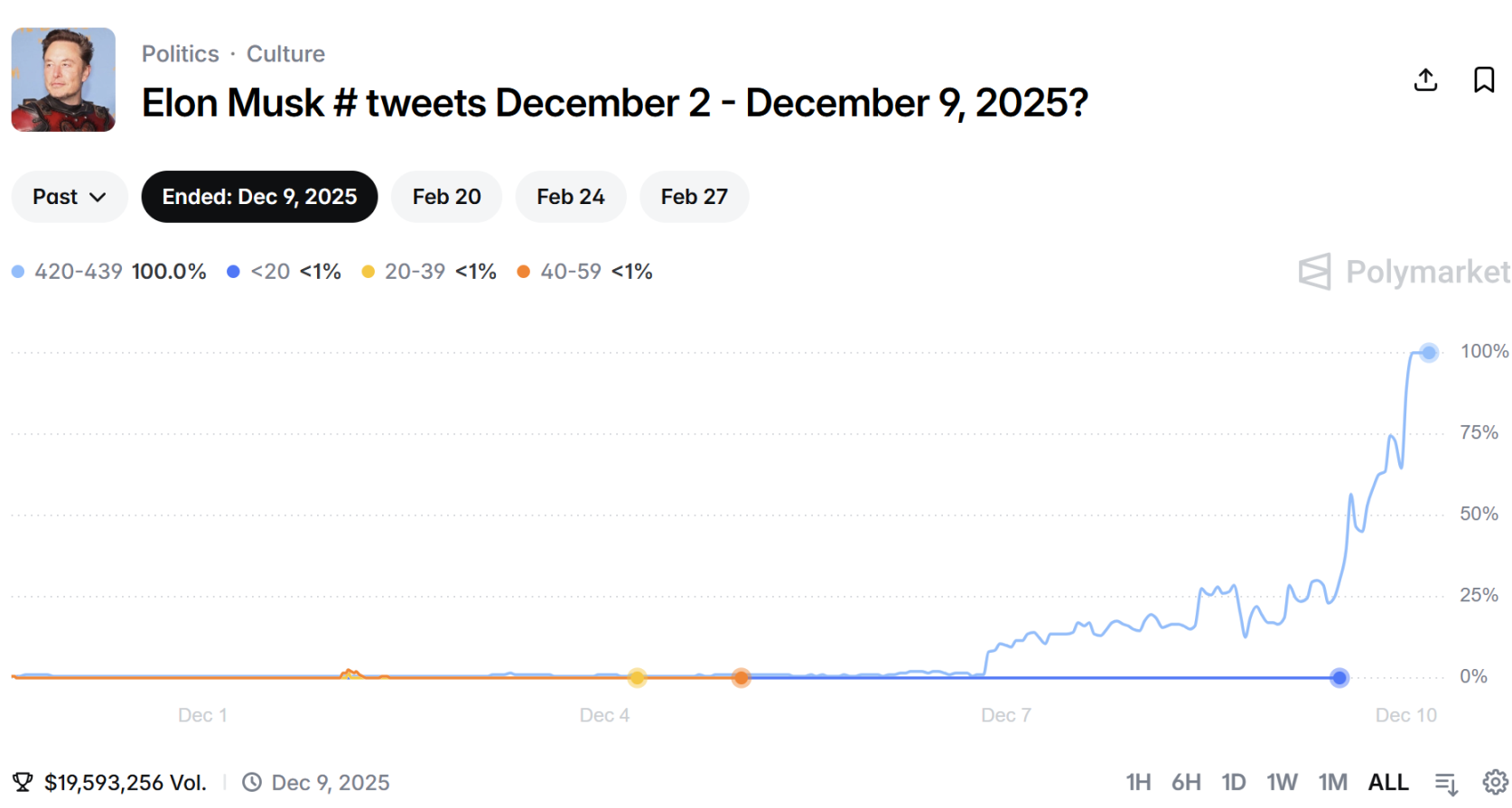
December 2-9: Will Musk post 420-439 tweets?

He bought at an average price of 24¢, heavily with $49,429, and finally profited over $130,000.

At that time, Musk's tweet count had already surged to 180+ by Tuesday. For the remaining days, he needed to maintain 65-70 tweets per day to firmly nail the 420-439 interval. That week had election aftermath and product pre-hype. The market priced it at 24 cents, but he saw that others were spreading their positions across the 400-419, 420-439, and 440-459 intervals, while the most likely landing spot was the middle one. He directly scooped up all 208,694 shares at a cost of $49k, settled for $186k—another near 3x return. Just these two December trades combined for over $255,000. The other thousand or so bets were mostly small tests or辅助 intervals in the same赛道, essentially keeping the machine oiled.

Why can this strategy keep making money, and why is it almost impossible to replicate?

First, the information barrier is too high. You need to scrape his timeline daily, preferably have a complete historical dataset, and write your own Poisson distribution model that refreshes every 6-12 hours. Ordinary people either can't scrape the data or can't be bothered to tune the parameters. The psychological hurdle is immense. Intervals priced at 2 cents or 7 cents look like throwing money away. Anyone who hasn't endured 100 weeks of drawdowns or witnessed 100 settlements firsthand would never dare to go heavy. When you look at his settled loss screenshots, you might breathe a sigh of relief—this player isn't a 100% win-rate god either.

Second, it requires extreme execution. Only go big when the advantage is greater than 10x, treat small losses as tuition, and let big wins compound. Most critically, market inefficiencies persist.

From noovd, what ordinary people can truly learn is to stop fantasizing about conquering all markets. First, find an extremely narrow, repeatable signal and study it thoroughly. Depth always beats breadth, as long as your edge is real. Abandon feelings entirely; speak with numbers and data. Making spreadsheets, scraping data, and running regressions are ten thousand times more reliable than relying on "a feeling that Musk will go crazy this week."

2 cents with a 20% real probability is far better than 50 cents with only a 5% edge. Most people do the exact opposite. In a casino where everyone shouts about 100x returns, the quietest and fiercest wealth was made by someone who could count tweets better than anyone else.

Now, new intervals for predicting Musk's weekly tweet count are still opening regularly. The only question is, very few can turn it into their own money printer.


Twitter:https://twitter.com/BitpushNewsCN

Bitpush TG Discussion Group:https://t.me/BitPushCommunity

Bitpush TG Subscription: https://t.me/bitpush

Original link:https://www.bitpush.news/articles/7613530

Связанные с этим вопросы

QHow did the user noovd make over $300,000 on Polymarket?

ABy accurately predicting the number of tweets Elon Musk would post each week, using a sophisticated data model to identify undervalued betting intervals.

QWhat specific strategy did noovd use to profit from Musk's tweet predictions?

AHe focused on buying 'Yes' shares in undervalued, narrow tweet count intervals (e.g., 420-439 tweets) with high probability but low market prices, often at 2-39 cents, and held until结算.

QWhat was noovd's most profitable single bet, and how much did he earn from it?

AHis most profitable bet was on December 2-9, predicting Musk would tweet 420-439 times. He invested $49,429 at an average price of 24 cents and profited over $130,000.

QWhy is noovd's approach difficult for others to replicate?

AIt requires high technical skills, including scraping Musk's historical tweet data, building a real-time Poisson distribution model, and executing large bets on low-probability intervals with psychological discipline.

QWhat key lesson can be learned from noovd's success on Polymarket?

AFocus on a narrow, repeatable opportunity, use data-driven models instead of intuition, and capitalize on market inefficiencies where probability is mispriced, rather than broadly betting on multiple events.

Похожее

Dialogue with Morgan Stanley Executive: Wall Street Isn't Rejecting Bitcoin, It's Just Waiting for the Right Time

In a podcast interview, Amy Oldenburg, Head of Digital Asset Strategy at Morgan Stanley, discusses Wall Street's evolving stance on Bitcoin, explaining the bank's measured approach and the road ahead. Oldenburg, with 26 years at Morgan Stanley, traces her perspective to witnessing transformative tech cycles and her experience in emerging markets, where she observed the need for alternative financial systems like mobile money (e.g., M-Pesa). This background informs her view of Bitcoin's value proposition. She clarifies that Morgan Stanley is "client-driven." Regulatory hurdles, particularly as a bank holding company under Federal Reserve oversight, initially slowed their entry. While the firm couldn't act as quickly as independent asset managers, persistent client demand and a changing regulatory environment led to offerings like their low-fee Bitcoin ETP (MSBT). They are now gradually rolling out spot Bitcoin trading on their E*Trade platform. Regarding advisor adoption, Oldenburg cites a "lack of education" as the primary barrier. Morgan Stanley recommends a 0-2% allocation for more conservative portfolios and 2-4% for aggressive ones, but price volatility and confusion about its place in asset allocation persist. She notes competition for investor attention from AI and commodities. Addressing Bitcoin's price stagnation despite institutional buying, Oldenburg points to a confluence of factors: competing investment narratives (AI, quantum computing) and the complex financial landscape. She suggests a catalyst for Bitcoin as a neutral reserve asset might require a "slow-burn crisis" that exposes fragility in traditional systems. For wider bank adoption, including holding Bitcoin on balance sheets, she identifies the need for regulatory clarity to reduce punitive capital treatment and for the asset to be usable as collateral within financial ecosystems. Looking ahead, Oldenburg predicts steady, moderate adoption growth through 2030 rather than an explosive "J-curve." She emphasizes the importance of differentiating Bitcoin from other crypto assets and expresses concern that the core cypherpunk ethos of self-custody is being diluted as traditional finance enters the space. She concludes that the digital asset field remains in its early stages with significant innovation, like AI agents and micropayments, still to come.

marsbit5 мин. назад

Dialogue with Morgan Stanley Executive: Wall Street Isn't Rejecting Bitcoin, It's Just Waiting for the Right Time

marsbit5 мин. назад

10% Position Limit Proposed: UK Retail Authorized Funds to Gain Indirect Exposure to Crypto Assets

The UK Financial Conduct Authority (FCA) is consulting on a proposal (CP26/17) that would allow retail funds, including UCITS and most Non-UCITS Retail Schemes (NURS), to invest up to 10% of their total assets in cryptoasset exchange-traded notes (crypto ETNs). This would enable indirect exposure to cryptoassets for mainstream investors through regulated funds. The rule maintains the existing prohibition on funds holding underlying cryptocurrencies like Bitcoin or Ethereum directly. The proposal introduces a strict 10% cap, positioning crypto ETNs as a potential satellite holding within diversified portfolios. Funds must ensure these investments align with their stated objectives and risk profiles. Notably, the cap does not apply to Qualified Investor Schemes (QIS) for professional clients, while Long-Term Asset Funds (LTAFs) would be prohibited from holding crypto ETNs. This move builds on the FCA's 2025 decision to permit retail trading of crypto ETNs on UK regulated exchanges. However, significant compliance burdens fall on fund managers, who must conduct thorough due diligence, assess liquidity, and provide clear risk disclosures to investors. The FCA emphasizes that even a small allocation can significantly impact a fund's risk profile. The policy's practical impact remains uncertain. Widespread adoption depends on whether asset managers deem the potential benefits worth the operational costs, disclosure requirements, and reputational risks. The consultation is open for feedback until July 13, 2026. Ultimately, the proposal represents a cautious, incremental step toward integrating cryptoassets into the regulated fund landscape, rather than a broad opening.

Foresight News34 мин. назад

10% Position Limit Proposed: UK Retail Authorized Funds to Gain Indirect Exposure to Crypto Assets

Foresight News34 мин. назад

Public Version of Mythos Officially Launched: Analyzing the Advantages and Limitations of AI Smart Contract Auditing

Publicly available Mythos, Anthropic's AI model, has officially launched, demonstrating both significant potential and limitations in smart contract security auditing. The article analyzes its capabilities through real-world cases. AI excels in identifying subtle, low-level vulnerabilities through pattern recognition and large-scale code screening. A key example is detecting a storage slot collision between a custom rewards mapping and a third-party library's ReentrancyGuard, a vulnerability easily missed in manual audits. In the recent Zcash incident, AI also rapidly discovered a critical soundness bug that had remained hidden for years. However, AI currently struggles with complex, interconnected scenarios. When tested on the Curve LlamaLend sDOLA exploit, which involved manipulating prices across multiple protocols (Curve pools, lending markets) to trigger liquidations, Fable 5 failed to identify the core cross-protocol attack vector. These scenarios require a deep understanding of DeFi economic models and multi-contract interactions. In conclusion, while AI tools like Mythos significantly boost efficiency in finding standardized, syntactic vulnerabilities, they cannot yet replace expert analysis for complex, business-logic, and cross-protocol attacks. An effective audit workflow combines AI's speed for initial screening with human expertise for in-depth, holistic analysis.

marsbit38 мин. назад

Public Version of Mythos Officially Launched: Analyzing the Advantages and Limitations of AI Smart Contract Auditing

marsbit38 мин. назад

Trade.xyz's Rebase Refusal Sparks Controversy, On-Chain Pre-IPO Market Faces Major Pricing Test

The debate surrounding Trade.xyz's refusal to adjust its SPCX (SpaceX pre-IPO) perpetual contract pricing amid updated share count revelations highlights a key challenge for on-chain pre-IPO markets. While several centralized exchanges (CEXs) paused and repriced their contracts after SpaceX's filing showed a ~10% increase in total shares, Trade.xyz maintained its market-driven pricing logic, which tracks expected per-share price sentiment rather than fundamental valuation metrics like market cap. This discrepancy triggered cross-platform arbitrage and caused leveraged long positions on Trade.xyz to suffer significant losses, as the platform's HIP-3 architecture lacks a native "Rebase" mechanism to neutrally adjust all user positions following such corporate actions. The incident underscores the difficulty for decentralized perpetual exchanges (Perp DEXs) to implement Rebase—a process CEXs handle by centrally pausing markets and adjusting ledger data. On-chain, this requires complex smart contract modifications, increasing gas costs, complexity, and potential attack surfaces. While some DEXs have managed similar adjustments, Trade.xyz's current design does not natively support it, though the team is reportedly exploring solutions for future events like stock splits. Ultimately, the controversy serves as a critical case study for the nascent on-chain pre-IPO sector, raising questions about price discovery reliability, transparent rule disclosure, and the readiness of DeFi infrastructures to handle traditional corporate actions as real-world assets (RWAs) gain traction.

marsbit46 мин. назад

Trade.xyz's Rebase Refusal Sparks Controversy, On-Chain Pre-IPO Market Faces Major Pricing Test

marsbit46 мин. назад

Торговля

Спот
Фьючерсы

Популярные статьи

Как купить S

Добро пожаловать на HTX.com! Мы сделали приобретение Sonic (S) простым и удобным. Следуйте нашему пошаговому руководству и отправляйтесь в свое крипто-путешествие.Шаг 1: Создайте аккаунт на HTXИспользуйте свой адрес электронной почты или номер телефона, чтобы зарегистрироваться и бесплатно создать аккаунт на HTX. Пройдите удобную регистрацию и откройте для себя весь функционал.Создать аккаунтШаг 2: Перейдите в Купить криптовалюту и выберите свой способ оплатыКредитная/Дебетовая Карта: Используйте свою карту Visa или Mastercard для мгновенной покупки Sonic (S).Баланс: Используйте средства с баланса вашего аккаунта HTX для простой торговли.Третьи Лица: Мы добавили популярные способы оплаты, такие как Google Pay и Apple Pay, для повышения удобства.P2P: Торгуйте напрямую с другими пользователями на HTX.Внебиржевая Торговля (OTC): Мы предлагаем индивидуальные услуги и конкурентоспособные обменные курсы для трейдеров.Шаг 3: Хранение Sonic (S)После приобретения вами Sonic (S) храните их в своем аккаунте на HTX. В качестве альтернативы вы можете отправить их куда-либо с помощью перевода в блокчейне или использовать для торговли с другими криптовалютами.Шаг 4: Торговля Sonic (S)С легкостью торгуйте Sonic (S) на спотовом рынке HTX. Просто зайдите в свой аккаунт, выберите торговую пару, совершайте сделки и следите за ними в режиме реального времени. Мы предлагаем удобный интерфейс как для начинающих, так и для опытных трейдеров.

1.4k просмотров всегоОпубликовано 2025.01.15Обновлено 2026.06.02

Как купить S

Sonic: Обновления под руководством Андре Кронье – новая звезда Layer-1 на фоне спада рынка

Он решает проблемы масштабируемости, совместимости между блокчейнами и стимулов для разработчиков с помощью технологических инноваций.

2.3k просмотров всегоОпубликовано 2025.04.09Обновлено 2025.04.09

Sonic: Обновления под руководством Андре Кронье – новая звезда Layer-1 на фоне спада рынка

HTX Learn: Пройдите обучение по "Sonic" и разделите 1000 USDT

HTX Learn — ваш проводник в мир перспективных проектов, и мы запускаем специальное мероприятие "Учитесь и Зарабатывайте", посвящённое этим проектам. Наше новое направление .

1.8k просмотров всегоОпубликовано 2025.04.10Обновлено 2025.04.10

HTX Learn: Пройдите обучение по "Sonic" и разделите 1000 USDT

Обсуждения

Добро пожаловать в Сообщество HTX. Здесь вы сможете быть в курсе последних новостей о развитии платформы и получить доступ к профессиональной аналитической информации о рынке. Мнения пользователей о цене на S (S) представлены ниже.

活动图片