How Much Bitcoin Is Quantum-Vulnerable? Researcher Says 6.9 Million BTC

bitcoinistОпубликовано 2026-02-11Обновлено 2026-02-11

Введение

Project Eleven CEO Alex Pruden disputes a CoinShares report estimating only 10,200 BTC are quantum-vulnerable, arguing that approximately 6.9 million BTC—including coins in addresses that have signed transactions at least once—could be at risk if quantum computers advance faster than anticipated. He emphasizes that once a public key is exposed on-chain, any remaining funds in that address become vulnerable to quantum attacks. Pruden specifically highlights Satoshi Nakamoto's estimated 1.1 million BTC as a large vulnerable target. He criticizes the notion that quantum threats are distant, citing evolving research and warning against complacency. The transition to quantum-resistant cryptography would be operationally complex for Bitcoin’s decentralized system, potentially requiring significant downtime and coordinated effort.

Project 11 CEO Alex Pruden is challenging a CoinShares estimate that only 10,200 bitcoin sit in “genuinely” quantum-vulnerable legacy addresses, arguing instead that roughly 6.9 million BTC could be exposed if cryptographically relevant quantum computers arrive sooner than the market expects.

The dispute, amplified by Castle Island partner Nic Carter, goes to the heart of a debate that has started to spill out of academic circles and into investor-facing research: not whether quantum computing would be catastrophic for today’s signature schemes, but how much Bitcoin is already exposed given how keys are used on-chain and how quickly the ecosystem would need to coordinate a migration.

Why ‘Only 10,000’ Bitcoin Are The Wrong Estimate

Pruden’s core objection to the “only 10k BTC” framing is definitional. In his thread, he argues quantum vulnerability extends well beyond old-style pay-to-public-key (P2PK) outputs and includes “any address that has signed a transaction once (and left residual funds there),” because the public key becomes visible on-chain once a spend is signed. In that model, coins left behind in those UTXOs could be vulnerable to an attacker able to derive a private key from a known public key.

He points to a “constantly updated tracker” run by Project Eleven listing 6,910,186 BTC as quantum-vulnerable, and cites Chaincode Labs’ technical report on post-quantum threats to Bitcoin as a cross-reference.

Pruden also singles out Satoshi Nakamoto’s presumed holdings as a large, dormant target surface. “The entity believed to be Satoshi alone holds 1,096,152 BTC across 21,924 addresses. All vulnerable,” he wrote, framing those coins as exposed under his broader definition.

Carter, responding to coverage circulating around the CoinShares number, said: “re that number of ‘only 10k quantum-vulnerable BTC’ you are seeing reported today... as much as I respect Chris and his work at Coinshares, he’s wrong on this one.”

Pruden situates the Bitcoin debate inside a wider shift among large tech companies and security institutions toward post-quantum planning. He cites a Google blog post by Hartmut Neven and Kent Walker that characterizes post-quantum cryptography as an urgent, systemic transition requiring coordinated action and accelerated adoption.

He also references a Google research result suggesting breaking RSA-2048 may require “~1 million noisy qubits,” lower than earlier estimates, and argues this compresses perceived timelines — even if Bitcoin uses ECDSA rather than RSA. To reinforce the uncertainty, Pruden quotes prominent theoretical computer scientist Scott Aaronson warning against complacency around Shor-vulnerable systems:

“On the other hand, if you think Bitcoin, and SSL, and all the other protocols based on Shor-breakable cryptography, are almost certainly safe for the next 5 years ... then I submit that your confidence is also unwarranted. Your confidence might then be like most physicists’ confidence in 1938 that nuclear weapons were decades away, or like my own confidence in 2015 that an AI able to pass a reasonable Turing Test was decades away... The trouble is that sometimes people, y’know, do that.”

Pruden’s conclusion from that framing is less about predicting a date and more about avoiding a planning regime built on “it’ll be slow.”

Pruden argues the CoinShares post underestimates the operational reality of a post-quantum transition for an already-deployed, decentralized system. He highlights the need to migrate “millions of distributed keys,” the lack of a centralized authority, and the fact that asset ownership is enforced purely by digital signatures, with “no fallback.”

He also cites peer-reviewed research claiming “the BTC blockchain would have to shut down for 76 days” to process migration transactions for the existing UTXO set in a best-case scenario — a datapoint meant to stress that even a distant threat can demand near-term engineering and governance work.

Pruden further criticizes what he calls an appeal to authority in citing a hardware-wallet executive as evidence quantum is far away, arguing vendors may have incentives to downplay urgency if quantum-resistant signatures would obsolete existing devices.

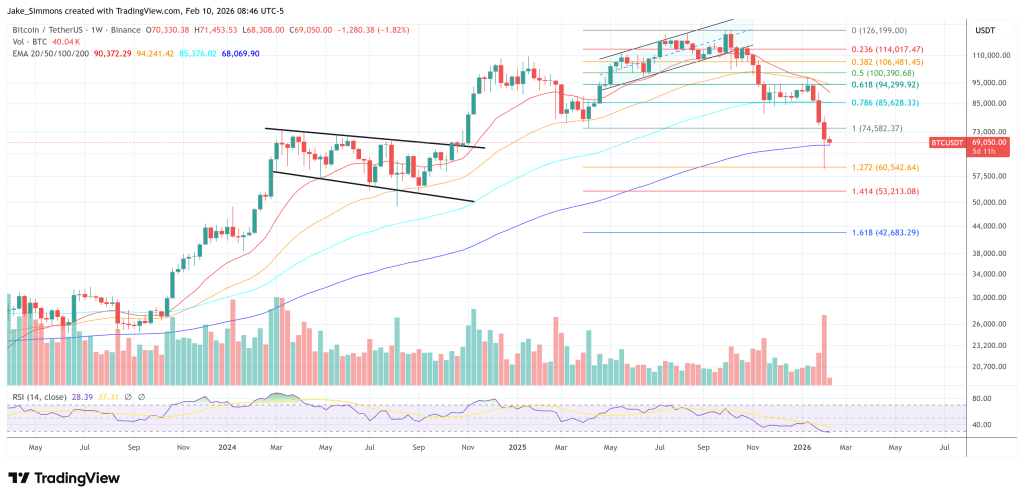
At press time, BTC traded at $69,050.

Bitcoin closed the week above the 200-week EMA, 1-week chart | Source: BTCUSDT on TradingView.com

Связанные с этим вопросы

QWhat is the main disagreement between Project 11 CEO Alex Pruden and CoinShares estimate regarding quantum-vulnerable Bitcoin?

AAlex Pruden disputes CoinShares' estimate of only 10,200 quantum-vulnerable BTC, arguing that approximately 6.9 million BTC are exposed due to his broader definition of vulnerability, which includes any address that has signed a transaction and left residual funds, making the public key visible.

QAccording to Pruden, why are Satoshi Nakamoto's presumed holdings particularly vulnerable to quantum attacks?

APruden states that Satoshi Nakamoto's holdings of 1,096,152 BTC across 21,924 addresses are all vulnerable because they are dormant and have exposed public keys, falling under his broader definition of quantum vulnerability.

QWhat does Pruden cite as evidence that the timeline for quantum threats might be shorter than previously expected?

APruden cites a Google research result suggesting breaking RSA-2048 may require only '~1 million noisy qubits,' which is lower than earlier estimates, and argues this compresses perceived timelines for quantum threats, even though Bitcoin uses ECDSA.

QWhat operational challenges does Pruden highlight for a post-quantum transition in Bitcoin?

APruden highlights the need to migrate millions of distributed keys, the lack of a centralized authority, and the fact that asset ownership is enforced purely by digital signatures with no fallback. He also references research claiming the Bitcoin blockchain would need to shut down for 76 days to process migration transactions in a best-case scenario.

QHow does Pruden criticize the appeal to authority in the quantum vulnerability debate?

APruden criticizes citing a hardware-wallet executive as evidence that quantum threats are far away, arguing that vendors may have incentives to downplay urgency if quantum-resistant signatures would make existing devices obsolete.

Похожее

Google and Amazon Simultaneously Invest Heavily in a Competitor: The Most Absurd Business Logic of the AI Era Is Becoming Reality

In a span of four days, Amazon announced an additional $25 billion investment, and Google pledged up to $40 billion—both direct competitors pouring over $65 billion into the same AI startup, Anthropic. Rather than a typical venture capital move, this signals the latest escalation in the cloud wars. The core of the deal is not equity but compute pre-orders: Anthropic must spend the majority of these funds on AWS and Google Cloud services and chips, effectively locking in massive future compute consumption. This reflects a shift in cloud market dynamics—enterprises now choose cloud providers based on which hosts the best AI models, not just price or stability. With OpenAI deeply tied to Microsoft, Anthropic’s Claude has become the only viable strategic asset for Google and Amazon to remain competitive. Anthropic’s annualized revenue has surged to $30 billion, and it is expanding into verticals like biotech, positioning itself as a cross-industry AI infrastructure layer. However, this funding comes with constraints: Anthropic’s independence is challenged as it balances two rival investors, its safety-first narrative faces pressure from regulatory scrutiny, and its path to IPO introduces new financial pressures. Globally, this accelerates a "tri-polar" closed-loop structure in AI infrastructure, with Microsoft-OpenAI, Google-Anthropic, and Amazon-Anthropic forming exclusive model-cloud alliances. In contrast, China’s landscape differs—investments like Alibaba and Tencent backing open-source model firm DeepSeek reflect a more decoupled approach, though closed-source models from major cloud providers still dominate. The $65 billion bet is ultimately about securing a seat at the table in an AI-defined future—where missing the model layer means losing the cloud war.

marsbit3 ч. назад

Google and Amazon Simultaneously Invest Heavily in a Competitor: The Most Absurd Business Logic of the AI Era Is Becoming Reality

marsbit3 ч. назад

Computing Power Constrained, Why Did DeepSeek-V4 Open Source?

DeepSeek-V4 has been released as a preview open-source model, featuring 1 million tokens of context length as a baseline capability—previously a premium feature locked behind enterprise paywalls by major overseas AI firms. The official announcement, however, openly acknowledges computational constraints, particularly limited service throughput for the high-end DeepSeek-V4-Pro version due to restricted high-end computing power. Rather than competing on pure scale, DeepSeek adopts a pragmatic approach that balances algorithmic innovation with hardware realities in China’s AI ecosystem. The V4-Pro model uses a highly sparse architecture with 1.6T total parameters but only activates 49B during inference. It performs strongly in agentic coding, knowledge-intensive tasks, and STEM reasoning, competing closely with top-tier closed models like Gemini Pro 3.1 and Claude Opus 4.6 in certain scenarios. A key strategic product is the Flash edition, with 284B total parameters but only 13B activated—making it cost-effective and accessible for mid- and low-tier hardware, including domestic AI chips from Huawei (Ascend), Cambricon, and Hygon. This design supports broader adoption across developers and SMEs while stimulating China's domestic semiconductor ecosystem. Despite facing talent outflow and intense competition in user traffic—with rivals like Doubao and Qianwen leading in monthly active users—DeepSeek has maintained technical momentum. The release also comes amid reports of a new funding round targeting a valuation exceeding $10 billion, potentially setting a new record in China’s LLM sector. Ultimately, DeepSeek-V4 represents a shift toward open yet realistic infrastructure development in the constrained compute landscape of Chinese AI, emphasizing engineering efficiency and domestic hardware compatibility over pure model scale.

marsbit3 ч. назад

Computing Power Constrained, Why Did DeepSeek-V4 Open Source?

marsbit3 ч. назад

Торговля

Спот
Фьючерсы

Популярные статьи

Тест по Bitcoin Биткоина

HTX Learn: Изучите Bitcoin halving и Заработаете Токены USDT

3.0k просмотров всегоОпубликовано 2024.04.16Обновлено 2024.04.16

Тест по Bitcoin  Биткоина

Что такое $BITCOIN

ЦИФРОВОЕ ЗОЛОТО ($BITCOIN): Комплексный анализ Введение в ЦИФРОВОЕ ЗОЛОТО ($BITCOIN) ЦИФРОВОЕ ЗОЛОТО ($BITCOIN) — это проект на основе блокчейна, работающий в сети Solana, который стремится объединить характеристики традиционных драгоценных металлов с инновациями децентрализованных технологий. Хотя он носит имя Биткойн, часто называемого “цифровым золотом” из-за его восприятия как средства хранения ценности, ЦИФРОВОЕ ЗОЛОТО является отдельным токеном, предназначенным для создания уникальной экосистемы в ландшафте Web3. Его цель — позиционировать себя как жизнеспособный альтернативный цифровой актив, хотя детали его применения и функциональности все еще развиваются. Что такое ЦИФРОВОЕ ЗОЛОТО ($BITCOIN)? ЦИФРОВОЕ ЗОЛОТО ($BITCOIN) — это токен криптовалюты, специально разработанный для использования в блокчейне Solana. В отличие от Биткойна, который выполняет широко признанную роль хранения ценности, этот токен, похоже, сосредоточен на более широких приложениях и характеристиках. Примечательные аспекты включают: Инфраструктура блокчейна: Токен построен на блокчейне Solana, известном своей способностью обрабатывать высокоскоростные и недорогие транзакции. Динамика предложения: ЦИФРОВОЕ ЗОЛОТО имеет максимальное предложение, ограниченное 100 квадриллионами токенов (100P $BITCOIN), хотя детали о его обращающемся предложении в настоящее время не раскрыты. Утилита: Хотя точные функциональные возможности не описаны, есть указания на то, что токен может быть использован для различных приложений, потенциально связанных с децентрализованными приложениями (dApps) или стратегиями токенизации активов. Кто создатель ЦИФРОВОГО ЗОЛОТА ($BITCOIN)? На данный момент личность создателей и команды разработчиков, стоящих за ЦИФРОВЫМ ЗОЛОТОМ ($BITCOIN), остается неизвестной. Эта ситуация типична для многих инновационных проектов в области блокчейна, особенно тех, которые связаны с децентрализованными финансами и феноменом мем-криптовалют. Хотя такая анонимность может способствовать культуре, ориентированной на сообщество, она усиливает опасения по поводу управления и ответственности. Кто инвесторы ЦИФРОВОГО ЗОЛОТА ($BITCOIN)? Доступная информация указывает на то, что у ЦИФРОВОГО ЗОЛОТА ($BITCOIN) нет известных институциональных спонсоров или значительных венчурных капиталовложений. Проект, похоже, функционирует по модели пирингового взаимодействия, сосредоточенной на поддержке и принятии сообществом, а не на традиционных путях финансирования. Его активность и ликвидность в основном сосредоточены на децентрализованных биржах (DEX), таких как PumpSwap, а не на устоявшихся централизованных торговых платформах, что еще больше подчеркивает его подход, ориентированный на grassroots. Как работает ЦИФРОВОЕ ЗОЛОТО ($BITCOIN) Операционные механизмы ЦИФРОВОГО ЗОЛОТА ($BITCOIN) можно подробно описать на основе его дизайна блокчейна и характеристик сети: Механизм консенсуса: Используя уникальный механизм доказательства истории (PoH) Solana в сочетании с моделью доказательства доли (PoS), проект обеспечивает эффективную валидацию транзакций, что способствует высокой производительности сети. Токеномика: Хотя конкретные дефляционные механизмы не были подробно описаны, большое максимальное предложение токенов подразумевает, что оно может быть предназначено для микротранзакций или нишевых случаев использования, которые еще предстоит определить. Интероперабельность: Существует потенциал для интеграции с более широкой экосистемой Solana, включая различные платформы децентрализованных финансов (DeFi). Однако детали относительно конкретных интеграций остаются неуточненными. Хронология ключевых событий Вот хронология, которая подчеркивает значимые вехи, касающиеся ЦИФРОВОГО ЗОЛОТА ($BITCOIN): 2023: Первоначальное развертывание токена происходит в блокчейне Solana, отмеченное его адресом контракта. 2024: ЦИФРОВОЕ ЗОЛОТО приобретает видимость, когда оно становится доступным для торговли на децентрализованных биржах, таких как PumpSwap, позволяя пользователям обменивать его на SOL. 2025: Проект наблюдает спорадическую торговую активность и потенциальный интерес к инициативам, возглавляемым сообществом, хотя на данный момент не зафиксировано никаких значительных партнерств или технических достижений. Критический анализ Сильные стороны Масштабируемость: Основная инфраструктура Solana поддерживает высокие объемы транзакций, что может повысить полезность $BITCOIN в различных сценариях транзакций. Доступность: Потенциально низкая цена торговли за токен может привлечь розничных инвесторов, способствуя более широкому участию благодаря возможностям дробного владения. Риски Отсутствие прозрачности: Отсутствие публично известных спонсоров, разработчиков или процесса аудита может вызвать скептицизм относительно устойчивости и надежности проекта. Волатильность рынка: Торговая активность сильно зависит от спекулятивного поведения, что может привести к значительной волатильности цен и неопределенности для инвесторов. Заключение ЦИФРОВОЕ ЗОЛОТО ($BITCOIN) является интригующим, но неоднозначным проектом в быстро развивающейся экосистеме Solana. Хотя он пытается использовать нарратив “цифрового золота”, его отход от установленной роли Биткойна как средства хранения ценности подчеркивает необходимость более четкого различения его предполагаемой утилиты и структуры управления. Будущее принятие и усвоение, вероятно, будут зависеть от решения текущей непрозрачности и более четкого определения его операционных и экономических стратегий. Примечание: Этот отчет охватывает синтезированную информацию, доступную на октябрь 2023 года, и с тех пор могут произойти события.

99 просмотров всегоОпубликовано 2025.05.13Обновлено 2025.05.13

Что такое $BITCOIN

Fractal Bitcoin: масштабирование Биткоина с помощью рекурсивной системы

Fractal Bitcoin — масштабное Layer-1-решнение, созданное на базе кода Биткоина, позволяющего достигать бесконечного масштабирования с помощью рекурсивного подхода.

2.2k просмотров всегоОпубликовано 2025.06.30Обновлено 2025.06.30

Fractal Bitcoin: масштабирование Биткоина с помощью рекурсивной системы

Обсуждения

Добро пожаловать в Сообщество HTX. Здесь вы сможете быть в курсе последних новостей о развитии платформы и получить доступ к профессиональной аналитической информации о рынке. Мнения пользователей о цене на BTC (BTC) представлены ниже.

活动图片