Gold Rushes Ahead of Quantitative Easing, Bitcoin Awaits Liquidity (Part 2)

marsbitОпубликовано 2026-01-09Обновлено 2026-01-09

Введение

The article analyzes why Bitcoin has remained stagnant around $80,000 despite the U.S. entering a rate-cut cycle, while gold continues to rise. It attributes this divergence to two structural factors: high real interest rates due to persistent inflation and a "middle-layer blockage" where monetary easing isn't translating into looser financial conditions. Additionally, this is a defensive rate-cut cycle driven by recession risks and rising debt burdens, not growth, causing capital to prioritize safety over risk-taking assets like Bitcoin. The U.S. faces a debt trilemma: rolling over debt, shifting to short-term issuance, or allowing currency devaluation. Gold's surge reflects hedging against dollar devaluation. Bitcoin awaits confirmed liquidity expansion. The outlook involves two phases: an initial recession shock where gold may peak while Bitcoin faces a sell-off, followed by Fed-led liquidity expansion (QE) where Bitcoin absorbs excess liquidity and surges. Silver's role is noted, with its price action tied to industrial demand and the gold-silver ratio. Long-term, both gold and Bitcoin are expected to appreciate against fiat currencies due to persistent monetary debasement, with leadership shifting from gold to Bitcoin once liquidity floodgates open.

To understand why Bitcoin has reacted tepidly to interest rate cuts, it's helpful to start with gold. Gold is a globally priced asset. While retail investors typically trade in grams, its international pricing is denominated in troy ounces and tons. It is this global pricing structure that makes the influence of macroeconomic factors so significant.

Bitcoin shares this characteristic. Furthermore, its price is globally uniform, meaning any serious analysis must begin with the U.S. macroeconomic situation.

The puzzle is evident. The U.S. has entered a new cycle of interest rate cuts, yet Bitcoin's price lingers around $80,000, while the price of gold continues to climb. Conventional theory suggests that low interest rates should benefit risk assets like stocks and cryptocurrencies. However, so-called defensive assets are rallying against the trend.

This contradiction can be explained by two structural factors.

The "Middle Layer Blockage" Problem

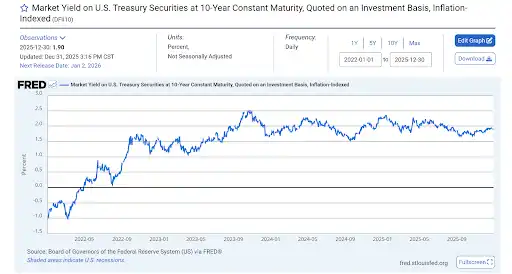
The market's focus is not on nominal interest rates, but on real interest rates. Inflation remains stubbornly high. As long as inflation persists, even if policy rates are cut, real rates struggle to break significantly lower from their elevated levels.

From the perspective of the real economy, rate cuts have not translated into easier financial conditions. Banks have not substantively loosened lending standards. Businesses remain reluctant to borrow. In other words, the intermediate link between policy and capital allocation remains blocked.

Meanwhile, the U.S. Treasury continues to issue a massive volume of new debt. In the second half of 2025, the pace of bond issuance for refinancing existing debt outpaced the liquidity released by rate cuts. The result seems counterintuitive but is crucial: overall liquidity did not expand; it actually contracted.

There simply isn't enough "available money" to push Bitcoin's price higher at the moment.

This is a Defensive Rate-Cut Cycle, Not a Growth Cycle.

This rate-cutting cycle is fundamentally different from previous ones that fueled bull markets. The Fed is cutting rates not because the economy is strong, but because unemployment is rising, corporate default rates are increasing, and the government's debt servicing costs are becoming unsustainable.

This is a defensive rate cut, driven primarily by recession fears and stagflation risks.

In this environment, capital behaves differently. Institutional investors prioritize survival over yield. Their first reaction is not to chase volatility but to reduce risk exposure and build cash buffers.

Despite its long lifecycle, Bitcoin remains one of the world's most liquid high-risk assets. When market stress increases, it is treated as a source of liquidity—a financial ATM. Risk-off flows start in crypto, not stop there.

This mirrors the logic during price expansions. Money flows into crypto last during price run-ups; it flows out of crypto first when uncertainty rises.

In contrast, as investors await a significant drop in real rates, gold is being used as a hedge against dollar devaluation.

The Deeper Issue: America's Debt Trilemma

U.S. interest payments now exceed defense spending, ranking as the federal government's third-largest expenditure after Social Security and Medicare.

Washington effectively has only three choices left.

First, roll over the debt indefinitely by issuing new bonds to pay off old ones. Given the total federal debt exceeds $38 trillion, this only exacerbates the problem.

Second, suppress long-term yields by shifting issuance towards short-term bills, lowering the average funding cost, but not addressing the fundamental imbalance.

Third, and most significantly, allow an implicit default through currency devaluation. When debt cannot be repaid in real terms, repay it with devalued dollars.

This is the structural reason behind gold's surge towards $4,500. The world is hedging against the late-stage credibility crisis of the U.S. dollar.

Rate cuts alone are insufficient. Many on Wall Street now openly state that to avoid collapse, the financial system needs continuous monetary expansion and managed inflation. This creates a vicious cycle: either print money leading to currency devaluation, or refuse to print triggering defaults.

History suggests the choice is inevitable. The Fed is unlikely to tolerate systemic collapse. The reintroduction of Quantitative Easing (QE) and Yield Curve Control (YCC) now seems more a question of timing than probability.

2026 Strategic Outlook: From Liquid Darkness to Flood

Once this framework is understood, the current divergence between gold and crypto makes perfect sense. Both assets hedge against it, but timing is crucial.

Gold is anticipating the future trend of monetary expansion; Bitcoin is waiting for confirmation.

In my view, the path forward unfolds in two phases.

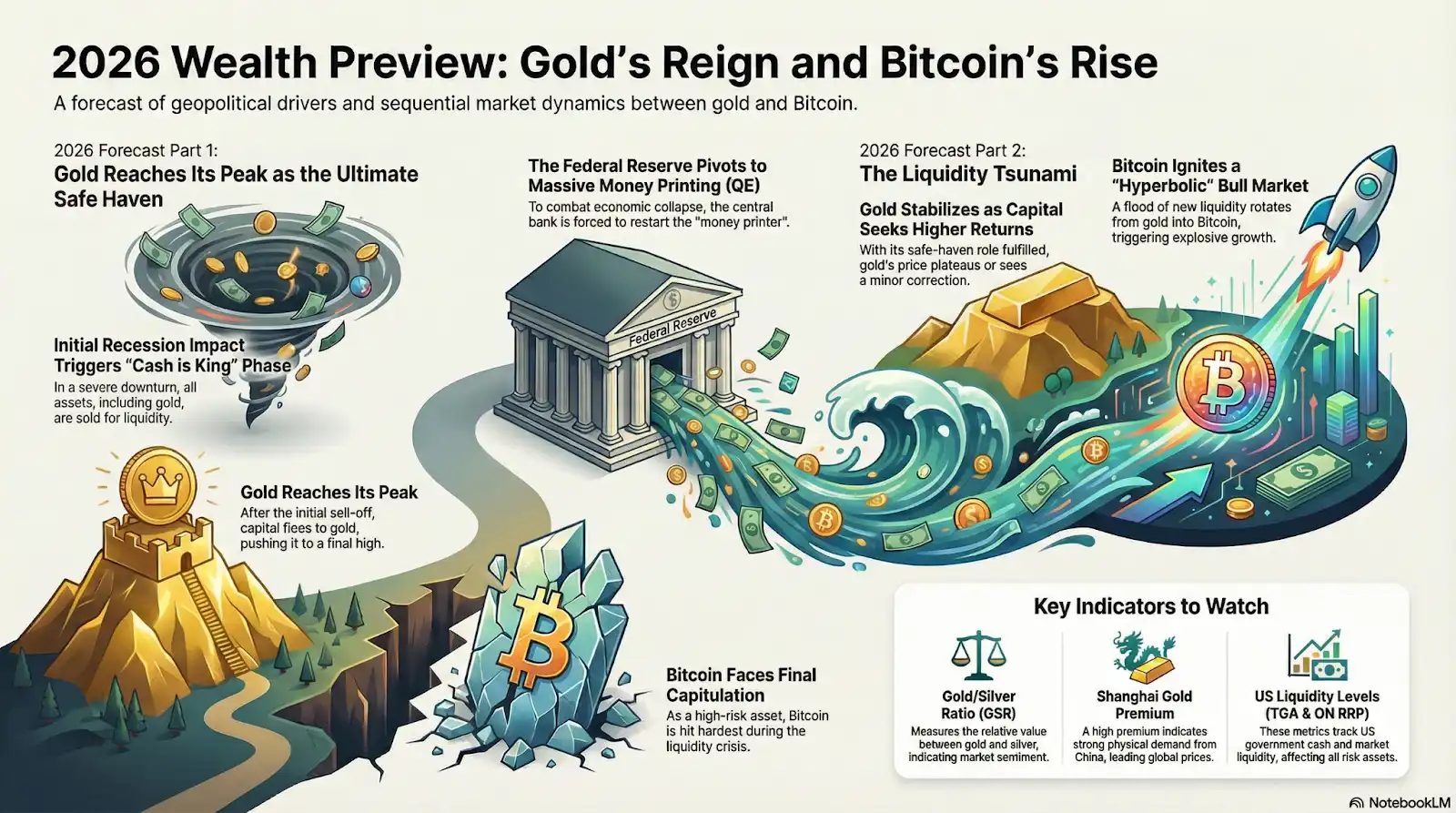
Act I: Recession Shock and the "Gold Peak"

When recession indicators are fully triggered—for example, U.S. unemployment rising above 5%—gold prices are likely to hold high or spike further. It will then be seen as the ultimate safe haven.

Bitcoin, however, could face a final leg down. In the initial phase of a recession, all assets are sold to raise cash. Margin calls and forced liquidations dominate market behavior.

History is clear on this. In 2008, gold fell nearly 30% before rebounding. In March 2020, gold dropped 12% in two weeks, while Bitcoin was halved.

Liquidity crises wash over all assets. The difference lies in which asset recovers first. Gold typically stabilizes and rebounds quicker; Bitcoin takes more time to rebuild market confidence.

Act II: Fed Capitulation and Bitcoin's Liquidity Explosion

Eventually, rate cuts will prove inadequate to handle the economic stress. Economic strain will force the Fed to expand its balance sheet again.

This is the moment the liquidity floodgates truly open.

Gold prices may consolidate or trade sideways. Capital will aggressively rotate into high-beta assets. Bitcoin, as the purest expression of excess liquidity, will absorb these flows.

In such scenarios, price moves are rarely gradual. Once momentum builds, Bitcoin's price can change violently within months.

A Note on Silver and the Gold-Silver Ratio

Silver's rally in 2025 was driven by two factors: its historical link to gold and its industrial demand. AI infrastructure, solar power, and electric vehicles are all heavily reliant on silver.

In 2025, inventories at major exchanges, including the Shanghai Futures Exchange and the London Bullion Market Association, fell to critical levels. In a bull market, silver typically outperforms gold, but in a bear market, it carries higher downside risk.

The gold-silver ratio remains a key metric.

Above 80, silver is historically cheap. Below 60, silver is expensive relative to gold. Below 50, speculative excess tends to dominate.

With the ratio currently around 59, the signal suggests a rotation towards gold, not aggressive accumulation of silver.

The Long View: Different Leaders, Same Destination

Setting aside the specific timing of 2026, the long-term conclusion remains unchanged. Both gold and Bitcoin are in an upward trend against fiat currencies.

The only variable is leadership. This year belongs to gold; the next phase belongs to Bitcoin.

As long as global debt expands and monetary authorities rely on currency debasement to relieve pressure, scarce assets will outperform. In the long run, fiat currency is the only consistently losing asset.

What matters now is patience, data, and discipline. The transition from gold dominance to Bitcoin dominance will not be announced—it will manifest through liquidity indicators, policy shifts, and capital rotation.

I will continue watching for these signals.

Связанные с этим вопросы

QWhy has Bitcoin's price remained around $80,000 despite the US entering a rate-cutting cycle, while gold continues to rise?

ABitcoin's冷淡 reaction is due to two structural factors: the 'middle-layer blockage' where actual financial conditions haven't loosened despite rate cuts, and the defensive nature of this cycle where investors prioritize risk reduction over yield chasing. Gold, however, is rising as a hedge against dollar devaluation amid recession fears and stagflation risks.

QWhat is the 'middle-layer blockage' problem mentioned in the article?

AThe 'middle-layer blockage' refers to the disconnect between policy rate cuts and actual capital allocation. Despite lower nominal rates, high inflation keeps real rates elevated, banks haven't substantially eased lending standards, and businesses remain reluctant to borrow. Concurrently, massive new debt issuance by the US Treasury absorbs liquidity faster than rate cuts can release it, leading to a contraction in overall liquidity.

QHow does a defensive rate-cutting cycle differ from a growth-driven one, and its impact on assets?

AA defensive rate-cutting cycle, driven by rising unemployment, increased corporate defaults, and unsustainable government debt costs, prioritizes economic survival over growth. In this environment, investors reduce risk exposure and build cash buffers, causing capital to flow out of high-risk assets like Bitcoin first. Conversely, growth-driven cycles encourage risk-taking and benefit assets like stocks and crypto.

QWhat are the three options the US government faces regarding its debt dilemma, according to the article?

AThe three options are: 1) Rolling over debt indefinitely by issuing new bonds to repay old ones, exacerbating the problem; 2) Shifting issuance to short-term bills to suppress long-term yields and lower financing costs, without solving the fundamental imbalance; 3) Allowing implicit default through currency devaluation, repaying debt with devalued dollars.

QWhat is the two-phase strategic outlook for 2026 regarding gold and Bitcoin?

APhase 1: Recession shock leads to a 'gold peak' where gold holds high or rises further as the safest asset, while Bitcoin faces a final sell-off due to liquidity crises and forced liquidations. Phase 2: The Fed capitulates and expands its balance sheet, unleashing massive liquidity. Gold may consolidate, and Bitcoin absorbs excess liquidity, experiencing explosive price gains as the purest expression of surplus capital.

Похожее

Warsh Hearing Concludes: What Are the Notable Signals for the Crypto Industry?

The Senate Banking Committee held a confirmation hearing for Judy Shelton, a Federal Reserve nominee, who faced intense questioning regarding her ability to maintain the central bank's independence amid pressure from President Trump to lower interest rates. Shelton denied any pre-arranged commitments on rate cuts and emphasized her independence, though Democrats remained skeptical, citing contradictions with Trump's public statements. Shelton characterized post-pandemic inflation as a major policy failure and called for a "regime change" in the Fed’s approach, including reforms to inflation measurement and communication strategies. She criticized the current practice of Fed officials frequently signaling future rate moves and did not commit to maintaining post-meeting press conferences, suggesting potential reductions in transparency. Regarding crypto markets, Shelton’s extensive investments in digital asset companies—including Solana, DeFi, and blockchain infrastructure—were noted, though she has pledged to divest these holdings due to ethics rules. Her familiarity with the crypto industry and deregulatory leanings may signal a more open, though cautious, stance toward digital assets. However, concerns were raised about potential conflicts of interest, especially given Trump family involvement in crypto-financial ventures. The timing of her confirmation remains uncertain, pending a Justice Department investigation into current Chair Powell. Shelton’s potential leadership could lead to a more hawkish, productivity-focused Fed with tighter policy communication—factors that may significantly influence liquidity conditions and macro narratives for crypto markets.

marsbit2 ч. назад

Warsh Hearing Concludes: What Are the Notable Signals for the Crypto Industry?

marsbit2 ч. назад

Торговля

Спот
Фьючерсы

Популярные статьи

Тест по Bitcoin Биткоина

HTX Learn: Изучите Bitcoin halving и Заработаете Токены USDT

3.0k просмотров всегоОпубликовано 2024.04.16Обновлено 2024.04.16

Тест по Bitcoin  Биткоина

Что такое $BITCOIN

ЦИФРОВОЕ ЗОЛОТО ($BITCOIN): Комплексный анализ Введение в ЦИФРОВОЕ ЗОЛОТО ($BITCOIN) ЦИФРОВОЕ ЗОЛОТО ($BITCOIN) — это проект на основе блокчейна, работающий в сети Solana, который стремится объединить характеристики традиционных драгоценных металлов с инновациями децентрализованных технологий. Хотя он носит имя Биткойн, часто называемого “цифровым золотом” из-за его восприятия как средства хранения ценности, ЦИФРОВОЕ ЗОЛОТО является отдельным токеном, предназначенным для создания уникальной экосистемы в ландшафте Web3. Его цель — позиционировать себя как жизнеспособный альтернативный цифровой актив, хотя детали его применения и функциональности все еще развиваются. Что такое ЦИФРОВОЕ ЗОЛОТО ($BITCOIN)? ЦИФРОВОЕ ЗОЛОТО ($BITCOIN) — это токен криптовалюты, специально разработанный для использования в блокчейне Solana. В отличие от Биткойна, который выполняет широко признанную роль хранения ценности, этот токен, похоже, сосредоточен на более широких приложениях и характеристиках. Примечательные аспекты включают: Инфраструктура блокчейна: Токен построен на блокчейне Solana, известном своей способностью обрабатывать высокоскоростные и недорогие транзакции. Динамика предложения: ЦИФРОВОЕ ЗОЛОТО имеет максимальное предложение, ограниченное 100 квадриллионами токенов (100P $BITCOIN), хотя детали о его обращающемся предложении в настоящее время не раскрыты. Утилита: Хотя точные функциональные возможности не описаны, есть указания на то, что токен может быть использован для различных приложений, потенциально связанных с децентрализованными приложениями (dApps) или стратегиями токенизации активов. Кто создатель ЦИФРОВОГО ЗОЛОТА ($BITCOIN)? На данный момент личность создателей и команды разработчиков, стоящих за ЦИФРОВЫМ ЗОЛОТОМ ($BITCOIN), остается неизвестной. Эта ситуация типична для многих инновационных проектов в области блокчейна, особенно тех, которые связаны с децентрализованными финансами и феноменом мем-криптовалют. Хотя такая анонимность может способствовать культуре, ориентированной на сообщество, она усиливает опасения по поводу управления и ответственности. Кто инвесторы ЦИФРОВОГО ЗОЛОТА ($BITCOIN)? Доступная информация указывает на то, что у ЦИФРОВОГО ЗОЛОТА ($BITCOIN) нет известных институциональных спонсоров или значительных венчурных капиталовложений. Проект, похоже, функционирует по модели пирингового взаимодействия, сосредоточенной на поддержке и принятии сообществом, а не на традиционных путях финансирования. Его активность и ликвидность в основном сосредоточены на децентрализованных биржах (DEX), таких как PumpSwap, а не на устоявшихся централизованных торговых платформах, что еще больше подчеркивает его подход, ориентированный на grassroots. Как работает ЦИФРОВОЕ ЗОЛОТО ($BITCOIN) Операционные механизмы ЦИФРОВОГО ЗОЛОТА ($BITCOIN) можно подробно описать на основе его дизайна блокчейна и характеристик сети: Механизм консенсуса: Используя уникальный механизм доказательства истории (PoH) Solana в сочетании с моделью доказательства доли (PoS), проект обеспечивает эффективную валидацию транзакций, что способствует высокой производительности сети. Токеномика: Хотя конкретные дефляционные механизмы не были подробно описаны, большое максимальное предложение токенов подразумевает, что оно может быть предназначено для микротранзакций или нишевых случаев использования, которые еще предстоит определить. Интероперабельность: Существует потенциал для интеграции с более широкой экосистемой Solana, включая различные платформы децентрализованных финансов (DeFi). Однако детали относительно конкретных интеграций остаются неуточненными. Хронология ключевых событий Вот хронология, которая подчеркивает значимые вехи, касающиеся ЦИФРОВОГО ЗОЛОТА ($BITCOIN): 2023: Первоначальное развертывание токена происходит в блокчейне Solana, отмеченное его адресом контракта. 2024: ЦИФРОВОЕ ЗОЛОТО приобретает видимость, когда оно становится доступным для торговли на децентрализованных биржах, таких как PumpSwap, позволяя пользователям обменивать его на SOL. 2025: Проект наблюдает спорадическую торговую активность и потенциальный интерес к инициативам, возглавляемым сообществом, хотя на данный момент не зафиксировано никаких значительных партнерств или технических достижений. Критический анализ Сильные стороны Масштабируемость: Основная инфраструктура Solana поддерживает высокие объемы транзакций, что может повысить полезность $BITCOIN в различных сценариях транзакций. Доступность: Потенциально низкая цена торговли за токен может привлечь розничных инвесторов, способствуя более широкому участию благодаря возможностям дробного владения. Риски Отсутствие прозрачности: Отсутствие публично известных спонсоров, разработчиков или процесса аудита может вызвать скептицизм относительно устойчивости и надежности проекта. Волатильность рынка: Торговая активность сильно зависит от спекулятивного поведения, что может привести к значительной волатильности цен и неопределенности для инвесторов. Заключение ЦИФРОВОЕ ЗОЛОТО ($BITCOIN) является интригующим, но неоднозначным проектом в быстро развивающейся экосистеме Solana. Хотя он пытается использовать нарратив “цифрового золота”, его отход от установленной роли Биткойна как средства хранения ценности подчеркивает необходимость более четкого различения его предполагаемой утилиты и структуры управления. Будущее принятие и усвоение, вероятно, будут зависеть от решения текущей непрозрачности и более четкого определения его операционных и экономических стратегий. Примечание: Этот отчет охватывает синтезированную информацию, доступную на октябрь 2023 года, и с тех пор могут произойти события.

99 просмотров всегоОпубликовано 2025.05.13Обновлено 2025.05.13

Что такое $BITCOIN

Fractal Bitcoin: масштабирование Биткоина с помощью рекурсивной системы

Fractal Bitcoin — масштабное Layer-1-решнение, созданное на базе кода Биткоина, позволяющего достигать бесконечного масштабирования с помощью рекурсивного подхода.

2.2k просмотров всегоОпубликовано 2025.06.30Обновлено 2025.06.30

Fractal Bitcoin: масштабирование Биткоина с помощью рекурсивной системы

Обсуждения

Добро пожаловать в Сообщество HTX. Здесь вы сможете быть в курсе последних новостей о развитии платформы и получить доступ к профессиональной аналитической информации о рынке. Мнения пользователей о цене на BTC (BTC) представлены ниже.

活动图片