From Pump.fun Acquisition to 1Keeper's Move: The Second Half of On-Chain Trading Terminals

marsbitОпубликовано 2026-02-28Обновлено 2026-02-28

Введение

The article discusses the potential shift in the on-chain trading terminal landscape following Pump.fun's acquisition of Padre, rebranded as Terminal, and its integration into Pump.fun's token launch ecosystem. This move suggests that independent trading terminals may not remain a standalone category long-term, as platforms capturing user flow at the source (like token launch or DEX levels) could dominate. Initially, trading terminals like GMGN, Axiom, and Photon gained traction by consolidating workflows—token discovery, smart money tracking, security checks, and trading—into single interfaces. However, independent terminals face structural challenges in user acquisition, while platforms like Pump.fun have inherent user bases from token creators and early buyers. The survival strategies of existing terminals vary: GMGN relies on data network effects, Axiom aims to become a comprehensive trading platform, Photon focuses on ultra-fast execution on Solana, and newcomer 1Keeper leverages late-mover advantages to avoid early pitfalls. The possible outcomes for independent terminals include integration into larger platforms, becoming platforms themselves, or dominating a niche. The article concludes that the winner in this space may not yet be determined, given the low user migration costs and dynamic nature of the crypto market.

When token launch platforms start building their own trading tools, the window for independent terminals may be shorter than imagined.

In February 2026, Pump.fun announced the acquisition of the on-chain trading terminal Padre, renaming it Terminal and directly embedding it into its token launch ecosystem.

This acquisition didn’t spark much discussion. Most people’s reaction was, "Oh, another acquisition." But if you’re using GMGN, Axiom, or any other independent trading terminal, this is worth thinking about for a moment.

Because it hints at a trend: on-chain trading terminals may not exist as an independent category for long.

First, Understand: Why Have Trading Terminals Suddenly Become Important?

A year ago, the standard toolchain for Meme traders was: Dexscreener for charts + Telegram Bot for orders + Twitter for Alpha. Three tools, three windows, barely functional.

By 2026, this workflow was compressed into a single interface. Trading terminals represented by GMGN integrated token discovery, smart money tracking, security checks, and one-click trading into one web application. Users no longer needed to jump between five tabs.

This isn’t a feature innovation; it’s a workflow innovation—accomplishing the same tasks with fewer steps.

The effect was immediate. GMGN quickly became the default choice for Meme traders, Axiom received investment from Y Combinator, and Photon built a loyal user base in the Solana community. In less than a year, the entire sector grew from zero to at least six or seven recognizable products.

But the Terminal Sector Has a Structural Problem

The problem lies in customer acquisition costs.

Where do trading terminal users come from? From Twitter KOL recommendations, community word-of-mouth, airdrop incentives. Every user is acquired through marketing expenses.

Platforms like Pump.fun don’t need to do this. Thousands of tokens are created on Pump.fun every day, and every token creator and early buyer is a natural trading terminal user. After Pump.fun acquired Padre, these users no longer need to leave the Pump.fun ecosystem from token creation to trading.

This is the power of vertical integration: you work hard to build a trading terminal to attract users, but the source of users is intercepted by the platform.

The same logic could also apply at the DEX level. If Jupiter or Raydium decided to add trading terminal features to their frontend—smart money tracking, new token boards, one-click buying and selling—the differentiation of independent terminals would be further eroded.

Where Is the Way Out for Independent Terminals?

This doesn’t mean independent terminals will disappear immediately. But it does mean that "building a feature-rich trading terminal" is no longer enough. You need to have some dimension that platform players are unwilling, unable, or too slow to do.

Looking back at the current sector landscape, every surviving product is essentially betting on a direction:

GMGN is betting on data network effects. More users → more wallets tracked → more accurate signals → more new users. Once this flywheel starts spinning, it’s hard for latecomers to catch up. GMGN’s biggest moat right now isn’t any single feature, but the data advantage brought by its user density.

Axiom is betting on platformization. Spot, perpetuals, farming, automated strategies, fiat on-ramps—Axiom isn’t trying to be just a Meme trading terminal, but an all-category trading center on-chain. If it can build an "on-chain Binance," then independence becomes irrelevant; it becomes the platform itself. YC’s backing gives it a longer runway to bet on this direction.

Photon is betting on extreme experience. No multi-chain, no social features, no flashy functions, only focusing on making trading execution the fastest and most stable on Solana. Photon’s bet is: there will always be a group of hardcore traders who only care about speed and latency, nothing else. This group might not be large, but its loyalty is extremely high.

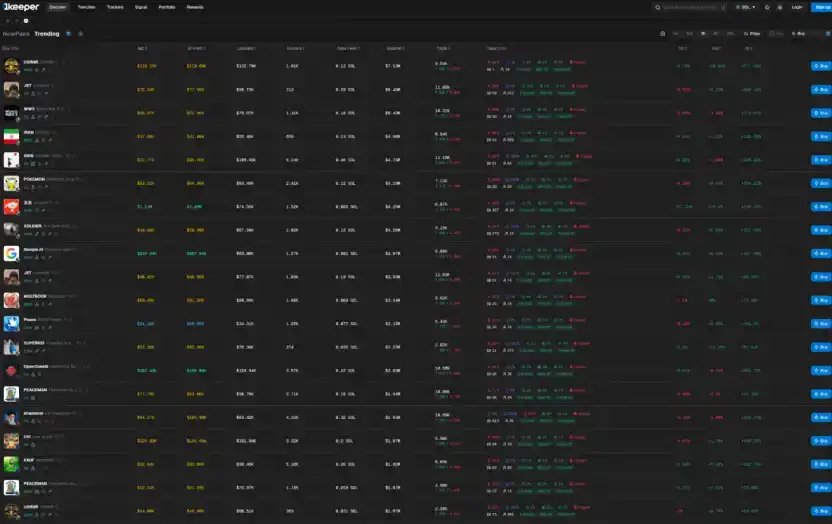
1Keeper is betting on the latecomer advantage. As a newcomer to the sector, 1Keeper’s background is somewhat special—the team previously worked on MPC multi-sig wallets, serving institutional clients. In early 2026, it pivoted to building an on-chain trading terminal for Solana and BSC, with features already including mainstream modules like Discover, Trenches, Signal (smart money signals), and Trackers (wallet tracking).

1Keeper Discover Page: Trending Token List, Covering Core Metrics Like Market Cap, Liquidity, Holders

The disadvantages for latecomers are obvious: small user base, weak brand recognition, many functional details to catch up on. But latecomers also have a subtle advantage: they can see all the pitfalls their predecessors encountered. The compromises pioneers made in product architecture (sacrificing scalability for early speed, design debt that couldn’t be changed for backward compatibility) can be bypassed directly by latecomers.

Whether this advantage can be realized depends on execution speed—the sector won’t wait.

Endgame Speculation

If we refer to Web2 experience, the endgame for tool-based products is usually one of three:

Acquired/Integrated. Platform players turn your features into a tab of their own. Corresponds to the logic of Pump.fun acquiring Padre.

Become the Platform. The tool itself expands upstream or downstream, becoming an indispensable ecosystem node. Axiom is walking this path.

Become the Niche Champion. Become the absolute number one in an extremely specific scenario. Photon is betting on this path.

For products like GMGN, 1Keeper, and Bullx, the question is: which path are you taking?

Those who move slowly might not see the end of the sector. But it’s also possible that the crypto industry simply doesn’t follow the Web2 script—user migration costs in this market are extremely low (switching terminals just requires connecting a wallet), meaning product moats are naturally weak, but it also means opportunities for a comeback always exist.

During DeFi Summer, no one predicted Uniswap would win. In the NFT frenzy, Blur replaced OpenSea in a few months.

The winner in on-chain trading terminals might not have appeared yet. Or it might already be in your bookmarks bar.

Связанные с этим вопросы

QWhat is the main trend suggested by Pump.fun's acquisition of Padre (Terminal)?

AThe acquisition suggests that on-chain trading terminals may not exist as an independent category for long, as platforms like Pump.fun can integrate trading tools directly into their ecosystems, capturing users at the source.

QWhy did trading terminals become important in the crypto space around 2026?

ATrading terminals became important because they integrated multiple tools—token discovery, smart money tracking, security checks, and one-click trading—into a single interface, streamlining the workflow for meme traders who previously had to switch between multiple applications.

QWhat is the structural problem facing independent trading terminal projects?

AThe structural problem is high customer acquisition costs. Independent terminals must spend on marketing to attract users, while platforms like Pump.fun or DEXs can naturally capture users through their existing token creation and trading ecosystems, making it harder for standalone terminals to compete.

QWhat are the three potential endgames for on-chain trading terminal projects, according to the article?

AThe three potential endgames are: 1) Being integrated into a larger platform (e.g., Pump.fun acquiring Padre), 2) Becoming a platform themselves (e.g., Axiom aiming to be a full trading hub), and 3) Becoming a vertical champion by dominating a niche (e.g., Photon focusing on speed and stability for hardcore traders).

QWhat advantage does a latecomer like 1Keeper have in the on-chain trading terminal space?

A1Keeper, as a latecomer, can avoid the pitfalls and compromises made by earlier projects, such as technical debt or scalability issues, by learning from their mistakes and building a more optimized product from the start—though success depends on execution speed.

Похожее

From MSTR to STRC+: Where Is the Limit of the Strategy Universe?

From MSTR to STRC+: The Evolution and Limits of the Strategy Universe This article examines the transformation of Strategy (formerly MicroStrategy) from a simple "Bitcoin treasury" company into a complex financial engineering firm building a BTC-backed credit system. **Core Thesis:** Strategy's true significance lies not just in its massive BTC holdings (~844k BTC), but in its attempt to transform this static reserve into a multi-layered credit curve within traditional capital markets and, subsequently, into on-chain yield infrastructure. **The MSTR Flywheel:** The initial model was a reflexive loop: BTC price rises → MSTR stock rises → company raises capital (debt/equity) at a premium → buys more BTC → increases per-share BTC exposure → MSTR premium grows. This "amplified Bitcoin" equity (MSTR) thrives on bullish momentum but is vulnerable to tightening premiums and rising funding costs. **Building the Credit Curve:** Strategy's innovation is slicing its single BTC balance sheet into different risk/return profiles via specialized securities: * **MSTR:** High-volatility equity layer absorbing full BTC upside/downside. * **STRC:** Key product. A perpetual preferred stock designed as "short duration high yield credit," offering ~11.5% floating monthly dividends. It attracts fixed-income investors seeking yield without direct BTC exposure, funding Strategy's operations. * **STRD/STRK/STRF:** Other preferred/share classes with varying durations, conversion rights, and fixed dividends. **Risks of the STRC Model:** STRC's high yield is not risk-free. Its stability depends on: 1) Sufficient BTC asset coverage, 2) Strategy's continued ability to pay dividends, and 3) Market faith in the MSTR/STRC funding flywheel. Stress points include deep BTC price declines eroding the asset buffer, rising dividend costs if STRC trades below par, and a broken flywheel if MSTR's premium (mNAV) falls persistently. **On-Chain Expansion: STRC+:** Projects like **Saturn** and **Apyx** aim to package STRC's (and other DAT preferred stock) cash flows into on-chain stablecoin yield (e.g., sUSDat, apyUSD). They offer DeFi a new yield source distinct from trading fees or incentives—cash dividends from traditional securities. However, this introduces compounded risks: off-chain custody, issuer credit risk, BTC volatility, and protocol execution risk. **Conclusion: The Ultimate Boundary** Strategy's endgame is not infinite BTC accumulation. It is the market's long-term acceptance of a new credit system where BTC serves as collateral for tradable securities whose cash flows can power on-chain financial applications. Its "universe" expands if this BTC-native credit curve gains legitimacy, but contracts if these instruments are repriced purely as high-risk, yield-bearing credit assets without stablecoin mythology.

marsbit5 мин. назад

From MSTR to STRC+: Where Is the Limit of the Strategy Universe?

marsbit5 мин. назад

Founder of Baixing.com: My Fourteen Claude Code Usage Experiences

Founder of Baixing.com Shares 14 Personal Tips for Using Claude Code The author outlines his personal, non-universal strategies for maximizing Claude Code. Key points include: focusing deeply on one primary tool (Claude Code) rather than constant comparison; mastering essential shortcuts for the editor and command line; utilizing voice input like HoldSpeak; starting projects with a structured PROJECT.md file; defaulting to Claude agents for most tasks; and leveraging integrations with GitHub and Cloudflare for build, deployment, and infrastructure. He emphasizes a clear separation between human and machine work: manually maintain a core CLAUDE.md file, and understand AI-generated content by asking the AI, not reading its raw code. Efficient communication involves dragging files (screenshots, audio, documents) directly into the interface. For knowledge management, he recommends a centralized, Git-synced memory system based on ~/.claude/CLAUDE.md to ensure permanence and avoid scattered project memories. Other practices include writing and continuously refining "Skills," using the expensive but reliable ultracode for complex dynamic workflows, and employing Git documentation as handoff points between agents. The overarching philosophy is to treat Claude Code like a horse (or a person) with its own pathfinding abilities—setting goals and boundaries rather than micromanaging every turn.

链捕手12 мин. назад

Founder of Baixing.com: My Fourteen Claude Code Usage Experiences

链捕手12 мин. назад

Gary Yang: Agent Economy and AI Submicroeconomics

**Title:** Agent Economy and AI Sub-Microeconomics - Gary Yang **Summary:** Following the AI singularity, the pace of evolution has accelerated rapidly, creating new generational disparities in technological advancement globally. While many regions are still grappling with single-agent bottlenecks, Silicon Valley has moved ahead into the next dimension: the Agent Economy and A2A ecosystems. The article outlines six key areas of this emerging paradigm: 1. **AI Payment Competition & H2A Bottlenecks:** A fierce battle for AI Agent payment protocol standards is underway (e.g., MPP, x402). However, most current efforts remain Human-to-Agent (H2A), essentially grafting AI onto traditional human-centric commerce, which creates a non-AI-native bottleneck. The true potential lies in Agent-to-Agent (A2A) autonomous economies. 2. **Agent Economy & the Inevitable A2A Trend:** The Agent Economy is defined by autonomous AI Agents creating, exchanging, and capitalizing value as independent economic actors. The A2A ecosystem describes their interactions. This represents the next major investment frontier, akin to the early days of e-commerce or DeFi, but with faster iteration and an AI-native, efficiency-first perspective that often diverges from human needs. 3. **AI Protocol vs. Crypto Protocol:** AI Protocols are the foundational rules for Agent interaction in an open network (communication, discovery, collaboration), akin to the governance and economic laws of the AI world. Currently, they focus on communication and weak boundaries, unlike Crypto Protocols which emphasize asset rights and clear ownership. While they appear different due to political-economic factors and legacy system constraints, their eventual convergence into a unified Digital Protocol system is seen as inevitable, driven by first principles. 4. **AI Agent Sub-Microeconomics & Biological Analogy:** AI Agent economics differ fundamentally from human economics: higher frequency/lower value transactions, energy/value direct correlation, efficiency-driven (not emotional) decisions, task-oriented (not consumption-oriented) behavior, and near-zero organizational/communication costs. A powerful analogy frames the Agent economy as a biological system: the LLM is the nucleus, the Agent harness is the cytoplasm, the Agent itself is a cell, its communication protocol is the cell membrane, and external tools (Skills, Prompts) are the extracellular environment. 5. **The Inevitability of AIFi & FinChip:** AIFi (AI Finance) represents the financial system where AI-native value within the Agent economy is tokenized and exchanged. Unlike TradFi/DeFi where value resides *in* finance, in AIFi, value originates *in* AI, and finance becomes its form. This shift is enabled by Agents taking over value discovery. FinChip (Financial Chip) is introduced as a key infrastructure—a fusion of AI autonomy and crypto smart contracts—forming intelligent financial assets to power the future A2A economy. 6. **AI-Native as a Paradigm Shift:** Adopting AI is not akin to "Internet+". It requires AI-Native thinking—designing systems based on first principles, the shortest energy-value path, and maximum efficiency. This abstract, counter-intuitive logic poses a significant, ongoing challenge for all practitioners, as effective, generalized upgrade methodologies will be slow to emerge in this rapidly evolving landscape.

链捕手53 мин. назад

Gary Yang: Agent Economy and AI Submicroeconomics

链捕手53 мин. назад

From 'The Big Short' to San Francisco: The Revelry and Dizziness Within the AI Bubble

From "The Big Short" to San Francisco: The Frenzy and Dizziness in the AI Bubble The article captures the intense, frenetic atmosphere in San Francisco, the epicenter of the current AI boom. Drawing a parallel to the "smell of money" from *The Big Short*, the author observes a city gripped by a singular status game centered entirely on AI and technology. This manifests in a palpable, caffeine-fueled anxiety ("people are shaking"), rampant comparison using vanity metrics like funding rounds, and pervasive "Big Bubble Behavior." The piece explores the city's stark contrasts: its dystopian streets versus beautiful vistas, and the disconnect between the doomsday concerns of some AI researchers and the optimistic, growth-focused "GTM" teams. It critiques the obsession with "math genius" founders as the new ticket to outsized returns, akin to scouting sports prodigies. Referencing economic historian Carlota Perez's "frenzy phase" and Karl Polanyi's "double movement," the author frames the boom as a period where financial speculation detaches from fundamentals, with society potentially becoming subordinate to a new economic force driven by "geniuses in data centers." Ultimately, while acknowledging the unprecedented wealth creation and party-like energy, the article concludes with cautionary advice: when the music is playing, you should dance, but don't get drunk. The core reminder is to stay grounded, avoid distorted judgment, and maintain perspective amidst the euphoria.

marsbit55 мин. назад

From 'The Big Short' to San Francisco: The Revelry and Dizziness Within the AI Bubble

marsbit55 мин. назад

Торговля

Спот
Фьючерсы

Популярные статьи

Как купить S

Добро пожаловать на HTX.com! Мы сделали приобретение Sonic (S) простым и удобным. Следуйте нашему пошаговому руководству и отправляйтесь в свое крипто-путешествие.Шаг 1: Создайте аккаунт на HTXИспользуйте свой адрес электронной почты или номер телефона, чтобы зарегистрироваться и бесплатно создать аккаунт на HTX. Пройдите удобную регистрацию и откройте для себя весь функционал.Создать аккаунтШаг 2: Перейдите в Купить криптовалюту и выберите свой способ оплатыКредитная/Дебетовая Карта: Используйте свою карту Visa или Mastercard для мгновенной покупки Sonic (S).Баланс: Используйте средства с баланса вашего аккаунта HTX для простой торговли.Третьи Лица: Мы добавили популярные способы оплаты, такие как Google Pay и Apple Pay, для повышения удобства.P2P: Торгуйте напрямую с другими пользователями на HTX.Внебиржевая Торговля (OTC): Мы предлагаем индивидуальные услуги и конкурентоспособные обменные курсы для трейдеров.Шаг 3: Хранение Sonic (S)После приобретения вами Sonic (S) храните их в своем аккаунте на HTX. В качестве альтернативы вы можете отправить их куда-либо с помощью перевода в блокчейне или использовать для торговли с другими криптовалютами.Шаг 4: Торговля Sonic (S)С легкостью торгуйте Sonic (S) на спотовом рынке HTX. Просто зайдите в свой аккаунт, выберите торговую пару, совершайте сделки и следите за ними в режиме реального времени. Мы предлагаем удобный интерфейс как для начинающих, так и для опытных трейдеров.

1.4k просмотров всегоОпубликовано 2025.01.15Обновлено 2026.06.02

Как купить S

Sonic: Обновления под руководством Андре Кронье – новая звезда Layer-1 на фоне спада рынка

Он решает проблемы масштабируемости, совместимости между блокчейнами и стимулов для разработчиков с помощью технологических инноваций.

2.3k просмотров всегоОпубликовано 2025.04.09Обновлено 2025.04.09

Sonic: Обновления под руководством Андре Кронье – новая звезда Layer-1 на фоне спада рынка

HTX Learn: Пройдите обучение по "Sonic" и разделите 1000 USDT

HTX Learn — ваш проводник в мир перспективных проектов, и мы запускаем специальное мероприятие "Учитесь и Зарабатывайте", посвящённое этим проектам. Наше новое направление .

1.8k просмотров всегоОпубликовано 2025.04.10Обновлено 2025.04.10

HTX Learn: Пройдите обучение по "Sonic" и разделите 1000 USDT

Обсуждения

Добро пожаловать в Сообщество HTX. Здесь вы сможете быть в курсе последних новостей о развитии платформы и получить доступ к профессиональной аналитической информации о рынке. Мнения пользователей о цене на S (S) представлены ниже.

活动图片