From Frenzy to Chill: Solana Falls Below $80, Meme Narrative Recedes

比推Опубликовано 2026-02-13Обновлено 2026-02-13

Введение

Foresight News reports that Solana (SOL) has experienced a significant downturn, falling below $80 and hitting a low of $67 in early February—its lowest point since December 2023. The token has declined for five consecutive months, with a peak drop of over 71% from its October 2025 high. Key NFT projects like Mad Lads also saw major devaluations. During the bull market, SOL rose dramatically from $8 to $295, fueled largely by meme coin mania on platforms like Pump.fun. Meme activity, including tokens like Dogwifhat and Bonk, drove high engagement, further amplified by Donald Trump’s token launch on Solana. However, the meme trend has since cooled, with trading volume on Pump.fun dropping to one-sixth of its peak. Attention and capital have partially shifted to BNB Chain, where meme platforms gained traction in late 2025. Solana also faces growing competition from other blockchains. Ethereum’s upgrades have improved its scalability and reduced fees, narrowing Solana’s speed advantage. Base chain has also grown, attracting users with AI-related tokens. Additionally, real-world asset (RWA) tokenization remains dominated by Ethereum, limiting Solana’s expansion in that sector. Despite earlier support from corporate digital asset treasuries (DATs)—which bought SOL as treasury assets—the overall bear market and declining confidence have outweighed buy-side pressure. Both Bitcoin and Ethereum have also seen significant price drops recently. Solana’s co-founder has openly sought ...

Author: Ma He, Foresight News

Original Title: Meme Recedes, Narrative Cools: Falling Below $80, Solana's Cycle Dividend Ends


Even one of the most successful public blockchains, Solana, has entered a winter moment.

During the market crash on February 5th, Solana's token SOL once fell to $67, hitting a new low since December 2023. As of now, SOL's latest quoted price is $80, with a 24-hour drop of 3.57%. Looking at the monthly chart, SOL has been declining for 5 consecutive months since the high in October 2025, with a maximum drop of over 71% during this period. The floor price of its ecosystem's most famous NFT representative, Mad Lads, once fell to 22 SOL, approximately $1,760, while at its peak, this NFT was once worth over $40,000.

Looking back during this bull market, SOL rose from a low of $8 all the way to $295, performing quite impressively among public blockchains. Coupled with the explosion of the Meme track, even US President Trump chose to launch his token first on the Solana network, during which countless wealth stories emerged.

However, as the market turns bearish, coin prices fall, TVL is halved, on-chain transaction volume plummets, and the growth flywheel stalls, Solana also faces its own various problems.

Meme Craze Ends

This cycle, the Meme craze began on Solana. From late 2024 to early 2025, Solana launched the "Meme Summer" through the Pump.fun platform, with the number of new tokens issued daily once breaking ten thousand, and the transaction volume peak exceeding $6 billion. Meme coins like Dogwifhat and Bonk saw their market capitalization soar, pushing Solana's overall activity to its peak. This reached its zenith when Trump issued TRUMP, creating a historic high of $295. However, as various frauds emerged and the wealth effect dissipated, starting from mid-2025, the Meme craze began to cool, with many projects having a graduation rate of less than 2%, and capital began to outflow.

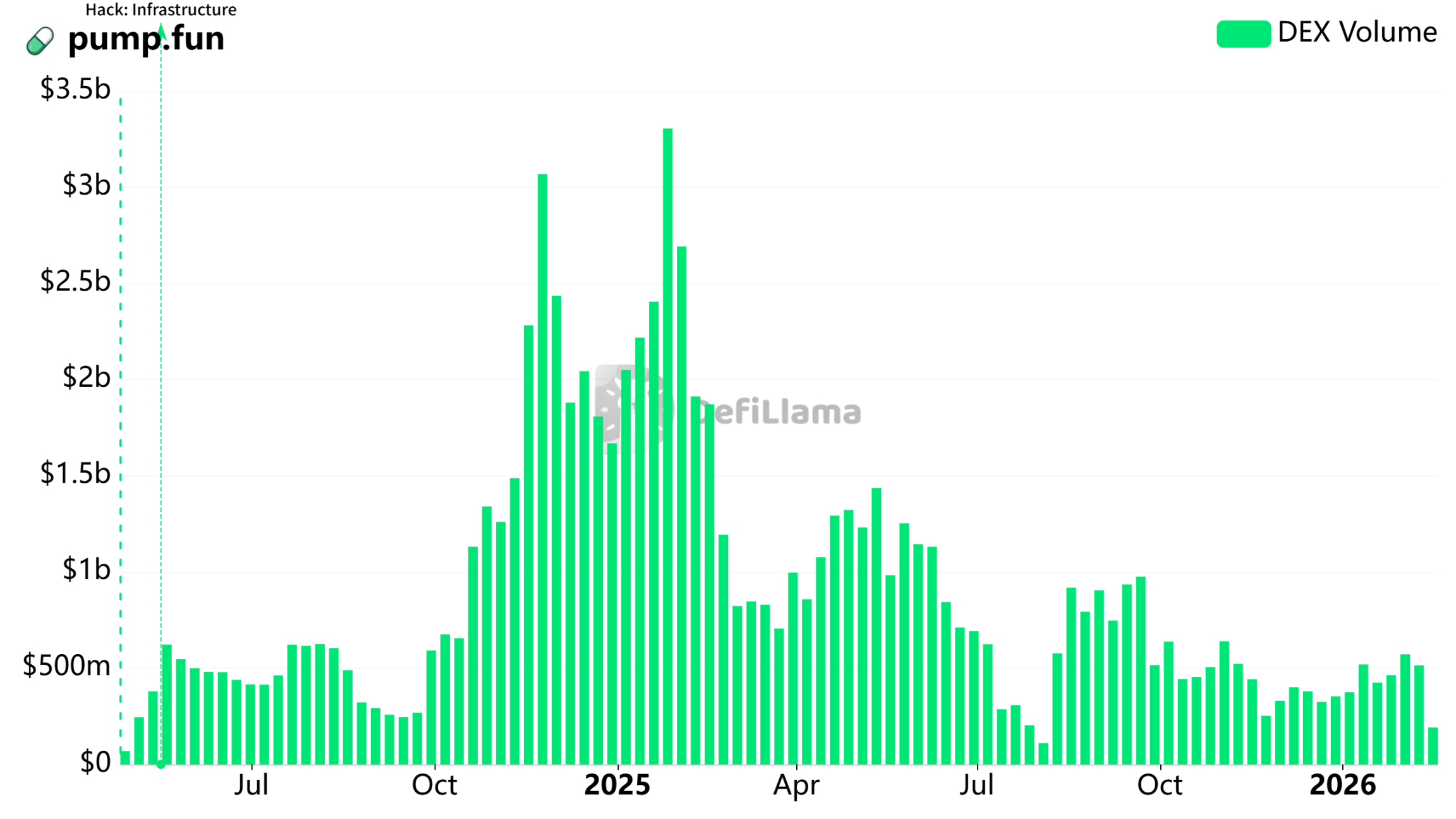
Defilama data shows that around the first few months of 2025, the transaction volume of the Meme platform pump.fun reached a historical high. The weekly transaction volume exceeded $3 billion twice, followed by a continuous decline. In early 2026, its transaction volume hovered around $500 million, one-sixth of its peak.

At the same time, some Meme traffic shifted to BNB Chain. BNB Chain rapidly rose through the Four.Meme platform. In the second half of 2025, Chinese-themed Memes like "Binance Life" and "I'm F*cking Coming" sparked FOMO sentiment. BNB Chain's Meme market capitalization grew from almost zero to hundreds of millions of dollars, with a 24-hour transaction volume reaching $460 million. In comparison, although Solana's Meme market capitalization still amounts to billions of dollars, growth has stagnated, with many projects falling over 95% from their peaks.

In October 2025, BNB Chain once replaced Solana on the trending Meme list, with obvious capital rotation: when BNB Chain Memes surged, Solana's capital contracted; after BNB Chain receded, capital partially flowed back, but the momentum had weakened. Furthermore, under the influence of influential figures CZ/He Yi, BNB Chain saw short-term growth stimulation, while Solana's Pump.fun, despite its first-mover advantage, weakened due to narrative exhaustion and a lack of incremental funds.

The end of the Meme wave means that the demand for its public chain token has also decreased simultaneously.

Public Chain Narrative Cools

Additionally, the overall cooling of the public chain narrative has further weakened Solana's ecosystem expansion plans. Between 2025-2026, the crypto market retreated from early high leverage and excessive narrative expansion. Many weak narratives, such as celebrity tokens and the Meme craze, quickly faded, shifting focus to areas with more practicality and institutional support. Solana's narrative as a "high-speed public chain" once attracted developers, but as the market entered the "deep water of value," investors tended to prefer mainstream assets like Bitcoin and Ethereum for their "digital gold" or "settlement layer" positioning, leading to a continued overall bear market and intensified capital outflow from Solana.

This narrative fatigue reflects that public chain competition has shifted from pure TPS competition to ecological maturity and regulatory adaptability. Solana's previous TPS and ecological advantages have been diluted. Whether in terms of Memes or airdrop incentives, Solana's appeal to new users has weakened.

Meanwhile, the significant speed improvement of the Ethereum mainnet has also weakened Solana's core advantage. Through the Fusaka upgrade in 2025, Ethereum increased data blob capacity from 3 to 6-9 and introduced the PeerDAS mechanism, significantly reducing transaction fees and increasing throughput. Transaction volume and active addresses subsequently rebounded.

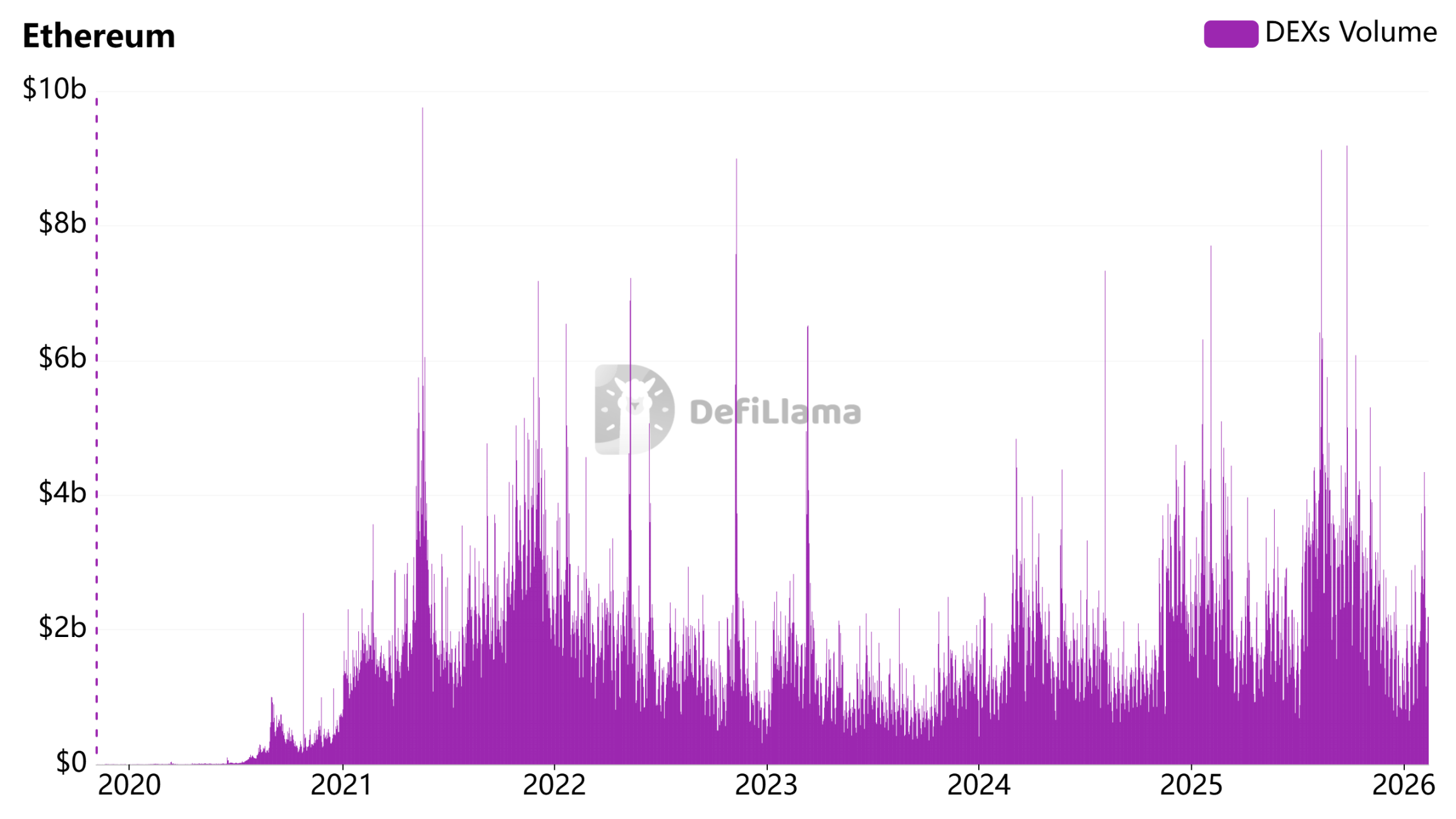
Data shows that DEX trading volume on Ethereum saw an overall upward trend in late 2025. Entering 2026, the Glamsterdam upgrade will achieve near-perfect parallel processing, further accelerating block verification and reducing fees, bringing the mainnet closer to an "operating system" level. These improvements bring Ethereum mainnet's TPS and cost close to Solana's levels, while retaining higher security and decentralization, reducing the necessity for users to switch to Solana.

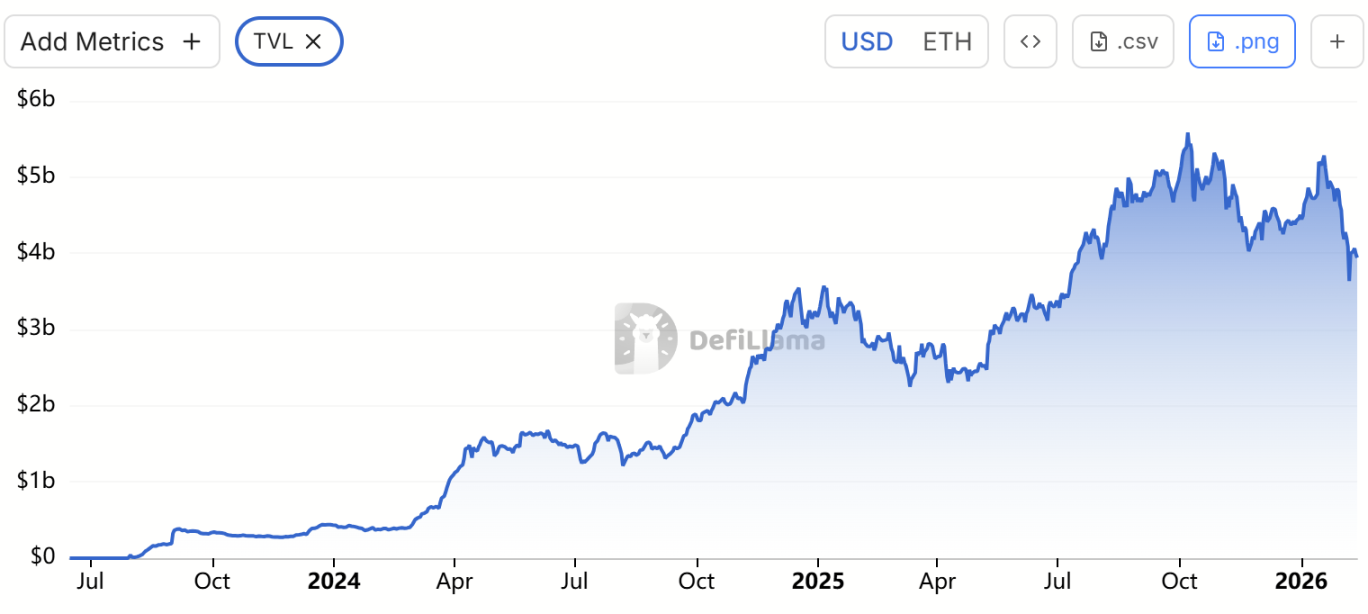
Another rising competitor, Base, is also growing rapidly, particularly with AI tokens attracting many users. According to DefiLlama data, its TVL is still maintained at a high level of $4 billion.

Under the tokenization boom, RWA occurs more on Ethereum, further marginalizing Solana's ecosystem. As of February 12, 2026, data from rwa.xyz shows that RWA assets on the Ethereum mainnet are $14.9 billion, while Solana is only $1.7 billion, still a significant gap. The tokenization trend of RWA emphasizes stability and compliance, with Ethereum's leading position making it difficult for Solana to get a share.

Digital Asset Treasury Buyers Fail to Offset Overall Bear Market Selling Pressure

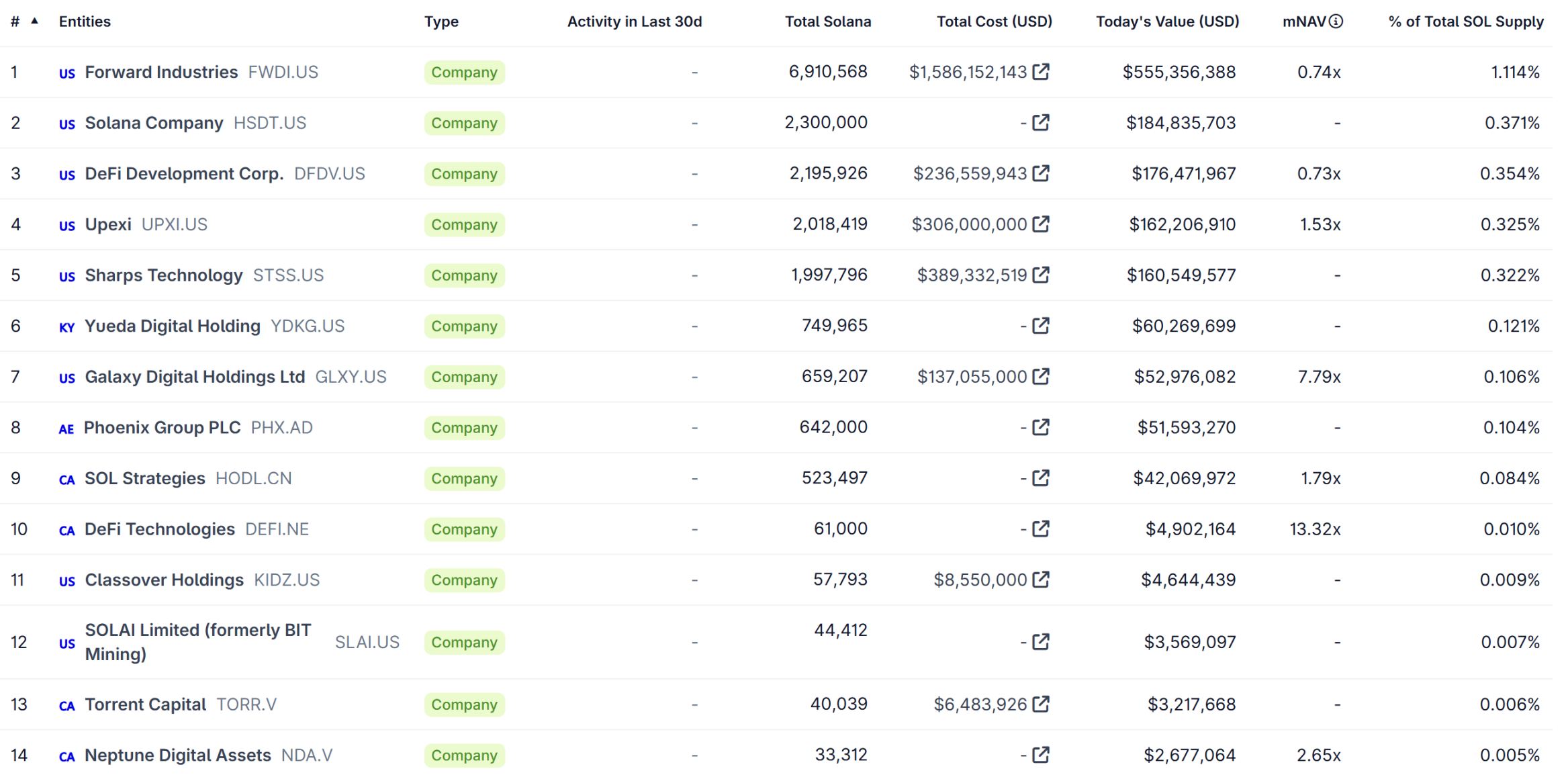
From the perspective of Digital Asset Treasuries (DAT), in 2025, the DAT model was once all the rage. Many publicly traded companies such as Forward Industries, Upexi, and Sharps Technology purchased large amounts of SOL as treasury assets through private financing or debt issuance.

Entering 2026, as the SOL price fell from the 2025 peak of around $200 to about $80, the market capitalization of these DAT companies shrank significantly. For example, Forward Industries spent $1.58 billion to purchase SOL, now worth only $555 million, shaking some investors' confidence.

Furthermore, the DAT buying frenzy has weakened, with fewer new joiners. Although the early purchased locked SOL reduces circulating supply, it has failed to offset the overall market bearish pressure.

Bitcoin and Ethereum prices have also been hit hard in the bear market of recent months. BTC fell from $126,000 to the current $67,000, and ETH fell from $4,900 to the current $2,000.

In January 2026, Solana founder toly asked on X in Chinese: What do you think is Solana's biggest challenge now? The comments section received a variety of feedback and answers, including: no direct exchange, users have less perception of other product ecosystems besides Meme, etc.

Perhaps Solana will find its own solutions.


Twitter:https://twitter.com/BitpushNewsCN

Bitpush TG Discussion Group:https://t.me/BitPushCommunity

Bitpush TG Subscription: https://t.me/bitpush

Original link:https://www.bitpush.news/articles/7611730

Связанные с этим вопросы

QWhat was the lowest price Solana (SOL) reached during the recent market crash, and what was its peak price during the bull run?

ADuring the market crash, Solana (SOL) fell to a low of $67, its lowest since December 2023. Its peak price during the bull run was $295.

QWhat was the primary driver of Solana's growth and activity during the recent bull cycle?

AThe primary driver was the Meme coin frenzy, which was largely facilitated by the Pump.fun platform on Solana, leading to massive daily token issuance and high trading volumes.

QWhich competing blockchain saw a rise in Meme coin activity, partially at the expense of Solana?

ABNB Chain saw a significant rise in Meme coin activity through its Four.Meme platform, attracting some of the Meme-related traffic and capital that was previously on Solana.

QHow did Ethereum's technical upgrades impact its competitive position against Solana?

AEthereum's Fusaka and upcoming Glamsterdam upgrades significantly increased its transaction throughput (TPS) and reduced fees, bringing its performance closer to Solana's while maintaining higher security and decentralization, thus reducing the incentive for users to switch to Solana.

QWhat is one major challenge for Solana's ecosystem mentioned in the article, beyond the decline of Meme coins?

AOne major challenge is the lack of user perception and engagement with products and ecosystems on Solana beyond Meme coins, as well as the overall cooling of the public chain narrative where investors are focusing more on established assets like Bitcoin and Ethereum.

Похожее

The Gold Buy-on-the-Dip Guide: Watch Interest Rates, Not Just War

"Gold Buying Guide: Focus on Interest Rates, Not Just War" Four months ago, gold buyers likely didn't anticipate buying at a peak that even a war couldn't sustain. After hitting a record high of $5,596 on January 29, gold entered a bear market just 91 days later, its fastest decline since 2008. A key trigger was the Fed's hawkish shift, highlighting that monetary policy, not geopolitics, is the primary driver. The article argues that the traditional "buy gold in turmoil" script has changed. While the US-Iran conflict initially boosted prices, the sustained rally in oil prices heightened inflation fears, forcing central banks to maintain or consider tighter policy. Since gold yields no interest, higher rates increase its opportunity cost, eroding its appeal. This dynamic was evident when gold fell sharply on May 18 despite positive peace talks, as lower oil prices eased inflation and thus rate hike pressures. The recent sell-off is also part of a broader market deleveraging. Correlations between gold, Nasdaq, and Bitcoin spiked as leveraged investors sold liquid assets to cover losses, creating a synchronized downturn. Historically, gold bottoms align with policy shifts, not conflict resolutions. The 2008 and 2022 bear markets ended with shifts to extreme easing and peak inflation expectations, respectively. For potential buyers, the author suggests monitoring three signals: 1) Peak interest rate hike expectations, 2) Reopening of the Strait of Hormuz (to ease oil/inflation pressure), and 3) A return to net inflows for Gold ETFs, indicating the end of forced selling. While predicting the exact bottom is impossible, the author's personal strategy involves scaling into a position across price levels like $4000, $3700, and $3500, committing no more than 30% of the intended total allocation initially, and adding the remainder only if key signals emerge. The core conclusion: In turbulent times, watching interest rates is more crucial than watching wars.

marsbit8 мин. назад

The Gold Buy-on-the-Dip Guide: Watch Interest Rates, Not Just War

marsbit8 мин. назад

Recent On-Chain Review: No Clear Narrative Under U.S. Stock Market Pressure, Just Hype

This article analyzes the current state of the Solana meme coin and community token ecosystem, highlighting a market caught between two dominant forces: attention-based PvP and a gradual return to community-centric projects. The first part explores the "Attention PvP" dynamic, where success is driven by celebrity endorsements, viral events, and speed. Examples include $JOTCHUA, which surged after its meme creator's social media activity, and $WORLDCUP, which outperformed a similar Base chain project ($PITCH) largely due to influencer support. The recent "pump.fun GO" feature, allowing bounty tasks for token promotion, is critiqued for fostering sensationalist and often negative stunts—like people getting token tickers tattooed on their bodies for rewards—reminiscent of old internet shock content. In contrast, the article points to a resurgence of organic, community-driven tokens that survive market volatility through strong holder bases and shared ideology, not just hype. Influencer Ansem is cited, arguing that durable meme coins rely on communities willing to endure losses and promote their core message daily. Examples given are older tokens like $neet (anti-work ethos), $troll, $buttcoin, and $triplet, which have maintained relative price stability. A prime example of this community-build model is the new project $KINS, the token for the browser-based MMORPG Kintara. Its success stems not from advanced graphics but from consistently delivering updates, fostering player trust, and creating genuine engagement (e.g., in-game economies, events, property auctions). It has attracted a growing player base and even notable KOLs as participants, demonstrating that sustainable growth can come from building trust rather than orchestrating pumps. The article concludes by questioning whether the market is ultimately a game of mutual trust or mutual deception, expressing hope that such reflection might lead to a healthier ecosystem.

marsbit8 мин. назад

Recent On-Chain Review: No Clear Narrative Under U.S. Stock Market Pressure, Just Hype

marsbit8 мин. назад

On-Chain Scene on Opening Day: $20 Billion Already Staked, How Do On-Chain Contracts Know Who Wins?

On the opening day of the 2026 World Cup, over $2 billion had already been wagered on just the "tournament winner" contracts on platforms like Polymarket and Kalshi. This article explores how these blockchain-based prediction markets actually function once the games begin. It breaks down the massive volume and explains how single-game and tournament-long contracts are priced, with values moving between 1-99 cents to reflect implied probabilities. A key mechanism highlighted is "elimination zeroing," where a team's "champion yes" contract immediately settles to zero once they are mathematically eliminated. The core technical question answered is: how does a smart contract "know" who won a real-world match? The answer lies in oracles. The article details two primary paradigms: UMA's "optimistic oracle" (used by most of Polymarket), which allows a challenge period after a proposed result, and Chainlink's multi-source data aggregation (used by FIFA partners like ADI Predictstreet), which automates settlement with minimal dispute windows. Finally, the article injects a note of caution, citing research estimating that a significant portion of historical trading volume on these platforms might be "wash trading" to inflate numbers. It concludes by contrasting the legal status of these "event contracts" under CFTC rules in the U.S. versus traditional, state-regulated sports betting. As the tournament progresses, the real-time operation of this multi-billion dollar machine—its settlements, eliminations, and underlying mechanisms—becomes a story as compelling as the football itself.

marsbit24 мин. назад

On-Chain Scene on Opening Day: $20 Billion Already Staked, How Do On-Chain Contracts Know Who Wins?

marsbit24 мин. назад

Sequoia Dialogue with Jensen Huang: Computing Model Undergoes a 60-Year Transformation; You Won't Be Replaced by AI, But You Will Be Dimensionality-Reduced by 'Those Who Master AI'

NVIDIA founder and CEO Jensen Huang, in a conversation with Sequoia Capital's Konstantine Buhler, argues that we are witnessing the most significant computing shift in 60 years—from retrieval-based to generative computing. Instead of just storing and retrieving data, future systems will generate highly personalized content (text, images, video) on demand, powered by massive "AI factories." Huang envisions a global "intelligence network" that will envelop the planet, following the historical patterns of energy and communication grids. He outlines a five-layer investment framework: 1) Energy, 2) Chips/Computers, 3) Infrastructure (data centers), 4) AI Models, and 5) Applications. He predicts this ecosystem will reach a scale of $20 trillion annually. Crucially, Huang pushes back against fears of AI-driven job loss. He distinguishes between specific "tasks" (e.g., typing, analyzing images) and overall "jobs" (e.g., CEO, radiologist). While AI automates tasks, it increases efficiency and demand for the higher-value problem-solving aspects of professions, thus creating more jobs and "up-leveling" careers. The real risk, he asserts, is not being replaced by AI, but being outperformed by someone who effectively leverages it. He urges everyone to embrace AI as a tool for augmented capability and innovation.

marsbit1 ч. назад

Sequoia Dialogue with Jensen Huang: Computing Model Undergoes a 60-Year Transformation; You Won't Be Replaced by AI, But You Will Be Dimensionality-Reduced by 'Those Who Master AI'

marsbit1 ч. назад

Торговля

Спот
Фьючерсы

Популярные статьи

Как купить MEME

Добро пожаловать на HTX.com! Мы сделали приобретение memecoin (MEME) простым и удобным. Следуйте нашему пошаговому руководству и отправляйтесь в свое крипто-путешествие.Шаг 1: Создайте аккаунт на HTXИспользуйте свой адрес электронной почты или номер телефона, чтобы зарегистрироваться и бесплатно создать аккаунт на HTX. Пройдите удобную регистрацию и откройте для себя весь функционал.Создать аккаунтШаг 2: Перейдите в Купить криптовалюту и выберите свой способ оплатыКредитная/Дебетовая Карта: Используйте свою карту Visa или Mastercard для мгновенной покупки memecoin (MEME).Баланс: Используйте средства с баланса вашего аккаунта HTX для простой торговли.Третьи Лица: Мы добавили популярные способы оплаты, такие как Google Pay и Apple Pay, для повышения удобства.P2P: Торгуйте напрямую с другими пользователями на HTX.Внебиржевая Торговля (OTC): Мы предлагаем индивидуальные услуги и конкурентоспособные обменные курсы для трейдеров.Шаг 3: Хранение memecoin (MEME)После приобретения вами memecoin (MEME) храните их в своем аккаунте на HTX. В качестве альтернативы вы можете отправить их куда-либо с помощью перевода в блокчейне или использовать для торговли с другими криптовалютами.Шаг 4: Торговля memecoin (MEME)С легкостью торгуйте memecoin (MEME) на спотовом рынке HTX. Просто зайдите в свой аккаунт, выберите торговую пару, совершайте сделки и следите за ними в режиме реального времени. Мы предлагаем удобный интерфейс как для начинающих, так и для опытных трейдеров.

823 просмотров всегоОпубликовано 2024.03.29Обновлено 2026.06.02

Как купить MEME

Что такое MEME 2.0

Memecoin 2.0: Восход $MEME 2.0 в мире криптовалют Введение В постоянно меняющемся ландшафте криптовалют появилось новое соперничество. Memecoin 2.0, символизируемый как $MEME 2.0, поднимает концепцию мем-коинов на захватывающий новый уровень. Являясь побочным продуктом оригинального Memecoin, этот проект привлек внимание крипто-сообщества, смещая акцент с типичных финансовых стимулов на вовлекающий и развлекательный опыт. Работающий на блокчейне Ethereum, Memecoin 2.0 смело переопределяет взаимодействие сообщества в криптосфере. Что такое Memecoin 2.0, $MEME 2.0? По сути, Memecoin 2.0 — это криптовалютный проект, который ставит на первое место дух сообщества и веселье, связанное с культурой мемов. В отличие от традиционных криптовалют, которые сосредоточены на практических случаях использования и ощутимых преимуществах, Memecoin 2.0 выделяется тем, что принимает легкую сторону цифровой валюты. Проект существует без обещаний полезности, структурированной дорожной карты или финансовых возвратов, сосредоточившись вместо этого на создании яркого сообщества вокруг мемов и совместного наслаждения. Таким образом, он использует растущую тенденцию мем-культуры в онлайн-пространстве, становясь уникальным игроком в мире цифровых активов. Создатель Memecoin 2.0, $MEME 2.0 Несмотря на обширные исследования происхождения Memecoin 2.0, явная идентичность его создателя остается неизвестной. Эта анонимность не является чем-то необычным в крипто-сообществе, где многие проекты возглавляют отдельные лица или группы, предпочитающие оставаться в тени. Отсутствие общедоступной информации о создателе можно рассматривать как стратегический ход, ставящий акцент на взаимодействие сообщества, а не на индивидуальную известность в этой сфере. Инвесторы Memecoin 2.0, $MEME 2.0 Информация о инвесторах или финансовой поддержке Memecoin 2.0 является скудной. Это отсутствие деталей может указывать на то, что проект либо финансируется самим собой, либо его внимание к сообществу, а не к традиционным инвестиционным структурам, привлекает другой тип сторонников. Поскольку мир мем-коинов обычно включает большее участие grassroots, чем институциональные инвестиции, этот подход соответствует философии проектов, управляемых сообществом. Как работает Memecoin 2.0, $MEME 2.0? Memecoin 2.0 полностью работает на блокчейне Ethereum, используя его надежные функции безопасности и масштабируемость. Используя преимущества Ethereum, Memecoin 2.0 может предложить безопасную среду для взаимодействия пользователей, обеспечивая при этом, чтобы транзакции были эффективными и экономичными. Одной из уникальных черт Memecoin 2.0 является его структура, ориентированная на сообщество. Ценность и популярность токена $MEME 2.0 вытекают из активного участия его пользователей, а не из внутренней полезности. Этот дизайн усиливает фокус проекта на развлекательной стороне криптовалюты, подразумевая, что смех и вовлеченность сообщества — это настоящие валюты, определяющие его успех. Более того, проект вписывается в более широкую экосистему мем-коинов, где ценность каждого мем-коина колеблется на основе культуры, трендов и вовлеченности сообщества, а не традиционных экономических принципов. Хронология Memecoin 2.0, $MEME 2.0 Чтобы лучше понять эволюцию и ключевые моменты Memecoin 2.0, вот хронология, подчеркивающая значимые события в его истории: 2024: Создание Memecoin 2.0 признается как ответвление от оригинального Memecoin, утвердившее себя в процветающем контексте мем-коинов, работая на блокчейне Ethereum. 13 июля 2024: Memecoin 2.0 официально позиционирует себя как мем-коин, ориентированный на сообщество, в сети Ethereum, подчеркивая свой развлекательный подход, который приглашает пользователей участвовать и способствовать его росту. Ключевые моменты о Memecoin 2.0, $MEME 2.0 Несколько критических характеристик определяют Memecoin 2.0: Подход, ориентированный на сообщество: Главная миссия Memecoin 2.0 — создать веселый и увлекательный опыт взаимодействия в сообществе, используя общее наслаждение, полученное от меметической культуры. Построен на Ethereum: Работа на блокчейне Ethereum предоставляет проекту необходимую инфраструктуру, которая обеспечивает безопасность и масштабируемость. Отсутствие полезности или дорожной карты: В резком отличии от традиционных криптовалют, Memecoin 2.0 не обещает никаких утилитарных функций или финансовых возвратов, подтверждая свою приверженность к вовлеченности сообщества и социальному взаимодействию. Фокус на меметической культуре: Принимая юмористические и культурные аспекты мем-феномена, Memecoin 2.0 предоставляет платформу для пользователей взаимодействовать с криптовалютой как офлайн, так и онлайн. Дополнительный контекст: Значение мем-коинов Мем-коины стали отдельным классом криптовалют, часто движимыми юмором и легкомысленным подходом к торговле. Эти монеты, как правило, не имеют значительной полезности или дорожных карт разработки, привлекая пользователей обещанием веселья, взаимодействия в сообществе и культурной значимости. В ландшафте более широкой криптоэкосистемы мем-коины восстанавливают важность вовлеченности сообщества, противодействуя исключительно ориентированным на прибыль подходам. Проекты, такие как Memecoin 2.0, открывают эру, где развлечение может гармонировать с финансовыми устремлениями, превращая блокчейн в игровую площадку для творчества и социального взаимодействия. Заключение Memecoin 2.0, или $MEME 2.0, олицетворяет новую волну криптовалют, которая ставит вовлеченность сообщества выше жестких финансовых структур. С акцентом на юмор и социальное взаимодействие, он использует увлечение, окружающее мем-культуру. Работая на блокчейне Ethereum, Memecoin 2.0 использует возможности технологии, оставаясь верным своему обязательству к развлекательной ценности цифровой валюты. Поскольку пространство вокруг криптовалют продолжает развиваться, Memecoin 2.0 служит свидетельством той мысли, что будущее цифровых активов может хорошо зависеть от общих опытов, смеха и крепких связей в сообществе. В непредсказуемом мире крипты, возможно, радость может быть столь же ценна, как и традиционная финансовая прибыль.

128 просмотров всегоОпубликовано 2024.04.04Обновлено 2024.12.03

Что такое MEME 2.0

Обсуждения

Добро пожаловать в Сообщество HTX. Здесь вы сможете быть в курсе последних новостей о развитии платформы и получить доступ к профессиональной аналитической информации о рынке. Мнения пользователей о цене на MEME (MEME) представлены ниже.

活动图片