Ethereum Unveils Post-Quantum Security Roadmap For Institutions

bitcoinistОпубликовано 2026-03-24Обновлено 2026-03-24

Введение

Ethereum has publicly formalized its post-quantum security roadmap, targeting a critical threat to its cryptographic foundations. Presented at the Institutional Ethereum Forum, researcher Will Corcoran outlined the risks quantum computers pose to elliptic-curve cryptography, which secures validator attestations, transactions, and wallet signatures. The core challenge is not just replacing signatures but managing the trade-offs: the proposed hash-based scheme, LeanSig, is significantly larger than current BLS signatures, threatening bandwidth and decentralization if naively implemented. Ethereum's solution pairs LeanSig with a STARK-based aggregation engine called Lean Multisig to compress signature data, making it viable. With a cryptographically relevant quantum computer estimated by 2032, Ethereum is targeting key upgrades for its 2029 hard fork. The effort, involving extensive research and testing, is positioned to set a new industry standard for all proof-of-stake blockchains facing this unavoidable scaling problem.

Ethereum is beginning to formalize its post-quantum security push in public. ETH Foundation researcher Will Corcoran used a presentation at the Institutional Ethereum Forum in New York to lay out both the threat model and the protocol work already underway. The effort matters well beyond ETH, he argued, because the core bottleneck is not unique to one chain: every proof-of-stake network built on today’s cryptographic assumptions will eventually face the same scaling problem.

Alongside the talk, the Ethereum Foundation launched pq.ethereum.org, a new portal that packages the project’s roadmap, technical resources, FAQs for institutions, and a registration form for a post-quantum retreat in Cambridge in October 2026. Corcoran framed the site as a way to consolidate years of research and answer what he described as growing inbound interest from institutions asking how Ethereum plans to prepare for a future in which quantum computers can break elliptic-curve cryptography.

Ethereum Eyes Post-Quantum Industry Standard

That future is still projected to be years away, but Corcoran said Ethereum is already working against a tight window. He pointed to current estimates for “Q-Day”: the arrival of a cryptographically relevant quantum computer, clustering around 2032, while the current roadmap targets key post-quantum components for the protocol’s “L” or “M” fork, roughly around 2029.

The presentation’s core argument was that post-quantum security cannot be reduced to a simple signature swap. Ethereum today relies on elliptic-curve cryptography across the stack: validator attestations at the consensus layer, blob proof data at the data layer, and transaction and wallet signatures at the execution layer. If that cryptography is broken, large parts of the network’s security model break with it.

But replacing it introduces a second-order problem. Ethereum’s current BLS signatures are compact and aggregate extremely efficiently: 10,000 signatures still compress to 96 bytes. The proposed post-quantum replacement, a hash-based scheme Corcoran called Lean Sig, is around 3,000 bytes per signature, and naively aggregating them would produce roughly 30 megabytes of data per slot.

That tradeoff is not merely an engineering inconvenience. Corcoran repeatedly tied it back to Ethereum’s decentralization constraint, arguing that bigger signatures would raise bandwidth requirements, reduce the number of viable home validators, and weaken the chain’s security properties. In his telling, the entire design challenge is downstream from that point.

“So making Ethereum post quantum secure isn’t just as simple as swapping out the signature schemes because that one change cascades through everything else,” he said. “Bigger signatures would result in more bandwidth that would result in fewer home validators, less decentralization, and weaker security guarantees. So that one change cascades through everything.”

Ethereum’s proposed answer is a pairing of LeanSig with a proving system called Lean Multisig, which Corcoran described as a STARK-based aggregation engine. Instead of forwarding all of the signatures directly, the system aims to prove that they were verified correctly and compress the output to around 125 kilobytes. He called that roughly 250x compression “the moon math” that makes post-quantum consensus viable on Ethereum.

Corcoran also used the talk to stress that this is no longer a purely theoretical research thread. He said Ethereum is already running devnets with 10 client teams, has shipped four devnets so far, and is building around three-slot finality and four-second slots as a design basis. The broader effort, he added, spans more than eight years of research, about $25 million in funding, and roughly 1,500 contributors across more than 250 organizations and teams.

For Ethereum, the immediate message is that post-quantum readiness is becoming a visible part of its long-range protocol agenda. For the rest of crypto, Corcoran’s claim was broader.

“Really, every proof of stake blockchain faces the same challenge, and that challenge is the ability to aggregate at scale hash based signatures. It’s nonnegotiable,” he said. “When we succeed in shipping LeanSig and LeanMultisig and Lean consensus, we think that this could really become the de facto industry standard.”

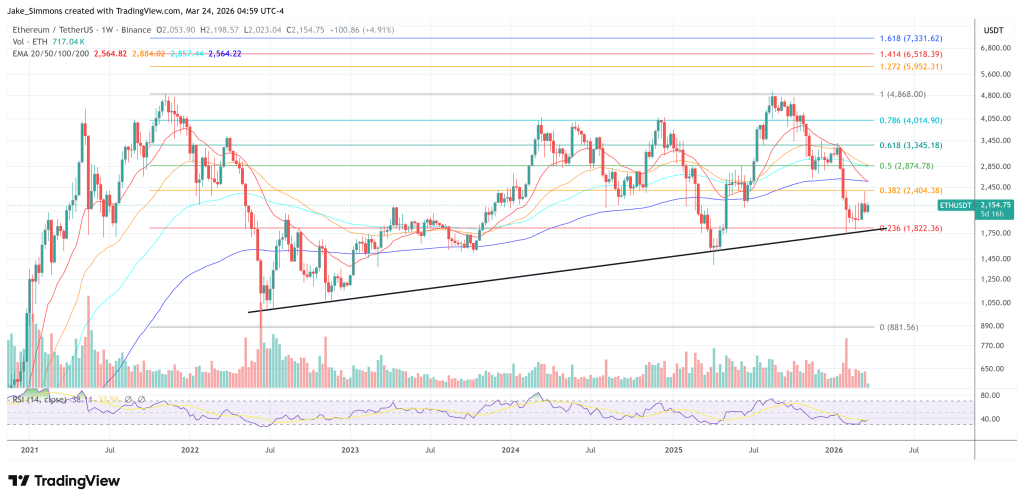
At press time, ETH traded at $2,154.

ETH must break above the 0.382 Fib, 1-week chart | Source: ETHUSDT on TradingView.com

Связанные с этим вопросы

QWhat is the main purpose of Ethereum's new portal pq.ethereum.org?

AThe portal pq.ethereum.org packages the project's post-quantum roadmap, technical resources, FAQs for institutions, and a registration form for a post-quantum retreat in Cambridge in October 2026. It serves to consolidate years of research and address growing institutional interest in Ethereum's quantum preparedness.

QWhy can't Ethereum simply swap its current BLS signatures with a post-quantum alternative?

AA simple signature swap is insufficient because the proposed post-quantum replacement, LeanSig, is significantly larger (around 3,000 bytes per signature vs. BLS's 96 bytes for 10,000 signatures). This size increase would drastically raise bandwidth requirements, reduce the number of viable home validators, and weaken the network's decentralization and security.

QWhat is the estimated timeline for 'Q-Day' and how does it relate to Ethereum's development schedule?

ACurrent estimates for 'Q-Day' (the arrival of a cryptographically relevant quantum computer) cluster around 2032. Ethereum's roadmap targets key post-quantum components for its 'L' or 'M' fork, which is roughly scheduled for around 2029.

QWhat two technologies form the core of Ethereum's proposed post-quantum solution?

AThe core technologies are LeanSig, a hash-based signature scheme, and Lean Multisig, a STARK-based aggregation engine that compresses the verification of multiple signatures to around 125 kilobytes, achieving roughly 250x compression.

QAccording to the researcher, why is Ethereum's post-quantum challenge relevant to the broader crypto industry?

AThe researcher argues that every proof-of-stake blockchain faces the same fundamental challenge: the need to aggregate hash-based signatures at scale. He believes that if Ethereum succeeds with its LeanSig and LeanMultisig solution, it could become the de facto industry standard for post-quantum security.

Похожее

Google and Amazon Simultaneously Invest Heavily in a Competitor: The Most Absurd Business Logic of the AI Era Is Becoming Reality

In a span of four days, Amazon announced an additional $25 billion investment, and Google pledged up to $40 billion—both direct competitors pouring over $65 billion into the same AI startup, Anthropic. Rather than a typical venture capital move, this signals the latest escalation in the cloud wars. The core of the deal is not equity but compute pre-orders: Anthropic must spend the majority of these funds on AWS and Google Cloud services and chips, effectively locking in massive future compute consumption. This reflects a shift in cloud market dynamics—enterprises now choose cloud providers based on which hosts the best AI models, not just price or stability. With OpenAI deeply tied to Microsoft, Anthropic’s Claude has become the only viable strategic asset for Google and Amazon to remain competitive. Anthropic’s annualized revenue has surged to $30 billion, and it is expanding into verticals like biotech, positioning itself as a cross-industry AI infrastructure layer. However, this funding comes with constraints: Anthropic’s independence is challenged as it balances two rival investors, its safety-first narrative faces pressure from regulatory scrutiny, and its path to IPO introduces new financial pressures. Globally, this accelerates a "tri-polar" closed-loop structure in AI infrastructure, with Microsoft-OpenAI, Google-Anthropic, and Amazon-Anthropic forming exclusive model-cloud alliances. In contrast, China’s landscape differs—investments like Alibaba and Tencent backing open-source model firm DeepSeek reflect a more decoupled approach, though closed-source models from major cloud providers still dominate. The $65 billion bet is ultimately about securing a seat at the table in an AI-defined future—where missing the model layer means losing the cloud war.

marsbit5 ч. назад

Google and Amazon Simultaneously Invest Heavily in a Competitor: The Most Absurd Business Logic of the AI Era Is Becoming Reality

marsbit5 ч. назад

Computing Power Constrained, Why Did DeepSeek-V4 Open Source?

DeepSeek-V4 has been released as a preview open-source model, featuring 1 million tokens of context length as a baseline capability—previously a premium feature locked behind enterprise paywalls by major overseas AI firms. The official announcement, however, openly acknowledges computational constraints, particularly limited service throughput for the high-end DeepSeek-V4-Pro version due to restricted high-end computing power. Rather than competing on pure scale, DeepSeek adopts a pragmatic approach that balances algorithmic innovation with hardware realities in China’s AI ecosystem. The V4-Pro model uses a highly sparse architecture with 1.6T total parameters but only activates 49B during inference. It performs strongly in agentic coding, knowledge-intensive tasks, and STEM reasoning, competing closely with top-tier closed models like Gemini Pro 3.1 and Claude Opus 4.6 in certain scenarios. A key strategic product is the Flash edition, with 284B total parameters but only 13B activated—making it cost-effective and accessible for mid- and low-tier hardware, including domestic AI chips from Huawei (Ascend), Cambricon, and Hygon. This design supports broader adoption across developers and SMEs while stimulating China's domestic semiconductor ecosystem. Despite facing talent outflow and intense competition in user traffic—with rivals like Doubao and Qianwen leading in monthly active users—DeepSeek has maintained technical momentum. The release also comes amid reports of a new funding round targeting a valuation exceeding $10 billion, potentially setting a new record in China’s LLM sector. Ultimately, DeepSeek-V4 represents a shift toward open yet realistic infrastructure development in the constrained compute landscape of Chinese AI, emphasizing engineering efficiency and domestic hardware compatibility over pure model scale.

marsbit5 ч. назад

Computing Power Constrained, Why Did DeepSeek-V4 Open Source?

marsbit5 ч. назад

Торговля

Спот
Фьючерсы

Популярные статьи

Manyu: восходящая мем-звезда на Ethereum, готовая открыть новую эру культуры Shiba

Manyu - это мемтокен на Ethereum, который приносит децентрализованную культурную и развлекательную ценность через вирусное влияние в соцсетях и вовлечённость сообщества.

1.9k просмотров всегоОпубликовано 2025.11.27Обновлено 2025.11.27

Manyu: восходящая мем-звезда на Ethereum, готовая открыть новую эру культуры Shiba

Обсуждения

Добро пожаловать в Сообщество HTX. Здесь вы сможете быть в курсе последних новостей о развитии платформы и получить доступ к профессиональной аналитической информации о рынке. Мнения пользователей о цене на ETH (ETH) представлены ниже.

活动图片