Ethereum Roadmap Could Advance Faster With AI, Vitalik Buterin Says

bitcoinistОпубликовано 2026-03-02Обновлено 2026-03-02

Введение

Vitalik Buterin suggests that AI could significantly accelerate Ethereum's development roadmap, citing an experiment where an AI-built client (ETH2030) was created in six days for $5,750. The prototype, covering 65 roadmap items, demonstrates potential but has limitations and bugs. Buterin emphasizes that AI should enhance both speed and security through formal verification and extensive testing. While not production-ready, the experiment highlights Ethereum's ambitious goals, including 10,000+ TPS and faster finality, and underscores that AI could help complete the roadmap faster and more securely than expected.

Ethereum’s long-range protocol roadmap may move faster than many expect as AI tools improve, according to Vitalik Buterin, who pointed to a recent experiment that used agentic coding to assemble an ambitious reference client spanning much of Ethereum’s planned 2030-era architecture.

The comment came after developer Jiayao Qi, posting as YQ via X, unveiled ETH2030, an experimental Ethereum client built to target the network’s draft “2030+” roadmap. The project weighs in at 702,000 lines of Go, covers 65 roadmap items across eight phases, passes 36,126 official Ethereum state tests, and can sync with mainnet through an integration with go-ethereum v1.17.0. Qi said the client was built in roughly six days using Claude Code at a cost of about $5,750 and 2.77 billion tokens.

AI Could Speed Up Ethereum Roadmap

Buterin called the effort “quite an impressive experiment,” while also stressing that a prototype built at that speed comes with obvious limits. “Such a thing built in two weeks without even having the EIPs has massive caveats,” he wrote. “Almost certainly lots of critical bugs, and probably in some cases ‘stub’ versions of a thing where the AI did not even try making the full version. But six months ago, even this was far outside the realm of possibility, and what matters is where the trend is going.”

That distinction mattered more to Buterin than the raw demo itself. In his view, AI is not just compressing development time. It could change how Ethereum engineers approach assurance. “Probably, the right way to use it, is to take half the gains from AI in speed, and half the gains in security,” he said. “Generate more test-cases, formally verify everything, make more multi-implementations of things.”

He tied that directly to ongoing formal verification work around Ethereum. Referring to the Lean Ethereum effort, Buterin said one collaborator had already used AI to produce a machine-verifiable proof of a complex theorem underpinning STARK security. “A core tenet of @leanethereum is to formally verify everything, and AI is greatly accelerating our ability to do that,” he wrote. “Aside from formal verification, simply being able to generate a much larger body of test cases is also important.”

ETH2030 itself was presented less as a candidate client than as a stress test for the roadmap. Qi repeatedly framed it as a rough draft, not production software, and argued that its value lies in forcing hard engineering questions into the open now rather than years from now.

The roadmap, as implemented in the project, aims at a version of Ethereum with 10,000-plus TPS on L1, finality in seconds instead of 15 minutes, solo staking for 1 ETH, stateless nodes running on a $7 Raspberry Pi, and more than 1 million TPS across L1 and L2. But the experiment also surfaced deep coupling between upgrades, from block access lists and gas repricing to PeerDAS, native rollups and fast finality.

Qi was blunt about the gaps. Pure-Go cryptographic implementations lag production code by roughly 10x to 100x, the consensus logic has not been battle-tested on a live beacon chain, and the jump from roughly 5 million gas per second today to a 1 billion gas-per-second target remains highly speculative under real-world MEV and contract dependency patterns.

Buterin did not claim AI would make those problems disappear. In fact, he cautioned against expecting a secure protocol from a single prompt. “There WILL be lots of wrestling with bugs and inconsistencies between implementations,” he wrote. “But even that wrestling can happen 5x faster and 10x more thoroughly.”

That, more than the headline numbers, is the point now in front of Ethereum researchers and client teams. If AI can speed both implementation and verification, the roadmap may not just be a distant architectural sketch. As Buterin put it, people should at least be open to the “possibility” that Ethereum’s roadmap could be completed “much faster than people expect, at a much higher standard of security than people expect.”

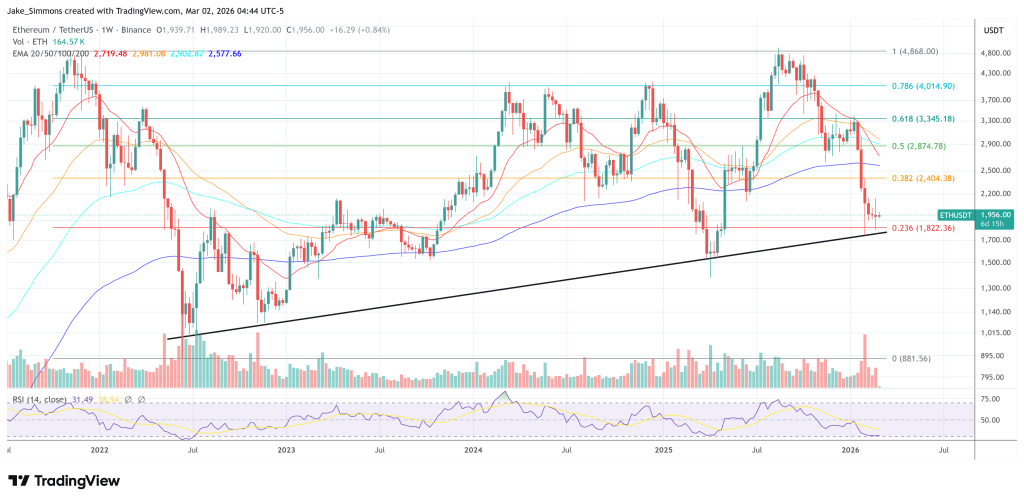
At press time, ETH traded at $1,956.

ETH remains above the black trendline, 1-week chart | Source: ETHUSDT on TradingView.com

Связанные с этим вопросы

QWhat is the ETH2030 project and how was it created?

AETH2030 is an experimental Ethereum client built to target the network's draft '2030+' roadmap. It was created by Jiayao Qi (YQ) using Claude Code in roughly six days at a cost of about $5,750 and 2.77 billion tokens. The project consists of 702,000 lines of Go code, covers 65 roadmap items across eight phases, passes 36,126 official Ethereum state tests, and can sync with mainnet.

QAccording to Vitalik Buterin, how should AI be used to advance Ethereum's development?

AButerin suggests that the right way to use AI is to take half the gains in development speed and half the gains in security. This includes generating more test cases, formally verifying everything, and creating more multi-implementations of components to enhance both development efficiency and protocol assurance.

QWhat are some of the key goals outlined in Ethereum's 2030-era roadmap as implemented in the ETH2030 project?

AThe roadmap aims for a version of Ethereum with 10,000-plus TPS on L1, finality in seconds instead of 15 minutes, solo staking for 1 ETH, stateless nodes running on a $7 Raspberry Pi, and more than 1 million TPS across L1 and L2.

QWhat limitations and caveats did both Qi and Buterin highlight about the ETH2030 experiment?

AThey highlighted that the prototype has massive caveats, including almost certainly lots of critical bugs, 'stub' versions where the AI didn't make full implementations, untested consensus logic on a live beacon chain, and cryptographic implementations that lag production code by 10x to 100x. Buterin also cautioned that a secure protocol cannot be built from a single prompt.

QHow does Buterin view the potential impact of AI on Ethereum's development timeline and security standards?

AButerin believes AI could allow Ethereum's roadmap to be completed 'much faster than people expect, at a much higher standard of security than people expect.' He emphasizes that while wrestling with bugs and inconsistencies will still occur, AI can make this process 5x faster and 10x more thorough.

Похожее

380,000 Apps Exposed, 2,000+ Apps Leaked Secrets: AI Programming Turns 'Intranet' into Public Internet

Israeli cybersecurity firm RedAccess uncovered a severe data exposure trend linked to "vibe coding" or AI-powered software development tools. Their research found approximately 38,000 publicly accessible web applications built with platforms like Lovable, Base44, Netlify, and Replit. Of these, an estimated 2,000 apps exposed sensitive corporate and personal data, including medical records, financial information, internal strategic documents, and customer chat logs. In some cases, access even granted administrative privileges. The core issue stems from default privacy settings that make applications public by default, combined with a lack of built-in security controls (like authentication) in the AI-generated code. This allows employees without security expertise—"citizen developers"—to easily create and deploy applications that bypass standard corporate security reviews. The exposed apps, often indexed by search engines, are trivially discoverable. While some platform providers (Replit, Lovable, Wix/Base44) argue that security configuration is the user's responsibility and question the validity of some findings, security researchers confirm the widespread reality of such exposures. This pattern, also noted in prior studies, highlights a critical security gap as AI democratizes app creation, potentially leading to massive, unintentional data leaks.

marsbit9 мин. назад

380,000 Apps Exposed, 2,000+ Apps Leaked Secrets: AI Programming Turns 'Intranet' into Public Internet

marsbit9 мин. назад

Attracting Global Capital, Asia's New 'Super Cycle' Is Unfolding

Investors are turning to Asia as the next frontier for global equity growth, with a new "super cycle" unfolding across the region. Driven by the AI revolution, Asian markets, particularly South Korea, have seen significant rallies. According to Morgan Stanley analysis, the underlying drivers of Asia's industrial cycle are shifting from traditional sectors like real estate and manufacturing to massive investments in AI infrastructure, energy security and transition, and supply chain resilience. Fixed asset investment in Asia is projected to grow from around $11 trillion in 2025 to $16 trillion by 2030, with a 7% annual growth rate from 2026-2030. The AI wave is a primary catalyst, driving immense capital expenditure for chips, servers, data centers, and power systems. Asia is central to this hardware supply chain. In China, AI investment is focused on building a full-system domestic capability, with the local AI chip market potentially reaching $86 billion by 2030. Beyond AI, China's export story is expanding from EVs and batteries to robotics. The country already captures about half of new global industrial robot demand and over 90% of humanoid robot shipments. This growth phase mirrors the early stages of China's EV export boom. Simultaneously, energy security investments, spurred by AI's massive power needs, are rising, with China benefiting from its leadership in solar, batteries, and EVs. Regional defense spending is also increasing structurally, supporting demand for advanced manufacturing. The main beneficiaries are China, South Korea, and Japan, positioned in core supply chain areas. However, risks remain, including potential overcapacity, profit margin pressures from competition, persistent technological restrictions, geopolitical friction, and workforce displacement due to AI-driven automation. Market volatility is also expected to increase as investor expectations diverge on the realization of these capital investment and export themes.

marsbit10 мин. назад

Attracting Global Capital, Asia's New 'Super Cycle' Is Unfolding

marsbit10 мин. назад

Funding Weekly Report | 14 Public Funding Events, Kalshi Completes $10B New Funding Round at $220B Valuation Led by Coatue Management

Weekly Funding Roundup: 14 Deals and $10.49B+ in Total Funding, Led by Kalshi's $1B Round Last week (5.4-5.10) saw 14 notable funding events in the global blockchain ecosystem, raising over $10.49 billion in total. Key highlights include Kalshi, a prediction market platform, securing a $1 billion round led by Coatue Management, reaching a $22 billion valuation. The platform now boasts ~2 million MAUs and $178B in annualized trading volume. In DeFi, regulated on-chain reinsurer OnRe raised $5 million in Series A funding, and Bitcoin-backed credit protocol Saturn Credit completed a $2 million seed round. For Infrastructure & Tools, OpenTrade raised $17 million to expand its stablecoin yield infrastructure, and RWA platform Balcony secured $12.7 million to deploy its property settlement service in the US. Centralized Finance saw one deal: AI-driven trading platform Stockcoin.ai completed a seed round led by Amber Group. In the prediction market sector alongside Kalshi, AI-powered platform Elastics raised $2 million. Other notable deals include SC Ventures' strategic investment in crypto market maker GSR and Centrifuge securing a "seven-figure" investment from Coinbase to become a core RWA partner for Base. On the investor side, Haun Ventures raised a new $1 billion fund targeting crypto and AI, and Multi Investment raised ~$616 million to focus on blockchain and Web3 investments.

marsbit1 ч. назад

Funding Weekly Report | 14 Public Funding Events, Kalshi Completes $10B New Funding Round at $220B Valuation Led by Coatue Management

marsbit1 ч. назад

Торговля

Спот
Фьючерсы

Популярные статьи

Manyu: восходящая мем-звезда на Ethereum, готовая открыть новую эру культуры Shiba

Manyu - это мемтокен на Ethereum, который приносит децентрализованную культурную и развлекательную ценность через вирусное влияние в соцсетях и вовлечённость сообщества.

1.9k просмотров всегоОпубликовано 2025.11.27Обновлено 2025.11.27

Manyu: восходящая мем-звезда на Ethereum, готовая открыть новую эру культуры Shiba

Неделя обучения по популярным токенам 14: Glamsterdam — самое ожидаемое обновление Ethereum в 2026 году

Ordinals/Runes по-прежнему стимулируют доходы от комиссий за блоки и активность разработчиков, рассматриваются как отправная точка «нативной эмиссии активов» в сети.

1.3k просмотров всегоОпубликовано 2026.04.29Обновлено 2026.04.29

Неделя обучения по популярным токенам 14: Glamsterdam — самое ожидаемое обновление Ethereum в 2026 году

Обсуждения

Добро пожаловать в Сообщество HTX. Здесь вы сможете быть в курсе последних новостей о развитии платформы и получить доступ к профессиональной аналитической информации о рынке. Мнения пользователей о цене на ETH (ETH) представлены ниже.

活动图片