Ethereum Foundation President Breaks Silence On New Mandate And Internal Tensions

bitcoinistОпубликовано 2026-06-02Обновлено 2026-06-02

Введение

Ethereum Foundation (EF) President Aya Miyaguchi has outlined the organization's new, more focused mandate, framing it as a necessary reset after internal debates became strained and the EF faced competing expectations. She explained the shift is not a retreat but reflects Ethereum's maturity beyond its original institution. The EF, holding less than 0.2% of all ETH, will now concentrate on preserving Ethereum's core properties like user self-sovereignty and coordination, acting as one node among many rather than a central command. Miyaguchi's comments follow co-founder Vitalik Buterin's own post on the EF's direction. She acknowledged a wave of high-profile departures in 2026, stating that a more focused EF naturally leads to a smaller, more concentrated team, with new leaders stepping in. The restructuring aims to ensure the EF accelerates what makes Ethereum uniquely valuable, while coordinating with allies who share that mission.

Ethereum Foundation President Aya Miyaguchi has laid out her view of the organization’s new mandate, framing the shift as a necessary reset after internal debates became increasingly strained and the Foundation faced pressure to be too many things at once.

Her comments, posted on X after Vitalik Buterin shared his own view of the Foundation’s direction, arrive during a sensitive period for Ethereum’s core nonprofit. The EF is moving toward a smaller, more focused structure while the broader ecosystem debates its governance role, technical priorities and a wave of high-profile departures.

Ethereum Foundation Enters New Power Era

Miyaguchi said the mandate came from the board, but that she proposed it late last year. The trigger, in her telling, was not a single dispute but a structural problem: EF had become a focal point for competing expectations.

“First, debates that were meant to be technical had started to become political and personal, and at times shaped by quieter incentives,” she wrote. “Second, as EF grew, more and more versions of ‘what EF should be’ began pulling at the core of the organization from every direction at once. I became convinced that trying to satisfy all of them would leave us achieving nothing at all.”

That line goes to the center of the Foundation’s dilemma. Ethereum has long relied on EF for research funding, coordination and stewardship, but its culture has also resisted the idea that any single entity should become Ethereum’s command center. Miyaguchi leaned heavily into that tension, arguing that EF’s reduced centrality is not a retreat from responsibility but proof that Ethereum has matured beyond its first institution.

“We have said it many times: EF is one of many nodes in Ethereum,” she wrote. “I know that is hard to hear for some, because EF was the first group, and in the early years it was essential for making things happen. But it was never meant to stay that way.”

Miyaguchi connected that philosophy to her own history in crypto, noting that she has been in the sector since 2012 and joined Kraken in 2013 shortly before the collapse of Mt. Gox, which she said she helped clean up. That experience, she argued, shaped her understanding of both growth and centralization risk. When she became executive director in 2018, her goal was to help Ethereum grow beyond EF.

The Foundation, she said, made deliberate choices to distribute power rather than retain control. Miyaguchi pointed to EF’s role in incubating and releasing projects such as Uniswap and ENS, supporting ETHGlobal and hackathons, and “funding the funders” through groups such as Gitcoin and Moloch. The guiding question, she said, was always: “how does this stand on its own, without us?”

That strategy, according to Miyaguchi, has left EF with less than 0.2% of all ETH and a role that is now narrower by design. The mandate, she said, is to preserve and accelerate the properties and goals that make Ethereum “uniquely valuable, competitive, and worth building on,” centered on what she called CROPS and “inalienable user self-sovereignty and self-sovereign coordination.”

“We cannot do it alone, and we do not intend to,” she wrote. “But defining this as the north star for the mission, and coordinating with the allies who share it, is the responsibility we are keeping.”

Miyaguchi also pushed back against the idea that a sharper EF means less concern for adoption. She said the opposite is true, arguing that everyday users and institutions both depend on Ethereum’s underlying value proposition. Adoption, including institutional adoption, remains part of EF’s work, she said, but only in ways that fit the mission.

The comments come as EF has seen a notable exodus of senior and high-profile contributors in 2026, including researchers and ecosystem figures such as Carl Beekhuizen, Julian Ma, Barnabé Monnot, Tim Beiko, Trent Van Epps, Josh Stark and former co-executive director Tomasz Stańczak. That turnover has intensified scrutiny over whether the Foundation’s restructuring is a sign of healthy decentralization, internal strain, or both.

Miyaguchi acknowledged the personnel implications directly. “As EF becomes more focused and more opinionated, the team naturally becomes smaller and more concentrated. That is part of the choice,” she wrote, adding that new leaders are already stepping into the mission and that management will provide more details on the new structure and strategy in the coming weeks.

Buterin’s May 24 post set the stage for Miyaguchi’s remarks. He described the EF as still being in transition, emphasized that he does not hold special power over the board, and said another leader is executing much of the current transition. He also framed the Foundation’s future as leaner and more focused, with less emphasis on being the center of Ethereum and more emphasis on preserving the network’s long-term properties.

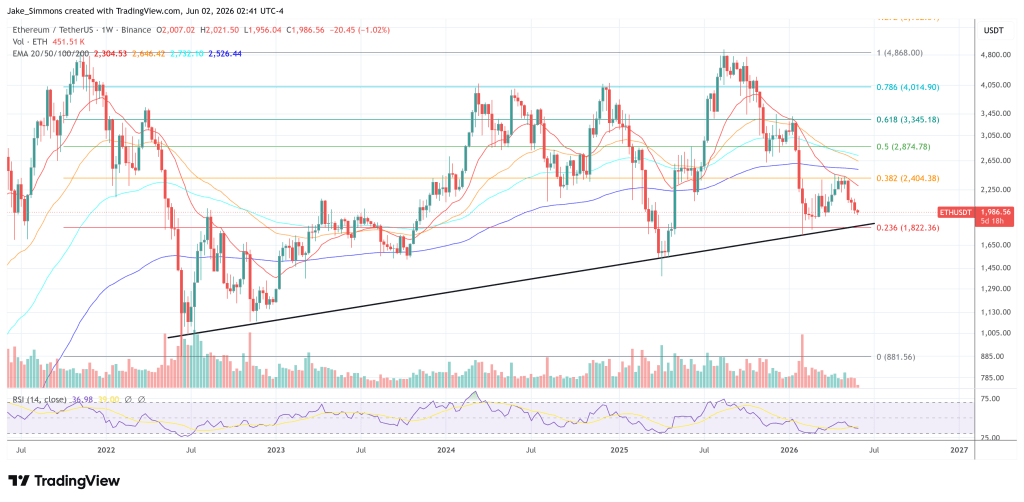
At press time, ETH traded at $1,986.

ETH uptrend remains intact, 1-week chart | Source: ETHUSDT on TradingView.com

Связанные с этим вопросы

QWhat is the new mandate of the Ethereum Foundation, according to Aya Miyaguchi, and why was it necessary?

AThe new mandate is for the Ethereum Foundation (EF) to become a smaller, more focused organization. Its role is to preserve and accelerate the properties and goals that make Ethereum 'uniquely valuable, competitive, and worth building on,' centered on concepts like CROPS and 'inalienable user self-sovereignty and self-sovereign coordination.' This shift was necessary because internal debates had become overly political and personal, and the EF was facing conflicting expectations, trying to be too many things at once, which risked achieving nothing.

QHow does Miyaguchi respond to the idea that a more focused EF means less concern for adoption?

AMiyaguchi pushes back against this idea, arguing the opposite is true. She states that both everyday users and institutions depend on Ethereum's underlying value proposition. Adoption, including institutional adoption, remains part of the EF's work, but only in ways that align with its newly defined, more focused mission.

QWhat is Miyaguchi's explanation for the wave of high-profile departures from the Ethereum Foundation?

AMiyaguchi acknowledges the departures are a direct consequence of the Foundation's strategic shift. She states, 'As EF becomes more focused and more opinionated, the team naturally becomes smaller and more concentrated. That is part of the choice.' She adds that new leaders are stepping into the mission and more details on the new structure will be provided soon.

QHow does Miyaguchi describe the historical and intended role of the Ethereum Foundation within the ecosystem?

AMiyaguchi describes the EF as 'one of many nodes in Ethereum.' While it was the first group and essential for making things happen in the early years, it was never meant to stay as the central command center. The goal was always to help Ethereum grow beyond the EF by distributing power, such as by incubating projects like Uniswap and ENS, and 'funding the funders' to ensure they could stand on their own.

QWhat was the trigger for proposing the new mandate, according to Miyaguchi's account?

AAccording to Miyaguchi, the trigger was not a single dispute but a structural problem. She identified two main issues: first, technical debates had become political and personal; second, as the EF grew, it was being pulled in too many directions by competing visions of 'what EF should be,' which threatened its effectiveness.

Похожее

For Hedging, Buy Gold and Oil; For Explosive Growth, Buy AI; Bitcoin, the 'Outdated' Asset, Enters a Bear Market

Bitcoin’s price has recently fallen sharply, hitting a two-month low near $66,000, with Ethereum also dropping to a three-month low. While surface explanations point to ETF outflows, geopolitical tensions, and corporate selling, a deeper issue is emerging: Bitcoin is losing a crucial asset competition. For years, Bitcoin thrived in a low-rate environment where investors sought alternatives amid inflation fears and dissatisfaction with traditional options. Now, the market landscape has shifted, leaving Bitcoin stuck in an "awkward middle ground," facing challenges on three fronts: 1. **As an inflation hedge, gold is winning.** Investors worried about persistent inflation are turning to tangible assets like gold, energy stocks, and commodity producers, which offer more direct pricing power and physical backing. 2. **For growth exposure, AI is winning.** Those seeking high growth now favor AI-related companies with actual revenues and profits, an area where Bitcoin's lack of cash flow puts it at a disadvantage. 3. **Within crypto, infrastructure and stablecoins are winning.** Even investors wanting crypto exposure have alternatives like exchanges, stablecoin issuers, and tokenization firms, whose performance is directly tied to real-world adoption and offers clearer operational leverage. The recent market reaction to inflation warnings highlights this shift. Instead of boosting Bitcoin as "digital gold," such news now drives flows toward traditional inflation-sensitive assets. Therefore, recent events like ETF outflows and corporate selling are seen not as causes, but as symptoms of this new reality. Capital has more compelling options, and investors are becoming more selective. The emerging bear case for Bitcoin is no longer about it being a fraud or failed technology, but rather that **scarcity alone is no longer enough**. It is no longer seen as the best hedge, the best growth asset, or the only crypto play.

marsbit2 мин. назад

For Hedging, Buy Gold and Oil; For Explosive Growth, Buy AI; Bitcoin, the 'Outdated' Asset, Enters a Bear Market

marsbit2 мин. назад

SaaS Battle Royale: The Survivors Who Win All Share One Common Trait

**Summary** The AI revolution has triggered a "SaaS apocalypse," forcing a brutal market shakeout. The key dividing line is the pricing model. Companies like Snowflake and Datadog, which charge based on consumption (e.g., data processed or compute used), are thriving. AI workloads actively *generate* more demand for their services, fueling growth. Datadog's accelerating revenue is a prime example. Microsoft and Palantir, as platform/ecosystem players, also benefit by acting as essential channels for AI deployment. In contrast, traditional SaaS firms built on per-seat or per-task licensing (e.g., Intuit, Adobe) face direct pressure, as AI threatens to automate the very human tasks their software supports. Companies like Salesforce, a per-seat giant, are caught in the middle. While showing strong AI monetization (e.g., its Agentforce platform) and experimenting with consumption-based "Flex Credits," its stock remains under pressure, illustrating that the market rewards *completed* transitions, not just the intent. The recent Microsoft Build conference underscored key trends: AI is evolving from an assistant to an autonomous "agent," and platform providers like Microsoft are consolidating their control. The market's recovery is highly selective, focused on identifying which companies are "fed by AI" versus "eaten by AI." Future focus will be on the diffusion of this recovery to transforming companies and the real-world adoption data of AI agents like Microsoft Copilot.

marsbit19 мин. назад

SaaS Battle Royale: The Survivors Who Win All Share One Common Trait

marsbit19 мин. назад

Trend in US Stocks: Jensen Huang's One Sentence Triggers $47 Billion Surge; Google Raises Funds for First Time in 20 Years

U.S. markets reached record highs on June 2nd, but the real story was the intensifying AI arms race, now pivoting from chip supremacy to a scramble for capital to fund compute infrastructure. The day highlighted two stark realities: Nvidia CEO Jensen Huang's endorsement of Marvell Technology as the "next trillion-dollar company" at Computex fueled a historic 32.5% surge, adding $47 billion to its value. Conversely, Alphabet announced its first equity raise in two decades—an $80 billion plan—signaling that even its massive cash flow can't keep pace with soaring AI capital expenditures, forecast to exceed $180 billion in 2026. While the S&P 500 closed above 7,600 for the first time, led by tech and semiconductor stocks (SOXX +5.79%), sector performance was mixed. Alphabet's 4% drop dragged down communications services, illustrating market anxiety over the unsustainable cost of the AI buildout. Hewlett Packard Enterprise soared 25% on stellar earnings, proving AI's benefits extend beyond chip designers to infrastructure providers. Beneath the index highs, concerns linger over extreme concentration in a few AI stocks and geopolitical tensions. The focus now shifts to upcoming economic data, particularly Friday's nonfarm payrolls, which could challenge the market's current "ignore rates, chase AI" mentality.

marsbit51 мин. назад

Trend in US Stocks: Jensen Huang's One Sentence Triggers $47 Billion Surge; Google Raises Funds for First Time in 20 Years

marsbit51 мин. назад

Торговля

Спот
Фьючерсы

Популярные статьи

Manyu: восходящая мем-звезда на Ethereum, готовая открыть новую эру культуры Shiba

Manyu - это мемтокен на Ethereum, который приносит децентрализованную культурную и развлекательную ценность через вирусное влияние в соцсетях и вовлечённость сообщества.

1.9k просмотров всегоОпубликовано 2025.11.27Обновлено 2025.11.27

Manyu: восходящая мем-звезда на Ethereum, готовая открыть новую эру культуры Shiba

Неделя обучения по популярным токенам 14: Glamsterdam — самое ожидаемое обновление Ethereum в 2026 году

Ordinals/Runes по-прежнему стимулируют доходы от комиссий за блоки и активность разработчиков, рассматриваются как отправная точка «нативной эмиссии активов» в сети.

1.5k просмотров всегоОпубликовано 2026.04.29Обновлено 2026.04.29

Неделя обучения по популярным токенам 14: Glamsterdam — самое ожидаемое обновление Ethereum в 2026 году

Обсуждения

Добро пожаловать в Сообщество HTX. Здесь вы сможете быть в курсе последних новостей о развитии платформы и получить доступ к профессиональной аналитической информации о рынке. Мнения пользователей о цене на ETH (ETH) представлены ниже.

活动图片