Ethereum activity hits 788K addresses – Can ETH finally break out?

ambcryptoОпубликовано 2026-04-03Обновлено 2026-04-03

Введение

Ethereum's network activity has surged, with over 788,000 daily active addresses and more than 255,000 new addresses created, indicating strong underlying demand and user growth. Despite this, ETH's price remains range-bound between $1,807 support and $2,371 resistance, failing to break out despite repeated tests. On-chain data shows persistent outflows from exchanges, suggesting accumulation, but this has not yet translated into significant buying pressure. Derivatives markets reveal declining open interest and a negative funding rate, reflecting bearish sentiment and reduced leverage. While network fundamentals strengthen, the price lacks the momentum for a sustained breakout due to ongoing consolidation and dominant short positioning.

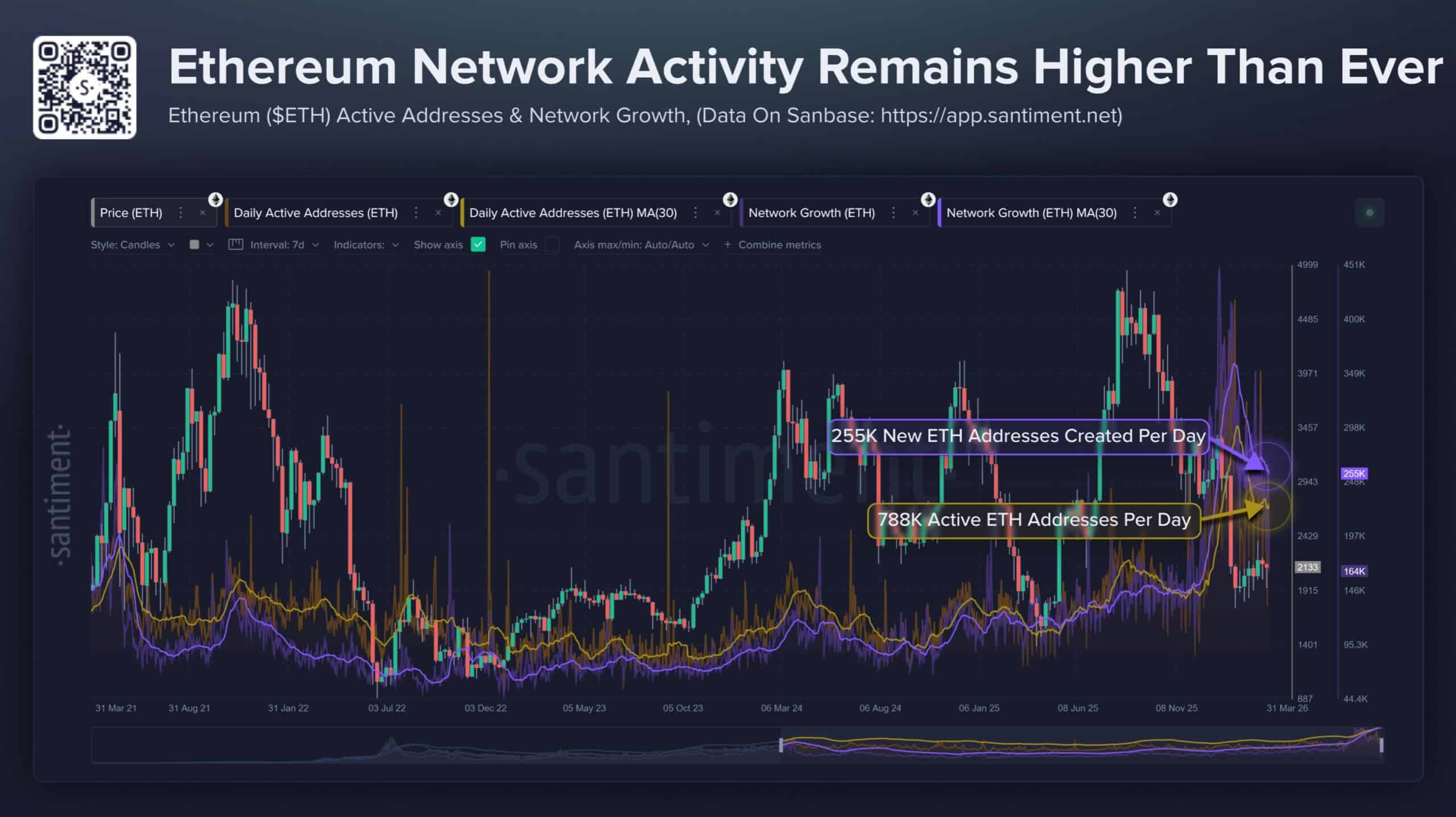
Ethereum’s network activity has surged toward historic highs, with over 788K Daily Active Addresses interacting across the network.

Source: Santiment

In addition, more than 255K new addresses are being created each day, reflecting sustained user onboarding.

As more addresses interact with the network daily, underlying demand appears to strengthen beneath the surface.

Yet, price behavior suggests that this demand has not fully translated into visible buying pressure.

This gap raises a critical question about how much of this activity reflects organic growth versus structural positioning, leaving the market in a state where participation increases, but price direction remains unresolved.

Ethereum price range holds as resistance caps upside

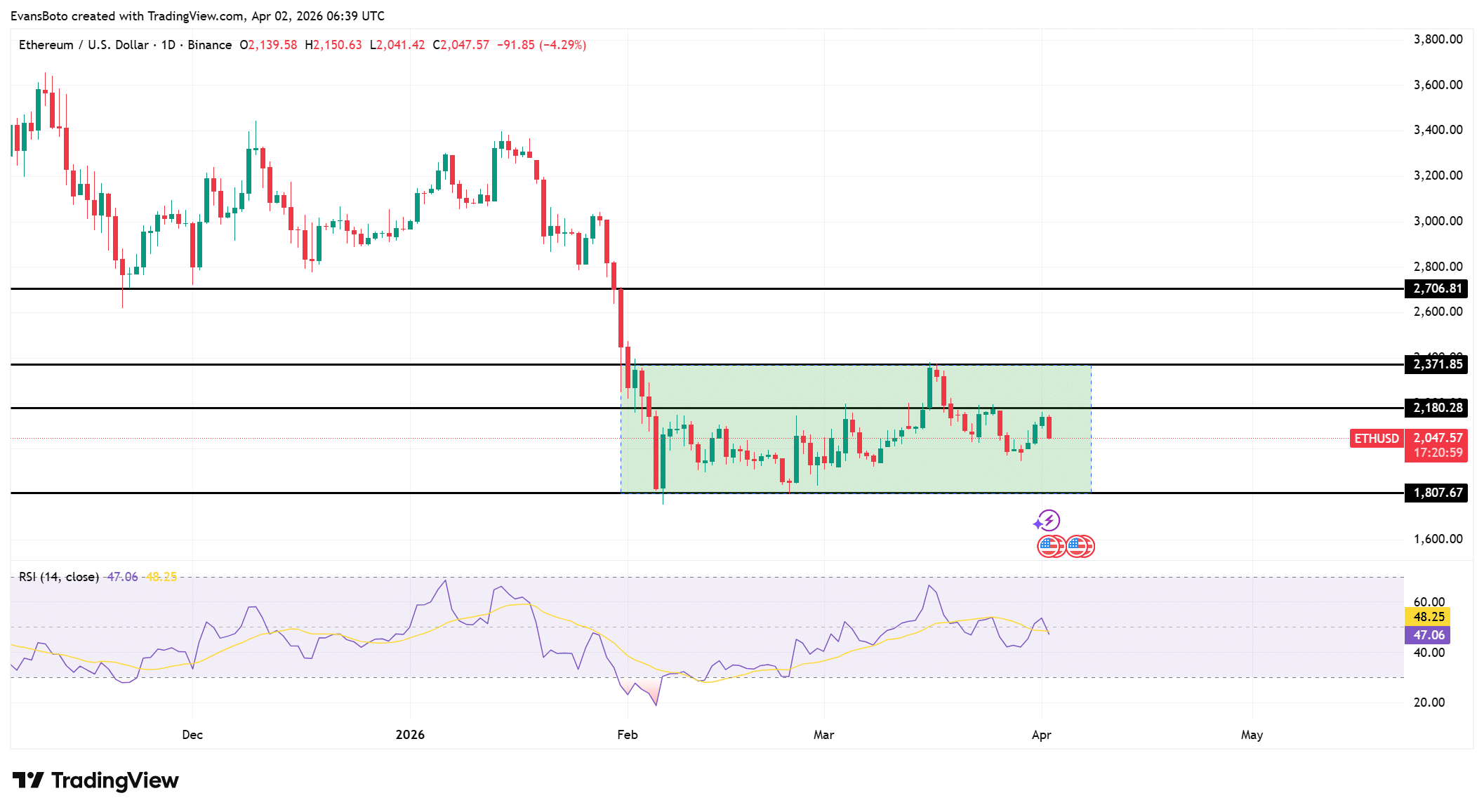
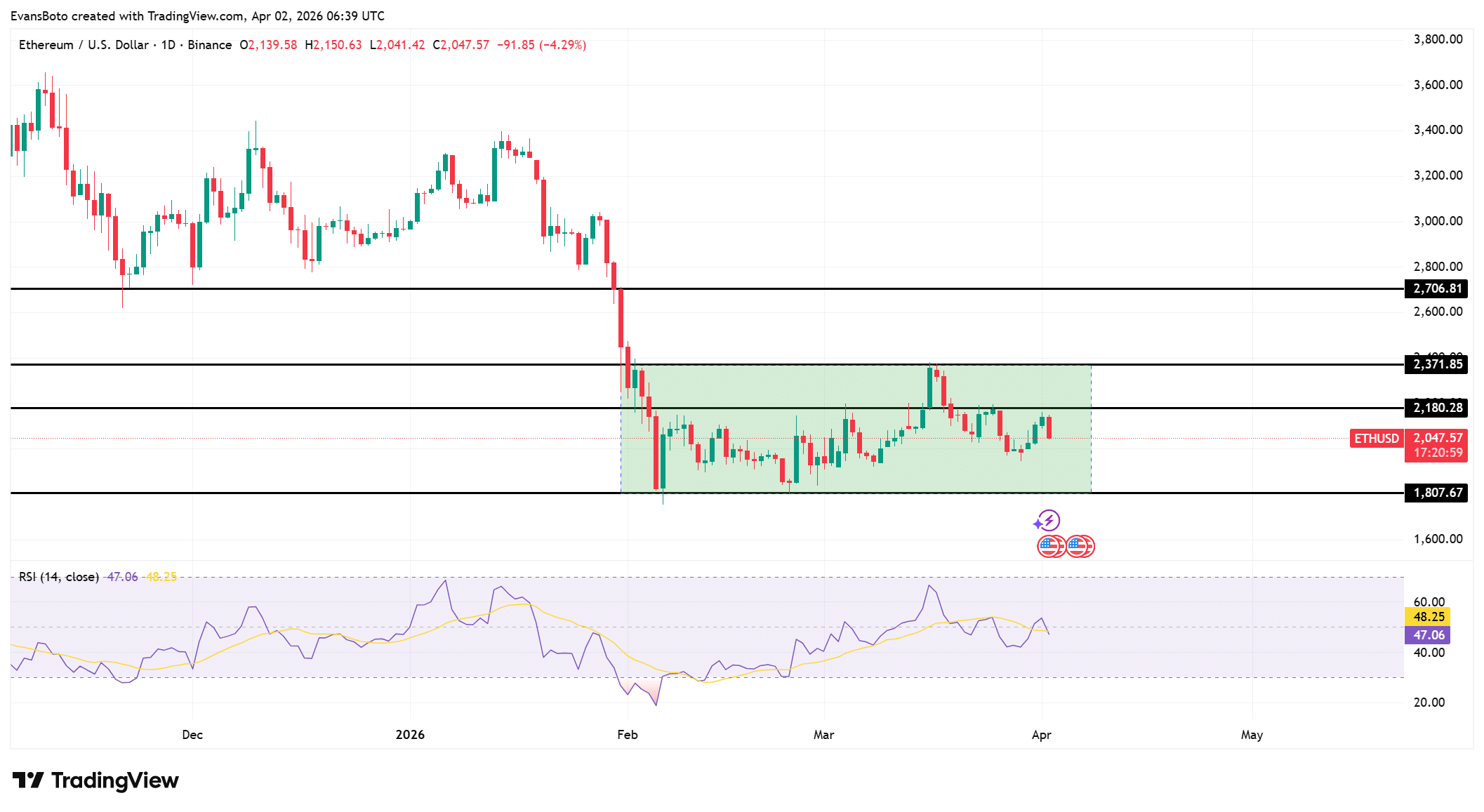
Despite strong on-chain growth, Ethereum [ETH] traded within a defined range between $1,807 support and $2,371 resistance.

Price repeatedly tested the $2,371 resistance but failed to sustain a breakout. This kept the structure compressed and limited upward expansion.

RSI stabilized near 47.06, reflecting neutral momentum without clear directional bias.

Although RSI recovered from oversold levels, it failed to break above 60. That indicated bullish strength remained limited.

Meanwhile, resistance near $2,180 continued to reject upward moves.

Each rejection maintained a pattern of lower highs within the range. This pattern limited bullish continuation.

However, repeated defenses of $1,807 showed buyers remained active at lower levels. That balance reflected ongoing indecision between accumulation and distribution.
Source: TradingView

Outflows persist despite consolidation phase

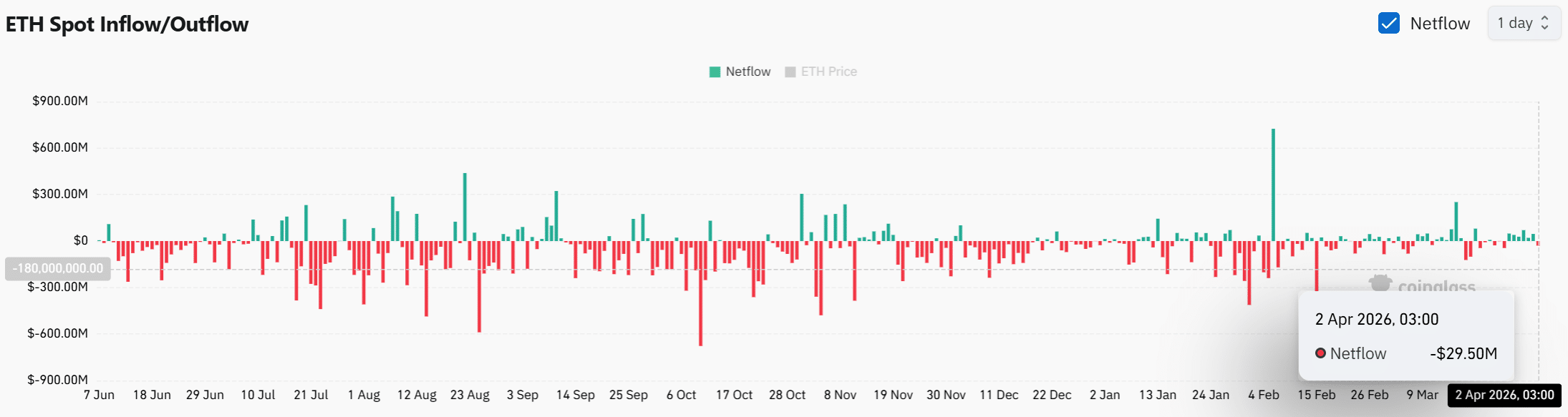
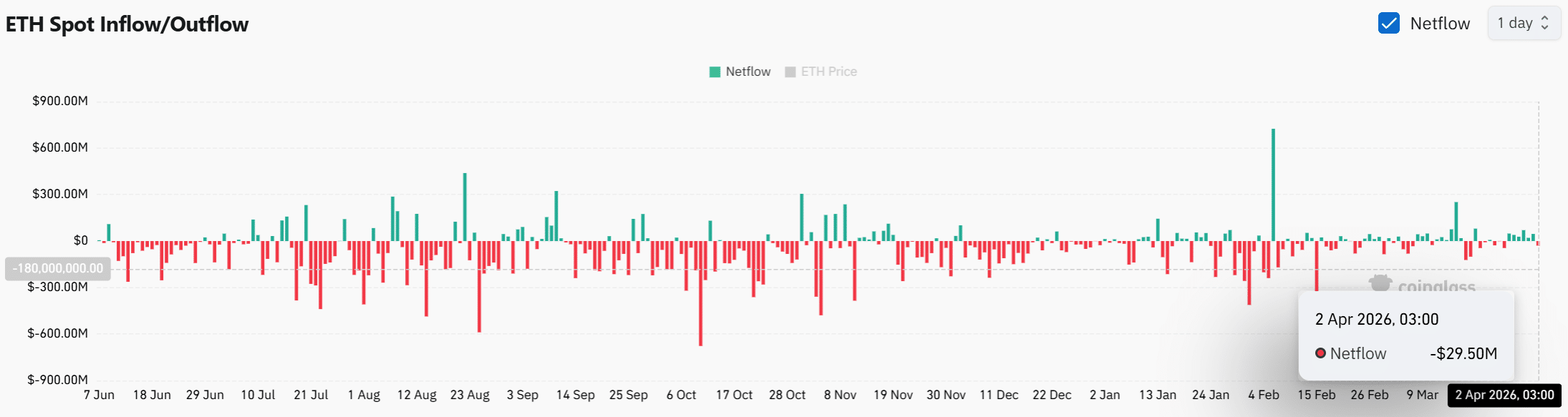
While price continues compressing, Spot Netflows remained negative, with recent data showing a $29.50M outflow.

This trend indicates that ETH continues leaving exchanges, which reduces immediately available supply for selling.

Such persistent outflows typically reflect accumulation behavior, as investors move assets into private wallets.

However, despite this supply tightening, price has not responded with upward expansion.

This suggests that although selling pressure may be decreasing, demand has not yet intensified enough to absorb resistance levels.

The continued outflow trend strengthens the underlying structure, yet price remains locked within the range as the market absorbs this shift gradually.
Source: CoinGlass

Ethereum leverage declines as shorts gain control

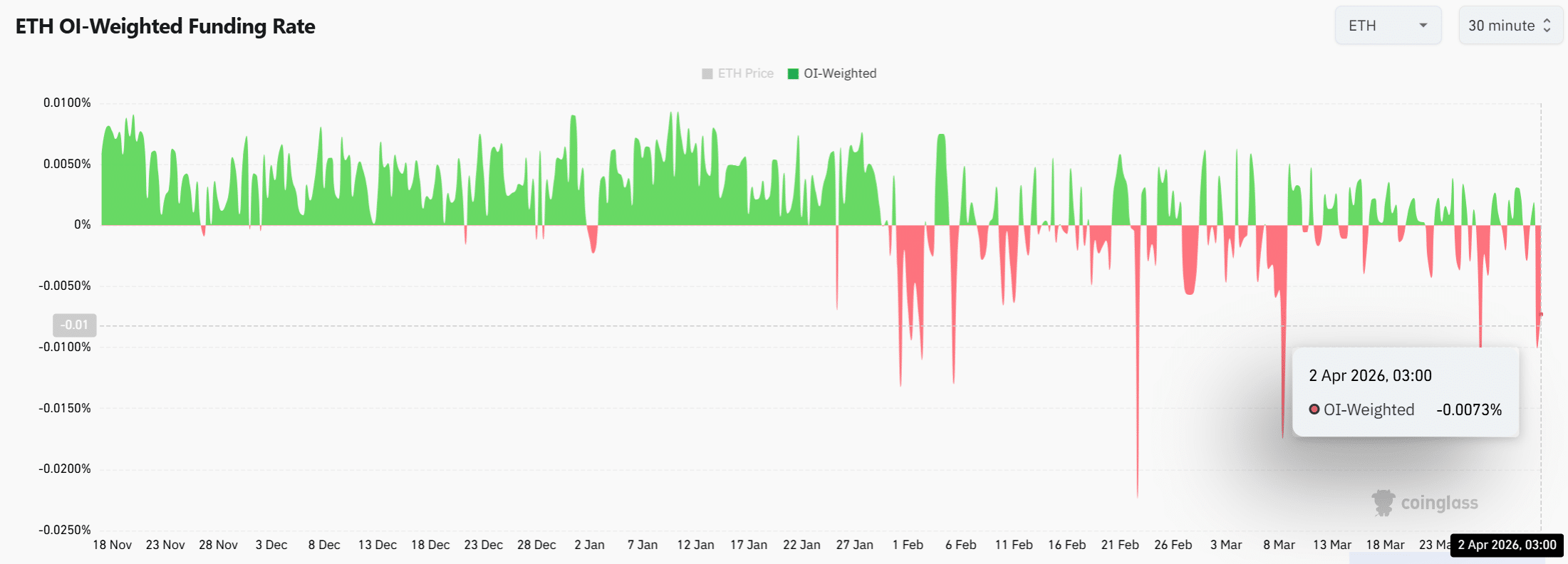
Beyond spot activity, derivatives data revealed a shift in positioning, as Open Interest [OI] dropped by 8.59% to $28.18B.

This decline showed that traders have reduced exposure, signaling lower participation in leveraged positions.

In addition, the OI-Weighted Funding Rate turned negative to -0.0073%, indicating that short positions now dominate.

This shift reflects growing bearish sentiment in the derivatives market, where traders increasingly position for downside or continued consolidation.

However, reduced leverage can also lower volatility, which reinforces the current range-bound behavior.

Therefore, as traders step back and shorts gain control, the price remains constrained, lacking the aggressive positioning needed to drive a breakout.
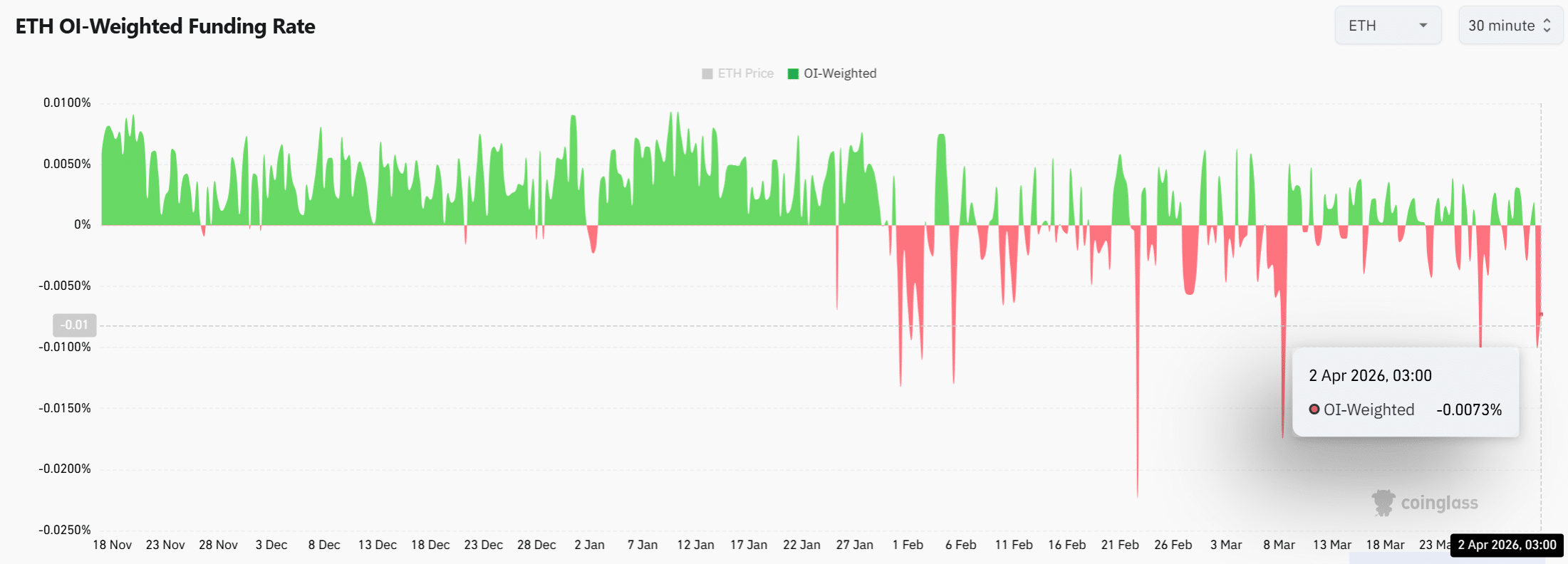
Source: CoinGlass

Can activity drive a breakout?

Ethereum’s network growth continues to strengthen its foundation, yet the price remains constrained within a defined range.

Reduced leverage and dominant short positioning limit upward expansion, despite ongoing accumulation signals.

This structure suggests that while underlying demand continues building, the market still requires stronger conviction to translate adoption into a sustained breakout.


Final Summary

  • Ethereum [ETH] network activity surged, with over 788K Daily Active Addresses and 255K new addresses created daily.
  • Rising participation signaled growing underlying demand, though price failed to reflect this strength.

Связанные с этим вопросы

QWhat is the current number of Daily Active Addresses on the Ethereum network mentioned in the article?

AOver 788,000 Daily Active Addresses.

QWhat are the key support and resistance levels for Ethereum's price as discussed in the article?

AThe key support level is $1,807 and the resistance level is $2,371.

QWhat does the negative Spot Netflows data indicate about Ethereum's market activity?

AIt indicates that ETH is leaving exchanges, which reduces immediately available supply and typically reflects accumulation behavior as investors move assets to private wallets.

QHow did the Open Interest (OI) and OI-Weighted Funding Rate change, and what does this signal?

AOpen Interest dropped by 8.59% to $28.18B, and the OI-Weighted Funding Rate turned negative to -0.0073%, signaling reduced trader exposure and that short positions now dominate, reflecting growing bearish sentiment.

QDespite strong on-chain growth, why has Ethereum price failed to break out according to the article?

AThe price has failed to break out due to reduced leverage, dominant short positioning in derivatives, and a lack of strong enough demand to absorb resistance levels, keeping the market range-bound.

Похожее

Apple Also Has to Pay Rent Now

Apple Pays Rent Too: The Two-Way Flow of "Traffic Tax" and "AI Capability Rent" Between Tech Giants For over two decades, Google has paid Apple an estimated $20 billion annually to remain the default search engine on Safari, a "traffic tax" for a critical user entry point. However, in 2026, the direction of this cash flow partially reversed. Apple agreed to pay Google roughly $1 billion per year to license its Gemini AI models, as Apple's own models reportedly struggled with complex tasks. This creates a unique dynamic: Apple acts as the "landlord" in the established search ecosystem, collecting rent from Google for access. Simultaneously, in the emerging AI arena, Apple becomes the "tenant," paying Google for access to cutting-edge AI capabilities it cannot currently match internally. While Apple claims its new models are "distilled" from Gemini outputs and contain "not a drop" of Google's original code, core dependencies remain. Its knowledge base is refined using Gemini's outputs, and its most powerful cloud model runs on Google's infrastructure. Apple has structured the deal as non-exclusive, allowing it to theoretically switch AI suppliers—a hedge against over-reliance. The future hinges on whether advanced AI models become a commodity (cheap and abundant) or remain a concentrated, scarce resource (expensive and controlled by few). Apple is betting on the former, leveraging its massive device ecosystem to be a powerful, choosy customer. If the latter proves true, its bargaining power could erode. This power dynamic is extending to developers. Apple, Google, and WeChat are all pushing for apps to expose their core functions as standardized "actions" or "intents" that their respective AI assistants (Siri, Gemini, WeChat AI) can directly call. The new scarce resource is no longer just app store visibility, but "being selected by the AI." The currency of "rent" has changed from a 30% revenue share to ceding control over how users interact with an app's functions.

marsbit1 ч. назад

Apple Also Has to Pay Rent Now

marsbit1 ч. назад

Missed the SpaceX IPO? WEEX's "First Trade Protection" Lets You Experience US Stock Trading Risk-Free.

With the excitement around SpaceX's recent public listing reigniting interest in the US stock market, Chinese investors face significant challenges accessing compliant and convenient trading channels following regulatory actions against major online brokers. This article explores the available options, highlighting their risks and limitations. Traditional paths for US stock investments remain problematic. Qualified Domestic Institutional Investor (QDII) and Listed Open-Ended Fund (LOF) products, while compliant, suffer from high fees, significant purchase premiums, and a very limited selection of assets. Small, unregulated offshore brokers pose substantial risks, including potential insolvency. While secure, VIP accounts at banks in Hong Kong or Singapore require high minimum deposits (often 1-2 million RMB) and in-person visits, placing them out of reach for most retail investors. The article positions cryptocurrency exchanges, specifically their TradFi (traditional finance on-chain) offerings, as a compelling alternative. Platforms like WEEX are noted for providing access to a wide range of US stocks and ETFs, including SpaceX (SPCXON), through tokenized assets. This method offers advantages such as a single account for both crypto and traditional assets, USDT-based settlement avoiding fiat complexities, flexible leverage, and robust risk management. To attract users, WEEX is promoting a "First Trade Guarantee" campaign. Running from June 15 to July 8 (UTC+8), it features a $30,000 prize pool. Users who trade $500 worth of US stock contracts can qualify for a guarantee on their first eligible trade: 100% loss coverage up to $30 or a 20% bonus on profits up to $30. The campaign is presented as a low-risk opportunity for both crypto natives and traditional investors to experience US stock trading.

marsbit1 ч. назад

Missed the SpaceX IPO? WEEX's "First Trade Protection" Lets You Experience US Stock Trading Risk-Free.

marsbit1 ч. назад

How Difficult is Chip Making? A Division Error Costs 475 Million Dollars

How Hard Is It to Make a Chip? A Division Error Cost $475 Million Chip expert Shi Kan, a researcher at the Chinese Academy of Sciences and a popular tech creator, explains the immense challenges of chip development. Chips are foundational to modern technology, but their creation is extraordinarily difficult. The journey from sand to a functional chip involves complex design and manufacturing, but a critical bottleneck is verification—ensuring the design works flawlessly before costly production. A single, undetected bug can have catastrophic consequences, as illustrated by the infamous 1994 Intel Pentium FDIV bug. A flaw in the floating-point division unit forced a recall costing $475 million. Unlike software, chips cannot be easily patched after manufacture, making "first-time success" paramount. However, industry surveys show only 24% of chip projects achieve this; over three-quarters require at least one costly re-spin due to design flaws. Verification has thus become the dominant phase, consuming up to 70% of the design cycle. The core challenge is a "verification impossible triangle" between high performance, good debuggability, and low cost. Exhaustively verifying a modern CPU core could take 15,000 years with software simulation, or 30 years with advanced hardware emulation—timeframes utterly impractical for development. Despite being essential, verification is often seen as unglamorous "dirty work," receiving less academic attention than fields like AI. Shi and his team are tackling this by developing an agile verification research framework called ENCORE, based on FPGA technology, to improve verification efficiency and debug capability. Beyond research, Shi engages in public science communication through long-form video content, aiming to demystify chip technology, AI, and computer science. He argues for the value of pursuing "hard and long-term" endeavors, whether in the meticulous world of chip verification or in creating substantive educational content, believing such sustained effort is likely the right path forward.

marsbit1 ч. назад

How Difficult is Chip Making? A Division Error Costs 475 Million Dollars

marsbit1 ч. назад

Торговля

Спот
Фьючерсы

Популярные статьи

Manyu: восходящая мем-звезда на Ethereum, готовая открыть новую эру культуры Shiba

Manyu - это мемтокен на Ethereum, который приносит децентрализованную культурную и развлекательную ценность через вирусное влияние в соцсетях и вовлечённость сообщества.

2.0k просмотров всегоОпубликовано 2025.11.27Обновлено 2025.11.27

Manyu: восходящая мем-звезда на Ethereum, готовая открыть новую эру культуры Shiba

Неделя обучения по популярным токенам 14: Glamsterdam — самое ожидаемое обновление Ethereum в 2026 году

Ordinals/Runes по-прежнему стимулируют доходы от комиссий за блоки и активность разработчиков, рассматриваются как отправная точка «нативной эмиссии активов» в сети.

1.5k просмотров всегоОпубликовано 2026.04.29Обновлено 2026.04.29

Неделя обучения по популярным токенам 14: Glamsterdam — самое ожидаемое обновление Ethereum в 2026 году

Обсуждения

Добро пожаловать в Сообщество HTX. Здесь вы сможете быть в курсе последних новостей о развитии платформы и получить доступ к профессиональной аналитической информации о рынке. Мнения пользователей о цене на ETH (ETH) представлены ниже.

活动图片