Dogecoin, Solana, & Other Altcoins End 2025 With Half The Weekly Volume Of 2024

bitcoinistОпубликовано 2026-01-01Обновлено 2026-01-01

Введение

On-chain data from Santiment reveals that Dogecoin, Solana, and other major altcoins are experiencing a significant decline in weekly trading volume, now at less than half the level seen at the end of 2024. This trend is observed across multiple assets, including Bitcoin, Ethereum, Cardano, BNB, XRP, Tron, and Chainlink. The drop in volume is attributed to recent price consolidation, which has reduced trader interest, as well as the holiday season's typical lull. Unlike the previous year, when altcoins remained active, current volumes are substantially lower. This lack of trading activity suggests muted price movement may continue unless unexpected news triggers market volatility. Dogecoin, for example, briefly rose to $0.128 but has since retreated to $0.122, reflecting the ongoing consolidation.

On-chain data shows Dogecoin, Solana, and other altcoins are currently seeing half the weekly Trading Volume compared to the end of 2024.

Dogecoin, Solana, & Others Have Seen A Decline In Volume Recently

In a new post on X, on-chain analytics firm Santiment has talked about the latest trend in the Trading Volume for the various assets in the cryptocurrency sector. This indicator measures, as its name suggests, the total amount of a given token that became involved in trading activities on exchanges over the past week.

When the value of the metric rises, it means trading activity related to the asset is going up. Such a trend can be a sign that interest in the cryptocurrency is increasing.

On the other hand, the indicator going down can imply investors are shifting their attention away from the coin as they are participating in a lower amount of trading.

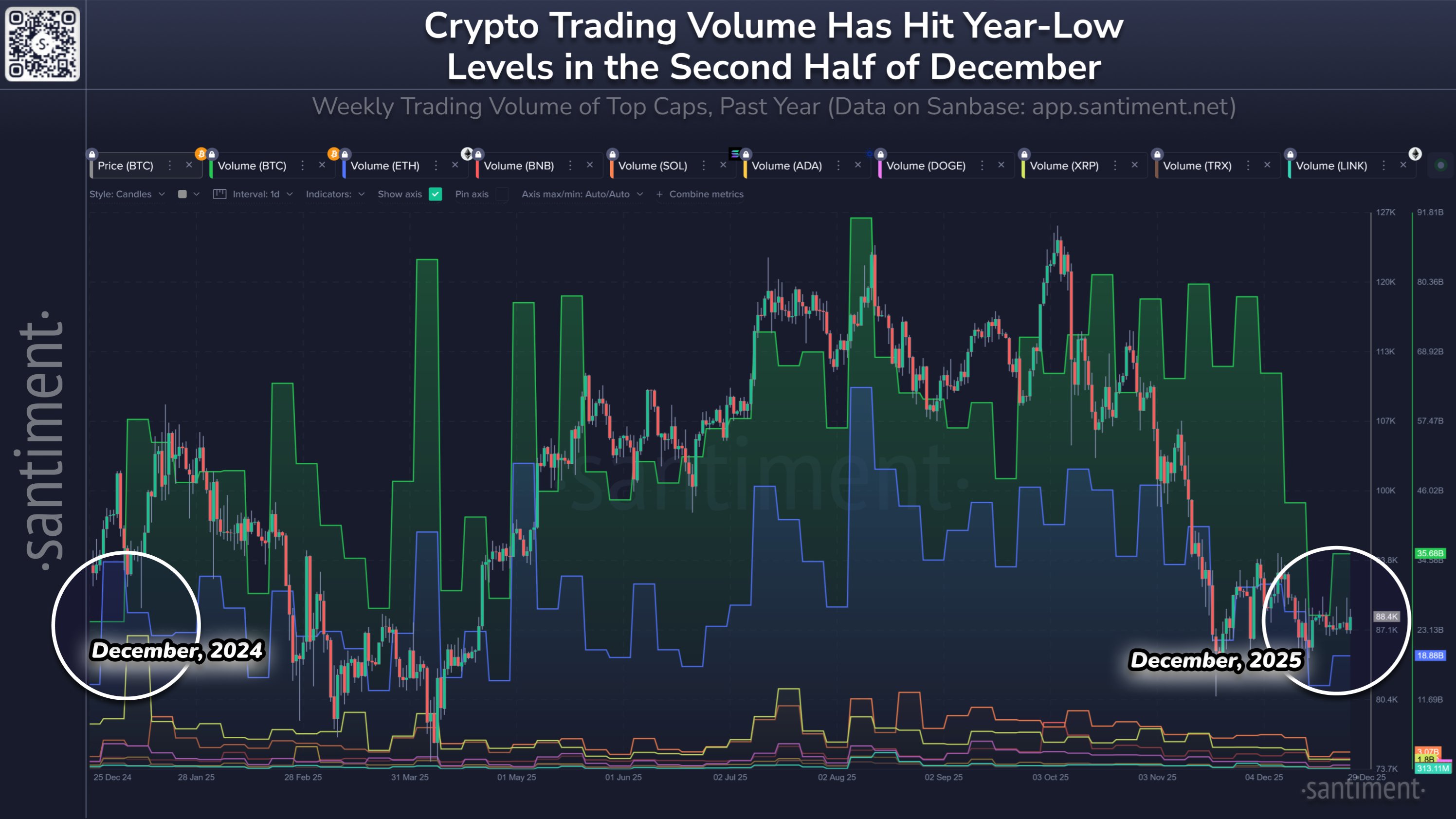
Now, here is the chart shared by Santiment that shows the trend in the Trading Volume for nine major assets: Bitcoin, Ethereum, Dogecoin, Cardano, Solana, BNB, XRP, Tron, and Chainlink.

How the current volume in the market compares against the same time from last year | Source: Santiment on X

As displayed in the above graph, the Trading Volume has witnessed a plunge across the sector over the last couple of weeks. Bitcoin, Dogecoin, and other assets have all shown price consolidation in this period, so the cooldown in trading activity could partly be due to traders getting bored.

Generally, investors like to trade more when price action is “exciting.” Volatile moves like rallies or crashes especially attract attention to the market. In phases of sideways price action, though, interest tends to die down.

There is also another reason behind the recent decline in the Trading Volume besides the price action: the holidays. From the chart, it’s visible that the holiday period at the end of 2024 also saw the indicator have a similarly low value for Bitcoin.

There has been one big difference in market behavior between now and then, however. As the analytics firm has explained:

Ethereum and other altcoins like Solana, Cardano, and Dogecoin were still seeing significant movement. This year, they have less than half the weekly trading volume.

What could be the consequence of this low activity? While hard to say for certain, price action usually tends to be muted when there is a lack of trading interest, as moves fail to build momentum in either direction.

Thus, it’s possible that the current phase of consolidation could stretch for the market, unless some surprise news drops that becomes a trigger for volatility.

DOGE Price

Dogecoin saw a surge to $0.128 earlier in the week, but the memecoin’s price has declined since then as it’s back at $0.122.

Looks like the price of the coin has overall moved sideways over the last few days | Source: DOGEUSDT on TradingView

Связанные с этим вопросы

QWhat does the on-chain data show about the weekly trading volume of Dogecoin, Solana, and other altcoins at the end of 2025 compared to 2024?

AThe on-chain data shows that Dogecoin, Solana, and other altcoins are currently seeing half the weekly trading volume compared to the end of 2024.

QAccording to Santiment, what is a potential reason for the recent decline in trading volume across the cryptocurrency sector?

AAccording to Santiment, a potential reason for the decline is price consolidation, which leads to traders getting bored, as they generally prefer to trade more during volatile or 'exciting' price action.

QBesides price consolidation, what other factor contributed to the low trading volume mentioned in the article?

AThe holiday period was another factor that contributed to the low trading volume, as similar low values were observed at the end of 2024.

QHow does the current trading volume for altcoins like Ethereum, Solana, and Dogecoin compare to the same period last year?

AThis year, altcoins like Ethereum, Solana, and Dogecoin have less than half the weekly trading volume they had during the same period last year.

QWhat is the potential consequence of low trading activity for cryptocurrency prices, as suggested in the article?

AThe potential consequence is that price action tends to be muted and consolidation phases could stretch, as moves fail to build momentum without significant trading interest or a trigger for volatility.

Похожее

$9.4 Billion: The Largest Robotics Funding This Year Has Emerged

Munich-based humanoid robotics company Neura has completed a $1.4 billion (approximately RMB 94.9 billion) Series C funding round, valuing the company at around $7 billion and positioning it among the global leaders in the sector. The investment round is notable not just for its size—reportedly the largest in robotics this year—but also for its strategic backers, which include tech giants like NVIDIA and Amazon, alongside established industrial players such as German engineering firms Bosch and Schaeffler. This mix of investors signals a significant shift in the industry's focus from technological demonstrations and general-purpose narratives toward practical, industrial deployment and commercialization. Neura's approach centers on developing humanoid robots for defined, high-value industrial tasks rather than pursuing a general-purpose model. Its early validation comes from a partnership with BMW, where its robots are being tested on actual production lines. The involvement of Bosch and Schaeffler, companies deeply embedded in global manufacturing, underscores a growing belief that humanoid robots are transitioning from labs to viable factory-floor solutions. The article highlights two converging trends driving investment: advancements in AI and large language models, which enhance robots' perception and decision-making in unstructured environments, and mounting pressure from labor shortages and rising costs in major manufacturing regions. The funding landscape is now bifurcating between companies like Figure AI, focusing on versatile general-purpose robots, and firms like Neura, targeting specific vertical industrial applications with clearer, shorter paths to ROI. While technical hurdles remain, the core challenges for widespread adoption are increasingly seen as engineering and commercial in nature: managing the high integration and customization costs for different factory environments and establishing robust, localized maintenance and service networks. The record investment in Neura, particularly from industrial capital, indicates the industry's growing confidence in moving from proving feasibility to solving the practical problems of scalability, reliability, and building sustainable business models around humanoid robots in real-world settings like automotive manufacturing and hazardous labor environments.

marsbit8 ч. назад

$9.4 Billion: The Largest Robotics Funding This Year Has Emerged

marsbit8 ч. назад

Торговля

Спот
Фьючерсы

Популярные статьи

Обсуждения

Добро пожаловать в Сообщество HTX. Здесь вы сможете быть в курсе последних новостей о развитии платформы и получить доступ к профессиональной аналитической информации о рынке. Мнения пользователей о цене на SOL (SOL) представлены ниже.

活动图片