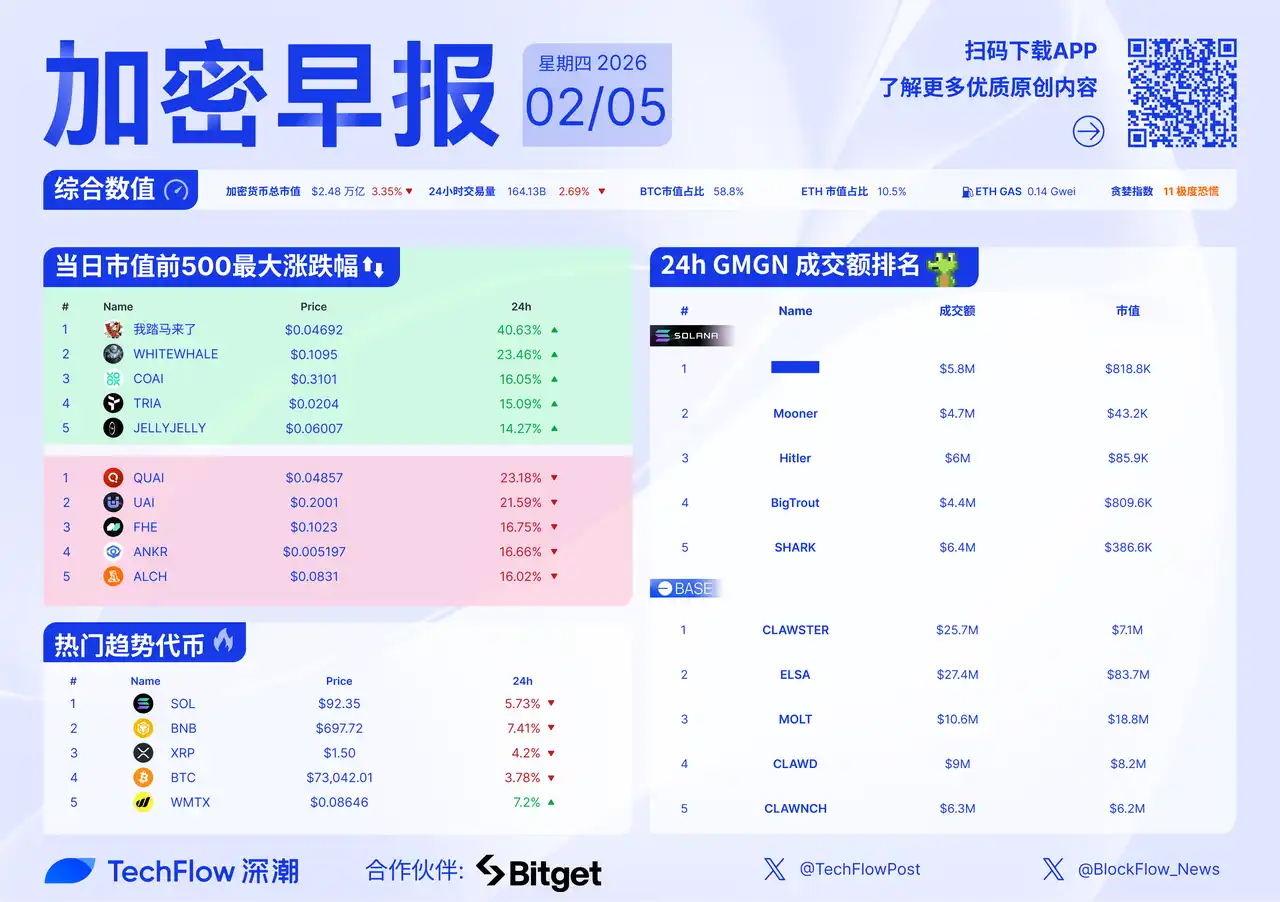
Crypto Morning Report: US ADP Data Falls Short of Expectations, Binance SAFU Fund Buys Another $100 Million in Bitcoin

marsbitОпубликовано 2026-02-05Обновлено 2026-02-05

Введение

U.S. ADP employment data fell short of expectations, reporting 22,000 jobs vs. 48,000 expected. Binance's SAFU fund purchased an additional $100 million worth of Bitcoin. In regulatory news, U.S. Senate Democrats are discussing crypto market structure, while the SEC charged three crypto market makers—ZM Quant, Gotbit, and CLS Global—with market manipulation. CME Group is exploring the launch of its own cryptocurrency, "CME Coin." On the investment front, TRM Labs raised $70 million, while Tether lowered its fundraising target to $5 billion amid investor skepticism. Solana co-founder updated his profile picture, sparking speculation about Backpack's upcoming TGE. Yi Lihua’s Trend Research transferred significant amounts to Binance, likely for loan repayments. Prediction markets Opinion and BLUFF secured $20 million and $21 million in funding, respectively.

Author: Deep Tide TechFlow

Yesterday's Market Dynamics

US Senate Democrats Restart Cryptocurrency Market Structure Discussions

According to Crypto in America, Senate Democrats plan to restart discussions on cryptocurrency market structure this afternoon. This is an important meeting following the postponement of last month's markup session for the "Clarity Act." The meeting will focus on key issues including ethics and DeFi. Previously, the White House had convened representatives from the cryptocurrency and banking industries for "constructive" dialogue on topics such as stablecoin yields. Patrick Witt, Executive Director of the White House Cryptocurrency Committee, urged all parties to reach an agreement by the end of the month.

US January ADP Employment: 22,000, Expected 48,000

US January ADP employment was 22,000, compared to an expectation of 48,000 and a previous value of 41,000.

US SEC Files Market Manipulation Charges Against Three Crypto Market Makers ZM Quant, Gotbit, and CLS Global

According to Financefeeds, the US Securities and Exchange Commission (SEC) has filed market manipulation charges against three crypto market makers—ZM Quant, Gotbit, and CLS Global. The SEC alleges that these companies used algorithms for wash trading, creating artificial trading volume to deceive retail investors. Additionally, the SEC has sued nine individuals, including promoters and company employees, accusing them of hiring manipulation services and executing meaningless trades, violating the anti-fraud and registration provisions of securities laws.

As part of the investigation, the US Federal Bureau of Investigation (FBI) conducted a sting operation using a fictional token called NexFundAI, exposing these companies' willingness to engage in wash trading. This case has led to 15 entities being charged and has triggered related criminal proceedings.

Binance SAFU Fund Buys Another $100 Million in Bitcoin

According to on-chain data monitoring, the Binance SAFU Fund withdrew 1,315 Bitcoin from a Binance hot wallet address one minute ago, worth approximately $100 million.

Solana Co-Founder Changes Avatar, Adds Backpack and Laser Eye Elements; Community Speculates TGE May Be Imminent

Solana co-founder Toly changed his X platform avatar, adding laser eyes and Backpack elements to the original Moonbird derivative avatar.

Some community users interpreted this change as a possible hint that Backpack's Token Generation Event (TGE) is approaching.

CME Group Plans to Launch Token "CME Coin," Collaborates with Google on Tokenized Cash Solution

According to CoinDesk, derivatives exchange CME Group CEO Terry Duffy revealed that the company is exploring the launch of its own cryptocurrency, "CME Coin," which may operate on a decentralized network.

Duffy stated in the latest earnings call that CME Group is evaluating different forms of margin and is collaborating with Google to develop a "tokenized cash" solution, expected to launch later this year.

Yi Lihua's Trend Research Transferred Another 25,000 ETH to Binance Early This Morning, Worth Approximately $53.24 Million

According to monitoring by Onchain Lens (@OnchainLens), Yi Lihua's Trend Research transferred another 25,000 ETH (worth approximately $53.24 million) to Binance exchange early this morning.

Data shows that Trend Research has now deposited a cumulative total of 188,588 ETH (worth approximately $426.87 million) into Binance for sale and loan repayment.

Prediction Market Opinion Completes $20 Million Series A Funding

According to CoinDesk, blockchain prediction market platform Opinion announced the completion of a $20 million Pre-A funding round. Investors included Hack VC, Jump Crypto, Primitive Ventures, and Decasonic, among others. The platform uses a fully on-chain settlement mechanism and currently handles one-third of the global prediction market trading volume, with open interest exceeding $130 million.

Prediction Market Platform BLUFF Completes $21 Million Funding Round, Led by 1kx

According to Chainwire, prediction market platform BLUFF has completed a $21 million strategic funding round led by 1kx, with participation from Makers Fund, Maximum Frequency Ventures, Delphi Ventures Founders, and other institutions, as well as sports champion and tech investor Tristan Thompson.

The BLUFF team consists of former executives from platforms like Stake, Bet365, William Hill, and Bodog, and is building a socialized prediction market platform for the new generation. The platform focuses on speed, transparency, and user benefit alignment, offering instant registration, real-time settlement, provably fair prediction mechanisms, and reward mechanisms for user participation in the ecosystem.

Blockchain Intelligence Company TRM Labs Completes $70 Million Series C Funding, Led by Blockchain Capital

According to Fortune magazine, UK-based blockchain intelligence company TRM Labs announced the completion of a $70 million Series C funding round, reaching a valuation of $1 billion. This round was led by early investor Blockchain Capital, with participation from traditional institutions such as Goldman Sachs, Bessemer, Brevan Howard, Thoma Bravo, and Citi Ventures.

Financial Times: Tether Lowers Funding Target to Just $5 Billion as Investors Question $500 Billion Valuation

According to the Financial Times, global largest stablecoin issuer Tether has lowered its funding target, from the original $15-20 billion to possibly just $5 billion, due to investor skepticism about its $500 billion valuation target.

Tether CEO Paolo Ardoino stated in an interview that the $15-20 billion funding amount was a "misunderstanding," and it was merely the maximum amount they were willing to sell, not the target. He emphasized that the company is highly profitable and "very satisfied" even without selling equity.

Ardoino also compared Tether to AI companies, saying: "AI companies generate the same amount of profit as us, just with a negative sign in front." It is reported that Tether's profit last year was approximately $10 billion, mainly from returns on its held assets, but profits in 2025 decreased by about 25% year-on-year.

Last September, it was reported that stablecoin giant Tether was seeking to raise up to $20 billion at a $500 billion valuation.

Market Dynamics

Recommended Reading

GameStop Exits and Runs Away, Saylor Keeps Buying

This article discusses how GameStop once attempted to explore new growth paths through Bitcoin investment but ultimately chose to exit. In contrast, Strategy company firmly holds and continues to accumulate Bitcoin, demonstrating a completely different belief and strategy. The article analyzes the logic and risks of companies using Bitcoin as a treasury asset and predicts three possible future development paths.

X Spends $1 Million Rewarding Good Articles; What Kind of Content Finally Got the Money?

This article discusses a long-form content creation contest hosted by platform X with a total prize pool of $2.15 million, aimed at incentivizing creators to produce high-quality original content, while attracting paying users and supporting the platform's long-form content features and AI models.

February 4th Market Summary: Software Stock Crash Triggers Chain Reaction, Safe-Haven Assets Rally Sharply

This article analyzes the volatility in global markets on February 4, 2026, particularly the crash in software stocks and the cryptocurrency market. It explores the impact of AI technology on SaaS companies, the reasons behind gold's rebound, and the core contradictions in the market.

OpenClaw and Moltbook Event Recap: From AI Social Narrative to Agent Economy Outlook

This article explores the latest developments in AI Agent technology, particularly the events surrounding OpenClaw and Moltbook and their market impact. It analyzes OpenClaw's technical architecture and innovation, discusses the false prosperity phenomenon of the Moltbook platform, and looks at future trends in the combination of AI × Crypto.

Tiger Research: How Is This Crypto Winter Different?

This article analyzes that the current crypto market is in a downward cycle, with increasing skepticism. Past crypto winters were mainly triggered by internal issues, while current market fluctuations are more driven by external factors such as ETF approvals, tariff policies, and interest rate changes. The macroeconomic environment is crucial for the future of the crypto market, and expectations of interest rate cuts and liquidity release may be key to driving market recovery. The future bull market will no longer be a blanket rise but will see separate development in compliant and non-compliant zones, with differentiated market performance.

Связанные с этим вопросы

QWhat was the reported US ADP employment number for January, and how did it compare to expectations?

AThe US ADP employment number for January was 22,000, which was significantly below the expected 48,000.

QWhich three crypto market makers did the US SEC charge with market manipulation?

AThe US SEC charged ZM Quant, Gotbit, and CLS Global with market manipulation.

QHow much Bitcoin did the Binance SAFU fund recently purchase, and what was its approximate value?

AThe Binance SAFU fund purchased 1,315 Bitcoin, valued at approximately $100 million.

QWhat is the name of the new cryptocurrency that CME Group is exploring, and who are they partnering with for its development?

ACME Group is exploring a cryptocurrency called 'CME Coin' and is partnering with Google to develop a tokenized cash solution.

QWhat was the final adjusted fundraising target for Tether, and why was it lowered from the initial goal?

ATether lowered its fundraising target to potentially just $5 billion from an initial $15-20 billion because investors were skeptical of its $500 billion valuation target.

Похожее

Understanding CPO (Co-Packaged Optics) in One Article: Why Nvidia Is Willing to Spend $3.2 Billion on a Fiber?

NVIDIA and Corning announced a multi-year strategic partnership on May 6, 2026, with NVIDIA committing up to $3.2 billion to support Corning's U.S. expansion. This investment will triple Corning's manufacturing plants and significantly boost its optical fiber and communications production capacity. The core driver behind this massive investment is the fundamental shift from copper to optical interconnect technology within AI data centers. As GPU clusters scale, copper wires face critical limitations: severe signal attenuation over distance, high energy consumption for signal integrity, and excessive heat generation. Optical fiber, transmitting light instead of electrical signals, solves these issues with minimal loss, near-light speed, and lower power needs. The article outlines a three-stage evolution of data center interconnect: 1. **Traditional Copper Interconnects:** The mainstream solution of the 2010s, now being phased out due to scaling bottlenecks. 2. **Pluggable Optical Modules:** The current mainstream, where modules convert electrical signals to light externally. This process still introduces energy loss and latency. 3. **CPO (Co-Packaged Optics):** The next-generation technology where the optical engine is integrated directly with the GPU chip package. This drastically reduces the electrical signal travel distance to mere millimeters, slashing power consumption and latency while boosting data density. NVIDIA CEO Jensen Huang has identified CPO as an essential core technology for AI infrastructure. NVIDIA's investment signifies a strategic shift from being a buyer to actively controlling its supply chain for critical components. With demand for specialized optical fiber far outstripping supply—evidenced by soaring prices—securing long-term manufacturing capacity has become a competitive necessity. While Corning's expansion may pressure some suppliers, a projected global fiber supply gap of 5-15% over the next few years creates a significant opportunity window, particularly for Chinese manufacturers competitive in optical preforms, chips, and modules. Ultimately, NVIDIA's move is not about chasing a trend but an engineering imperative. The transition to light-based interconnects like CPO is driven by the physical limits of copper, marking a definitive step in the ongoing AI computing revolution.

marsbit11 мин. назад

Understanding CPO (Co-Packaged Optics) in One Article: Why Nvidia Is Willing to Spend $3.2 Billion on a Fiber?

marsbit11 мин. назад

KOL's Perspective: Why Is SOL Set to Rise from This Point?

**Summary: Why SOL is Positioned for Growth at This Level** The article argues that SOL is poised for an upward move from its current price point, citing several key factors. Primarily, SOL has just broken out of a 4-month consolidation phase. This breakout signals a return of risk appetite to the broader crypto market, as SOL is seen as a key indicator of overall crypto health. The token's ownership has reportedly shifted from short-term traders and tourists to long-term accumulators, leading to low volume. Any meaningful increase in trading activity could thus trigger significant upward momentum. Fundamental strengths include strong institutional adoption, integration with DeFi and RWAs (Real-World Assets), and the potential benefits from the Clarity Act. Despite its high volatility—having dropped 70% from its all-time high but still up 12x from its bear market low—SOL is highlighted as one of the few tokens from the last cycle to reach new highs. It boasts a robust ecosystem of applications, users, and protocols. Future catalysts include the expected influx of AI developers following the Miami Accelerate conference, which focused on AI on Solana. Furthermore, Solana is positioned as the premier chain for memecoin activity, a trend expected to continue and drive network usage and fees. The article concludes that recent price action reflects a healthy transfer to long-term holders, setting the stage for growth.

marsbit1 ч. назад

KOL's Perspective: Why Is SOL Set to Rise from This Point?

marsbit1 ч. назад

Those Pre-Bitcoin PoW Protocols Have Recently Been Reimplemented

This article details a recent surge in replicating pre-Bitcoin Proof-of-Work (PoW) protocols, specifically focusing on Hal Finney's 2004 RPOW (Reusable Proofs of Work). Within five days in May 2026, multiple independent builders in the Bitcoin/cypherpunk community launched projects inspired by this early electronic cash proposal. The initiative began with Fred Krueger's `rpow2.com`, a centralized but auditable system that replaced RPOW's original IBM 4758 hardware with Ed25519 signatures. Initially a faithful replica, it later adopted Bitcoin-like features (21M supply cap, difficulty adjustment) and a controversial 5.24% founder allocation. This sparked rapid forks, including `rpow4.com` which incorporated full Bitcoin parameters, a prediction market (`rpowmarket.com`), and a DEX (`rpow2swap.com`). Concurrently, Mike In Space created a prototype of Wei Dai's 1998 b-money proposal (`b-money.replit.app`), pushing the historical exploration even further back. The article contrasts these centralized, server-dependent experiments with Bitcoin's core innovation of decentralized, trustless consensus. It also highlights a parallel development: the `HASH` project on Ethereum, which uses smart contract hooks to enable a purely fair-launch, browser-mineable PoW token with 0% allocations to team or VCs. The collective activity is framed as a meme-driven, educational exploration of cypherpunk history rather than a serious financial movement, with all projects heavily disclaiming any investment value.

marsbit1 ч. назад

Those Pre-Bitcoin PoW Protocols Have Recently Been Reimplemented

marsbit1 ч. назад

South Korean Exchanges 'Battle' Regulators, Challenging the Boundaries of Enforcement and Legislation

South Korea's cryptocurrency industry is engaged in a rare, direct confrontation with regulators. The Financial Intelligence Unit (FIU), the primary anti-money laundering (AML) watchdog, has recently imposed heavy penalties on major exchanges like Upbit and Bithumb for alleged violations involving unregistered overseas VASPs and AML procedures. However, exchanges are now actively challenging these actions in court and through industry associations. In a significant shift, the Seoul Administrative Court ruled in favor of Upbit's operator, Dunamu, overturning part of an FIU-ordered business suspension. The court found the FIU's penalty criteria and justification insufficiently clear. Similarly, the court suspended the enforcement of a six-month business suspension against Bithumb pending a final ruling, citing potential irreversible harm to the exchange. Beyond legal battles, the industry is contesting proposed legislative amendments. The Digital Asset eXchange Alliance (DAXA) strongly opposes a draft rule that would mandate Suspicious Transaction Reports (STRs) for all crypto transfers over 10 million KRW (~$6,800). DAXA argues this "poison pill" clause violates legal principles and would overwhelm the STR system, increasing reports from 63,000 to an estimated 5.45 million annually for major exchanges, thereby crippling effective AML monitoring. This conflict highlights a structural tension in South Korea's crypto governance: comprehensive digital asset laws are still developing, while regulators rely heavily on AML enforcement. The industry's move from passive compliance to active legal and legislative challenges signifies a new phase, pressing for clearer rules and more proportionate enforcement. While short-term disputes may intensify, this clash could ultimately lead to a more mature and sustainable regulatory framework for South Korea's vibrant crypto market.

marsbit1 ч. назад

South Korean Exchanges 'Battle' Regulators, Challenging the Boundaries of Enforcement and Legislation

marsbit1 ч. назад

Торговля

Спот
Фьючерсы

Популярные статьи

Тест по Bitcoin Биткоина

HTX Learn: Изучите Bitcoin halving и Заработаете Токены USDT

3.0k просмотров всегоОпубликовано 2024.04.16Обновлено 2024.04.16

Тест по Bitcoin  Биткоина

Что такое $BITCOIN

ЦИФРОВОЕ ЗОЛОТО ($BITCOIN): Комплексный анализ Введение в ЦИФРОВОЕ ЗОЛОТО ($BITCOIN) ЦИФРОВОЕ ЗОЛОТО ($BITCOIN) — это проект на основе блокчейна, работающий в сети Solana, который стремится объединить характеристики традиционных драгоценных металлов с инновациями децентрализованных технологий. Хотя он носит имя Биткойн, часто называемого “цифровым золотом” из-за его восприятия как средства хранения ценности, ЦИФРОВОЕ ЗОЛОТО является отдельным токеном, предназначенным для создания уникальной экосистемы в ландшафте Web3. Его цель — позиционировать себя как жизнеспособный альтернативный цифровой актив, хотя детали его применения и функциональности все еще развиваются. Что такое ЦИФРОВОЕ ЗОЛОТО ($BITCOIN)? ЦИФРОВОЕ ЗОЛОТО ($BITCOIN) — это токен криптовалюты, специально разработанный для использования в блокчейне Solana. В отличие от Биткойна, который выполняет широко признанную роль хранения ценности, этот токен, похоже, сосредоточен на более широких приложениях и характеристиках. Примечательные аспекты включают: Инфраструктура блокчейна: Токен построен на блокчейне Solana, известном своей способностью обрабатывать высокоскоростные и недорогие транзакции. Динамика предложения: ЦИФРОВОЕ ЗОЛОТО имеет максимальное предложение, ограниченное 100 квадриллионами токенов (100P $BITCOIN), хотя детали о его обращающемся предложении в настоящее время не раскрыты. Утилита: Хотя точные функциональные возможности не описаны, есть указания на то, что токен может быть использован для различных приложений, потенциально связанных с децентрализованными приложениями (dApps) или стратегиями токенизации активов. Кто создатель ЦИФРОВОГО ЗОЛОТА ($BITCOIN)? На данный момент личность создателей и команды разработчиков, стоящих за ЦИФРОВЫМ ЗОЛОТОМ ($BITCOIN), остается неизвестной. Эта ситуация типична для многих инновационных проектов в области блокчейна, особенно тех, которые связаны с децентрализованными финансами и феноменом мем-криптовалют. Хотя такая анонимность может способствовать культуре, ориентированной на сообщество, она усиливает опасения по поводу управления и ответственности. Кто инвесторы ЦИФРОВОГО ЗОЛОТА ($BITCOIN)? Доступная информация указывает на то, что у ЦИФРОВОГО ЗОЛОТА ($BITCOIN) нет известных институциональных спонсоров или значительных венчурных капиталовложений. Проект, похоже, функционирует по модели пирингового взаимодействия, сосредоточенной на поддержке и принятии сообществом, а не на традиционных путях финансирования. Его активность и ликвидность в основном сосредоточены на децентрализованных биржах (DEX), таких как PumpSwap, а не на устоявшихся централизованных торговых платформах, что еще больше подчеркивает его подход, ориентированный на grassroots. Как работает ЦИФРОВОЕ ЗОЛОТО ($BITCOIN) Операционные механизмы ЦИФРОВОГО ЗОЛОТА ($BITCOIN) можно подробно описать на основе его дизайна блокчейна и характеристик сети: Механизм консенсуса: Используя уникальный механизм доказательства истории (PoH) Solana в сочетании с моделью доказательства доли (PoS), проект обеспечивает эффективную валидацию транзакций, что способствует высокой производительности сети. Токеномика: Хотя конкретные дефляционные механизмы не были подробно описаны, большое максимальное предложение токенов подразумевает, что оно может быть предназначено для микротранзакций или нишевых случаев использования, которые еще предстоит определить. Интероперабельность: Существует потенциал для интеграции с более широкой экосистемой Solana, включая различные платформы децентрализованных финансов (DeFi). Однако детали относительно конкретных интеграций остаются неуточненными. Хронология ключевых событий Вот хронология, которая подчеркивает значимые вехи, касающиеся ЦИФРОВОГО ЗОЛОТА ($BITCOIN): 2023: Первоначальное развертывание токена происходит в блокчейне Solana, отмеченное его адресом контракта. 2024: ЦИФРОВОЕ ЗОЛОТО приобретает видимость, когда оно становится доступным для торговли на децентрализованных биржах, таких как PumpSwap, позволяя пользователям обменивать его на SOL. 2025: Проект наблюдает спорадическую торговую активность и потенциальный интерес к инициативам, возглавляемым сообществом, хотя на данный момент не зафиксировано никаких значительных партнерств или технических достижений. Критический анализ Сильные стороны Масштабируемость: Основная инфраструктура Solana поддерживает высокие объемы транзакций, что может повысить полезность $BITCOIN в различных сценариях транзакций. Доступность: Потенциально низкая цена торговли за токен может привлечь розничных инвесторов, способствуя более широкому участию благодаря возможностям дробного владения. Риски Отсутствие прозрачности: Отсутствие публично известных спонсоров, разработчиков или процесса аудита может вызвать скептицизм относительно устойчивости и надежности проекта. Волатильность рынка: Торговая активность сильно зависит от спекулятивного поведения, что может привести к значительной волатильности цен и неопределенности для инвесторов. Заключение ЦИФРОВОЕ ЗОЛОТО ($BITCOIN) является интригующим, но неоднозначным проектом в быстро развивающейся экосистеме Solana. Хотя он пытается использовать нарратив “цифрового золота”, его отход от установленной роли Биткойна как средства хранения ценности подчеркивает необходимость более четкого различения его предполагаемой утилиты и структуры управления. Будущее принятие и усвоение, вероятно, будут зависеть от решения текущей непрозрачности и более четкого определения его операционных и экономических стратегий. Примечание: Этот отчет охватывает синтезированную информацию, доступную на октябрь 2023 года, и с тех пор могут произойти события.

99 просмотров всегоОпубликовано 2025.05.13Обновлено 2025.05.13

Что такое $BITCOIN

Fractal Bitcoin: масштабирование Биткоина с помощью рекурсивной системы

Fractal Bitcoin — масштабное Layer-1-решнение, созданное на базе кода Биткоина, позволяющего достигать бесконечного масштабирования с помощью рекурсивного подхода.

2.2k просмотров всегоОпубликовано 2025.06.30Обновлено 2025.06.30

Fractal Bitcoin: масштабирование Биткоина с помощью рекурсивной системы

Обсуждения

Добро пожаловать в Сообщество HTX. Здесь вы сможете быть в курсе последних новостей о развитии платформы и получить доступ к профессиональной аналитической информации о рынке. Мнения пользователей о цене на BTC (BTC) представлены ниже.

活动图片