Crypto has everything needed for a bull market, so why is the market down?

cointelegraphОпубликовано 2025-12-19Обновлено 2025-12-19

Введение

Despite numerous positive drivers such as increased liquidity, a pro-crypto U.S. government, ETF launches, and institutional buying, the crypto market is on track to end 2025 lower than it started. Analysts question why the market isn’t in a bull run, with some suggesting structural issues or excessive leverage are to blame. Selling pressure persists from long-term holders, technical traders, and cycle theorists. While some declare a bear market has already begun, others highlight strong fundamentals, including regulatory progress and institutional adoption, calling 2025 a foundational year for long-term growth.

Analysts and investors are questioning why crypto isn’t in a bull market, given the amount of positive drivers that have taken place this year.

“At some point, we need to admit that something is structurally broken in the crypto market,” CNBC crypto contributor Ran Neuner said on Tuesday.

He said that multiple favorable factors should be leading to crypto markets performing better, such as increased liquidity, a pro-crypto US government, various exchange-traded fund launches, major institutional and crypto treasury company buying, and strong performance in traditional markets such as gold, silver, and major stock indexes.

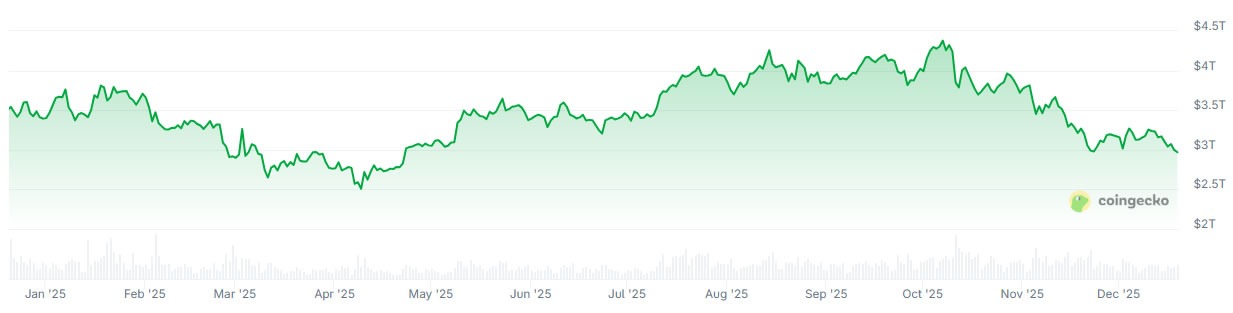
However, crypto markets are on track to end the year lower than when they began, with the total market capitalization falling more than 32% from its all-time high of $4.4 trillion in early October and almost 13% down from Jan. 1.

Crypto market cap is on track to end the year lower than it started. Source: CoinGecko

Two possible outcomes for crypto

Neuner said there were two possible outcomes for crypto: discovery of “what’s actually broken and who is selling” or the “mother of all catch-up trades because that’s how markets work.”

Economist Adam Kobeissi said that “one day, we will look back at the last 2 months of seemingly daily mass crypto liquidations and what’s happening will be crystal clear:”

“Crypto is experiencing a structural shift amid historic levels of leverage.”

Related: Most crypto sectors lagged Bitcoin over past 3 months: Glassnode

Analyst “PlanB” called it an “epic battle until sellers are out of ammo,” explaining that selling pressure is still coming from “OGs traumatized by 2021,” technical investors looking at relative strength index, and those who believe in the four-year cycle and that a bear market is due.

Crypto winter is already here

Meanwhile, some analysts are convinced that the bear market is already underway.

“Bitcoin entered a bear market in late October 2025, becoming the first major risk asset to price in a slowing economy,” 10x Research CEO Markus Thielen told Cointelegraph.

“Retail participation never meaningfully returned this cycle, and value creation remained narrowly concentrated in Bitcoin rather than broadening across risk assets. Winter isn’t approaching; it has already arrived.”

Things aren’t that bad, really

Despite the poor performance of spot markets, the industry’s fundamentals remain solid.

“While prices may have fallen short of expectations, this year delivered more structural progress than any in crypto’s history,” Erik Lowe, head of content at blockchain venture firm Pantera, said in a report on Tuesday.

Like Neuner, he listed several milestone achievements for the industry this year, including a shift in staff and stance at US financial regulators, the establishment of a US strategic Bitcoin reserve and digital asset stockpile, and increases in stablecoin supplies and onchain value of tokenized real-world assets.

“From that perspective, we believe there hasn’t been a more important year for the industry than 2025. This is the year we began laying the deep caissons to support durable, long-term growth.”

Magazine: Bitcoin’s critical level is $82.5K, Ethereum ‘not done yet’: Trade Secrets

Связанные с этим вопросы

QAccording to the article, what are some of the positive factors that should have led to a crypto bull market in 2025?

AThe positive factors include increased liquidity, a pro-crypto US government, various exchange-traded fund (ETF) launches, major institutional and crypto treasury company buying, and strong performance in traditional markets like gold, silver, and major stock indexes.

QWhat does analyst Ran Neuner suggest are the two possible outcomes for the crypto market?

ARan Neuner suggests the two possible outcomes are the discovery of 'what's actually broken and who is selling' or the mother of all catch-up trades because that's how markets work.

QWhat reason does 10x Research CEO Markus Thielen give for stating that a crypto bear market is already underway?

AMarkus Thielen states that Bitcoin entered a bear market in late October 2025, becoming the first major risk asset to price in a slowing economy. He adds that retail participation never meaningfully returned this cycle and value creation remained narrowly concentrated in Bitcoin.

QDespite the poor market performance, what does Erik Lowe from Pantera highlight as a positive for the crypto industry in 2025?

AErik Lowe highlights that 2025 delivered more structural progress than any year in crypto's history, citing milestone achievements like a shift in US financial regulators' stance, the establishment of a US strategic Bitcoin reserve, and increases in stablecoin supplies and onchain value of tokenized real-world assets.

QWhat does economist Adam Kobeissi identify as the core reason for the current crypto market conditions?

AAdam Kobeissi states that 'Crypto is experiencing a structural shift amid historic levels of leverage,' implying that excessive leverage is a fundamental cause of the current market downturn and liquidations.

Похожее

From Banning Doubao to Embracing Honor: Why Did WeChat Suddenly 'Change Its Face'?

The article explores the sudden shift in WeChat's strategy towards AI assistants from mobile phone manufacturers, transitioning from strict opposition to active collaboration. For over a year, WeChat fiercely resisted attempts by phone AI assistants (like ByteDance's Doubao in late 2025) to control its features via GUI automation ("simulated clicking"), citing security and data control concerns. This stance created a significant barrier for system-level AI integration. Now, Tencent has initiated A2A (Agent-to-Agent) partnerships with major phone brands like Honor, Xiaomi, OPPO, and vivo. This model allows a phone's system AI (e.g., Honor's YOYO) to parse a user's voice command and send a structured request directly to WeChat's own internal AI agent via secure APIs. WeChat then executes the action (e.g., sending a message) and returns the result. The article attributes Tencent's "change of face" to strategic pressure. While leading in social app usage, Tencent trails rivals like ByteDance and Alibaba in standalone AI app popularity. WeChat, with its vast mini-program ecosystem, is Tencent's key asset for an AI comeback. The upcoming WeChat AI agent aims to handle tasks like booking and payments within the app. However, phone system assistants remain the primary AI entry point for most users. The A2A collaboration allows Tencent to extend WeChat's AI reach to this crucial system layer while maintaining control over its core functions and data. For phone manufacturers, embracing A2A is a pragmatic move. The GUI route proved unviable due to WeChat's blocks. A2A offers a compliant path to integrate a vital service, enhancing their AI assistants' usefulness. It allows them to focus on developing their own AI ecosystems for other services while cooperating on WeChat access. The collaboration is framed as a mutual, strategic necessity: Tencent gains a distribution channel, and manufacturers gain a key functionality. The partnership relies on a "dual authorization" mechanism for security, requiring both user and app consent for each action. While questions about long-term data privacy practices remain, experts note A2A is more secure and compliant than GUI automation. Ultimately, this cooperation is seen as a tentative, calculated truce. Tencent's long-term goal is to make WeChat an AI-powered "service OS." Phone manufacturers aim to make their system AI the central user interface. Their paths may converge or clash in the future, but for now, the A2A deal represents the opening chapter in the battle for the AI-era user入口, driven by necessity and strategic calculus on both sides.

marsbit1 ч. назад

From Banning Doubao to Embracing Honor: Why Did WeChat Suddenly 'Change Its Face'?

marsbit1 ч. назад

On-Chain Figures on the Eve of Kickoff: 1.6 Billion Traded Before the World Cup Even Begins

"On-Chain Numbers on the Eve of the World Cup: $1.6 Billion Traded Before Kick-off" Analysis of on-chain markets before the 2026 FIFA World Cup reveals significant crypto integration into football. The most striking figure is the approximately **$1.6 billion** in total trading volume on the single "World Cup Winner" contract on the Polymarket prediction market platform, accumulated before a single match was played. This represents explosive growth for a sector whose annual volume surged from ~$16B in 2024 to ~$64B in 2025. The ecosystem is maturing beyond speculation. Key developments include: 1) **Infrastructure upgrades** like Polymarket's migration to native, regulated USDC stablecoin for settlements; 2) **Reliable data oracles**, such as Chainlink, being used to resolve real-world match outcomes on-chain; and 3) **Official recognition**, with FIFA appointing its first-ever "Prediction Markets" partner. Over 100 contracts now cover everything from the outright winner to individual match results and even non-sporting risks like venue relocation. This evolution marks a fundamental shift. While crypto firms are absent from FIFA's top-tier sponsor list, the technology has deeply penetrated the tournament's financial and predictive infrastructure through regulated stablecoin settlements, decentralized oracles, and new official partnership categories. The regulatory landscape remains complex and varies by jurisdiction, but on-chain markets for the World Cup are already a multi-billion-dollar reality.

marsbit1 ч. назад

On-Chain Figures on the Eve of Kickoff: 1.6 Billion Traded Before the World Cup Even Begins

marsbit1 ч. назад

From SpaceX's IPO to the Future of Crypto: Which Crypto Sectors Will Host the Trillion-Dollar Narrative?

From the SpaceX IPO, which targets a $750 billion raise at a $1.77 trillion valuation, we can extrapolate capital flow trends relevant to crypto. The focus shifts from speculative narratives to foundational infrastructure and real-world asset (RWA) integration. Key crypto sectors poised to benefit include: 1. **AI Infrastructure**: The narrative is moving from consumer-facing AI applications to underlying, scarce resources like compute power and decentralized GPU networks (e.g., TAO, RENDER, AKT, IO). These protocols are positioning as the essential "picks and shovels" providers for the AI economy. 2. **Real-World Assets (RWA)**: Beyond tokenized treasury bonds, RWA's future lies in on-chain equity and pre-IPO assets like SpaceX. This could democratize access to high-growth assets and reshape global capital flows, benefiting infrastructure projects like ONDO, LINK, and Plume that facilitate issuance, data, and liquidity. 3. **Core Financial Infrastructure**: Stablecoins, payment networks, and DePIN (Decentralized Physical Infrastructure Networks) are critical for settling the future on-chain economy. Their role expands from internal trading tools to foundational layers for global finance, AI systems, and real-world asset networks, leading to potential value reassessment. In summary, the next cycle may prioritize long-term infrastructure value—AI compute, asset tokenization networks, and settlement layers—over short-lived application hype, mirroring the broader market's shift towards funding the foundational systems of the future.

marsbit2 ч. назад

From SpaceX's IPO to the Future of Crypto: Which Crypto Sectors Will Host the Trillion-Dollar Narrative?

marsbit2 ч. назад

Торговля

Спот
Фьючерсы

Популярные статьи

Как купить ZEST

Добро пожаловать на HTX.com! Мы сделали приобретение Zest Protocol (ZEST) простым и удобным. Следуйте нашему пошаговому руководству и отправляйтесь в свое крипто-путешествие.Шаг 1: Создайте аккаунт на HTXИспользуйте свой адрес электронной почты или номер телефона, чтобы зарегистрироваться и бесплатно создать аккаунт на HTX. Пройдите удобную регистрацию и откройте для себя весь функционал.Создать аккаунтШаг 2: Перейдите в Купить криптовалюту и выберите свой способ оплатыКредитная/Дебетовая Карта: Используйте свою карту Visa или Mastercard для мгновенной покупки Zest Protocol (ZEST).Баланс: Используйте средства с баланса вашего аккаунта HTX для простой торговли.Третьи Лица: Мы добавили популярные способы оплаты, такие как Google Pay и Apple Pay, для повышения удобства.P2P: Торгуйте напрямую с другими пользователями на HTX.Внебиржевая Торговля (OTC): Мы предлагаем индивидуальные услуги и конкурентоспособные обменные курсы для трейдеров.Шаг 3: Хранение Zest Protocol (ZEST)После приобретения вами Zest Protocol (ZEST) храните их в своем аккаунте на HTX. В качестве альтернативы вы можете отправить их куда-либо с помощью перевода в блокчейне или использовать для торговли с другими криптовалютами.Шаг 4: Торговля Zest Protocol (ZEST)С легкостью торгуйте Zest Protocol (ZEST) на спотовом рынке HTX. Просто зайдите в свой аккаунт, выберите торговую пару, совершайте сделки и следите за ними в режиме реального времени. Мы предлагаем удобный интерфейс как для начинающих, так и для опытных трейдеров.

263 просмотров всегоОпубликовано 2026.05.19Обновлено 2026.06.02

Как купить ZEST

Обсуждения

Добро пожаловать в Сообщество HTX. Здесь вы сможете быть в курсе последних новостей о развитии платформы и получить доступ к профессиональной аналитической информации о рынке. Мнения пользователей о цене на A (A) представлены ниже.

活动图片