Cardano Founder Unveils Midnight Rollout Plan As Mainnet Launch Begins

bitcoinistОпубликовано 2026-03-24Обновлено 2026-03-24

Введение

Cardano founder Charles Hoskinson has announced the start of the federated mainnet phase for Midnight, a privacy-focused blockchain. The launch is being conducted gradually with daily operational checkpoints to ensure network stability. Initially, the mainnet is running in a guarded mode with limited transactions and dApp deployments. Federated node operators, including Google Cloud, Telegram, and MoneyGram, are managing the rollout. The first user-facing feature is DUST generation, accessible via Lace wallet. Hoskinson emphasized Midnight's complex architecture, which integrates zero-knowledge proofs and spans both public and private ledgers. Future upgrades will introduce composable contracts, cross-chain intents, and governance features, though full decentralization is expected to take 6–12 months due to the broad distribution of tokens via a "glacier drop."

Cardano founder Charles Hoskinson says Midnight has entered its federated mainnet phase, marking the start of a guarded rollout that he described as the first step in turning on one of the most technically ambitious networks in crypto.

In a March 23 livestream, the Cardano founder framed the week as “Midnight Week” and said the network was being activated gradually with daily operational checkpoints. “What’s happening this week is the federated launch and this is basically the mainnet network and it’s turning on step by step,” Hoskinson said. “Every day we have a go no-go meeting and based upon what we’re getting back from the federated mainnet nodes, they tell us a whole bunch of stuff. ... Basically the goal here is to get to a stable network.”

Cardano’s Midnight Launch Week Begins

That first phase is intentionally restrictive. Hoskinson said Midnight is live as a mainnet rather than a testnet, but operating in a guarded mode where transactions and decentralized application deployments are limited until the team is satisfied that consensus, block production, and core cryptographic components are working as intended. The immediate user-facing milestone, he said, is DUST generation, which should become visible through an update to Lace after the earlier Glacier Drop period ended.

The rollout is being handled by federated node operators, or FNOs, rather than an open validator set from day one. Hoskinson said those operators include firms such as Google Cloud, Telegram and MoneyGram, drawing a parallel to Cardano’s Byron era, when a small group of entities initially ran the network before control was broadened over time. Once the network proves stable, Midnight plans to lower its guardrails in stages and begin deploying applications in waves.

“So you go from just dust generation to Lace plus DApps and you can actually start using some of these experiences,” he said. “You’re basically looking for a stable consensus. You’re looking for stable block generation in the mainnet environment. And then as that gets stable, everybody’s happy, you go from guarded to less guarded to less guarded to less guarded.”

Hoskinson argued that Midnight’s launch path is more complicated than Cardano’s because the system spans both Cardano and Midnight, with separate roles for its assets and multiple address formats across public and private ledgers. He also pointed to its layered design, naming consensus components such as Aura, Grandpa and Beefy, while describing Compact as “basically Zcash with smart contracts.”

That framing is central to the pitch. Midnight, in Hoskinson’s telling, is not just another chain launch but a privacy-preserving smart contract system being opened in phases. The first version shipping with the federated mainnet includes zero-knowledge tooling such as Plonk and Halo 2, while later upgrades are expected to bring composable contracts, Nightstream-related infrastructure, capacity exchange, crosschain intents and the Midnight passport system.

The decentralization roadmap comes later. Hoskinson said Midnight is now entering phase two, with phase three set to introduce an incentivized testnet for stake pool operators, allowing them to begin making blocks in parallel with ongoing federated mainnet upgrades. Governance experiments are also expected to begin in that phase, although he cautioned that Midnight’s broad token distribution through its “glacier drop” means the ecosystem needs time to mature before full governance can be safely turned on.

“One of the problems with Midnight, and this is why you need at least 6 to 12 months to stabilize, is that Midnight was distributed with a glacier drop,” he said. “That’s a huge benefit because you get lots of people. The problem is that those people haven’t decided whether they want to be a good-faith member of the Midnight ecosystem community or if they just want to dump their NIGHT or be adversarial.”

Hoskinson also used the livestream to make a much broader claim about Midnight’s long-term role, describing it as infrastructure for privacy, compliance and AI-driven commerce. He said the system’s mix of zero-knowledge proofs, multi-party computation and trusted execution environments could make it a natural framework for autonomous software agents to transact and verify one another.

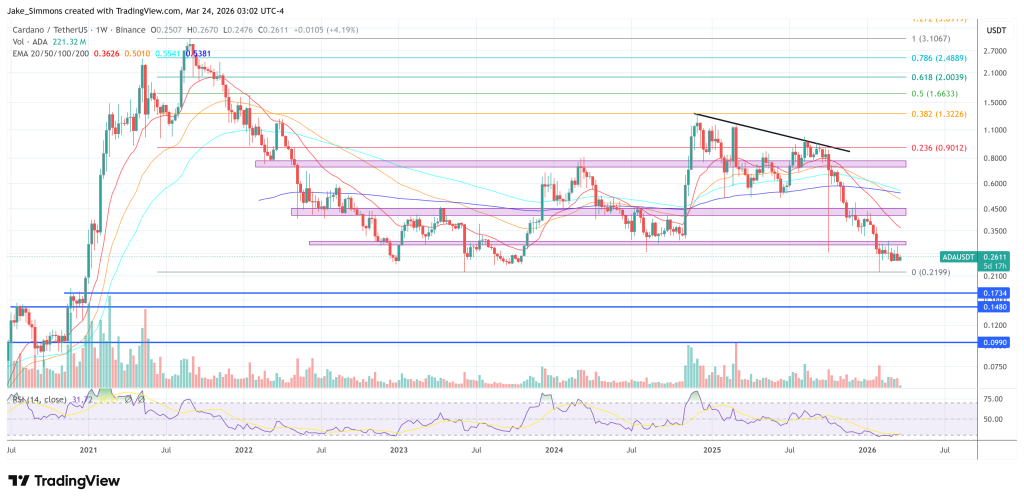
At press time, Cardano traded at $0.2611.

ADA hovers below key resistance, 1-week chart | Source: ADAUSDT on TradingView.com

Связанные с этим вопросы

QWhat is the current phase of Midnight's launch as announced by Charles Hoskinson?

AMidnight has entered its federated mainnet phase, which is the start of a guarded rollout.

QWhich companies are mentioned as federated node operators (FNOs) for the initial launch?

AGoogle Cloud, Telegram, and MoneyGram are mentioned as federated node operators.

QWhat is the first user-facing milestone expected after the Glacier Drop period?

AThe first user-facing milestone is DUST generation, which should become visible through an update to Lace.

QAccording to Hoskinson, why does Midnight need 6 to 12 months to stabilize after launch?

AIt needs time to stabilize because the broad token distribution through the 'glacier drop' means the ecosystem needs to mature before determining if participants will be good-faith members or adversarial.

QWhat broader long-term role did Hoskinson claim for Midnight beyond being a blockchain?

AHe described Midnight as infrastructure for privacy, compliance, and AI-driven commerce, using zero-knowledge proofs, multi-party computation, and trusted execution environments for autonomous software agents.

Похожее

From Theft to Re-entry: How Was $292 Million "Laundered"?

A sophisticated crypto laundering operation was executed following the $292 million hack of Kelp DAO on April 18. The attack, attributed to the North Korean Lazarus group, began with anonymous infrastructure preparation using Tornado Cash to fund wallets untraceably. The hacker exploited a vulnerability in Kelp’s cross-chain bridge, stealing 116,500 rsETH. To avoid crashing the market, the attacker used Aave and Compound as laundering tools—depositing the stolen rsETH as collateral to borrow $190 million in clean, liquid ETH. This move triggered a bank run on Aave, causing an $8 billion drop in TVL. After consolidating funds, the attacker fragmented them across hundreds of wallets to evade detection. A major breakpoint was THORChain, where over $460 million in volume—30 times its usual activity—was processed in 24 hours, converting ETH into Bitcoin. This shift to Bitcoin’s UTXO model exponentially increased tracing complexity by shattering funds into countless untraceable fragments. The final destination was Tron-based USDT, the primary channel for illicit crypto flows. From there, funds were cashed out via OTC brokers in China and Southeast Asia, using unlicensed underground banks and UnionPay networks outside Western sanctions scope. Ultimately, the laundered money supports North Korea’s weapons programs, which rely heavily on crypto hacking for foreign currency. The incident underscores structural challenges in DeFi: its openness, composability, and lack of central control make such laundering not just possible, but inherently difficult to prevent.

marsbit1 ч. назад

From Theft to Re-entry: How Was $292 Million "Laundered"?

marsbit1 ч. назад

Google and Amazon Simultaneously Invest Heavily in a Competitor: The Most Absurd Business Logic of the AI Era Is Becoming Reality

In a span of four days, Amazon announced an additional $25 billion investment, and Google pledged up to $40 billion—both direct competitors pouring over $65 billion into the same AI startup, Anthropic. Rather than a typical venture capital move, this signals the latest escalation in the cloud wars. The core of the deal is not equity but compute pre-orders: Anthropic must spend the majority of these funds on AWS and Google Cloud services and chips, effectively locking in massive future compute consumption. This reflects a shift in cloud market dynamics—enterprises now choose cloud providers based on which hosts the best AI models, not just price or stability. With OpenAI deeply tied to Microsoft, Anthropic’s Claude has become the only viable strategic asset for Google and Amazon to remain competitive. Anthropic’s annualized revenue has surged to $30 billion, and it is expanding into verticals like biotech, positioning itself as a cross-industry AI infrastructure layer. However, this funding comes with constraints: Anthropic’s independence is challenged as it balances two rival investors, its safety-first narrative faces pressure from regulatory scrutiny, and its path to IPO introduces new financial pressures. Globally, this accelerates a "tri-polar" closed-loop structure in AI infrastructure, with Microsoft-OpenAI, Google-Anthropic, and Amazon-Anthropic forming exclusive model-cloud alliances. In contrast, China’s landscape differs—investments like Alibaba and Tencent backing open-source model firm DeepSeek reflect a more decoupled approach, though closed-source models from major cloud providers still dominate. The $65 billion bet is ultimately about securing a seat at the table in an AI-defined future—where missing the model layer means losing the cloud war.

marsbit7 ч. назад

Google and Amazon Simultaneously Invest Heavily in a Competitor: The Most Absurd Business Logic of the AI Era Is Becoming Reality

marsbit7 ч. назад

Торговля

Спот
Фьючерсы

Популярные статьи

Как купить ADA

Добро пожаловать на HTX.com! Мы сделали приобретение Cardano (ADA) простым и удобным. Следуйте нашему пошаговому руководству и отправляйтесь в свое крипто-путешествие.Шаг 1: Создайте аккаунт на HTXИспользуйте свой адрес электронной почты или номер телефона, чтобы зарегистрироваться и бесплатно создать аккаунт на HTX. Пройдите удобную регистрацию и откройте для себя весь функционал.Создать аккаунтШаг 2: Перейдите в Купить криптовалюту и выберите свой способ оплатыКредитная/Дебетовая Карта: Используйте свою карту Visa или Mastercard для мгновенной покупки Cardano (ADA).Баланс: Используйте средства с баланса вашего аккаунта HTX для простой торговли.Третьи Лица: Мы добавили популярные способы оплаты, такие как Google Pay и Apple Pay, для повышения удобства.P2P: Торгуйте напрямую с другими пользователями на HTX.Внебиржевая Торговля (OTC): Мы предлагаем индивидуальные услуги и конкурентоспособные обменные курсы для трейдеров.Шаг 3: Хранение Cardano (ADA)После приобретения вами Cardano (ADA) храните их в своем аккаунте на HTX. В качестве альтернативы вы можете отправить их куда-либо с помощью перевода в блокчейне или использовать для торговли с другими криптовалютами.Шаг 4: Торговля Cardano (ADA)С легкостью торгуйте Cardano (ADA) на спотовом рынке HTX. Просто зайдите в свой аккаунт, выберите торговую пару, совершайте сделки и следите за ними в режиме реального времени. Мы предлагаем удобный интерфейс как для начинающих, так и для опытных трейдеров.

1.9k просмотров всегоОпубликовано 2024.03.29Обновлено 2025.07.02

Как купить ADA

SNEK: ведущий мемкоин на блокчейне Cardano, открывающий новую эпоху для экосистемы Cardano

SNEK - это дефляционный мемкоин, выпущенный на блокчейне Cardano. Он создаёт децентрализованную культурную и развлекательную ценность за счёт участия глобального сообщества.

2.0k просмотров всегоОпубликовано 2025.10.15Обновлено 2025.10.15

SNEK: ведущий мемкоин на блокчейне Cardano, открывающий новую эпоху для экосистемы Cardano

Неделя обучения по популярным токенам 8: запуск основной сети Ouroboros Leios для ADA ожидается в 2026 году

Основная сеть Ouroboros Leios для ADA, как ожидается, будет запущена в 2026 году, а хардфорк до версии протокола 11 запланирован на I квартал 2026 года.

1.9k просмотров всегоОпубликовано 2026.02.10Обновлено 2026.02.12

Неделя обучения по популярным токенам 8: запуск основной сети Ouroboros Leios для ADA ожидается в 2026 году

Обсуждения

Добро пожаловать в Сообщество HTX. Здесь вы сможете быть в курсе последних новостей о развитии платформы и получить доступ к профессиональной аналитической информации о рынке. Мнения пользователей о цене на ADA (ADA) представлены ниже.

活动图片